News · 6 May 2026
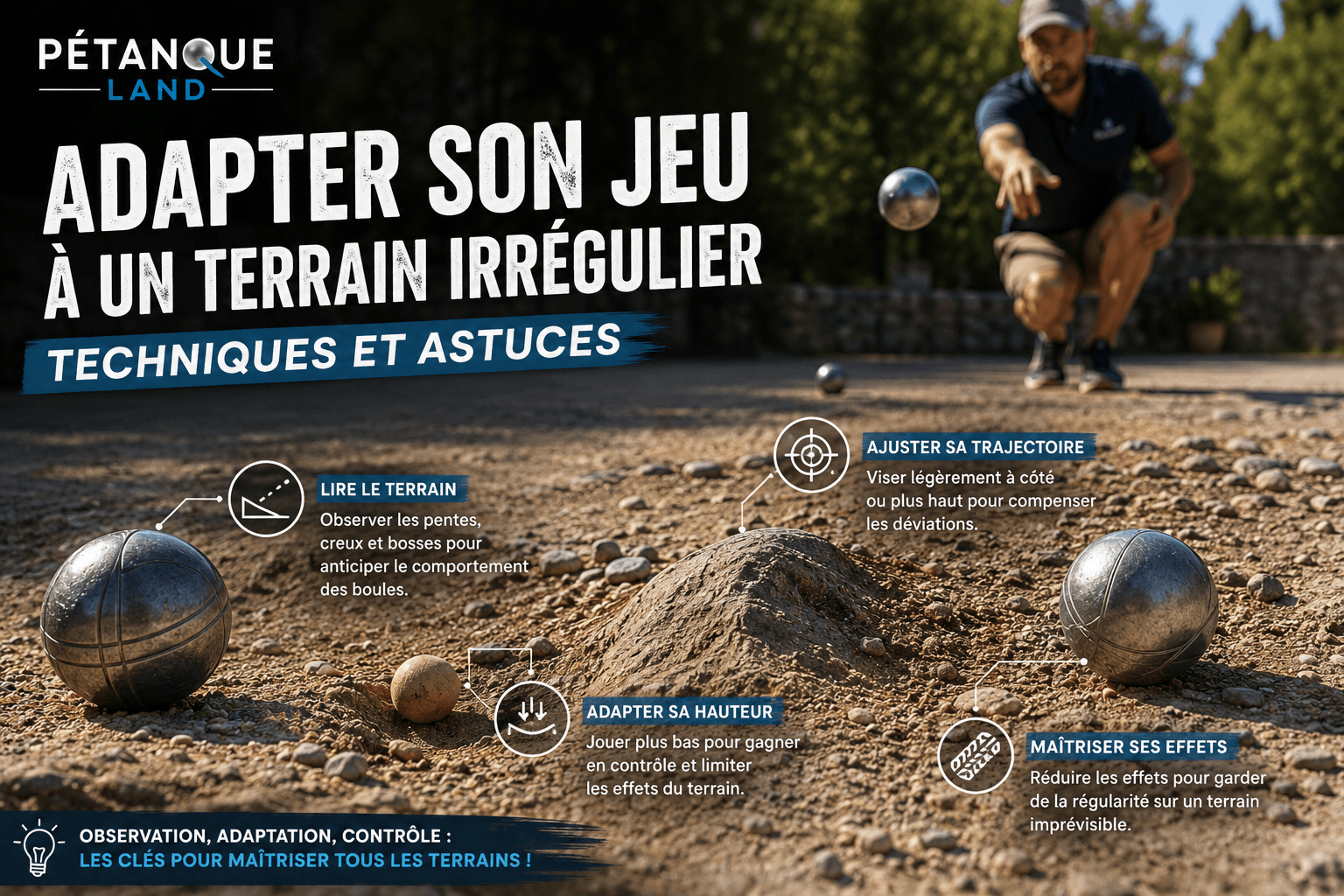
Adapting your game to an uneven terrain
NewsAn uneven terrain isn't just endured — it's read, understood, thenThe right mindset — curiosity rather than frustration
The difference between a player who endures an uneven terrain and one who exploits it isn't primarily technical — it's mental. It comes down to a single substitution: replacing "why is this terrain so bad?" with "what are the rules of this terrain?"
🎙️ Paquita on approaching an uneven terrain "The worst thing you can do on an uneven terrain is to spend the first two ends trying to play as if the terrain were normal — with the same landing zones, the same power, the same technique. You build up mistakes, get frustrated, and waste precious time. The best thing is to decide from the very first bowl that these first two ends are observation ends, not ends to win. I can fail to score in the first two ends — if in return I've understood the terrain and my opponent hasn't yet, the following ends are mine." — Paquita 🔑An uneven terrain is always symmetric in its constraints — it hampers both teams in the same way. The advantage belongs to neither by default. It belongs to the team that understands its rules first. It's a race to understand, not a lottery.
Reading the terrain: the 4 variables to identify first
Before even placing the jack, visually observe the terrain and gather essential information. These 4 variables must be identified on arrival.
① SLOPE AND TILTIs there a slope? Longitudinal (along the line of play), transverse (sideways), or combined? The tilt can be read by eye — watch whether bowls placed on the ground roll on their own.
Test: place a bowl on the ground and watch whether it rolls, in which direction, at what speed. ② SURFACE AND FRICTIONIs the surface homogeneous? There may be areas of compacted earth (long roll), sandy areas (bowls that stall), grassy areas (variable friction). Each area has its own behaviour.
Test: rub your sole over different areas — feel where the surface is hard, soft, sandy, grassy. ③ FIXED OBSTACLESAre there significant stones, visible roots, bumps or hollows? Fixed obstacles are reproducible — their effect on bowls is constant and can be learned, avoided or exploited.
Test: walk on the terrain before playing, memorise the 2–3 main obstacles in the likely playing area. ④ FAVOURABLE ZONESAre there "cleaner" or more predictable areas? These areas are potential targets for the jack — playing where you're calibrated and your opponent isn't yet is an informational advantage.
Test: mentally identify 2–3 priority areas before the game even starts.The two-first-ends protocol
🔬 OBSERVATION PROTOCOL — 2 LABORATORY ENDS Turning the first ends into terrain data End 1 — play your normal gesture, observe without correcting END 1 Throw with your usual technique, without trying to adapt. The aim is to measure the gap between what the terrain should produce and what it actually produces. Where do the bowls stop? In which direction do they deviate? How do the opponent's bowls behave? Observing the opponent's bowls too — double information END 1 The opponent's bowls provide information independent of your gesture. If their bowls deviate in the same direction as yours → it's the terrain. If your bowls deviate but theirs don't → it's your gesture. This distinction is fundamental. Collective debrief between ends 1 and 2 — 30 seconds BETWEEN ENDS Share the observations: "The slope pulls to the right in the jack area", "The stone at 4 metres on the left side deflects the bowls", "The terrain is soft in the first half". These shared observations allow all the players to adjust simultaneously. End 2 — test a first adaptation, a single variable END 2 Incorporate a single correction — change the landing zone, or the line, or the power. Not two at once. If two corrections are made simultaneously, there's no way of knowing which one improved or worsened the result. Ends 3+ — exploit what you know END 3+ From end 3 onwards, you know the rules of the terrain better than your opponent if they haven't done the same work. Use this knowledge: place the jack in the areas that favour you, anticipate how the terrain treats the opponent's bowls.Technical adjustments according to the irregularity
Each type of irregularity requires a specific adjustment. These aren't fundamental changes to your gesture — they're parameters you tweak temporarily for that surface.
① On a stony terrain — switch to a lofted point A rolling point interacts with every stone over the whole of its path. A lofted point passes over the stones and only lands in the clean area close to the jack. Adapt the landing zone to land beyond the main stony area. → If the stones are in the first 4 metres, aim for a landing zone at 4.5–5 metres and let the bowl roll the last few metres on clean ground. ② On a transverse slope — compensate your line of aim A slope that pulls the bowls to the right requires deliberately aiming to the left of the jack to arrive at the centre. Quantify the compensation during end 1. Aim to the opposite side of the deviation, by an angle proportional to the slope. → If your first bowl deviated 20 cm to the right at 7 m, aim 20 cm to the left of the jack for the next bowl. ③ On a downhill slope — reduce the power and land further away Downhill, bowls accelerate and often go too far. Two simultaneous adjustments: slightly reduce the power AND move the landing zone further in front of the jack — this shortens the roll on the slope. → Correcting only one of the two parameters is insufficient. Reducing the power without changing the landing zone still leaves too much roll downhill. ④ On a terrain with very different friction zones — adapt the landing zone If the terrain is hard on one side and sandy on the other, choose a landing zone in the same friction area as the final area around the jack to avoid unpredictable transitions. → A bowl that lands on compacted earth then rolls onto sand will be braked abruptly — choose the landing zone that maximises consistency after landing. ⑤ On a terrain with fixed obstacles — use the clean lanes Fixed obstacles define "lanes" between them. Identify these lanes and send your bowls down them. This sometimes means slightly adjusting your line of aim to use a clean lane rather than a direct path onto an obstacle. → A clean lane slightly off-line is better than a direct path onto a stone. ⑥ On a muddy terrain — direct technique and cleaning the bowls Mud absorbs energy massively. The rolling point becomes ineffective. Switch to an almost direct point with more power. And above all: clean each bowl before throwing it. A muddy bowl in the hand alters the release unpredictably. → On a muddy terrain, the player who systematically cleans their bowls has a structurally higher precision.Placing the jack as a tactical weapon
🎯 ADVANCED TACTICS A well-placed jack on an uneven terrain is worth 3 good bowls ⛰️On a transverse slope — place the jack on the side where the slope favours your type of point. Your compensated bowls arrive well, the opponent's uncompensated bowls drift. 🪨On a stony terrain — if you loft and your opponent rolls, place the jack in the stoniest area. Your bowls pass over. Theirs go through the stones. 🎲Alternating playing area — alternate the jack between two difficult areas for different reasons. The opponent has to recalibrate their compensation every end — their cognitive load increases, and so do their mistakes. 🏠Already-mastered area — if in end 2 you've calibrated a specific area, come back to that area. You're playing with automated corrections, the opponent is still playing blind. 🔍The area the opponent avoids — observe where the opponent never places the jack. This area is a problem for them. If you can play there comfortably, it's an area to exploit deliberately. 🧠 The golden rule of placement on an uneven terrainThe jack is your choice of playing terrain. On a perfect terrain, you choose the distance. On an uneven terrain, you also choose the area — and that area can be deliberately difficult for the opponent and easy for you. Every time you get back the right to throw the jack, ask yourself: which area of this terrain favours me most?
Table: irregularity → adaptation → recommended technique
| Terrain irregularity | Pointing technique | Power adaptation | Landing zone | Jack placement |
|---|---|---|---|---|
| Stones in the first half | Lofted point mandatory | +15% | Beyond the stony area | Stony area if you loft |
| Transverse slope | Neutral | Normal | Line offset to the opposite side of the slope | Side where the slope pulls the opponent's bowls out |
| Longitudinal downhill slope | Half-lob or lofted point | –20% | Further in front of the jack | Downhill area — opponent goes too far more easily |
| Longitudinal uphill slope | Rolling point or half-lob | +20–30% | Closer to the jack | Uphill area — stable bowls |
| Sandy / soft terrain | Direct lofted point | +25–35% | Directly onto the jack | Sandy area if the opponent rolls |
| Muddy terrain | Almost direct | +30% | As close as possible | Less muddy area if available |
| Alternating friction zones | Half-lob | Adjust according to landing zone | Area of the same friction as the final area | Most homogeneous area |
| Roots / fixed bumps | Lofted point or clean lanes | Normal | In an identified clean lane | Area away from the obstacles for your technique |
| Tall grass → hard earth | Half-lob | +20% | Beyond the grass area | Earth area if available |
Exercises to develop terrain adaptability
01 The "deliberately degraded terrain" session 📍 Training ⏱️ 30 min 🌿 Developing terrain adaptabilityTrain deliberately in poor conditions to develop technical robustness and adaptability.
Identify the least-used terrains at your pétanque court. Train there deliberately 1 time in 3 instead of always choosing the best terrain. Before throwing the first bowl: walk on the terrain and mentally identify the 4 variables. Voice two concrete observations quietly: "slope to the right" and "clean area in the centre". Play the first end without trying to score points — observe only. After the end, mentally note what the terrain did to your bowls. Were your observations correct? From end 2 onwards, apply the adaptations and measure the improvement. The aim: observe that prior observation + adaptation produces better results than playing blind. 02 The zones game — tactical jack placement 📍 Training for 2 ⏱️ 20 min 🌿 Exploiting the areas tacticallyDevelop awareness of tactical jack placement on an uneven terrain.
Mark out 4 areas on the terrain with markers: stony area, slope area, clean area, soft area. Each area must be distinct. Rule of the game: every end, the player placing the jack must announce their target area out loud AND the tactical reason ("I'm placing in the stony area because I loft and you roll"). This verbalisation forces tactical thinking. Play 8 ends normally. At the end, analyse together: were the tactical calls correct? Does the outcome of the ends confirm the expected advantage? Advanced variant: play "blind terrain" — one player has their back to the terrain while the opponent chooses the area. They have to adapt without having seen the placement from the playing position.FAQ — Your frequent questions
If I cannot adapt my action in 2 rounds, can I ask to change the terrain during the competition?+ In an official competition, no — the courts are assigned by the organization. The irregularity of the pitch is part of the playing conditions accepted by both teams. On the other hand, if the pitch presents a real physical danger, the referee can find a solution. In wild or friendly competitions, this is negotiable between participants. How do you adapt when the terrain changes during the game — for example after a sudden rain?+ A sudden rain radically changes the properties of the terrain. The protocol is the same as for new, unknown terrain: agree to “start from scratch” the adaptation, treat the first post-rain periods as observation periods. The main adaptation on wet ground: significantly increase strength and clean the balls before each throw. The team that adapts in one lead wins over the team that takes three leads. Does the home team on difficult terrain still have an advantage over the visitors?+ Yes, a real and significant advantage. The home team has played on this field dozens or hundreds of times — their compensations are automated, their mental map is precise. Visitors must build this map during the first few rounds. The local advantage is all the greater as the terrain is difficult - on perfect terrain it is almost zero, on very irregular terrain it can represent the equivalent of 2 to 3 leads at the start. Should we adapt differently depending on whether we are a pointer or a shooter?+ Yes. For the pointer, the main adaptation is technical — changing the given area, angle and force depending on the surface. For the shooter, adaptation is more tactical — identifying how the terrain affects opposing balls after impact. On very irregular terrain where the opposing balls move a lot on their own, shooting less sometimes becomes more relevant than shooting systematically. The environment adapts both according to what is required at each lead. 📎 Related articles Rules: Ground marks — markings allowed on the terrain Rules: The one-minute rule — playing fast even while adapting Equipment: Choosing your bowls — adapting to the surface RulesRegulatory playing distances 2026 TournamentsOfficial 2026 calendar — outdoor tournaments ToolsFree PetanqueLand tools© Pétanque by Paquita — petanqueland.fr · 📖 Paquita's book on Amazon