News · 20 July 2026
How does official refereeing work in petanque according to the FFPJP rules?
NewsThe umpire's role, measurements, disputes, sanctions and good attitudes: understanding how official umpiring works in pétanque.1.The referee applies the rules, not the opinion of the terrain
In a tense game, everyone often sees the situation from their own interest. The umpire brings a neutral reading. He doesn't choose the most convincing side; he applies the rules to the observed situation. That's what distinguishes official umpiring from a club discussion.
Their role is not to replace the players in all their decisions. The teams remain responsible for their play, their order of play and their behaviour. The umpire steps in when a check or a regulatory decision becomes necessary.
2.When should you call an umpire?
You call the umpire when a situation cannot be settled cleanly by the players: a disputed measure, a moved jack, a boule out, a contested terrain, an uncertain order of play, a problematic behaviour. The call must be made calmly, before the situation is altered.
The worst mistake is to keep playing and then request a decision after the fact. If the boules have been moved or if the end has advanced, the umpire has fewer elements. In an official event, it is better to cleanly stop play for a few seconds than to create an insoluble dispute.
3.Measuring: the most frequent case
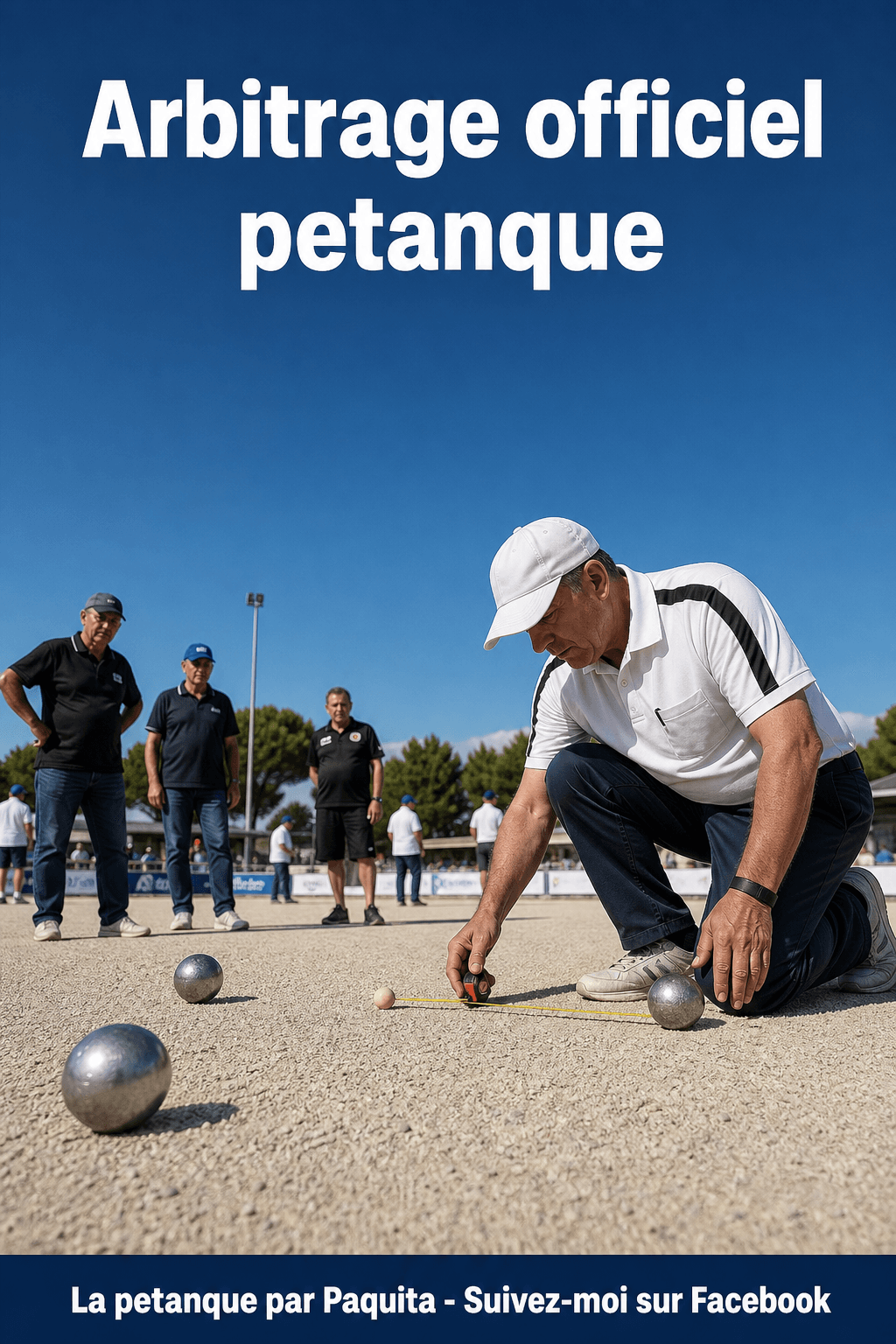
Measuring is the best-known intervention. It must be done without moving the boules or the jack. The umpire uses the suitable tool: tape measure, callipers, gauge or other authorised device. Players must leave the space clear, avoid comments that disrupt the decision and accept the announced result.
A good reflex is never to touch a boule “just to see”. Even a minimal move can change the situation and complicate officiating. Anyone wanting to contest a measurement must do so before any change to the play.
4.Penalties: warn before punishing, but punish when necessary
Cards, warnings, cancelled boule or disciplinary measures aren't show accessories. They serve to protect fairness. Deliberate time-wasting, inappropriate behaviour, failure to respect the circle, repeated contesting: certain attitudes call for an official response.
Important point: a sanction is not necessarily a sign of excessive severity. It reminds us that the rules apply just as much when the game is tight and the pressure rises.
5.What players must do during a decision
The right attitude is simple: you stop, you let the umpire observe, you answer the factual questions, then you accept the decision. Endless debates generally change nothing. They wear everyone out and can degrade the atmosphere of the game.
It is useful for one player to speak on behalf of the team. When three people explain at the same time, the information becomes confused. A calm captain makes refereeing faster and more accurate.
6.Why refereeing also protects players
Some see the umpire as a threat. In reality, he protects serious players. He prevents a team from imposing its bad faith, a debatable measurement from becoming a dispute, or aggressive behaviour from turning a game. The higher the level, the more indispensable this neutrality becomes.
Knowing the umpiring is also about playing better. You know when to ask for a measurement, when to stay quiet, when to take back the circle and when to accept that the decision has been made. This mastery is part of the competitor's culture.
In major competitions, this culture often makes the difference. Teams used to the official setting lose less energy in disputes. They know that a clear decision, even an unfavorable one, is better than an end polluted by doubt. It's a form of sporting maturity: accepting the framework to stay focused on the next boule.
| Situation | Good reflex | Error |
|---|---|---|
| Contested measurement | Calling before touching | Move then discuss |
| Doubtful jack | Freeze the end | Continuing to play |
| Behavior | Report calmly | Respond in the same tone |
When you call the umpire, prepare a short sentence: “We have a doubt about the measure” or “the jack has been moved”. Staying calm saves time.
Understanding refereeing also helps keep a cool head in tense moments: less conflict, more clarity.
Discover