News · 11 July 2026
Boule accidentally moved in pétanque: what to do according to the rulebook?
NewsA stopped boule is moved by a player, referee, spectator, or moving object: should it be put back? The official rule explained simply.1.The basic rule: put the boule back if its position is known
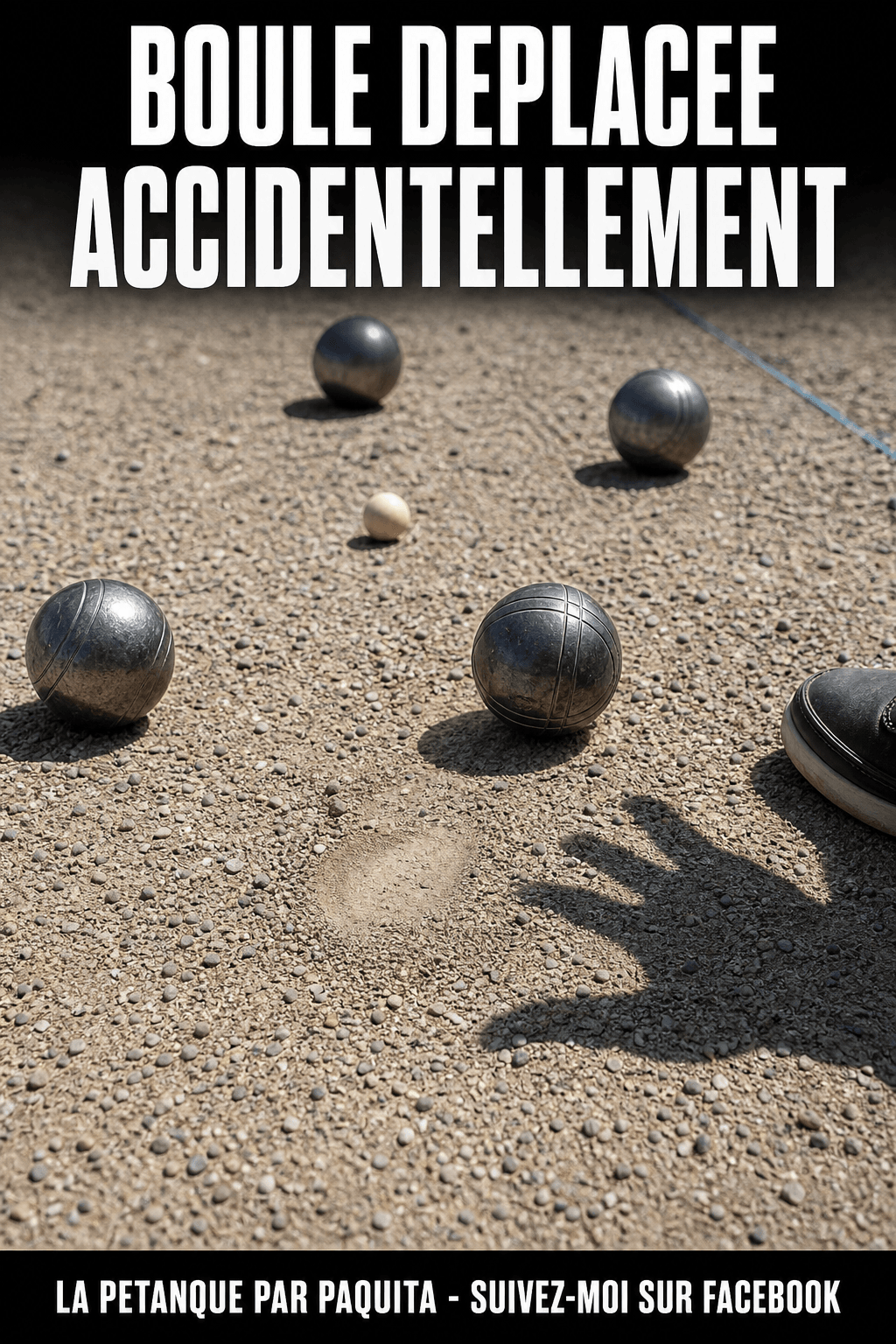
A boule that has come to rest can be displaced after the fact: a player steps back without looking, an umpire leans over to measure, a child crosses, a boule from another court hits it. In these cases, if the boule was marked, it is put back to the exact spot where it lay. The purpose of the rules is to restore the initial situation, not to punish a team for an external accident.
The logic is different from a boule displaced by a boule played in the same end. There, the displacement is part of play. The accident occurs after the boule has come to rest or through a cause foreign to the normal end. It is this distinction that must be established before deciding.
Key sentence: a boule accidentally displaced is put back only if its initial position can be established, generally because it has been marked.
2.Marking: a small gesture, huge protection
Marking a boule is not a maniac’s reflex. It is a regulatory insurance. Two small marks around the boule make it possible to put it back precisely if it moves. Without this mark, everyone remembers a different position: a little closer, a little more to the left, almost glued to the jack. The conflict starts there.
Players should systematically mark the important boules: the one holding the point, the one blocking a trajectory, the one that will be measured, the one at risk of being touched in passing. The tighter the end, the more worthwhile marking becomes.
3.Player, umpire, spectator, moving object: the causes provided for
The rules do not limit the accident to the clumsy player. They also cover the umpire, the spectator, the animal or any moving object. In a crowded competition, a boule or a jack coming from another game can also cause a displacement. The rule therefore seeks to cover the real life of the courts, not an ideal game on an empty space.
What matters is the accidental and external nature relative to the normal shot. If a player in the act of shooting displaces a boule through the effect of the boule played, it is not the same case. If someone touches a boule that has come to rest after the action, we return to the principle of putting it back if it was marked.
When an important boule comes to rest, mark it before discussing tactics. This two-second gesture can save a whole end in case of a clumsy foot or a disputed measurement.
4.If the boule was not marked: the claim becomes fragile
Without a mark, the umpire cannot invent a position. He rules according to what he observes and according to the reliable elements available. If no one can prove the exact position, the boule often stays where it lies after the incident, or the decision is made as close as possible to the observable reality. It is frustrating, but necessary: a rule based on memories would be unmanageable.
It is also why experienced teams never snigger at a player who marks. They know that at the end of a game, at 12-12, two millimetres can be worth a season. Marking is not a luxury: it is a competitive discipline.
5.Accidental or deliberate: mind the boundary
A deliberate displacement is much more serious. Deliberately stopping or displacing a boule to prevent a normal result can lead to a heavy penalty, up to the loss of the game depending on the situation. Intent therefore changes the reading. Clumsiness can be corrected; a deliberate intervention is penalized.
In case of doubt, do not too quickly attribute intent. Observe the facts, call the umpire and let him qualify the incident. Hot-headed accusations inflame games and sometimes make a simple decision much tenser.
6.Deciding without getting it wrong
| Incident | Condition | Consequence |
|---|---|---|
| Displaced by a foot | Marked | Put back in place |
| Displaced by a spectator | Marked | Put back in place |
| Unmarked | Uncertain position | Fragile claim |
| Deliberate displacement | Serious fault | Possible sanction |
The point is also won in the details: marking, reading the positions, protecting an important boule and avoiding errors late in the end.
Discover the book