News · 20 July 2026
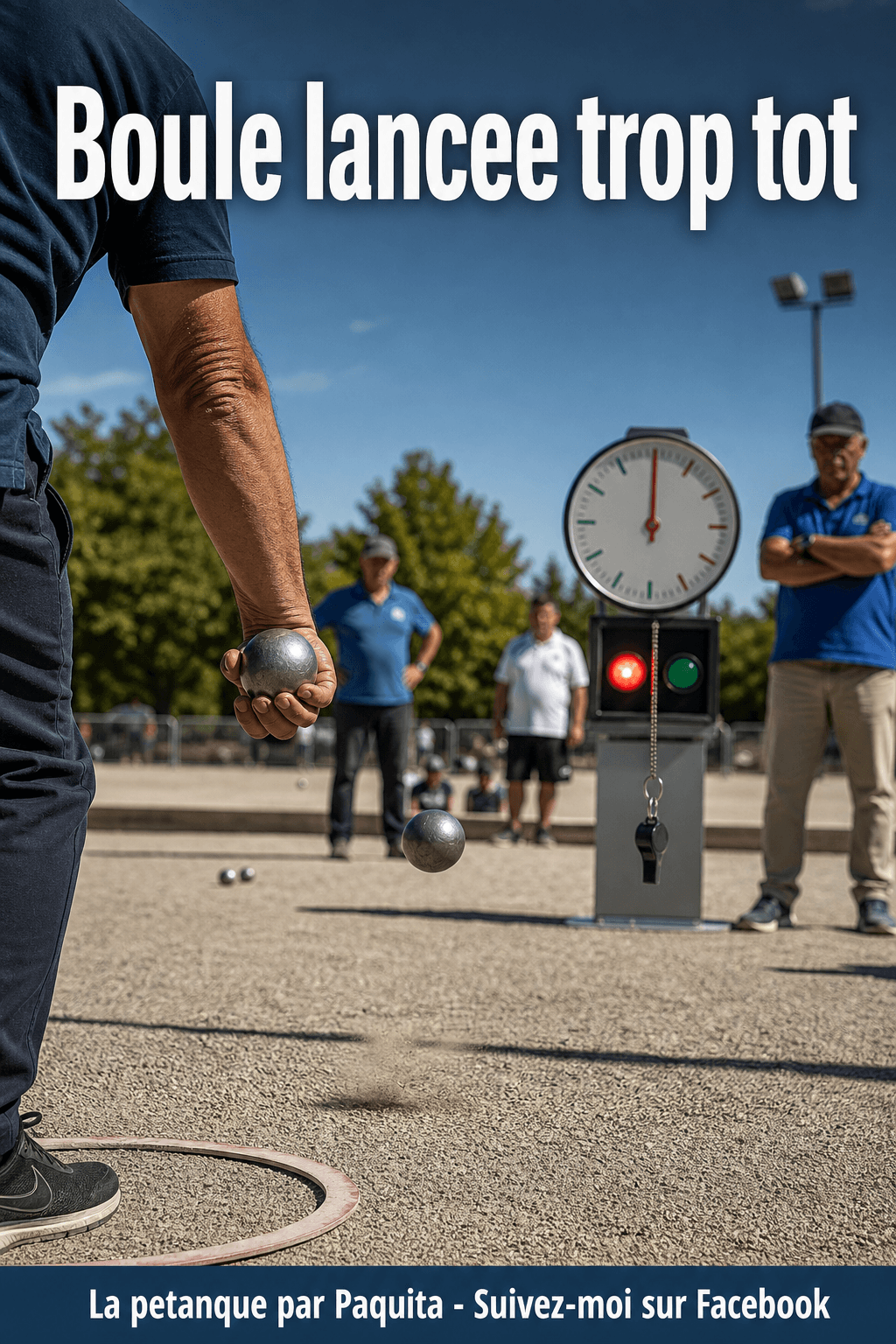
Boule thrown too early before the signal in pétanque: the official rule
NewsWhat happens if a boule is thrown before the signal or the official resumption of play? Rules, reflexes and consequences in competition.1.Why the signal matters in competition
The signal is not an administrative detail. It indicates that players may start, resume or continue within a shared framework. Without this marker, one team could play while the other is not ready, while a measurement is in progress, or before an organisational instruction has ended.
In a friendly game, approximations are often tolerated. In an official competition, precision protects everyone. The player who waits for the signal must not be disadvantaged by the one who rushes.
2.Cases where a boule may be judged too early
The most obvious case is starting a game before authorization. But there are other situations: resuming after a weather interruption, resuming after the referee's passage, throwing while a measure is requested, or a boule played while the order of play is not yet established.
The practical rule is simple: if the situation is not officially available to play, you keep the boule in hand. Doubt must work in favour of stopping, not rushing.
3.What does the player risk?
The consequence depends on the exact context and the umpire's decision. A boule may be considered irregularly played, the situation may be restored if possible, and a penalty may be considered if the behaviour is deliberate or repeated. What matters is that the advantage created by the rushing is not validated automatically.
You have to distinguish between a good-faith mistake and an opportunistic gesture. A player who throws because they did not hear can be called to order; a player who clearly takes advantage of a stoppage exposes themselves to a firmer response.
4.The link with the playing time rule
Some confuse two things: respecting the time limit to play and waiting for the authorisation to play. Once play is open and the order established, the player must keep a conforming rhythm. But as long as play is suspended or uncertain, the minute doesn't justify a rushed throw.
Useful reference point: playing time begins when the playing conditions are met. It does not serve as an excuse to play during a measurement or before an official restart.
5.How to avoid the dispute
Prevention is easy: look at the umpire or the organiser, confirm the order of play with the opponent, and only enter the circle when everyone knows the end is resuming. A short phrase is enough: "Is it our turn?" or "Can we play?".
This caution doesn't slow the game down. On the contrary, it avoids the long discussions that arise after a boule thrown into uncertainty.
6.What the opponent must do
If the opponent plays too early, you must not move the boules or reply by playing a boule in turn. You must immediately signal the problem and, if necessary, call the umpire. Continuing the end often amounts to accepting a confusing situation.
Calm is decisive. A timing dispute quickly becomes a matter of behavior if players lose their temper. Staying factual helps the referee: "the boule was played before the signal" is more useful than ten reproaches.
You must also avoid the trap of wild compensation. A team cannot decide on its own to replay a boule, cancel the opponent's throw or reset the play its own way. As soon as the official timing is disputed, the right solution goes through a neutral decision. This protects the wronged team, but also the team that made the mistake, because the rest of the game restarts on a clean basis.
| Time | To do | To avoid |
|---|---|---|
| Start | Waiting for authorisation | Throw as soon as possible |
| Measurement | Stop play | Playing during the check |
| Resumption | Confirm the signal | Assume it's started again |
When you feel the pressure, force yourself to look around the circle before throwing. A second's wait sometimes avoids ten minutes of dispute.
Regulated timing is also a matter of mindset: knowing how to wait, breathe and play at the right moment.
Discover