News · 26 July 2026
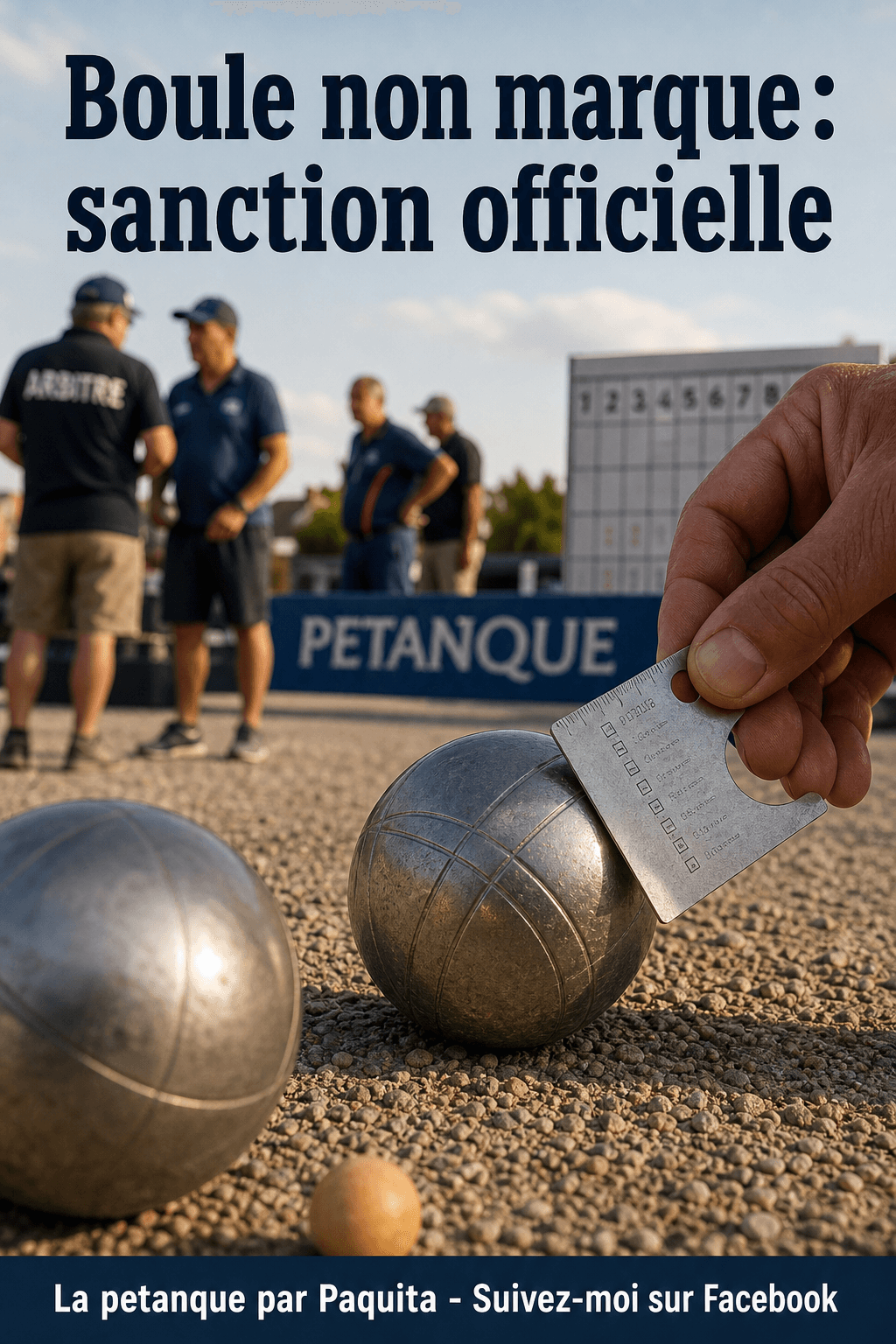
Unmarked ball in pétanque competition: what official sanction?
NewsUnmarked ball in pétanque competition: official rule, control, possible sanction and good reflexes to avoid FFPJP disputes.1.Why marking really matters
Marking a ball is primarily used to identify it. On a competition field, several players sometimes use balls of the same diameter, the same appearance and the same steel color. Without legible engraving, confusion becomes possible. The regulations seek to avoid this gray area: each player must be able to present compliant and recognizable equipment.
The problem is not theoretical. A ball accidentally moved, picked up too early or taken out of a compact group sometimes needs to be put back in place. If no one can identify it, the discussion quickly escalates. Marking therefore protects the player as much as the opponent.
In official competitions, the referee does not only judge the shot played. He can also check the equipment when a serious doubt arises.
2.What the referee checks
A check concerns general conformity: authorized diameter, weight, hardness, approved manufacturer, condition of the ball and inscriptions. A ball that is too worn is not automatically prohibited, but it becomes problematic if its essential markings are no longer legible or if it has been modified.
The referee assesses the facts: does the ball appear to belong to the declared game? Do the inscriptions still allow reasonable identification? Can the player present the three balls of his game? The sanction depends on the seriousness and the context.
| Situation | Regulatory reading | Risk |
|---|---|---|
| Readable engraving | Simple control | Low |
| Very worn mark | To watch | Medium |
| Modified ball | Not compliant | Strong |
| Mixed play | Questionable | Strong |
3.What sanction can fall
The sanction is not automatic as soon as an inscription is difficult to read. On the other hand, if the ball is judged to be non-compliant or if the player cannot resolve the doubt, the referee may prohibit its use and request a compliant replacement. In serious cases, notably voluntary modification or prohibited material, the decision may go further.
The essential point is verifiable good faith. An old game, worn by years of practice, cannot be treated like a tampered ball. But the prudent player does not present the referee with insoluble doubt.
4.Checking to do before a competition
Before you leave, place your three balls on a table and check them as a referee would. Are the inscriptions visible? Is the game consistent? Are the balls clean? Do the numbers or marks match? This minute saves a lot of trouble.
Cleaning a ball does not mean sanding it until you erase its markings. Normal maintenance removes dust and light oxidation; it does not modify the surface or the manufacturer's instructions. The limit is simple: if the interview changes the identity of the ball, it goes too far.
5.How to react if an opponent challenges
Don't chat for long in the middle of the field. Calmly present the balls, propose the call to the referee and let the decision be made within the normal framework. The higher the tone, the more the hardware problem becomes a behavioral problem.
If you are the adversary, avoid direct accusation. Just say: is this ball clearly identifiable? A doubt posed correctly is quickly resolved. A sudden suspicion can break the game.
Always keep a small photo of your bowl game before the season. This is not absolute official proof, but it is a useful benchmark to show your good faith in case of confusion.
6.What to remember
An unmarked or poorly identifiable ball is never a comfortable detail in a competition. The rule aims above all to guarantee fairness: everyone plays with compliant, recognizable and controllable equipment. The good player does not leave this subject to chance.
The best defense remains prevention: approved balls, legible inscriptions, complete game, reasonable maintenance. It's simple, quick, and avoids turning a tight fight into an endless debate.
To progress without neglecting the details that cause you to lose a game, the complete series helps to structure training, routine and game culture.
Discover