News · 21 July 2026
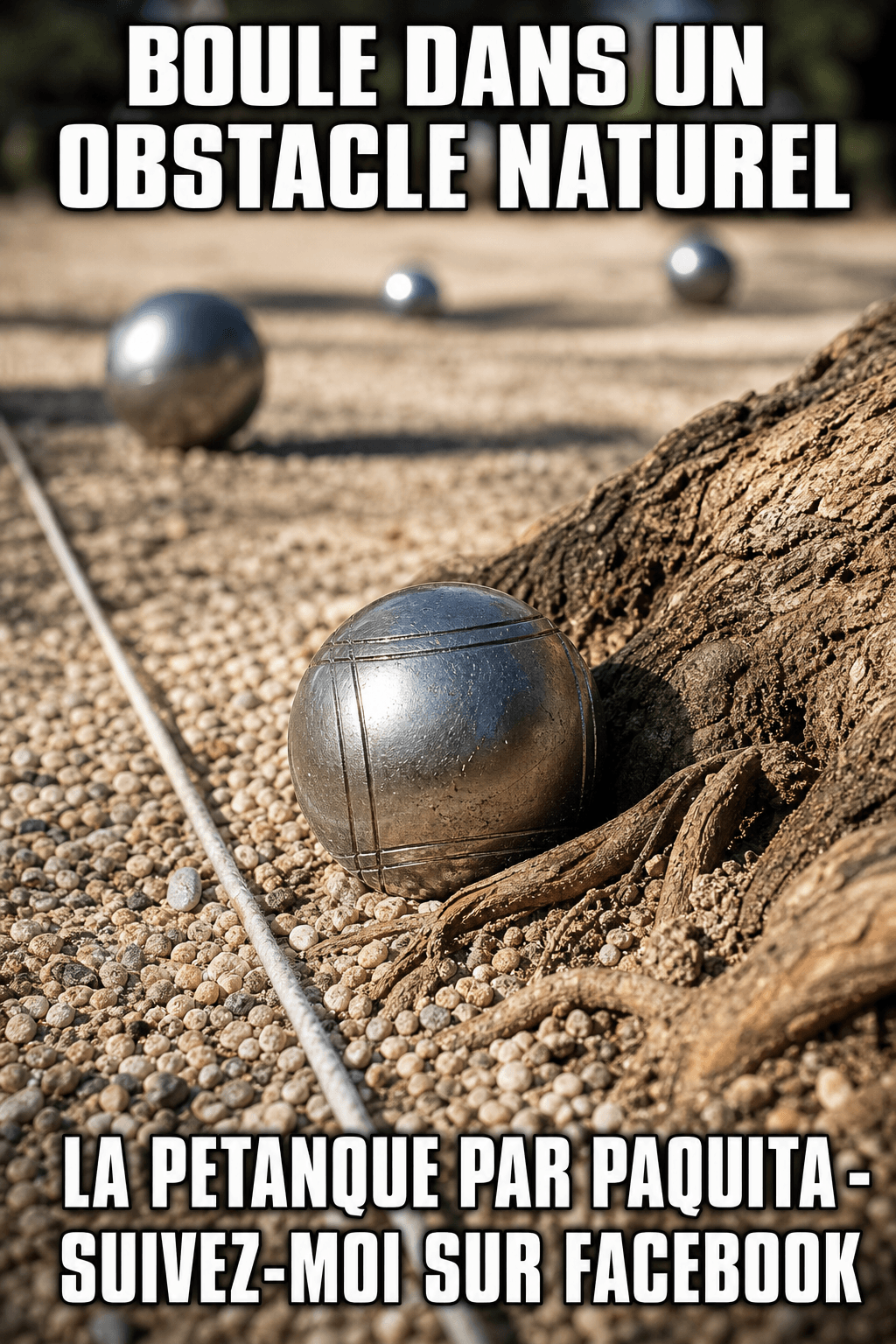
Boule in a natural obstacle in pétanque: what the rules really say
NewsBall stuck in a root, a hole or a natural obstacle: validity, limits, marks and good reflexes according to the FFPJP regulations.1.Natural obstacle does not mean canceled ball
The first error consists of believing that a ball blocked in a natural element necessarily becomes unplayable. The regulation does not reason like this. If the ball remains within the authorized frame and has not crossed a loss line, it can remain valid, even if its position is uncomfortable.
It’s the terrain that speaks. An apparent root, a small channel, a slope or a fixed stone are part of the playing conditions as long as they have not been declared a prohibited obstacle by the organization.
2.The boundary of the land remains the real criterion
In the majority of cases, the decisive question is the boundary. Has the ball completely crossed the loss line? Is it only against an obstacle located inside? Does it affect an external area? Until this reading is done, do not pick up or replace.
A ball can be very annoying to play and yet still be valid. Conversely, a ball which still appears close to play may be void if it has crossed the intended limit.
The right reflex is always the same: observe, keep the marks, then decide. This discipline protects the point as much as the climate of the game.
3.Why mark before discussing
Markings on the ground protect everyone. They make it possible to find the position if a ball is moved by checking the obstacle or if a player touches it by reflex. Without a mark, the discussion becomes a matter of memory, and the memory of a team is never neutral when a point is at stake.
In competitions, a serious team marks the goal and the important balls before any manipulation. This simple reflex avoids most conflicts.
In a borderline situation, don't try to win the discussion. Try to reconstruct the facts in order: where the goal was, where the ball was, what boundary was crossed, and by what.
4.The method for deciding without getting upset
We start by identifying the nature of the obstacle: natural, mobile, external limit or element added by the organization. Next, we check the real position of the ball in relation to the lines. Finally, we decide if the lead continues or if a specific rule applies.
This method seems slow, but it saves time. A messy discussion can last five minutes; a calm check lasts thirty seconds.
| Useful reflex | Why | Frequent mistake |
|---|---|---|
| Mark before moving | Secure the proof | Moving too fast |
| Check the validity | Avoid a false point | Play by eye |
| Call the referee if in doubt | Neutral decision | Endless debate |
5.What the referee will look at in a competition
The referee does not come to judge intentions. He looks at the facts: where is the ball, where is the goal, where does the boundary pass, has the object been moved, has the ball been marked. The more players have retained the game state, the simpler the decision.
This is why we must avoid sentences like “here we do it like that”. In official competition, only the situation observed counts.
6.The good tactical reflex after the decision
If the ball remains valid but stuck, it can become a tactical obstacle. It can protect the point, hinder a trajectory or force the opponent to shoot. The regulations do not remove the difficulty from the terrain: they require players to integrate it intelligently.
An experienced player therefore does not simply ask if the ball counts. He also wonders how to exploit this position in the rest of the lead.
To learn to read uneven ground, anticipate bounces and transform obstacles into tactical decisions rather than arguments.
Discover