News · 16 April 2026
Smooth or grooved pétanque boules: The real impact on your game
NewsThe grooves aren't just decorative. They change the boule's behaviour at theWhat is grooving — exact definition
The grooving of a pétanque bowl refers to the grooves or channels engraved on the surface of the steel during manufacturing. These grooves can be more or less deep, more or less wide, more or less numerous — and their arrangement (parallel, crossed, helical) generates different behaviors.
📐Grooving is measured by its grooving index — a figure that indicates the density and depth of the grooves. Manufacturers use internal notations (0 for smooth, then 1 to 6+ depending on the brand) that are not standardized between brands. An Obut "3" grooving and an MS "3" grooving are not identical. Physical observation and the hand test remain the best judges.
🎙️ Paquita on grooving confusion "I've met dozens of players who told me 'I have grooving 3 bowls' without knowing what it meant. They chose that figure because a neighbor had 3. There is no universal figure — there is a surface texture that produces measurable physical effects. The right question is not 'which number?' — it's 'which texture gives me the best control over what I want to do with the bowl?'" — PaquitaThe physics of grooves — what really changes
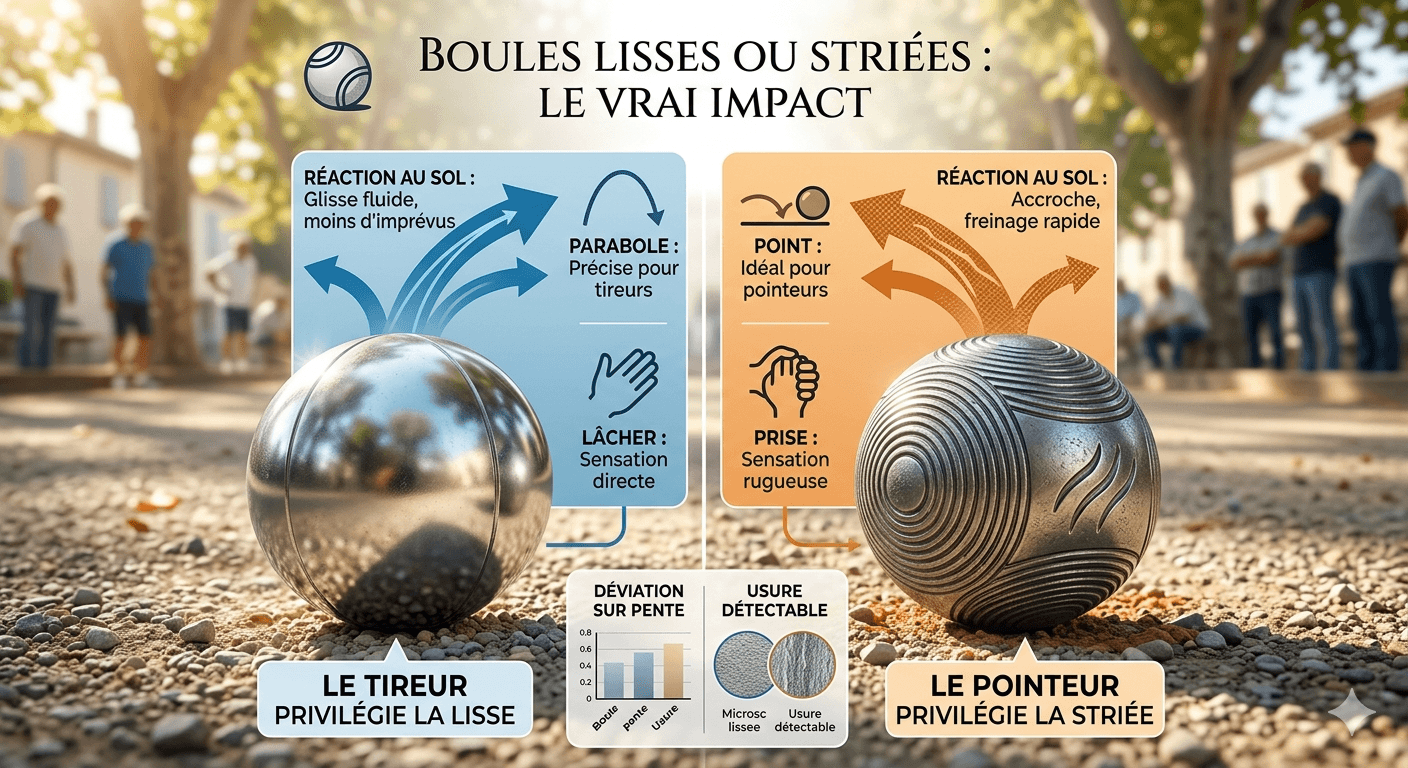
The grooves modify three distinct physical phenomena: hand friction at the moment of release, ground friction at the moment of impact, and post-impact roll behavior. These three effects are independent and sometimes contradictory — that is why "grooved is better" or "smooth is better" are answers that are too simple.
🖐️ Grip in the handThe grooves create edges that catch slightly on the fingers. A grooved bowl offers a firmer grip on release — which allows a more controlled and more "felt" release through the fingers. A smooth bowl slips more freely.
Grooves = better hand grip 🌍 Ground friction (impact)At the moment the bowl touches the ground, the grooves increase the effective contact surface with the earth or gravel. This creates more friction on impact — the bowl absorbs more energy and "grips" the terrain better. Less rebound.
Grooves = more absorbing impact 🔄 Post-impact rollAfter the first contact, a grooved bowl has more friction with the ground during rolling. It slows down faster than a smooth bowl on the same terrain. The residual rolling distance is shorter — which can be an advantage or a disadvantage.
Grooves = shorter roll ⚡ Shooting behaviorFor an iron shot, the increased friction on impact of a grooved bowl helps the bowl "bite" the ground if it touches before the target bowl. On a hard surface, a smooth bowl bounces further after impact — which can make it overshoot the desired zone.
Grooves = better holding on shooting 💨 Air resistanceThe grooves create micro-turbulence on the surface of the bowl in flight — an effect similar to that of the dimples on a golf ball. This effect is negligible over the short distances of pétanque but can be slightly favorable on long throws of 10 meters.
Minimal but real effect at long distance 🌡️ Behavior in damp weatherIn damp weather, a smooth bowl slips more on wet ground — the layer of water forms a lubricating film. The grooves cut through this film and maintain better friction. On a wet terrain, grooves offer superior stability to smooth.
Grooves = more stable in damp weatherImpact on the ground: smooth vs grooved — compared behaviors
⚪ SMOOTH BOWL ⟶Livelier rebound on hard terrain — the bowl goes far after impact ⟶Long roll after impact — less absorption by friction ⟶More predictable post-impact trajectory on very regular terrain ⟶Less sensitive to surface irregularities (stones, gravel) ⟶Slips more on wet terrain ⟶More "fluid" release — less catch on the fingers ⟶Suited to rolled pointers on compact and dry terrain 🟡 GROOVED BOWL ⟶Cushioned rebound — the bowl "dies" on the ground more quickly ⟶Short roll after impact — good holding in the zone ⟶Slightly more variable post-impact trajectory depending on the grooves ⟶Grips better on gravel, sand, loose terrain ⟶Holds better on wet terrain — cuts the water film ⟶More "felt" release — better perception of the release from the fingers ⟶Suited to shooters and lofted pointers on varied terrains 🔬 The critical point — the delivery on hard terrainThe most important difference between smooth and grooved plays out on the delivery on hard terrain (concrete, very hard packed earth). On this type of surface, a smooth bowl bounces significantly harder than a grooved bowl at the same angle of attack. For a lofted pointer on hard terrain, the smooth bowl can overshoot by 30 to 50 cm more than a grooved one — at identical speed. It is concrete, measurable, and changes the necessary delivery calibration.
Grip in the hand — the often-forgotten parameter
The discussion on grooving almost always concerns the bowl's behavior on the ground. The effect on grip is less often discussed — yet it is just as important, especially for pointers whose precision relies on the quality of the release.
🖐️The precision of a point relies largely on the quality of the release — the exact moment the fingers release the bowl. A grooved bowl, by creating a slight catch on the fingers, imperceptibly slows the release speed and makes the release more "felt". For players who have a tight grip, it is an advantage. For players who have a very light grip and a naturally fluid release, the grooves can disrupt that natural release. The only way to know: test.
An often-neglected complementary parameter: smooth bowls with wet or sweaty hands. In hot weather, with sweating hands, a smooth bowl can slip slightly earlier than expected in the gesture — creating premature releases. The grooves partially compensate for this effect by maintaining more constant finger friction.
According to terrain type: which grooving to choose
TERRAIN TYPE SMOOTH BOWL GROOVED BOWL 🟤 Hard and compact packed earth Lively rebound — long roll. Adapt the delivery accordingly. Functional for the rolled point. Cushioned impact, short roll. Very good zone control. Recommended for the lofted point. 🟡 Sand or gravel The bowl slips on the surface without "biting" well. Difficult zone control. Not very recommended. Grips the sand well. Better control of the stopping distance. Clearly recommended. 🌿 Short grass Grass creates its own friction — the smooth one works correctly. Slight adaptation. Good grip. Marginal advantage over the smooth one. Both work. ⚪ Concrete or synthetic Very strong rebound — bowl that often overshoots. A very shallow angle is necessary. Hard to master. Cushions better than the smooth one. Still hard to master. Slightly superior to the smooth one. 🌧️ Damp / wet terrain Slips noticeably more on wet ground. Reduced control. Not recommended. Cuts the water film. Better stability and predictability. Clearly recommended. 🪨 Stony / irregular terrain Stones deflect both types equally. Slightly less "grip" on the stones. Grips marginally better on the stones. Little significant difference on truly chaotic terrain.According to your game: profiles and recommendations
PROFILE 01 🎯 Pointer — lofted technique GROOVED RECOMMENDEDThe lofted delivery involves a relatively steep angle of attack. The grooved bowl cushions the impact, reduces the rebound and controls the stopping zone. On varied terrains (outdoor tournaments), the grooved one is clearly superior. Medium to strong grooving depending on the hardness of the usual terrains.
PROFILE 02 ↔️ Pointer — rolled technique SMOOTH OR LIGHT GROOVINGThe rolled point has a very shallow impact angle — ground friction is less determining than at a steep angle. The long roll is a desired characteristic of the rolled point. On compact terrains, smooth or light grooving gives a more fluid and predictable roll.
PROFILE 03 💥 Iron shooter GROOVED RECOMMENDEDThe iron shot benefits from the increased friction on impact — the bowl "dies" better on the opposing bowl or the nearby ground. The risk of excessive post-carreau rebound is reduced. The grip is also more secure for a powerful throw. Medium to strong grooving depending on the hardness of the usual opposing bowls.
PROFILE 04 🎳 Front shooter INTERMEDIATEThe front shot combines the characteristics of the lofted point and the shot. A medium grooved bowl offers a good compromise — correct cushioning on impact and sufficient friction for the bowl to stay in the zone after displacing the opposing bowl.
PROFILE 05 🌍 Player on varied terrains (outdoor tournaments) GROOVED RECOMMENDEDWhen you play on unknown terrains of different types, the grooved bowl is more versatile — it cushions hard terrains better, grips loose terrains better. The smooth one is optimal on a single known terrain type, not on the diversity of tournaments.
PROFILE 06 🏟️ Player on a fixed club terrain DEPENDING ON THE TERRAINIf you play almost exclusively on the same terrain that you know perfectly, optimize for that specific terrain. Compact and hard terrain + rolled pointer = smooth or light grooving. Sandy terrain + lofted pointer = grooved. Knowledge of the terrain takes precedence over the general rule.
The myths about grooving — debunked one by one
❌ MYTH ✓ REALITY ❌"The pros play grooved so grooved is objectively better." ✓The pros play on varied terrains in outdoor tournaments — the grooved one is more versatile in that context. On a known fixed terrain, the smooth one can be optimal depending on the style of play. ❌"The more grooves, the better the bowl grips — so the maximum number of grooves is ideal." ✓Beyond a certain grooving, the effects stabilize — and excessive grooving can make the release difficult (too much catch on the fingers) and the trajectory slightly less fluid. There is an optimum depending on style and terrain. ❌"The smooth bowl is reserved for beginners." ✓High-level pointers play smooth or light grooved — notably for the rolled point on compact terrain. The smooth one is not a beginner's bowl, it is a bowl suited to certain styles and specific terrains. ❌"Grooving is the most important parameter in choosing a bowl." ✓The weight and hardness of the steel generally have a greater impact on behavior than grooving. Grooving is a fine-tuning parameter — after the weight and hardness have been correctly chosen. ❌"The grooved bowl shoots better because it grips the opposing bowl better." ✓Bowl-to-bowl contact is a collision on smooth steel on both sides — the grooves have practically no role in this metal-to-metal impact. The advantage of the grooved one on shooting comes from its interaction with the ground, not with the opposing bowl. ❌"The grooves wear quickly and the bowl becomes smooth anyway." ✓The grooves machined into the steel wear very slowly — several years of regular play are needed to see a significant difference. The aging of the bowl first affects the geometry (slight wear of the edges) well before rendering the bowl functionally smooth.Wear of the grooves — when to change your bowls
The grooves of a quality bowl (treated steel Obut, MS, Boulenciel) resist for many years under regular play. Wear is progressive and first shows up as a rounding of the groove edges, before the channels themselves fade.
| Wear stage | Visual appearance | Behavior | Action |
|---|---|---|---|
| New | Sharp grooves, edges keen to the touch | Nominal behavior according to the type of grooving | None |
| Slightly worn (1–3 years) | Slightly rounded edges, channels still clearly visible | Marginally reduced friction — imperceptible in play | None |
| Moderate wear (3–7 years) | Channels visible but shallow, increased shine | Slight reduction of the friction effect — compensable | Monitor |
| Advanced wear (7+ years intensive play) | Quasi-erased channels, surface close to smooth | Behavior close to a smooth bowl — notable loss of control | Change |
| Dented / chipped bowl | Impact marks, micro-chips, irregular surface | Unpredictable trajectories — bowl to be removed immediately | Remove from play |
It is tempting to want to "refresh" the grooves of an old bowl by recutting them with a tool. This is a modification of the bowl after manufacturing — forbidden by the FIPJP rules. A bowl whose grooves have been modified post-manufacturing entails immediate exclusion from the tournament. See: approval verification.
📖 PAQUITA'S BOOK Choosing your equipment — and using itGrooving, hardness, weight, diameter — all the parameters of bowl choice explained and put in context with technique. Paquita's book covers equipment AND method, with 100 exercises to anchor the technique regardless of the bowl.
📦 Order on AmazonFAQ — Your frequent questions
How can we compare the streaking indices between Obut and MS since they are not standardized? + The best method: pass your finger over the surface of the two balls and compare the tactile grip. The ball whose grooves create more resistance to the passage of the finger actually has a greater groove - whatever the numerical notation. This tactile assessment is more reliable than numbers. In addition, visually observing the depth and density of the furrows is generally sufficient to compare them. Several specialist retailers offer samples to touch before purchasing — it's the best way to choose. Can we play with a smooth ball and a ribbed ball in the same triplet? + Regulatory no — to be played together by the same player, the three boules of a triplet must be of the same manufacturer and the same model, with the same FIPJP approval number. In practice, this implies the same grading since the models are defined by their manufacturing characteristics. On the other hand, in a team, each player can have his own boules with his own groove - one player in smooth, another in groove 3, the third in strong groove, this is perfectly valid. Is the hardness of the steel more important than the ribbing when choosing a ball? + Yes, in general. The hardness of the steel affects the ball's behavior on impact — a hard ball bounces more, a soft ball absorbs more. This effect is more important than the effect of streaking for most playing situations. The priority in choosing a ball should be: 1) weight (most important for control), 2) hardness (for impact behavior), 3) ribbing (for friction on the ground and in the hand). Streaking is the fineness parameter that we work on last, once the first two are well chosen. See our complete guide: Choosing your bowls 2026. My ball took a violent impact and a small scale formed — can I still play with it? + No. A chipped ball has an irregular surface that distorts its trajectories in unpredictable ways. In practice, it generates random results that you will probably attribute to your actions. In official competition, a ball with significant impact marks may be refused by the referee. The simple test: run your thumb over the entire surface — if you feel a sharp edge or hollow, the ball should be removed. Small superficial marks (black marks, light scratches) without surface deformation are of no consequence. Does the streaking change depending on the season or weather conditions? + Some players who play a lot outdoors actually change balls depending on the season. In summer on dry and compact terrain, a ball with medium grooves is ideal. In autumn and winter on wet and loose terrain, a slightly stronger groove improves grip. In practice, few club players make this distinction — it is more common among regular competitors who play on a wide variety of terrains. For players on a limited budget: choose an average ribbing that works well in all seasons without being optimal in any. 📎 Related articles Equipment Choosing your pétanque boules — complete guide 2026 Equipment Stainless steel vs carbon — complete comparison Equipment Top 3 best shooter boules 2026 Equipment Checking the FFPJP approval of your boules Video Why changing bowls does not change your level Tools Free PetanqueLand tools© Pétanque by Paquita — petanqueland.fr ·
📖 Paquita's book on Amazon
The physical values presented are approximations observed on varied terrains — they vary according to the hardness of the steel, the depth of the grooves, the type of terrain and the speed of the bowl. To be used as reasoning markers, not as absolute data.