News · 20 July 2026
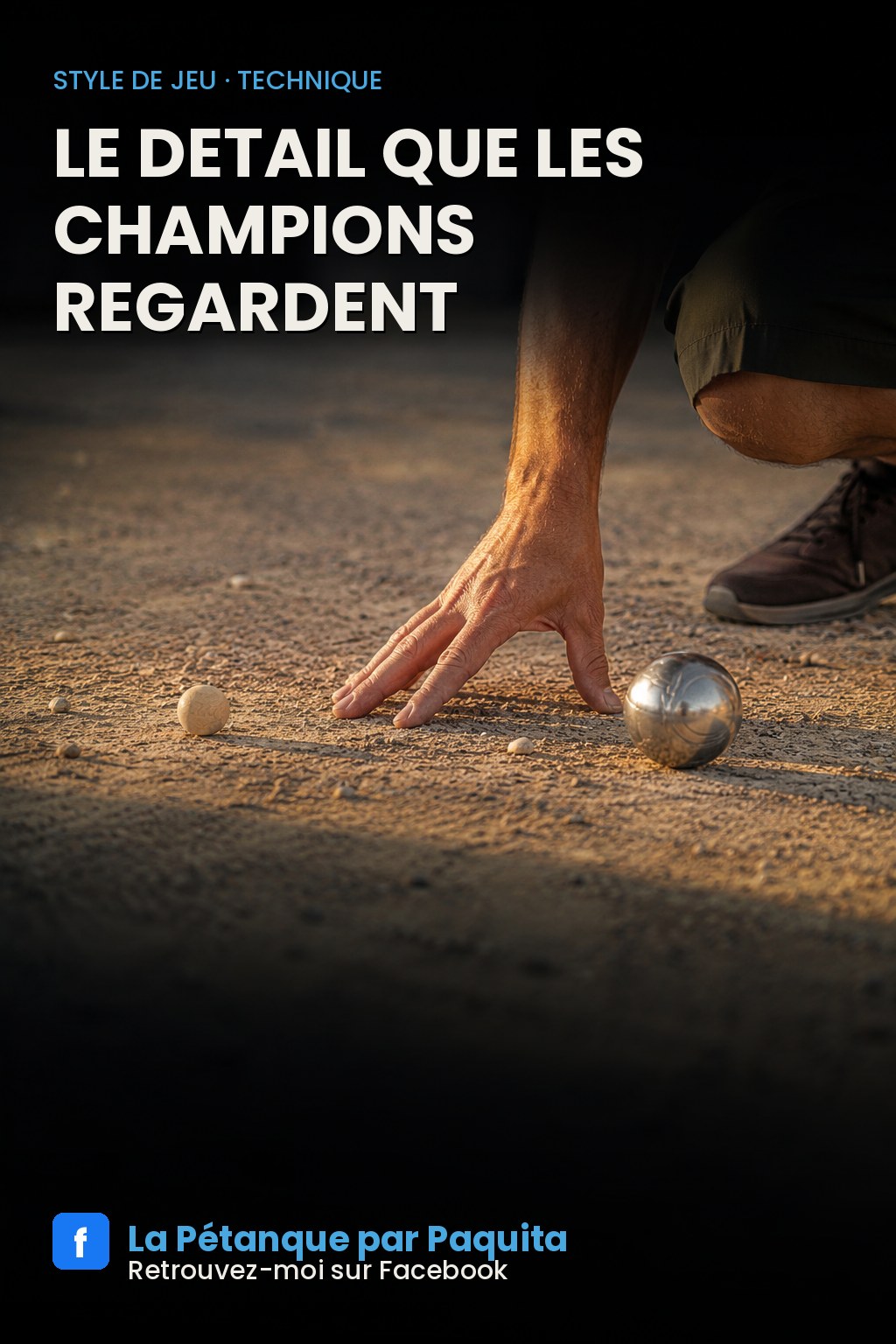
The detail that champions look at before each lead
NewsBefore playing the first ball, the big players analyze a detail that most do not know: the area between the last ball played and the cork.1.What is the detail in concrete terms?
Before each end, the champion observes a well-defined zone: the corridor of one to two meters between the last stopped ball of the opposing camp (or his own) and the stopper. Not just anywhere on the field: precisely the trajectory that his ball will take. He looks at the ground, the traces, the humidity, the slope, the gravel displaced by the previous balls. Three to five seconds later, he knows whether to point at half-range, high-range, lead roulette, or change bands.
For a beginner, this area is just a patch of land — he's looking at the cap. For a champion, it's a card. This area carries all the memory of previous shots and it tells how the next ball will behave.
The arrival zone is not the traffic jam. It's the last meter before the traffic jam, where the ball decides to die where it wants or not. Looking at the cork is almost useless — it's the ground right in front that decides.
2.Why this zone, and not another?
The terrain is never homogeneous. Over two meters, there can be changes in firmness, slope, gravel that no one sees. The ball feels them: a single misplaced gravel is enough to deviate the last ten centimeters. It is exactly in this ten centimeters that the game is played.
The champions have understood that the final precision of a point does not depend on the gesture of letting go, but on the reading of the final ground. A perfect gesture on a poorly read area gives an average point. An imperfect move on a well-read area often results in a winning point. See also our little-known rules on the jet and arrival.
3.The 4 signals to spot in 3 seconds
The champion doesn't look at everything. It seeks four specific pieces of information, each time the same. For the uninitiated, here is the reading grid:
1. The color of the ground
A lighter area = drier, therefore faster. A darker area = moist, therefore stickier. On the last meter before the traffic jam, this information radically changes the way of playing: on dry ground, a half-range rolls long; when wet, it stops dead.
2. Traces of previous balls
Each previously played ball left a trace. If they all converge towards the same point just before the traffic jam, there is a hollow. If they all move apart, there is a bump. These two indices change the choice between high point and low point.
3. Gravels moved
An area where gravels have been pushed = the ball slides. A clean area where they stay = the ball slows down. It's the most discreet detail, but the one that makes a 5 cm ball tip over in the last meter.
4. The local slope
Over three meters, a piece of land may appear flat even though there is a slight slope over the last meter. A sideways glance, while crouching, is enough to spot it. Many balls miss because of a slope that no one had noted.
4.The 3 observation mistakes of amateurs
Why do so many players skip this step? Three reasons always come up:
5.The method of champions in 30 seconds
All schools basically share the same routine. Here it is broken down:
| Step | Duration | What is observed |
|---|---|---|
| 1. Approach the circle | 3 s | Check the area behind the cap — where the ball will stop if it leaks. |
| 2. Crouching gaze | 3 s | Low angle view: slope, bump, hollow in the last meter. |
| 3. Reading traces | 3 s | Convergence/divergence of balls previously played. |
| 4. Shot decision | 2 s | Choose between low point, half range, high range, plumb. |
| 5. Choice of ball | 3 s | Heavy or light, hard or soft, depending on what was seen. |
At the next training, impose on yourself three seconds of crouching observation, three seconds of looking at the tracks, three seconds of decision. After a week, your point consistency increases without changing anything else. It's not a gift: it's a protocol.
6.When this observation is not sufficient
On very worn or very humid grounds (after a downpour, for example), the reading becomes uncertain — the ground moves one after another. In this case, the champions re-observe each round instead of relying on their initial reading. This is why we see them crouching five or six times during a game, even when they seem confident.
On fast indoor pitches, the reading is the opposite: everything slides, you have to accept that you brake less and aim shorter. And on sand, observing the gravel is of no use - the reading focuses on the slope.
7.How to integrate the reflex without disrupting your game
The trap, when reading this kind of article, is wanting to change everything at once. Bad idea: too much information to integrate at the same time, and the first one leads to confusion. The correct method is progressive:
Week 1 — only the color
For a week, you only observe one thing: the color of the ground in the last meter. Dry or wet? That's all. You don't change anything else.
Week 2 — add the traces
Now, after the color, you look at the traces of the previous balls: do they converge, do they diverge? You get used to it in a few days.
Week 3 — the local slope
You add the crouching observation of the slope. This is the most profitable step for many players — it reveals things that standing hides.
After three weeks, these observations become automatic. The gesture comes next, naturally adapted to what has been read. It is this automation that defines the experienced player.
The complete method for reading each course like a champion: observation, choice of shot, gesture adapted to reading. Top scorers' routines, explained step by step.
📗 Discover the guide