News · 20 July 2026
How many boules per player according to the official game format in petanque?
NewsTête-à-tête, doublette, triplette: how many boules should each player use in an official pétanque competition? The FFPJP rule explained simply.1.The basic rule: the format decides the number of boules
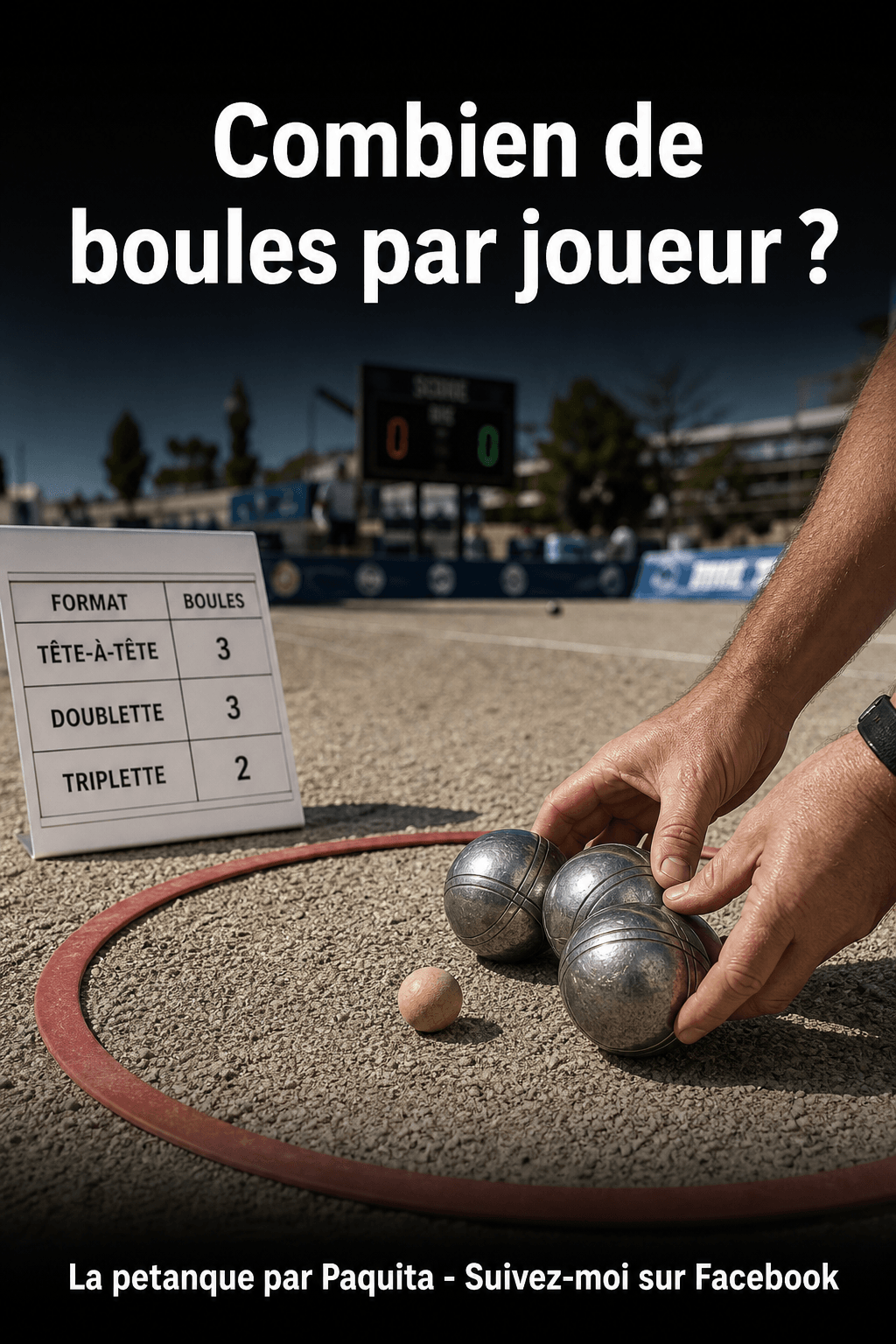
The official principle is very clear: the more players there are in a team, the fewer boules each player has. In tête-à-tête, two players face each other and each plays three boules. In doublette, two teams of two players compete and each player keeps three boules, making six boules per team. In triplette, the teams have three players and each player has only two boules left, again six boules per team.
The rules thus seek a balance: a team always plays six boules in total in doublette as in triplette. It is therefore not a material detail, but a rule that structures how the end unfolds, pointing strategy and shot management.
To remember: tête-à-tête = 3 boules each, doublette = 3 boules each, triplette = 2 boules each. The total per team remains decisive for understanding the rhythm of the game.
2.Tête-à-tête: three boules and total responsibility
In singles, each player has three boules. This means they must take on every role: pointing, shooting, defending, attacking and sometimes saving the end on their own. Three boules offer more chances to correct, but they also expose choice mistakes more. A player who wastes their first boule often has to use the next two to repair it.
This format demands a complete reading of the game. You can't hide behind a specialised shooter or pointer. The three boules are a personal resource, and every decision commits the whole end.
3.Doublette: three boules each, but a real distribution of roles
In the doublette, each player also has three boules. However, the game logic changes: the team has six boules in total, and the two partners can distribute the missions. One can point more, the other shoot more often, but the rules don't block these roles. Each player plays their three boules when their team decides it's their turn to step in.
Confusion sometimes comes from club games where players are rotated mechanically. In competition, what matters is respecting the number of boules per player and the order of play of the team that must play, not creating an artificial rotation.
4.Triplette: two boules each, six boules for the team
In triples, each player only has two boules. It is the most collective format: pointer, middle player and shooter must manage a shorter resource. A poorly used boule weighs heavily, because only one remains for the player. Strong teams therefore know how to prepare the end before playing, choosing who opens, who takes back and who keeps a decisive boule.
This rule also explains why the triplette seems more tactical: the total number of boules per team stays at six, but it is split between three different hands. The quality of coordination becomes as important as individual technique.
5.Common mistakes about the number of boules
The most common mistake is to believe that each player always has three boules, whatever the format. In official triplette, that would be wrong: only two boules. Conversely, some beginners think that in doublette you drop to two boules to imitate triplette. Again, that's incorrect: doublette is played with three boules per player.
Another trap: friendly games with an odd number of players. If you play two against three to balance out a club evening, you step outside the strict framework of an official tournament. That is fine in casual play, but it should not be presented as an FFPJP rule.
6.How to simply check before an official game
Before the start of a game, count the players and the total boules of each team. In doubles or triples, a team must play six boules. In singles, each player plays three. This check avoids late disputes, particularly after an end has already begun.
For organizers, the simplest approach is to announce the format clearly at the draw and to remind players of the number of boules allowed. In a packed competition, this precision avoids pointless debates and helps new license-holders feel properly framed.
| Situation | Good reflex | Frequent mistake |
|---|---|---|
| Singles | 3 boules each | Playing only 2 boules out of habit |
| Doubles | 3 boules per player | Confuse with the triplette |
| Triples | 2 boules per player | Leaving a player 3 boules |
| Free play | Announcing the arrangement | Presenting it as official |
Before throwing the jack, always count the team total: six boules in doubles, six boules in triples. This simple reflex catches almost all errors.
To improve across all formats, the full series helps you work on reading, pointing, shooting and team strategy.
Discover