News · 20 July 2026
Doublette, triplette, tête-à-tête: the official rules of each game format
NewsTête-à-tête, doublette, triplette: number of players, boules per player, tactical choices and rule mistakes to avoid in an official pétanque competition.1.The basic rule: the format determines the boules
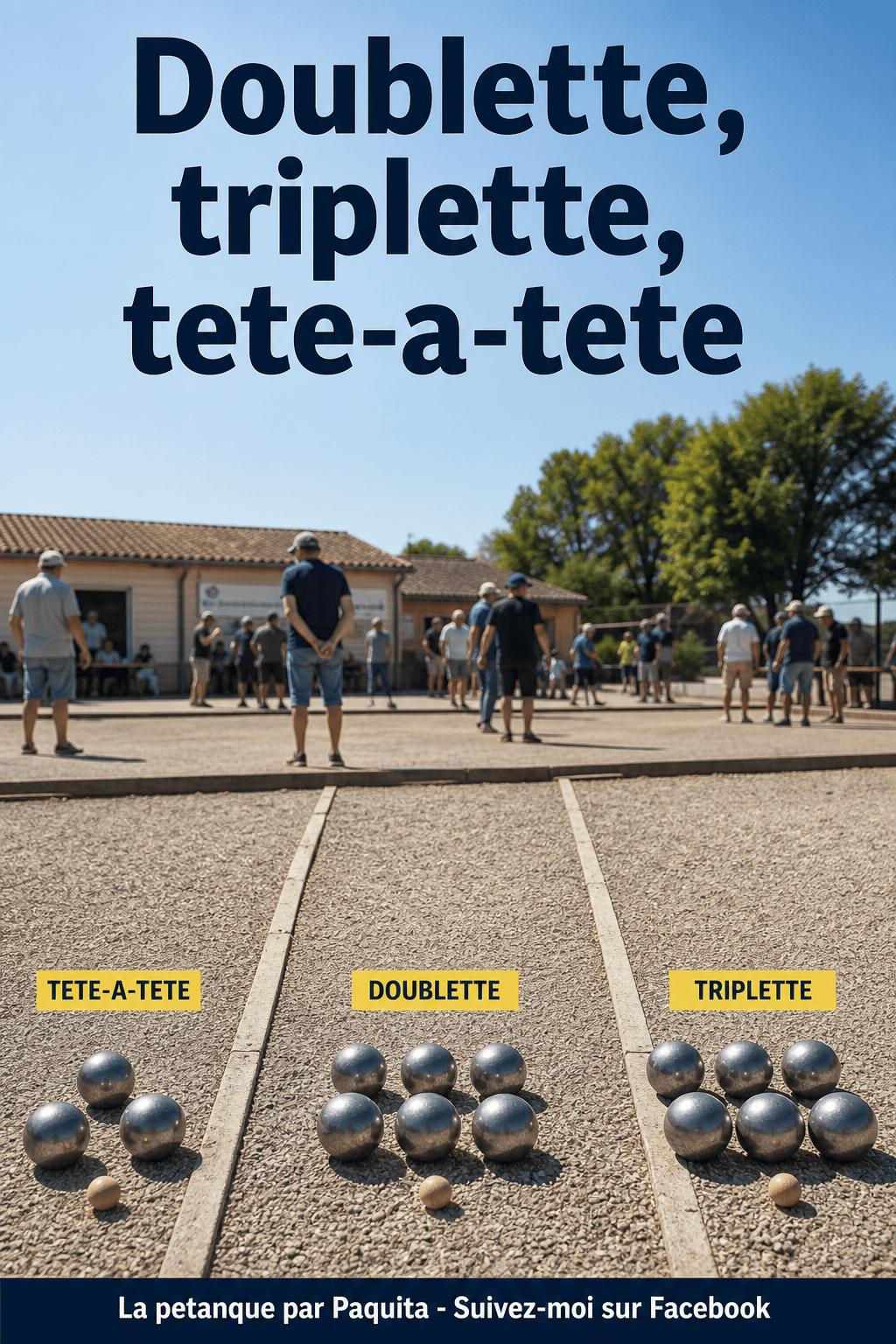
The simplest principle is also the one that causes the most misunderstandings: the number of boules is not decided at random. In tête-à-tête, each player plays with three boules. In doublette, each player also has three boules, making six boules per team. In triplette, each player has only two boules left, but the team still has six boules in total.
This detail changes the reading of the game. In tête-à-tête, the player has to do everything alone: point, shoot, correct, take on the last boule. In doublette, specialisation begins but stays flexible. In triplette, the roles become more marked: pointer, middle, shooter, with stricter collective management.
2.Tête-à-tête: three boules, no hiding place
Tête-à-tête is the most revealing format. With three boules, a player can build a complete end, but he has no one to repair his hesitations. The rules are simple; the difficulty is mental and tactical. You have to decide quickly whether to keep a boule for defence, whether to attack straight away, or whether to lay down a safety point.
This format also forces you to respect the order of play perfectly. The one who doesn't have the point plays again. Without a partner to check, measuring or reading errors come quickly. A good habit is to announce clearly who holds the point before stepping into the circle.
3.Doublette: the balance between freedom and specialization
In the doublette, each player has three boules. The team therefore has a large margin for correction. One player can point twice and shoot once; the other can reverse it depending on the end. The rules don't force the roles, but the logic of the game often pushes toward designating a more stable pointer and a more offensive shooter.
The common mistake is to believe that both players must stay in a fixed pattern. It's not a regulatory requirement. A smart doublette adapts its roles to the terrain, the score and the form of the moment. The official framework gives six boules: the team chooses how to use them.
4.Triplette: two boules each, heavier decisions
Triplettes gives two boules per player. It may seem comfortable because the team is larger, but each individual boule carries more weight. The pointer cannot multiply attempts. The shooter does not always have a recovery boule. The middle player becomes the pivot: he corrects, prepares, protects and sometimes attacks.
The rules set the number of players and boules; they do not dictate strategy. But in practice, triplette punishes teams that discuss for too long or change their plan after every boule. Since the roles are shared out, communication must be clear before stepping into the circle.
5.Format errors that create disputes
Disputes often arise at the start: wrong number of boules, misunderstood substitution, absent player, confusion between a doublette competition and a friendly game with a variable number of players. In an official event, you don't “sort it out” as you do at the club. The format announced by the organizers sets the rights of each team.
To remember: the total of six boules per team is the practical benchmark in doubles and triples, but the distribution per player is not identical. It is precisely this distribution that changes the game.
6.How to choose the right format to progress
To improve technically, the tête-à-tête is unforgiving: it reveals weaknesses with no filter. To learn cooperation, the doublette is ideal, as the exchanges stay simple. To work on collective strategy, the triplette is the richest format. None is superior; each develops a different skill.
A player who knows the three formats understands competitions better. He knows why a boule kept in tête-à-tête does not mean the same as a boule kept in triplette. He also knows that the rules are not an abstract constraint: they are the structure that gives each game its character.
| Format | Players | Boules per player | Key point |
|---|---|---|---|
| Singles | 1 vs 1 | 3 | total autonomy |
| Doubles | 2 vs 2 | 3 | role flexibility |
| Triples | 3 vs 3 | 2 | strict coordination |
Before a competition, train in the exact format of the tournament. A triples team prepared like a doubles team quickly loses its bearings.
For clubs, the PétanqueLand software helps frame registrations, formats, draws and game tracking without mixing up doublettes, triplettes and têtes-à-têtes.
Discover