News · 16 April 2026
Hardness of pétanque boules: The complete guide to understanding everything and choosing well
NewsSoft, semi-hard, hard, extra-hard... The hardness ofWhat is hardness — the physics explained
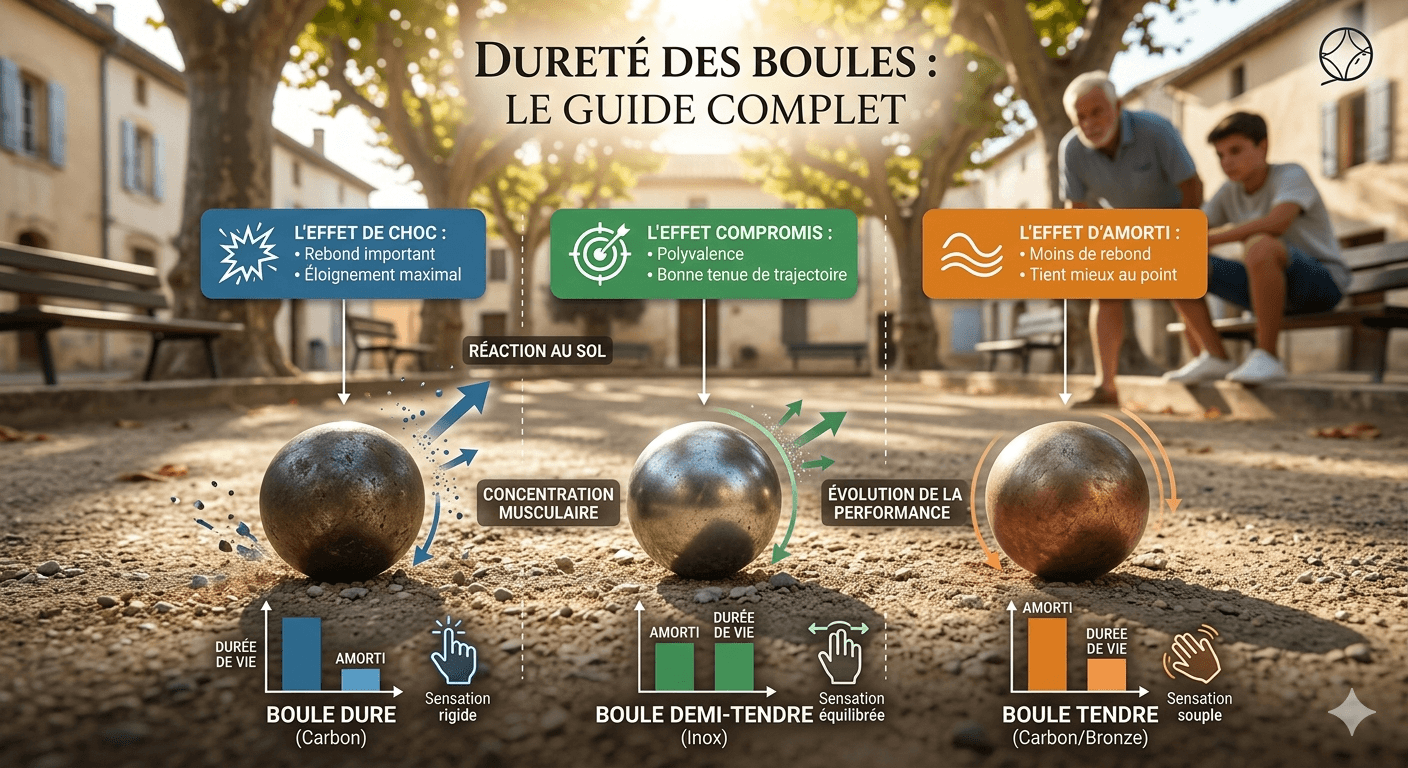
The hardness of a material measures its resistance to permanent deformation under the effect of a force. For pétanque bowls, it is expressed in Rockwell units (HRC) — a standardized scale used in metallurgy. The higher the HRC value, the harder the steel.
🔬Pétanque bowls are made of heat-treated steel (quenching and tempering). The heat treatment modifies the crystalline structure of the steel and determines its final hardness. An "extra-hard" bowl has undergone a more intense heat treatment than a "soft" bowl — which gives it both higher hardness and increased wear resistance, at the price of a livelier rebound behavior. It is not superior quality — it is a different behavior.
🎙️ Paquita on hardness "When I hear a player say 'I want the hardest bowls possible', I know he hasn't understood. Maximum hardness is not an absolute advantage — it is a choice of behavior. An extra-hard bowl bounces harder, ages better, gets damaged less. But it cushions less on ground impact, it bounces more off opposing bowls, and it is less forgiving of gesture errors. For certain profiles and certain terrains, it is the right choice. For others, it is the wrong bowl, well maintained." — PaquitaThe 4 hardness levels — detailed fact sheets
DTSOFT SOFT The softest bowl — maximum comfort and cushioning Confirmed pointer Compact terrain Optimal cushioning Faster wear REBOUND BEHAVIOR The soft bowl absorbs more energy on impact — its slight elastic deformation acts as a shock absorber. The rebound is reduced and controlled. On hard terrain, it does not go far after impact. For the pointer, this is valuable: the bowl "dies" better on the terrain. IMPACT ON OPPOSING BOWL During metal-to-metal contact (on shooting), a soft bowl against a hard bowl is disadvantaged: it absorbs more energy, goes less far, and displaces the opposing bowl less effectively. The shooter loses impact power. WEAR AND DURABILITY The soft bowl gets damaged faster — repeated impacts create deeper marks. Over 5 years of intensive play, it shows more significant impact marks than a hard bowl. Less durable, but more comfortable for pointing. COMPARED PERFORMANCE Cushioning Rebound Shooting impact Durability FOR WHOM? Expert pointer on compact and hard terrains (indoor pétanque courts, very hard packed earth). The player who wants a bowl that "dies" after the delivery with a minimum of roll. Not recommended for shooters — the impact on the opposing bowl is penalized. SDSEMI-HARD SEMI-HARD The versatile compromise — the best balance for the majority Versatile All terrains All levels Good durability/cushioning ratio REBOUND BEHAVIOR Moderate rebound — neither too cushioned like the soft, nor too lively like the extra-hard. On the wide variety of terrains encountered in outdoor tournaments, it is the most predictable and the most stable. The bowl reacts consistently regardless of the terrain. IMPACT ON OPPOSING BOWL Good compromise — the semi-hard bowl correctly displaces the opposing bowl on shooting without being penalized like the soft. It remains effective for pointing and sufficiently performant for shooting. The versatile hardness par excellence. WEAR AND DURABILITY Correct durability — wear is reasonable over several years of play. Impact marks appear less quickly than on the soft. With minimal maintenance (cleaning and light oiling), a semi-hard bowl lasts many years. COMPARED PERFORMANCE Cushioning Rebound Shooting impact Durability FOR WHOM? The great majority of club players, beginners to confirmed. The middle who points and shoots. The player who changes terrain regularly and does not want to adapt their bowls according to conditions. The reasonable first choice for anyone hesitating. DUHARD HARD The shooters' favorite — lively rebound and powerful impact Dominant shooter Strong impact Good durability Varied terrains REBOUND BEHAVIOR Fairly lively rebound — the hard bowl returns more energy on impact and goes further after ground impact. For the pointer, this requires a distance correction (delivering further ahead). For the shooter, it can help clear the opposing bowl more. IMPACT ON OPPOSING BOWL Strong and decisive impact. Against a soft or semi-hard bowl, a hard bowl transfers more energy — the opposing bowl is displaced further. That is why shooters favor it. The effectiveness of the iron is maximized with a hard bowl. WEAR AND DURABILITY Good durability — hard steel resists repeated impacts well. Impact marks are less deep and less numerous. It is an investment that lasts — several years with regular use without notable degradation of behavior. COMPARED PERFORMANCE Cushioning Rebound Shooting impact Durability FOR WHOM? Regular shooters who want to maximize the effectiveness of their irons. Players on varied terrains who want stable behavior and good durability. Intermediate to advanced level. Not recommended for pure pointers on very hard terrain — the excessive rebound complicates the stopping zone. XDEXTRA-HARD EXTRA-HARD The competitors' bowl — maximum performance and extreme durability Expert shooter Competition Maximum durability Strong rebound to manage REBOUND BEHAVIOR Very lively rebound — the extra-hard bowl returns a maximum proportion of energy on impact. On hard terrain (concrete, indoor pétanque courts), the rebound can be spectacular. Requires significant gesture adaptation for pointers — the delivery must be calculated for this strong rebound. IMPACT ON OPPOSING BOWL Maximum impact — against any opposing hardness, the extra-hard bowl is the most performant on impact. Against an opposing soft bowl, the advantage is maximal. But against another extra-hard, the effect is similar for both. Impact is maximal when the two bowls have different hardnesses. WEAR AND DURABILITY Maximum durability — extra-hard steel resists impacts and wear the best. A well-maintained extra-hard bowl can last 10 to 15 years of regular play without notable change in behavior. It is the most profitable long-term investment. COMPARED PERFORMANCE Cushioning Rebound Shooting impact Durability FOR WHOM? Expert shooters who master rebound behavior and know how to exploit it. Regular competition players who want bowls that last for years. Not recommended for beginners and pointers — the lively rebound complicates zone control and requires significant gesture adaptation.Performance comparison — criterion by criterion
⚙️ COMPARISON OF THE 4 LEVELS ON 5 CRITERIA GROUND CUSHIONING (POINTER ZONE CONTROL) Soft9/10 Semi-hard6.5 Hard4/10 Extra-hard1.5 SHOOTING IMPACT POWER Soft3.5 Semi-hard6.5 Hard8.2 Extra-hard9.5 DURABILITY (WEAR RESISTANCE) Soft4/10 Semi-hard6.5 Hard8/10 Extra-hard9.5 ALL-TERRAIN VERSATILITY Soft5/10 Semi-hard8.5 Hard7.2 Extra-hard5.5 EASE OF USE (BEGINNERS/INTERMEDIATES) Soft7/10 Semi-hard8.8 Hard6.2 Extra-hard3.8According to your role and your terrain
| Profile | Recommended hardness | Main rationale | To avoid |
|---|---|---|---|
| Beginner — all roles | Semi-hard | Versatile, forgiving, good for learning | Extra-hard — rebound hard to manage |
| Pointer — hard/covered terrain | Semi-soft | Maximum cushioning for zone control | Hard/Extra-hard — excessive rebound on hard surface |
| Pointer — varied outdoor terrain | Semi-hard | Versatility and stable behavior | Soft on loose terrains (gets damaged) |
| Shooter — intermediate level | Hard | Good shooting impact, correct durability | Soft — loses effectiveness on the iron |
| Shooter — competition expert | Extra-hard | Maximum impact + durability over long seasons | Semi-hard — suboptimal on impact if the gesture is perfect |
| Middle — point and shoot | Semi-hard | The only reasonable compromise for both roles | Extremes — penalize one or the other role |
| Player on indoor pétanque courts | Soft or Semi-hard | Hard surface = strong rebound — cushioning needed | Extra-hard on hard surface = unmanageable rebound |
Interaction with the opposing bowl — the key forgotten factor
Your bowl's hardness does not work in a vacuum — it interacts with the opposing bowl's hardness at the moment of metal-to-metal impact. This interaction is governed by the laws of elastic collision physics and can significantly modify the effectiveness of your shot.
⚡The fundamental physical rule: during a collision between two bowls, the harder bowl transfers more energy to the softer bowl. An extra-hard bowl against an opposing soft bowl = the opponent flies far, you stay (quasi-carreau). A soft bowl against an opposing extra-hard bowl = you absorb the energy, you go back, the opponent stays almost in place. This is not anecdotal — against certain teams in competition, choosing your hardness based on the opposing hardness can make a measurable difference.
🧪 The advanced strategy — adapting hardness to the opponentIn high-level competitions, some teams have two sets of bowls of different hardnesses and choose based on the opponent. It is a rare practice at club level but perfectly legal — and it illustrates how much hardness is a tactical parameter as much as a technical one. For the majority of players, a hardness adapted to their role and terrain is amply sufficient.
Hardness and wear — what gets damaged the fastest
💧 Soft — visible wear in 2–3 yearsImpact marks appear relatively quickly. The bowl "takes" the impacts and the surface shows marks after 2–3 years of intensive play. The behavior can evolve slightly over time.
🌿 Semi-hard — good longevity (4–6 years)Correct wear over several years of regular play. Impact marks are present but superficial. Stable behavior over time. The good durability/cost ratio for regular players.
⚡ Hard — very good longevity (6–10 years)Hard steel resists impacts well. Only superficial marks. The behavior remains stable over many years. A profitable investment for regular shooters in competition.
🔴 Extra-hard — maximum longevity (10–15+ years)Maximum wear resistance. Bowls that can go through decades of play without notable change in behavior. The true lifetime investment for serious competitors.
Comparison between brands — the problem of names
⚠️Hardness names are not standardized between brands. An Obut "hard", an MS "hard" and a Boulenciel "hard" do not necessarily correspond to the same HRC value. Each manufacturer defines its own categories. To correctly compare two bowls of different brands: ask for the exact HRC value (some manufacturers communicate it), or physically test the rebound of the bowl against a known hard surface. Obut bowls are generally positioned on the medium-hard spectrum, MS bowls have a reputation for high hardness, and Boulenciel offers stainless steels whose hardness compares differently from standard steels.
The myths about hardness — debunked
❌ MYTH ✓ REALITY ❌"Harder = better for everyone." ✓Harder = better shooting impact AND livelier rebound. For a pointer on hard terrain, an extra-hard bowl can be counter-productive — too much rebound, too little cushioning. ❌"A soft bowl is a poor-quality bowl." ✓Soft is a quality bowl that meets a specific need — ground cushioning for pointers on hard terrain. Some high-end soft bowls cost more than entry-level hard bowls. ❌"Hardness is the most important parameter in choosing a bowl." ✓Weight is generally more determining for mastery. Hardness comes next — after weight, before grooving. The three parameters form a coherent set to choose according to profile. ❌"A soft bowl gets damaged on the first hard impact." ✓A quality soft bowl (treated steel) resists normal game impacts correctly. It gets damaged faster than a hard one — but on a scale of several years, not a few games. ❌"My bowls are soft so my shots are bad." ✓Bad shots come from the gesture, not the hardness. A soft bowl has slightly lower impact than a hard one — but the difference on a correctly executed shot is marginal compared to the gesture error of a bad shot. 📖 PAQUITA'S BOOK Mastering your equipment — and your gameHardness, weight, grooving, diameter — the complete guide to choosing a bowl in Paquita's book, combined with 100 exercises to exploit the optimal equipment with the optimal technique.
📦 Order on AmazonFAQ — Your frequent questions
Can we play with three balls of different hardness in the same triplet? + No — the three boules of the same player must be of the same FIPJP approved model, which implies the same hardness. On the other hand, in a triplet team, each player can have their own balls of different hardness — the shooter on extra-hard, the middle on hard, the pointer on semi-hard. This is perfectly legal and even recommended to optimize each role. How to test the hardness of a ball without specialized equipment? + Two practical methods: 1) Rebound test — drop the bowl from hip height onto a flat hard surface (concrete). An extra-hard bowl will bounce noticeably more than a soft one. Compare several bowls under the same conditions. 2) Sound test — hit two balls against each other. A hard ball produces a clear, prolonged metallic sound. A soft ball produces a duller, less resonant sound. These tests are approximate but allow a relative comparison. Does the hardness of a ball change with time and wear? + The crystalline structure of hardened steel does not change significantly with normal wear and tear from play. An extra-hard ball remains extra-hard after 10 years of play. What changes with wear is the surface (ridges, geometry) — not the intrinsic hardness. On the other hand, a chipped ball or one that has suffered an unusual violent impact may present micro-cracks in the steel which locally modify its behavior - this is an additional reason to remove shocked balls from the game. Is the hardness indicated on the balls or their packaging? + Yes, generally. On the packaging and on the manufacturers' product sheets, the hardness is indicated — sometimes in full (semi-soft, hard, etc.), sometimes by a numerical code or a letter specific to the brand. On the ball itself, the hardness is generally not engraved — only the weight and the FIPJP approval number are. If you buy used balls and no longer have the packaging, use the practical tests described above or compare with a ball of known hardness. What is the recommended hardness to start playing pétanque? + Semi-hard is the universal recommendation for beginners — and for most intermediate levels. It is versatile on all types of terrain, suitable for both roles (point and shooting), easy to use (predictable behavior), and durable. It is the hardness which gives the most margin for gesture error - a moderate bounce is more forgiving of gesture imperfections than an extra-hard one whose lively behavior amplifies the errors. See our complete guide: Choosing your bowls 2026. 📎 Related articles Equipment Choosing your pétanque boules — complete guide 2026 Equipment Stainless vs carbon — the hardness of alloys compared Equipment Top 3 best shooter boules 2026 Equipment Checking the FFPJP approval of your boules Video Why changing bowls does not change your level Tools Free PetanqueLand tools© Pétanque by Paquita — petanqueland.fr ·
📖 Paquita's book on Amazon
The compared performances presented in this article are practical estimates based on field observation and general physical principles. They vary according to brands, models and conditions — to be used as reasoning markers.