News · 27 April 2026
The half-lob: when it becomes more effective than the roll
NewsThe half-lobPrecise definition — what distinguishes the half-lob
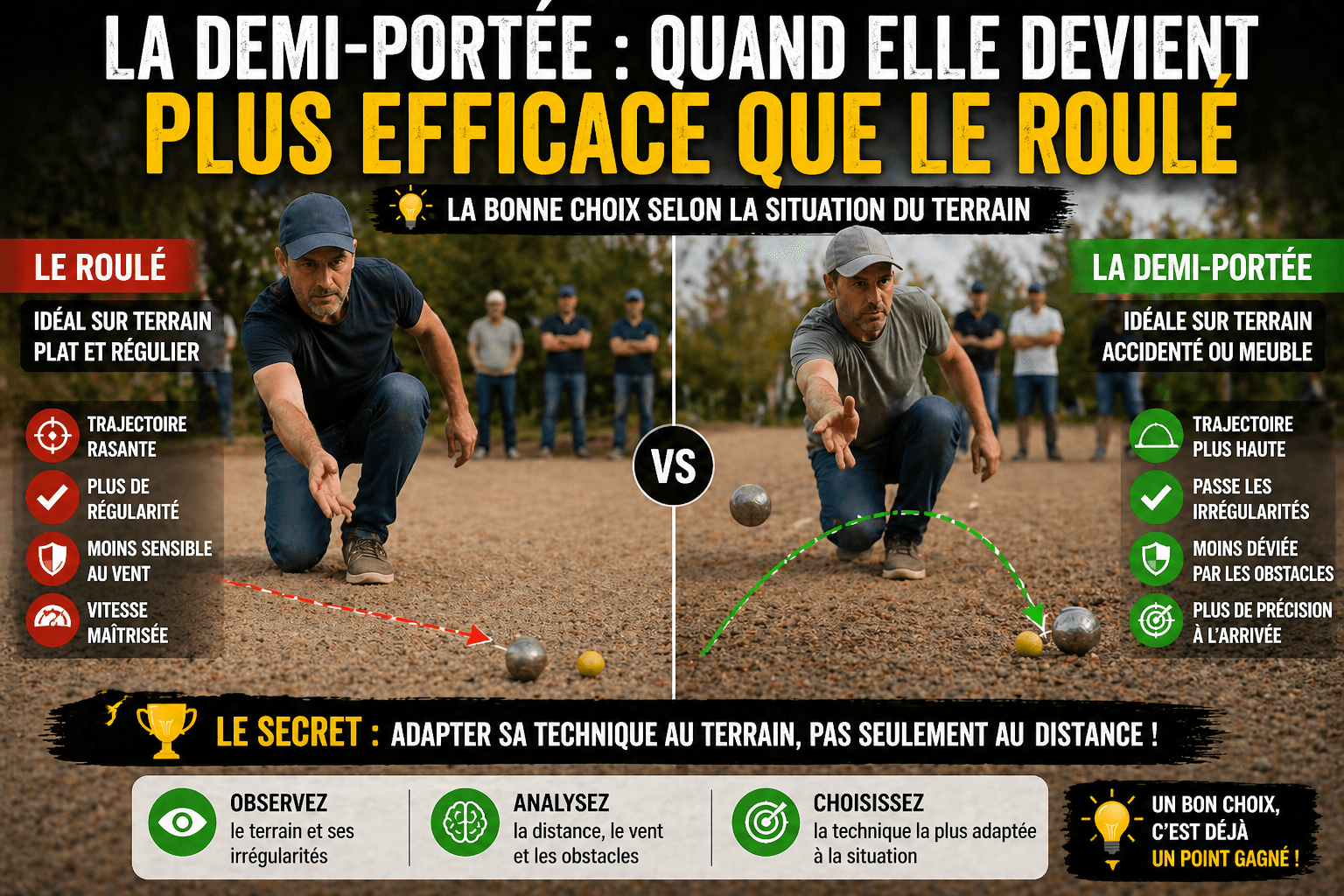
➡️ ROULÉ 0–15° → Skimming angle, almost horizontal trajectory → The bowl touches the ground very early and rolls over almost the whole distance → Effective on flat and smooth terrain → Very sensitive to terrain irregularities → Long roll = high friction = distance sensitive to the surface ↗️ DEMI-PORTÉE ★ 20–40° → Intermediate angle, moderate curved trajectory → The bowl lands halfway and rolls the second half → Effective on varied terrain, obstacles in the first half → Reduces interaction with the first 3–4 metres of the terrain → Compromise between flight control and residual roll ⬆️ SOULEVÉ 45–70° → Steep angle, high trajectory → The bowl flies over most of the distance → Effective for clearing obstacles, very uneven terrain → Very sensitive to bounce on landing → Demands higher release precision 📐The half-lob is defined by the landing point as much as by the angle. In a correct half-lob, the bowl touches the ground at 40–60% of the total distance to the jack — so it passes "over" the first half of the terrain and rolls over the second. This halfway landing point is its signature. If the bowl lands before a quarter of the distance → roulé. After two thirds → soulevé. In between → half-lob.
The physics of the half-lob vs the rolling shot
↗️ COMPARISON OF TRAJECTORIES — SAME DISTANCE, SAME COCHONET ROLLING (0–15°) Ground ball from the start. Rides 100% of the distance. Total interaction with the terrain. HALF-SPAN (20–40°) Fly 50–60% of the distance, roll the rest. Avoid the pitch in the 1st half.The blue dot = landing zone of the half-lob (halfway) — where the flight → roll transition takes place
The fundamental physical difference: the rolling shot interacts with the terrain over 100% of the distance. The half-lob only interacts with the terrain over the final 40–50%. Every stone, every irregularity, every surface variation that the rolling shot encounters in the first half of the path, the half-lob passes over them. That is the source of all its advantages.
🎙️ Paquita on the half-lob "Many players play a half-lob without knowing it — they think they are playing a roulé but their natural angle produces a trajectory of 25 or 30 degrees. It is not a mistake. It is often their natural action that has adapted to their usual terrain. The problem is when this player arrives on a perfectly smooth terrain and continues their usual effective half-lob — there it becomes less precise than a true roulé on smooth terrain. The half-lob is an adaptive tool, not a universal action." — PaquitaThe 7 situations where the half-lob dominates the rolling shot
1 Uneven terrain in the first half of the distance Stones, bumps, a root in the first 3–4 metres in front of the throwing circle. The rolling shot goes through them all — every contact is a potential deviation. The half-lob passes over them and only lands on cleaner terrain in the second half. → The half-lob reduces the number of parasitic interactions by 50 to 70% compared with the rolling shot. 2 An opponent's or partner's bowl in the middle of the trajectory A bowl sits on the most direct path between the circle and the jack — about halfway. The rolling shot will necessarily hit it or has to go around (then losing its axis). The half-lob passes over it if the obstacle bowl is sufficiently below the flight trajectory — then lands on the other side and rolls towards the jack. → The half-lob can pass over an obstacle bowl at mid-trajectory — the rolling shot cannot. 3 Terrain sloping gently down towards the jack The terrain slopes slightly towards the jack. In a rolling shot, the bowl accelerates on the slope and risks going too far — distance control is difficult. In a half-lob, the bowl lands halfway down the slope and rolls the second half with controlled speed from a more advanced point. The rolling distance is reduced — and so the acceleration effect of the slope is reduced accordingly. → The half-lob reduces the rolling distance on a slope, reducing the gravitational acceleration effect. 4 Long distance (9–10 metres) on moderately regular terrain Over 9–10 metres, the rolling shot accumulates a lot of terrain interactions — every irregularity has time to affect the trajectory. The bowl can gradually drift from its initial axis over such a long rolling distance. The half-lob halves the rolling distance — terrain interactions only accumulate over 4–5 metres instead of 9–10. → Over long distances, the half-lob accumulates fewer trajectory errors than a rolling shot over the full distance. 5 Muddy or waterlogged terrain in the first half The starting area is waterlogged or muddy (around the circle, very common), but the terrain improves towards the jack. The rolling shot spends its whole run in the mud — the bowl gets heavier, accumulates earth, slows down excessively. The half-lob passes over the muddy zone and only lands on the drier part, closer to the jack. → The half-lob avoids the muddy zone around the circle — frequent after morning rain on a terrain often watered around the throwing circle. 6 Tall grass in the first half of the terrain The terrain is half grass, half beaten earth. The starting area is grassy (high friction, the bowl slows down quickly) and the area around the jack is more compact earth. The rolling shot loses much of its speed in the grass. The half-lob passes over the grass and lands on the earth part, retaining enough energy to reach the jack. → The half-lob overcomes the high friction of the grass in the first zone of the terrain. 7 Jack close to an opponent's bowl — precise passage required The jack is protected by an opponent's bowl just in front of it. A ground-skimming rolling shot has to pass to the side of the opponent's bowl — which leaves a very small margin and a precise corridor. A half-lob can land just after the opponent's bowl (in the "hollow" behind it) and roll the last few centimetres up to the jack — taking advantage of the fact that the opponent's bowl acts as a natural stop. → The half-lob can use the space "behind" a protective opponent's bowl — where the rolling shot cannot pass without colliding with it.Terrain × optimal technique matrix
| Terrain / game condition | Roulé | Half-lob | Soulevé |
|---|---|---|---|
| Perfect, smooth, flat terrain | Optimal | Correct | Less precise |
| Stones in the 1st half | Risky | Optimal | Also valid |
| Obstacle bowl halfway | Blocked | Optimal if sufficient height | Also valid |
| Slope downhill towards the jack | Difficult | Advantageous | Strong bounce |
| Long distance (9–10m) | Accumulation of errors | Better tolerance | Difficult precision |
| Mud around the circle | Heavily slowed | Passes over the mud | Also valid |
| Tall grass → beaten earth | Slowed in the grass | Optimal | Bounce on earth |
| Hard terrain, concrete | Ideal roll | Bounce to manage | Very strong bounce |
| Fine sand | Bogs down | Reduces bogging down | Risk of sinking |
To decide between roulé and half-lob: look at the first half of the terrain, not the jack. If the first half is clean, flat and regular → roulé. If the first half has irregularities, obstacles or a difficult surface → half-lob. The jack and the opponent's bowls only change this choice if an obstacle bowl blocks the trajectory.
The technical action — how to produce a true half-lob
🤲 ACTION TECHNIQUE The 5 parameters that define a precise half-lob Release height — between the knee and the hip, i.e. about 50–80 cm from the ground. Lower → roulé. Higher → soulevé. For the half-lob, the hand at release is at mid-height of the torso. It is the main control variable of the angle of attack. Swing angle — the arm must follow a trajectory of about 20–40° relative to the horizontal. Neither skimming (roulé) nor vertical (soulevé). Mentally: imagine that the bowl must land halfway between you and the jack — and adjust the angle accordingly. Targeted landing zone — consciously identify the desired landing point before throwing: a precise spot on the terrain at 40–60% of the total distance. Aim at this landing point, not the jack itself. In a half-lob, the jack is the final destination but the landing zone is the immediate target. Throwing force — the half-lob demands more force than the equivalent rolling shot, because the bowl must cover the same total distance but with part of the path in flight. The kinetic energy of the flight does not benefit from the help of the ground. An under-powered half-lob falls short; an over-powered one bounces too hard and goes too far. Release control — the release in a half-lob must leave the bowl with a slight natural backspin. This backspin will slow the bowl down after landing and prevent it from rolling too far. A flat release (no backspin) in a half-lob produces a bowl that rolls too much after landing — it often goes too far.The 5 common half-lob mistakes
⬇️ Aiming at the jack instead of the landing zoneThe player fixes on the jack and calibrates their force to get there. The bowl lands too far from its optimal landing point and still rolls much too far — or not enough.
✓ Aim at the halfway landing point 💪 Under-powering — the bowl lands too earlyThe force is calibrated as for a roulé. The bowl lands at a third of the distance and still has to roll for too long — going through exactly the obstacles it was supposed to avoid.
✓ Increase by 10–20% compared with the equivalent roulé 🪨 Irregular landing zoneThe chosen landing zone is itself irregular (stone, bump). The bowl lands on a stone and bounces sideways — cancelling the advantage of the half-lob.
✓ Analyse the landing zone before deciding on the technique ↪️ Flat release — too much roll after landingThe release does not produce enough backspin. The bowl lands well but keeps rolling very far — often going 30 to 50 cm past the jack.
✓ Work on natural backspin at the release 🎲 Lack of consistency of the landing pointThe landing point varies from 50 cm to 1 metre depending on the throws — the technique is not yet anchored. The results are inconsistent and unpredictable despite a good intention.
✓ Visual target exercise on the ground (see exercises)Exercises to anchor the half-lob
01 The intermediate ground target 📍 Training ⏱️ 15 min ↗️ Anchor the landing zoneThe fundamental exercise for learning to aim at the landing point rather than the jack.
Place a jack at 8 metres. Put a visible object (marker, coin, piece of chalk) at 4 metres — exactly halfway. This is your landing target. Throw aiming to land the bowl on or at most 20 cm from the intermediate object. Temporarily ignore the jack — only the landing point counts for this exercise. After 10 throws, remove the intermediate object. Throw while mentally visualising the landing point at 4 metres. Observe whether the bowls continue to reach the jack regularly. Vary the distances: 6m (target at 3m), 9m (target at 4.5m), 10m (target at 5m). The proportion always stays close to 50% of the total distance. 02 The simulated obstacle terrain 📍 Training ⏱️ 20 min ↗️ Half-lob over a real obstacleSimulate the conditions where the half-lob is superior to the rolling shot — create an obstacle in the first half of the terrain.
Place 3 bowls in a line halfway between the circle and the jack, spaced 15 cm apart — simulating an obstacle zone. The rolling shot will have to go around them; the half-lob must pass over them. Play 10 bowls as a rolling shot — note how many reach the jack without touching the obstacles (usually few). Observe the deviations caused by the contacts. Play 10 bowls as a half-lob — same objective. Observe that the bowls that land after the obstacles continue their run towards the jack normally. Compare the success rates. The aim is to mentally anchor that the half-lob is objectively superior on this type of terrain — which motivates you to use it naturally in the same conditions in a tournament. 📖 PAQUITA'S BOOK Mastering the 3 pointing techniques — on any terrainRoulé, half-lob, soulevé... Paquita's book covers each technique with its conditions of effectiveness and 100 numbered exercises to anchor them in every playing context.
📦 Order on AmazonFAQ — Your frequent questions
Is the putt always greater than half-range on perfect terrain? + On perfect, flat and smooth terrain, the roll has the advantage of regularity — the behavior of the ball is predictable over the entire distance and the force required is less (the ground helps). But "advantage" doesn't mean "always better" — some players have a more precise half-range than their putt even on perfect terrain, because it's their more ingrained natural technique. The most precise technique is the one you master best in the given conditions. On perfect terrain with two players of the same level, the one who masters the roll better will win. But a good half-range player on a perfect field will be competitive — the difference is marginal on an ideal surface. How do I know if I'm playing true roll, half-range or deadlift? + The simplest method: observe where your boule first hits the ground, as a percentage of the total distance to the jack. If it hits in the first 20% → rolled. Between 35 and 65% → half-range. After 70% → raised. To measure this precisely, film your profile throws and watch paused for the moment of first contact with the ground. Most players are surprised to see that their "roll" is often a half-range, and their "lift" is sometimes closer to a high half-range. This objective observation of the landing point is the starting point for all technical work on point techniques. Can you use half range for shooting, or is it just a point technique? + The half-range is essentially a point technique — the goal is to place the ball close to the jack with precision. For shooting, the two main techniques are the iron shot (ball which directly hits the opposing ball with a variable angle trajectory) and the roundup (ball which rolls to the target). Half-range is not generally used for shooting in the strict sense, but there are mid-range shots that come close to it — especially for clearing a ball behind an obstacle. These hybrid gestures exist but are advanced techniques, not fundamental. Is the half-span more or less sensitive to wind than the roll? + The half-reach is slightly more sensitive to wind than the roll — because part of its trajectory is overhead. A ball in flight (even 3–4 meters) is more affected by a crosswind than a ball in contact with the ground. However, the effect is small for pétanque distances (6–10 meters) and moderate winds — steel balls (650–800g) resist normal winds well. In strong and constant winds, adapting the aiming axis is generally sufficient. The deadlift is significantly more sensitive to wind than the half-lift; the roll is the least sensitive of the three. This is a factor to consider but rarely decisive under normal playing conditions. 📎 Related articles Equipment Choosing your bowls — adapting to your pointing technique Equipment Top 3 best shooter boules 2026 Rules The one-minute rule Regulations 2026 regulation playing distances Video Why changing bowls does not change your level Tools Free PetanqueLand tools© Pétanque by Paquita — petanqueland.fr · 📖 Paquita's book on Amazon