News · 16 April 2026
The pétanque survival kit: The essential accessories
NewsTape measure, cloth, magnet, hook, spare jack... The accessories thatThe 5 essentials — without them, you're vulnerable
These five accessories aren't luxuries — they're functional necessities. In an official tournament, lacking them can cost you a point, a dispute, or an entire end.
📏 The tape measure — referee of all disputes 🔴 Essential Official measurement Dispute FFPJP rulesDisputes over measurements are among the most common situations in pétanque — and the only way to settle them objectively is the tape measure. In an official tournament, the team requesting the measurement is responsible for having one available. Without a tape measure, you depend on the opposing team's good faith, the referee's tape measure if they have one, or a spectator who happens to have one. That's an unacceptable dependency in a potentially decisive situation.
The ideal pétanque tape measure: 2 to 3 meters in length (enough for 99% of measurements), flexible tape (not a rigid cable that deflects the boules), millimeter graduations, and a tape lock button for long measurements. Pétanque-specific models often have a hook at one end — handy but not essential.
PRACTICAL TIP Learn to measure correctly — the tape must touch the surface of both boules, taking the shortest path between them. Never go over other boules. Keep the tape measure against the ground rather than in the air — gravity can bend the tape on long measurements and skew the result. COMMON MISTAKE Using a large rigid construction tape measure — it deflects the boules and doesn't slide easily between them. And never measure by hand or "by eye" in an official tournament — an eyeball measurement error can cost you the end. 🧻 The grip cloth — the most underrated 🔴 Essential Grip Heat and sweat Light rainA 15×15 cm microfiber square in your pocket. It's the least glamorous accessory and one of the most useful. In hot weather, hands sweat — the release is altered, the boule slips earlier than expected and falls to the right. In damp weather or light rain, the boule is wet — same problem. Wiping your hands and the boule before each throw takes 3 seconds and stabilizes your grip throughout the tournament.
A microfiber cloth is superior to cotton: it absorbs more, dries faster, and leaves no lint on the boule's surface. An eyeglass cleaning cloth works perfectly — no need to buy a pétanque-specific one.
HEAT PROTOCOL Keep the cloth in your non-dominant hand pocket. Before each throw, take it out and quickly wipe both hands and the boule. The cloth gradually becomes saturated — pack a second one in your bag for the second half of the tournament. 🟡 The spare jack — the silent emergency 🔴 Essential Broken jack Lost jack FFPJP rulesThe jack can be broken by a violent shot (rare but it happens), fall into a storm drain, roll off the terrain into an inaccessible spot, or simply be impossible to find in fine gravel. Any team that cannot provide a valid jack loses the right to place it — which passes to the opposing team.
The regulation FIPJP jack is made of wood, 30 mm in diameter (± 1 mm), unpainted or with paint that doesn't significantly add weight. Pack 2 spare jacks in your bag — they weigh 10 grams each and take up less space than a pen.
BUYING TIP Buy approved FFPJP jacks rather than supermarket jacks, whose wood may be too heavy or too light. Boxwood or quality hardwood jacks last longer than cheap jacks that split at the first violent impact. 🧲 The pickup magnet or hook — the backbone 🔴 Essential Picking up boules Protects your back Soft terrain300 throws in a day = 300 times picking up a boule from the ground. Without the right tool, that's 300 small bends of the back — harmless at first, exhausting and potentially injurious over 8 hours. The pétanque magnet is a powerful magnet on the end of a retractable cable — it picks up the steel boule without bending down. The pétanque hook is a bent rod with a tip that slides under the boule — same principle, non-magnetic.
The magnet is superior to the hook in most cases — except on terrain with metallic gravel that sticks to the magnet. The hook is universal but requires a little skill to slide under the boule. Both cost under €5 and clip easily onto your bag.
WHO SHOULD PRIORITIZE THE MAGNET? Everyone — but especially players over 50, players with chronic lower back pain, and players who play several tournaments a week. Preventing back pain with a 20g tool is one of the best health investments in pétanque. WARNING — MAGNETS AND TERRAIN On some sandy terrains or those made of ferrous shale, the magnet picks up small metallic debris from the terrain that accumulates on its surface. Clean the magnet regularly to avoid "scratching" your boules with this micro-debris. ✒️ The permanent marker and boule marker — regulation identification 🔴 Essential Boule identification Regulatory requirement for tournaments Ownership disputeIn an official tournament, boules must be marked or individually identifiable — a player who cannot identify their own boules against similar opposing boules can be put in difficulty during disputes. A permanent metal marker (like Posca or Molotow) lets you mark your initials, a symbol, or a color on the boule.
In some clubs, two players may play with the same boule models — without marking, it's impossible to tell which belong to whom after a shot. A permanent marker in your bag solves this problem in 10 seconds and lasts several tournaments.
WHERE AND HOW TO MARK Draw a distinctive mark on the least frequently impacted area of the boule (the top cap) to prevent the marking from fading quickly. A 5 mm dot, initials, or symbol is enough. Some players use metallic stickers — effective but they can peel off in damp conditions.The 6 highly recommended — for regular players
These accessories aren't mandatory — but any player who plays one tournament a week or more invariably ends up regretting not having them along.
🧴 Protective oil for boules — maintenance and lifespan 🟡 Highly recommended Anti-corrosion After each damp tournament Shine and groovesThe steel of pétanque boules isn't stainless — it rusts on contact with moisture, sweat, and wet earth. A light protective oil (paraffin oil, light mineral oil, or pétanque-specific products) applied after each damp tournament or monthly under normal use protects the grooves, preserves the surface, and extends the lifespan of the boules by several years.
A 50ml bottle lasts a whole season for 3 boules. A few drops on a cloth, rub the entire boule, let dry for 5 minutes. That's the minimum maintenance that makes the difference between boules that last 3 years and boules that last 10 years.
WATCH OUT FOR CHROMED OR STAINLESS BOULES Some stainless or chromed models don't need oil — check the manufacturer's recommendations. Oil on a stainless boule doesn't harm it but isn't essential. 📓 The scorebook and pencil — traceability and tactics 🟡 Highly recommended Official score Tactical memory Score disputesIn an official tournament, the score must be recorded and validated at each end. A score dispute (team A says 10–9, team B says 9–10) without a written scorebook is impossible to settle. The official FFPJP scorebook is often provided by the organizer — but having your own ensures you can start recording from the first end even if the organizer is running late.
Beyond the score, a scorebook lets you note tactical observations — terrain side, distances played, observations about the opponent — that can come in handy if you face the same team again in the final phase.
A PENCIL RATHER THAN A PEN A pencil works wet, in the rain, and in bitter cold when ballpoint pens seize up. An HB pencil in your bag is more reliable than a pen in difficult weather conditions. 🩹 The mini first-aid kit — minor emergencies 🟡 Highly recommended Blisters Scrapes Mild painA tournament day walking on sandy or gravel terrain, often in less familiar shoes — foot blisters are common. Same goes for small scrapes on the hands from cold boules. A mini-kit of 4 items is enough to cover 95% of a tournament's minor emergencies.
THE MINIMUM MINI-KIT 3 bandages of different sizes / 1 sterile compress / 1 adhesive tape / 2 ibuprofen or paracetamol tablets (depending on your usual medication). All of it fits in a 10×8 cm ziplock bag. 🧴 Compact sunscreen — health in the background 🟡 Highly recommended Outdoor tournament Summer season Hands and forearmsPétanque is often played in full sun, for several hours, without intense movement that masks the burning sensation. The hands, forearms, and the back of the neck are the most exposed areas. A travel-size (50ml) SPF 30+ in your bag, applied at the start of the day and reapplied at midday, is enough to prevent sunburn that undermines concentration and comfort late in the tournament.
WATCH OUT FOR YOUR HANDS Apply sunscreen to your hands, then wait for it to absorb (5 minutes) before playing — fresh cream on your hands before a throw alters your grip. Apply between games, not right before a throw. 🖌️ The small boule brush — terrain cleaning and grooves 🟡 Highly recommended Sandy terrain After rain Groove maintenanceOn sandy terrain or after rain, boules get covered in deposits of earth, sand, or mud that build up in the grooves. A boule clogged in its grooves no longer behaves like a clean boule — ground friction is altered, grip is affected. A small stiff-bristled brush (like a nail brush or moped cleaning brush) lets you quickly clean the grooves between ends.
TIP Lightly dampen the brush before cleaning the grooves — water helps lift the earth deposit without scratching the steel. Finish with a wipe of a dry cloth to remove residual moisture. 💧 The insulated water bottle — all-day hydration 🟡 Highly recommended Essential in summer Cognitive performance Throwing enduranceA 500ml to 750ml insulated bottle keeps water cool for 8 hours. Top up at available fountains. Dehydration impairs concentration, release precision, and fatigue resistance — even mild (1 to 2% of body weight), it measurably degrades performance. Having water within reach (in your bag or on a table next to the terrain) encourages you to drink regularly without having to look for a distant water source.
HEATWAVE TIP Put ice in your water bottle in the morning. Add a pinch of salt + a pinch of bicarbonate of soda to make a homemade electrolyte drink — more effective than plain water alone at maintaining cellular hydration during prolonged exertion in hot weather.Useful ones depending on your profile
🔦Mini flashlight 🔵 Evening playerFor night tournaments or finals at dusk — finding a boule in dark gravel or reading a measurement in low light. A mini LED keychain flashlight weighs 15g.
🧤Playing gloves 🔵 Winter playerThin pétanque-specific gloves or lightweight cycling gloves. Essential below 8–10°C to maintain release sensitivity. Useless in summer but precious from October to April.
📱Rules app 🔵 Amateur refereeThe official FFPJP app (or a downloaded offline PDF of the rules) lets you check a rule in case of a dispute without depending on a referee. Invaluable for rare and contested situations.
🎯Circular measuring wire 🔵 Technical playerFor disputes where the tape measure isn't precise enough — the circular wire pivots around a boule and lets you measure the radial distance of several boules simultaneously. Used by referees; useful for technical players.
🧂Powdered electrolytes 🔵 Intensive summer playerIndividual sachets of salt + magnesium + potassium. Dissolve in your water bottle to maintain cellular hydration on hot days. Prevents muscle cramps late in the day.
📸Mini smartphone tripod 🔵 Player working on their techniqueTo film your throwing motion from the side without a partner — set the phone on the tripod, film 10 throws, analyze. Video feedback is irreplaceable for identifying pendulum faults. See our article on profile video.
🏷️Identification stickers 🔵 Team playerWater-resistant metallic stickers in different colors to identify each player's boules on a team. Useful when several players have similar boules. Variable lifespan depending on sticker quality and playing conditions.
🧊Pocket hand warmer 🔵 Winter playerChemical hand warmer (8-hour duration) or USB rechargeable. Slip it into your bag or pocket — keeps hands and boules at a usable temperature in biting cold. Essential below 5°C.
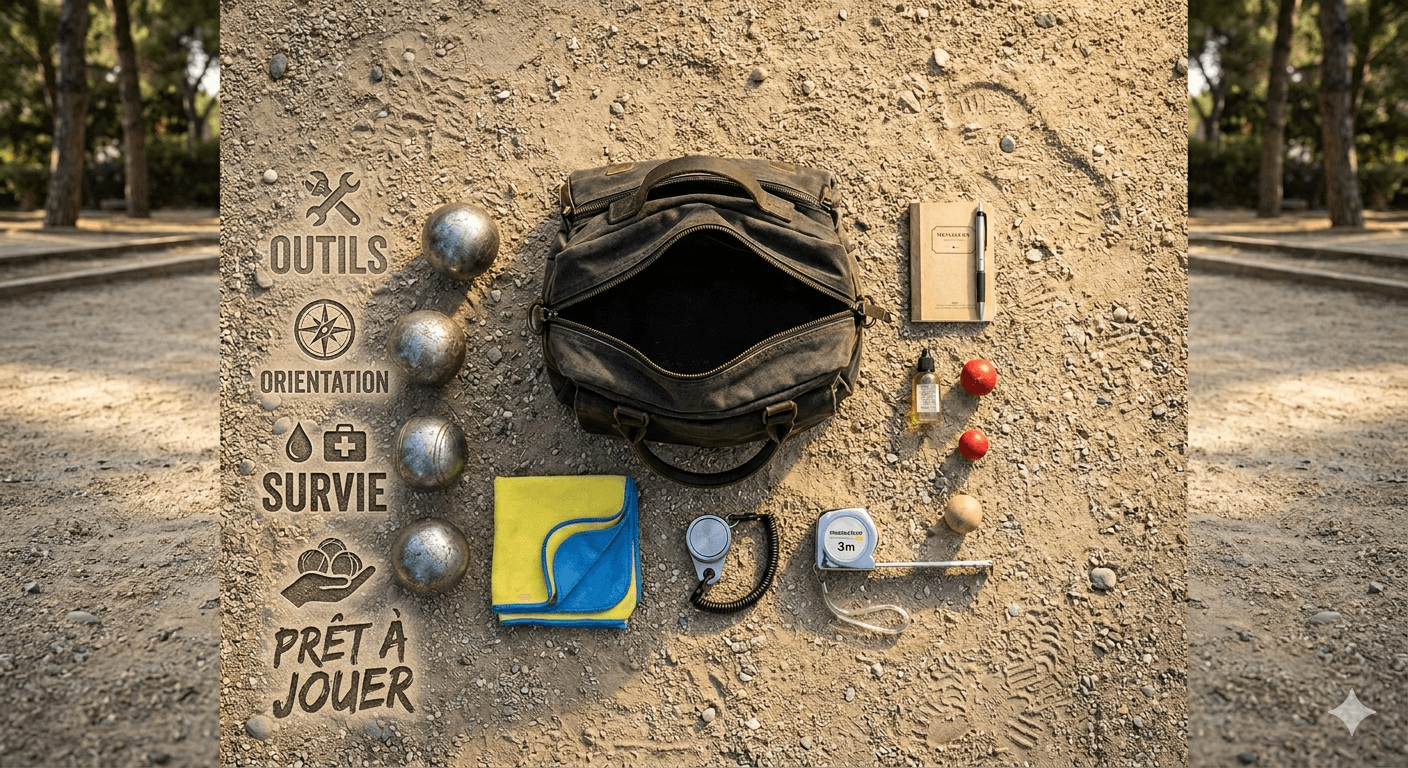
The complete bag — visual summary
🎒 IDEAL CONTENTS OF A PÉTANQUE BAG 🔴 ESSENTIALS — ALWAYS 📏 Flexible tape measure (2–3m) 🧻 Microfiber cloth ×2 🟡 Approved jacks ×2 🧲 Pickup magnet or hook ✒️ Permanent marker for metal 🟡 HIGHLY RECOMMENDED 🧴 Protective oil for boules (50ml) 📓 Scorebook + pencil 🩹 Mini first-aid kit 🧴 Sunscreen SPF30+ (50ml) 🖌️ Boule brush (stiff bristles) 💧 Insulated water bottle (500ml) 🔵 DEPENDING ON SEASON/PROFILE 🔦 Mini LED flashlight (evenings) 🧤 Playing gloves (winter) 🧊 Hand warmer (winter) 🧂 Electrolytes (summer) 📸 Mini smartphone tripod 🏷️ Identification stickers ⚖️ The 200-gram ruleThe entire "Essentials" + "Highly recommended" column weighs less than 200 grams. That's half a boule. There's no practical reason not to keep this kit in your permanent bag — once assembled, it stays in place and gets topped up over the course of tournaments. The only rule: check before each tournament that the tape measure is there, that the jacks are there, and that the cloth isn't too saturated.
Where to find these accessories
ACCESSORY SOURCES BUYING TIP 📏 Tape measure Specialized pétanque retailers (Obut, MS), big-box sports stores, hardware stores Avoid rigid or overly long tape measures — a 2m flexible one is enough and weighs less. 🧻 Cloth Supermarkets (optical aisle), office supplies, opticians (often free) Microfiber is superior to cotton for absorption and quick drying. 🟡 Jacks Pétanque retailers, FFPJP shop, sports stores Buy FFPJP approved only. Plastic or toy jacks are invalid in tournaments. 🧲 Pickup magnet Specialized pétanque retailers, Amazon, pétanque clubs (direct sales) Test the magnet strength before buying — some cheap models can't lift heavy boules. 🧴 Boule oil Pétanque retailers (specific products), pharmacy (paraffin oil), hardware store Theparaffin oil sold in pharmacies (as a laxative) is perfectly suitable and cheaper than "pétanque" products. ✒️ Metal marker Posca or Molotow (stationery stores), fine art supplies, big-box stores The white or gold Posca markers are the most visible on dark steel. Avoid standard markers that fade quickly.Gadgets to avoid — pétanque marketing
The pétanque accessories market is full of products that look useful in the store and end up at the bottom of a drawer after two uses. Here are the most common ones with their verdict.
⚫ The pétanque laser measuring device A device that measures distance with a laser. Seemingly accurate — but in practice, boules are not perfectly flat surfaces, the laser reflects off the steel imprecisely, and no official rules recognise a laser as a valid means of measurement in a dispute. The tape measure remains the only recognised measuring tool. Cost: €30–80 for a gadget with no regulatory validity. ⚫ The "premium" magnetic belt boule holder Magnetic holders that attach the boules to your belt during play. Convenient in theory — in reality, the boules knock against your hips with every movement, the magnets eventually stop holding the heavy boules securely, and the whole thing ends up damaging your clothes. A simple handheld boule bag remains more practical and reliable. ⚫ The LED pointing target Illuminated targets placed where the jack would be to practise pointing. An appealing idea for indoor training — but a boule thrown at an LED target breaks it after 3 impacts. Useless in competition. A regulation €1 jack is 100x more functional. ⚫ The electronic terrain "slope detector" A precision electronic spirit level "specially designed for pétanque". A boule released from a standstill gives you the same information for free, with no battery and no screen to read in the sun. The price (€15–30) is not justified by any added value over a free method. ⚫ "Non-stick" spray for boules Sprays that are supposed to reduce soil build-up in the grooves. A small damp brush does the same thing for €0. Furthermore, some of these sprays technically alter the surface of the boule — which could theoretically be deemed an unauthorised modification in an official competition. 🎙️ Paquita on gadgets "Every year, new pétanque accessories appear with impressive marketing claims. I've bought many of them. What is still in my bag after 20 years: the tape measure, cloth, jacks, magnet and marker pen. Everything else ended up in a drawer. Pétanque is a simple sport — its accessory bag should be simple too. Be wary of anything that costs more than €20 and isn't a boule." — Paquita 📖 PAQUITA'S BOOK The complete player — equipment, technique and tacticsChoosing your equipment, maintaining your boules, preparing your bag, mastering your throw... Paquita's book covers every dimension with 100 numbered exercises and level-based programs.
📦 Order on AmazonFAQ — Your frequent questions
What is the regulatory length of meter to measure in an official competition? + The FIPJP regulation does not impose a specific length of meter — it requires that the measurement be carried out precisely. In practice, a meter of 1.5 to 3 meters is sufficient for 99% of petanque measurements (the opposing boules are rarely more than 2 meters away from the jack during disputes). Some clubs and referees use 5 meter meters for complex setups or jack and boundary disputes. The main thing: the meter must be flexible (to pass between the balls), graduated in millimeters, and allow precise reading. Can we use a smartphone to measure instead of the meter? + AR (Augmented Reality) measurement applications on smartphones give approximate measurements — with an accuracy of 5 to 10 mm in the best case. For a common measurement this is insufficient (disputes often come down to the millimeter) and no official regulations recognize smartphone measurement as a valid means of measurement in the event of a dispute. In the absence of a tape measure, smartphone measurement can serve as a first-level guide to see if the measurement is clearly to one side's advantage — but when in doubt, only the physical tape measure is used. How much does it cost to assemble the complete kit of 5 essentials? + Indicative budget for the 5 essentials: pétanque meter (3–8€), microfiber cloth ×2 (1–3€ or free at an optician), approved jacks ×2 (2–5€), collection magnet (3–6€), indelible metal marker (2–4€). Total: between €11 and €26 for the whole. By adding the 6 strongly recommended, the complete kit comes to €30–60 depending on the brand choice. Paraffin oil in pharmacies (600ml, €3) and the scorebook (€1–2) keep the cost very low. It’s a one-time investment that lasts for years. What size and type of bag is recommended for carrying balls and accessories? + The ideal pétanque bag contains the 3 boules (main compartment) + an exterior or side pocket for accessories. Common formats: soft leather 3-ball bag (classic, good durability, €20–40), specific pétanque backpack for players traveling by public transport (€30–60), or simply an ordinary sports bag with an interior net to separate the balls from the accessories. Avoid rigid plastic bags without cushioning - the balls clatter together and can be damaged on the edges. A bag with separation between the balls (three individual compartments) is ideal for protecting the streaks. 📎 Related articles Equipment Choosing your boules — complete guide 2026 Equipment Checking the FFPJP approval of your boules Rules Complete FFPJP rulebook 2026 Rules The one-minute rule Equipment Rigid circle — mandatory in 2026 tournaments? Tools Free PetanqueLand tools© Pétanque by Paquita — petanqueland.fr ·
📖 Paquita's book on Amazon
The prices mentioned are indicative and likely to vary depending on retailers and periods. This article contains no sponsored links — the recommendations are based on field experience.