News · 27 April 2026
The perfect boule release: the invisible detail that changes everything
NewsThe release lasts less than 0.1 seconds. Yet itThe physics of the release — the 80 milliseconds that decide everything
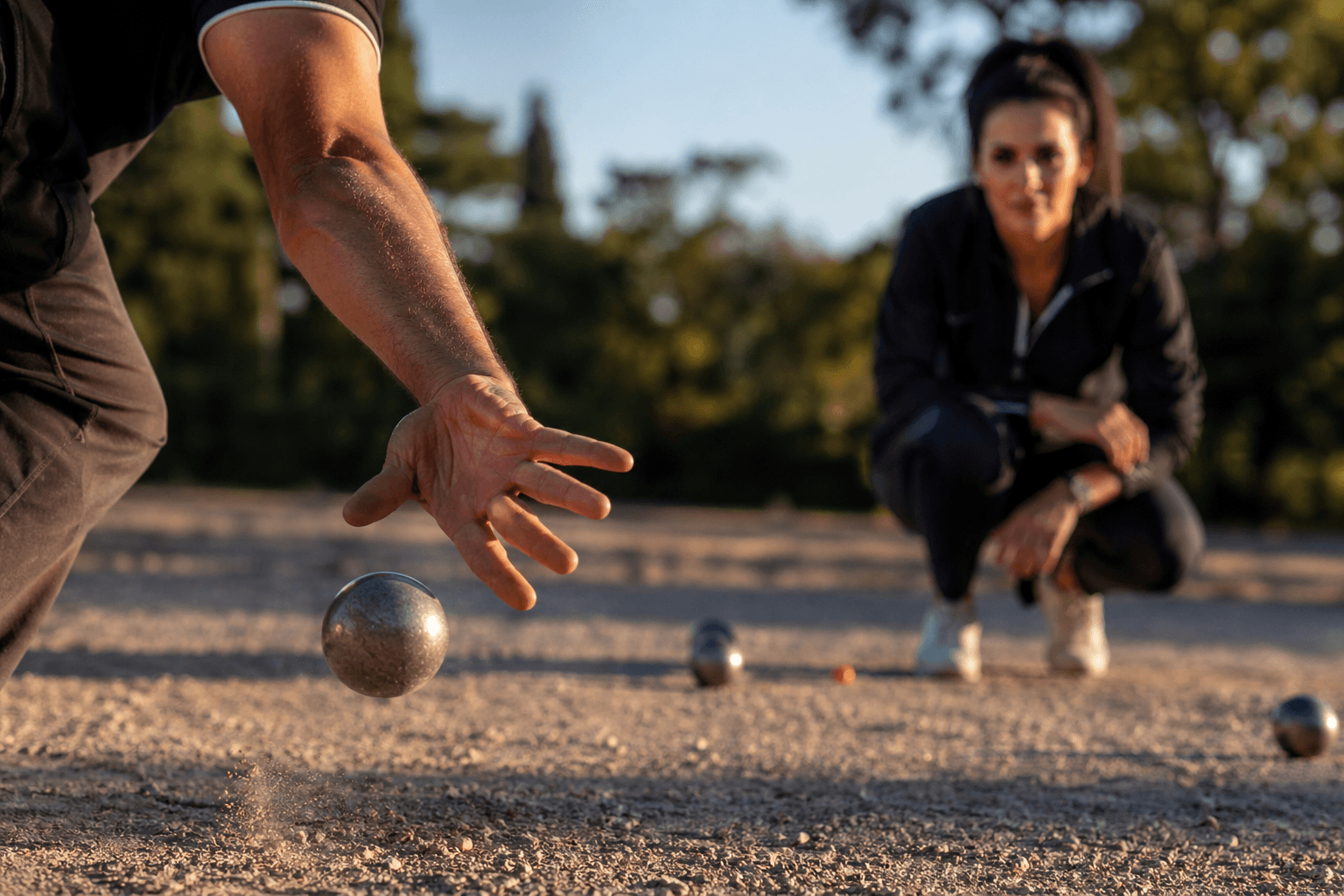
⚡ BIOMECHANICS What happens during the release The release is not simply "opening the hand". It is a dynamic transfer of all the energy and all the information of the action towards the bowl, via the friction between the fingers and the surface of the bowl.During the forward swing, the bowl is in contact with the fingers that guide it. When the hand begins to "let go" of the bowl, there is a fraction of a second during which the fingers still slide against the surface of the bowl as they leave their grip. It is this final sliding of the fingers that encodes the spin — the backspin, the topspin or the sidespin — into the rotation of the bowl.
The final direction of the bowl is determined by theexact axis in which the hand pushes the bowl at the moment of release — this axis may differ from the axis of the swing if the hand "turns" slightly at the last moment. This is a major and very discreet source of error.
The speed of the bowl at the release depends on the energy built up during the swing AND the precise timing of the release — a bowl released 0.05 seconds too late in the swing leaves the hand more slowly than a bowl released at the peak of the arm's acceleration. 🎙️ Paquita on the release "When I ask a player 'do you work on your release?', the answer is almost always 'uh… no, I work on my swing.' As if the release were automatically good as soon as the swing is good. That is not true. I have coached players with an impeccable swing and a release that systematically deviated by a few degrees — because their wrist turned slightly during the last few centimetres of the action. We corrected the release in two sessions. Their accuracy increased spectacularly — not the swing, just the release." — Paquita
The 4 variables of the perfect release
① Timing The precise moment in the forward swing at which the bowl leaves the fingers. Too early = short or too low a bowl. Too late = long or too high a bowl. Precision required: a window of ±0.03 seconds. → Determines the speed and the launch angle ② Finger speed How quickly the fingers release their pressure on the bowl. A slow release creates friction and encodes a spin. A fast (neutral) release transmits little spin. A conscious or unconscious variable. → Determines the spin (backspin, topspin, neutral) ③ Release axis The exact orientation of the hand at the moment of release — straight, slightly turned inwards, outwards. Even 3° of rotation generates a measurable deviation at distance. The main source of unexplained lateral deviation. → Determines the final direction of the bowl ④ Position of the fingers on release Do the index and middle fingers open symmetrically? A finger that leaves the bowl before the others creates an asymmetric friction point that deflects the bowl. The symmetry of the fingers' release is invisible but decisive. → Determines the symmetry of the spin transmittedThe release window — too early, just right, too late
⏱️ THE RELEASE WINDOW — POSITION OF THE HAND AT THE MOMENT OF RELEASE TOO EARLYHand still lowbefore the peak of the swing OPTIMALHand level with
the hip TOO LATEHand already high
after the peak Release too early — The bowl leaves too low, with less energy than it would have had if the arm had finished its acceleration. Result: short bowl, lower trajectory than expected, lack of distance. Common among players who "hold back" their bowl or who are afraid of releasing.
Release at the right moment — The hand is level with the hip, at the end of the forward swing, at the point of maximum arm speed. The kinetic energy is at its maximum. The direction of the arm corresponds exactly to the aimed axis. This is the optimal window.
Release too late — The arm has passed its peak of acceleration. The bowl "exits" the swing following too high a trajectory, with too steep an angle. Result: long bowl on a smooth terrain, or too bouncy. The bowl may also pick up an involuntary topspin if the fingers slide downwards during this late release. 🎯
The simplest way to correct the timing: visualise the bowl "leaving" the hand at the moment the hand is in the exact axis of the target — that is, when the arm forms a straight line between the shoulder and the target. This is also the moment of maximum arm speed. This mental image "aligned axis = release" is more effective than cues like "hip height" which vary according to body shapes.
The spins depending on how you release
The rotation of the bowl after the release depends on how the fingers slide over the surface during the release. These rotations — called "spins" — deeply influence the behaviour of the bowl after landing.
↩️ BACKSPIN Backward rotation (reverse topspin). The fingers close slightly as they leave the bowl, as if lightly "pulling" towards yourself at the moment of release. Backspin slows the bowl after landing — it stops much shorter than its initial speed would suggest. This is the spin of a well-executed lobbed point. Lobbed point and half-lob — the ideal spin ➡️ NEUTRAL Little or no rotation transmitted. The fingers separate cleanly from the bowl, without significant friction in either direction. The bowl rolls "naturally" according to its arrival speed and the terrain's friction. This is the spin suited to the rolling point — where natural rolling is wanted. Rolling point on a smooth terrain — the default spin ↪️ TOPSPIN Forward rotation. The fingers "push" lightly over the top of the bowl at the moment of release. Topspin accelerates the bowl after landing — it rolls further than expected. Hard to control, often involuntary. It can be used deliberately to make a bowl "run" on a long downward slope. Rarely wanted — often a sign of a release that is too late ↗️ SIDESPIN Rotation on the vertical axis — the bowl deflects sideways during its roll, like a bowling ball with spin. In pétanque, sidespin is almost always involuntary — it results from a twisted release axis or an asymmetry of the fingers at the release. The bowl arrives in a straight line then curves slightly at the end of its trajectory. Almost always involuntary — a sign of a deflected release axisThe influence of the grip on the release
The way you hold the bowl before and during the release directly determines which spin can be transmitted and with what precision. Three main grips coexist — each with its advantages at the release.
🖐️ PALM UPThe bowl rests in the palm, fingers on top. The standard pointer's grip. Naturally promotes backspin at the release — the fingers naturally "close" downwards as they leave the bowl.
→ Natural backspin, good for the lobbed point 🤌 FRONT PINCERBowl held by the fingers in front, palm little involved. The shooter's grip. Allows a more direct transmission of energy with less spin — good for shooting the iron, which requires a fast and direct release.
→ Neutral or light spin, good for shooting the iron 🤙 SIDE THUMBThumb on the side of the bowl, index and middle finger on top. A variant that offers more lateral control of the release — reduces the risk of involuntary sidespin. Used by some players with deviation problems.
→ Improved lateral control, less risk of a curve 👊 INTENTIONAL TOPSPINBowl held with the fingers underneath, "reverse spoon". A specialised grip for creating topspin — the bowl rolls far after landing. Rare, used for advanced very-long rolling techniques.
→ Strong topspin, very long roll — advanced technique 🔬 Test your release spin — an observation exerciseOn hard terrain (concrete or synthetic), throw 5 bowls as a lobbed point towards a clear area. Observe the behaviour of the bowl after landing: if it stops short after the bounce → you have natural backspin, an excellent sign. If it keeps rolling for a long time → neutral or topspin, to be corrected for the lobbed point. If it curves slightly to the left or right → you have an involuntary sidespin, the release-axis variable needs work.
The 6 most common release errors
1 ⏰ Premature release — the bowl leaves before the end of the swing SHOOTING & POINTINGThe player releases the bowl too early in the forward swing — often through anticipating the result or a slight tensing of the fingers. The bowl does not benefit from the arm's maximum energy and leaves with less force than intended.
SYMPTOMS Bowls systematically short despite an impression of "throwing well". The distance varies more than expected from one bowl to the next. Shots lack power at distances usually comfortable. CORRECTION Mentally anchor the release to a geographical point of the swing — "the bowl leaves my hand when my arm is parallel to the ground", for example. The release-against-a-wall exercise (see exercises) helps calibrate the precise timing. 2 🔄 Wrist rotation at the release — the axis that deflects imperceptibly SHOOTING & POINTINGDuring the last few centimetres of the forward swing, the wrist turns slightly — inwards (pronation) or outwards (supination). This movement is often completely unconscious. It alters the release axis by 3 to 8° and creates a reproducible lateral deviation.
SYMPTOMS Systematic lateral deviation always in the same direction (always to the left, or always to the right), regardless of distance. The deviation is proportional to the distance — at 5m it is almost invisible, at 9m it is clearly visible. Correcting the swing changes nothing. CORRECTION Film the release from the front (camera placed on the ground in the axis of the throw). Look at the orientation of the palm at the exact moment of release. The palm must be oriented towards the target, not turned. Exercise: hold a pencil in the hand and practise throwing it straight ahead — the pencil's trajectory reveals the release axis exactly. 3 🤏 Tensing of the fingers at the last moment — the grip that holds back SHOOTING & POINTINGJust before the release, the fingers tense slightly — a micro-hesitation in the release. This tensing can encode an involuntary topspin (the fingers push on the surface of the bowl as they open in an uncontrolled way) or alter the timing of the release.
SYMPTOMS Bowls that "roll too much" after landing even on a lobbed point. Inconsistency of the distance from one bowl to the next. A physical sensation of "holding back" in the hand during the throw. Often appears under pressure (fear of missing, decisive shot). CORRECTION Work on a progressive release — practise throwing very slowly over a surface, letting the bowl "slip" out of the hand without ever holding it back. The correct sensation is that of a bowl that "leaves on its own" rather than one that you "send". 4 ☝️ Index finger leaving the bowl before the other fingers POINTING ESPECIALLYThe index finger opens faster than the middle finger at the moment of release. The bowl does not leave the hand symmetrically — it pivots slightly on the asymmetric friction created by the middle finger holding on longer. This pivot encodes a sidespin or alters the direction of the bowl.
SYMPTOMS Slight sidespin visible at distance. Slightly variable deviation depending on the throws (not always in the same direction, but a tendency). The bowl seems to leave slightly "at an angle". Filming in slow motion reveals the asymmetry of the fingers. CORRECTION Symmetry exercise: throw 20 bowls focusing exclusively on the sensation that the index and middle fingers leave the bowl at exactly the same moment. At first, deliberately slow the release to feel the synchronisation. With repetition, the symmetry becomes automatic. 5 👀 Looking at the bowl instead of the target at the moment of release SHOOTING & POINTINGDuring the final swing, the gaze falls on the bowl in hand rather than on the target. This shift of gaze causes a slight rotation of the head — and since the head guides the shoulders, a micro-rotation of the throwing axis. The bowl follows the direction of the head rather than the direction of the target.
SYMPTOMS Variable deviation from throw to throw — sometimes on target, sometimes off — with no clear pattern. The player does not understand why identical throws give different results. The problem worsens on difficult shots (more attention on the bowl to "hold it well"). CORRECTION Golden rule: the gaze leaves the bowl to settle on the target as soon as the backswing begins. Throughout the forward swing and up to the release, the gaze is fixed on the target — never on the bowl. The bowl is released "blind" from the hand, guided only by the proprioceptive sensation. 6 🎭 A release that changes under pressure — the stress action SHOOTING & POINTINGThe release is a fine action. Under pressure (decisive tournament, watched shot, high stakes), muscle tension increases in the hand and forearms. This tension alters the speed of the fingers' release, the timing of the release and sometimes the release axis. The "pressure" release is different from the training release.
SYMPTOMS Shots that work in training and fail in tournaments, with no apparent technical reason. A sensation of "squeezing" the bowl until the last moment in a stress situation. Inconsistency of results in tournaments versus training. CORRECTION Work deliberately under artificial pressure in training — create stakes (a run of points, symbolic bets). The goal is to make the release robust to stress. Associate a hand-relaxation routine before each throw: open and close the hand twice before picking up the bowl to "chase out" the tension.Method for anchoring the release in muscle memory
🧠 ANCHORING METHOD — 5 STEPS Isolate the release from the rest of the action — First work on the release alone, with no real distance. Stand up, bowl in hand in the release position, and practise opening the hand while observing how the bowl falls. Feel the symmetry of the fingers, the absence of wrist rotation, the neutrality of the axis. This work without a swing lets you concentrate solely on the mechanics of the release. Throw at very short distance with explicit intent — From the circle, throw only 2–3 metres, very slowly. The goal is not accuracy at this distance but to feel each parameter of the release in slow motion. Observe the spin on the bowl — does it roll straight? Does it stop quickly (backspin) or keep rolling (neutral/topspin)? This direct observation anchors the link between the action and its spin. Gradually increase the distance — Move to 4m, then 6m, then 8m over 10 throws at each step. At each distance, keep the same release intent. Observe whether errors emerge with distance (often from 6m, timing and axis errors become visible). Identify at which distance the release degrades in order to target the work. Train the release under variations of conditions — Work by deliberately varying the conditions: wind, position, different bowls, fatigue. A release anchored in muscle memory must be robust to external variations. If the release degrades when the conditions change, it is not yet deeply anchored. Create a sensory anchor — Identify the physical sensation of a perfectly executed release — the lightness in the hand at the moment of release, the symmetry of the fingers, the absence of tension. Memorise this sensation. Before each throw in a tournament, mentally recover this sensation in the hand before throwing. This is the proprioceptive anchor — more reliable than visual cues.Exercises to work on the release in isolation
01 The release against a wall 📍 Anywhere ⏱️ 10 min ⚡ Calibrate the timing and the axisA pure timing exercise — no terrain, no real distance. Lets you completely isolate the release from the swing.
Stand 1 metre from a wall. Hold the bowl in a normal grip. Perform a normal forward swing, letting the bowl go towards the bottom of the wall (not thrown, just released at the usual release point). Observe where the bowl hits the wall: at the skirting board (release too early), halfway up the wall (correct release for a rolling point), near the ceiling (release too late). Calibrate the timing by adjusting the release point until you consistently get the same spot on the wall. Repeat 20 times seeking consistency of the contact point. Variant: put coloured tape on the wall at the target height and try to hit that tape on each throw. It measures the consistency of the timing. 02 The voluntary slow motion 📍 Training ⏱️ 15 min ⚡ Feel each variable of the releaseDeliberately throwing in slow motion lets you consciously feel each component of the release — which is not possible at normal speed.
Place a jack at 3 metres. Throw with an extremely slow swing — 3 to 4 times slower than normal. The goal is not accuracy but the sensory awareness of the release. At this reduced speed, observe: which finger leaves the bowl first? Does the wrist turn slightly? Do the fingers opening create forward friction (topspin) or backward friction (backspin)? After 10 slow throws, note the observations. Then make 10 throws at normal speed trying to reproduce the same sensations. The slow exercise "programmes" what the fast action must reproduce. Advanced variant: alternate a slow throw and a normal throw. The slow throw as a "model", the normal throw as an "execution". Compare the results. 📖 PAQUITA'S BOOK From the release to the jack — the complete techniqueRelease, swing, posture, grip, timing, spin... Paquita's book breaks down each component of the action with 100 numbered exercises to build a solid and reproducible technique.
📦 Order on AmazonFAQ — Your frequent questions
Should we “accompany” the ball with the hand after release, or stop suddenly? + Post-release “hand tracking” (the arm continuing its trajectory toward the target after the ball has gone) is an often-debated issue. The physical response: once the ball leaves the hand, the follow-through technically cannot influence the ball anymore. However, tracking has an indirect use: it prevents the player from stopping his action prematurely. A player who "anticipates the stop" of the arm tends to reduce the acceleration of the arm before release — which reduces the speed transmitted to the ball. The natural follow-up of the hand is therefore recommended, not because it influences the ball after the release, but because it ensures that the arm was still accelerating at the time of release. Do ridged vs smooth balls change release? + Yes, measurably. The ribbed balls offer more friction surface in contact with the fingers - which amplifies the effect transmitted when released. The same release with backspin will produce more backspin on a ribbed ball than on a smooth ball. For a player who usually plays with ridged balls and switches to smooth balls (or vice versa), the strength of the spin release must be consciously recalibrated. Smooth balls “slide” more easily through the fingers — they are less forgiving of spin transmission errors and require a “cleaner” release to avoid unintended spin. See our article on smooth vs ribbed balls. Does the release change in cold or wet conditions? + Yes — two distinct effects. In cold conditions, the hands become cold and the flexibility of the fingers reduces. The unfolding of the fingers upon release is less fluid, less symmetrical, and can create more friction on one side. Result: no more unintended effects. Keeping your hands warm between pockets (pockets, light gloves) helps. In wet conditions (sweaty hands), friction between fingers and ball is reduced — intentional effects are less transmitted. A habitual release of backspin may no longer produce backspin on a wet ball. Drying the ball thoroughly before each throw in wet conditions is non-negotiable. How do I know if my release is correct if I don't "feel" it problematic? + This is the main problem with letting go: errors are often imperceptible consciously because they have been part of the automated gesture for years. Two methods to evaluate it objectively. 1) Test the effect: on hard ground, throw 10 lifting points and observe the behavior after landing. If the balls all roll the same distance and stop quickly → release correct backspin. If behaviors vary a lot → inconsistent release. 2) Slow-motion video: film the release from the front and side with the slow-motion mode of a smartphone. Carefully look at the orientation of the palm at the time of release, the timing of the fingers, and whether the wrist is rotating. Both of these methods reveal problems that sensation alone does not detect. 📎 Related articles Equipment Choosing your bowls — smooth or grooved, weight and hardness Equipment Inox vs carbone — behaviour on impact Rules The one-minute rule Equipment Top 3 best shooter boules 2026 Video Why changing bowls does not change your level Tools Free PetanqueLand tools© Pétanque by Paquita — petanqueland.fr · 📖 Paquita's book on Amazon