News · 16 April 2026
The mid: Why is it the hardest position?
NewsPoint and shoot. Read the game and decide. Make up for the mistakes of the other two. The triplette mid concentrates all the demands of the game into a single role. Paquita dismantles why this position is the most demanding — and how to master it.Exact definition of the middle role
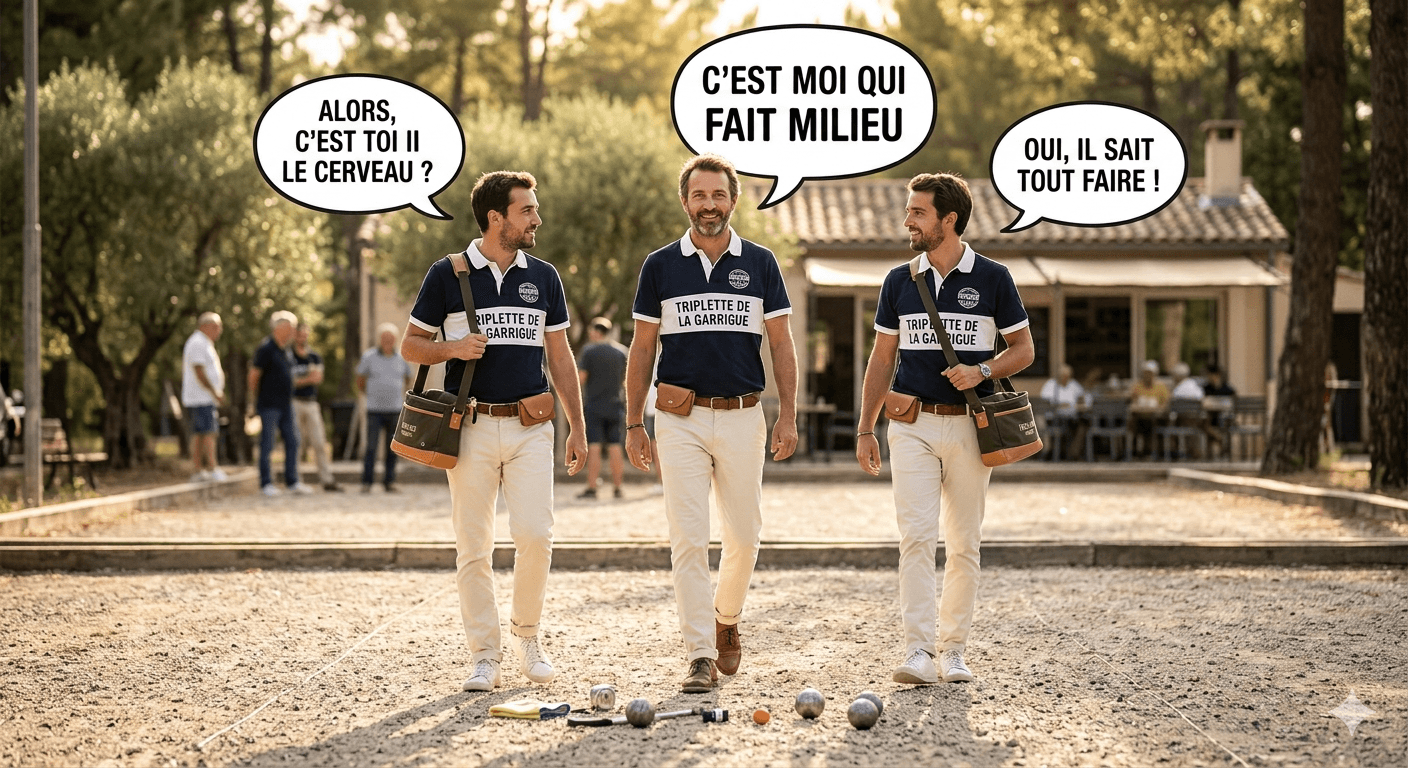
In a triplette, each player has two boules. The pointer plays first, the middle plays second, the shooter plays last. This position in the playing order is in itself a source of complexity: the middle always arrives after the first act — they inherit a situation the pointer created, favourable or unfavourable — and before the last resort, the shooter.
📋The rules don't define roles in a triplette — there's no obligation to play "pointer" or "shooter" in a strict sense. A captain can theoretically send any player on any boule. In practice, roles are defined by each player's skills and by team convention. The middle role is a tactical convention, not a regulatory requirement. Some teams don't have a middle in the strict sense — they have two "all-rounders" and a specialist shooter.
🎙️ Paquita on the middle "I've played every position in a triplette. The pointer is stressful because you start — no information on the situation. The shooter is stressful because you finish — the pressure is at its peak. But the middle is the hardest because it combines both. You need the pointer's finesse to save a compromised end, and the shooter's precision to clear out when the situation demands it. And on top of that you have to decide which of the two to do — in under a minute, while the captain is watching you, the score is tight and the pitch is tricky." — PaquitaWhat the three positions do — an honest comparison
Pointer Plays first — no game context Single role: point with precision Doesn't have to choose between pointing/shooting Their boule defines the context for the following ones Can focus on their technique alone Pressure: opening the end with a good point Maximum freedom — blank pitch MIDDLE ★ Plays after the pointer — inherits a situation Has to decide: point or shoot on every boule Has to master both techniques Compensates for the pointer's errors AND spares the shooter Real-time tactical reading of the game mandatory Pressure: not make it worse AND improve the situation The least freedom — the most constraints Shooter Plays last — most defined situation Main role: shoot, clear out, make the carreau Very rarely called on to point Technique often more specialised and more ingrained Fewer decisions to make — pure execution Pressure: last chance, game-winning boules Clearest context — fewer variables to factor inThe 7 specific demands on the middle
1 🎯 Mastery of pointingThe middle has to be able to point at a level usable in competition — not at a specialist's level, but enough to place a useful boule when the end is in the team's favour and shooting isn't needed.
2 💥 Mastery of shootingSymmetrically, the middle has to shoot properly — a precise shot to clear the opposing leading boule when the pointer has left the opponent holding the head. It's not the specialist shooter's level, but it's operational.
3 🧠 Real-time game readingBefore each boule, the middle analyses the situation: who's holding? By how much? Are there dangerous opposing boules? Does the shooter still have boules? What's the score? This reading has to be fast, precise and lead to a decision.
4 ⚡ Decision-making under pressureThe one-minute rule imposes a decision within 60 seconds. The middle has to decide quickly without time for a long deliberation. An indecisive middle slows the team down and betrays their nervousness to the opponent.
5 🔄 Constant adaptabilitySituations change from one end to the next. A middle who points systematically because they prefer pointing is predictable. A true middle adapts their game to every configuration — even if it means shooting ten times in a row if the situation demands it.
6 🛡️ Compensating for errorsWhen the pointer misses, it's often the middle who has to compensate — by shooting the opposing leading boule so the shooter has a manageable situation. This "firefighter" role is thankless and little-seen — but it's often the middle who saves compromised ends.
7 🧘 Ego managementThe middle rarely plays the "glorious" role. They're neither the opener nor the finisher. Their value lies in consistency and quiet efficiency. A middle with an oversized ego wants to shoot spectacular carreaux where a simple point would have done — and compromises the end.
Real-time decision — point or shoot?
⚡ THE MIDDLE'S DECISION TREE Every boule, the same question in under 30 seconds The middle doesn't head to the circle with a preconceived idea. They head there with a method. Before every throw, they answer four questions in order — and the answer to each determines the next. 🔍 Is the team already holding with a solid boule? → YES → Point — consolidate the head NO → Next question ↓ 💥 Is there an opposing leading boule to clear? → YES → Shoot — free the pitch NO → Next question ↓ 🎳 Does the shooter still have boules available? → YES → Point — spare the shooter for what's coming NO → Next question ↓ 📊 Is the score tight or unfavourable? → YES → Shoot — take the calculated risk NO → Point — play it safe ⏱️ The middle's 20-second ruleAn effective middle makes their decision in 20 seconds — the remaining 40 seconds are for execution. If after 20 seconds of analysis the decision still isn't made, the situation is ambiguous — and in that case, the simple rule is to to point. A point costs less than a missed shot: a missed shot leaves the opposing boule in place AND loses one of the middle's boules. A missed point leaves the situation unchanged. In doubt, pointing is almost always the less risky decision.
The middle's 5 typical situations
✅ Situation 1 — The pointer opened well: consolidate POINTThe pointer placed a boule 10 cm from the jack. The opponent has nothing to answer with for now. The middle receives a favourable situation — their mission is to consolidate, not to take risks.
MIDDLE'S ACTION Point a second boule close to the jack to create a "wall" that's hard to dislodge. Don't shoot — no opposing target justifies risking a boule. Two boules close to the jack force the opponent to shoot twice to free the pitch. This is end-building, not improvisation. ⚠️ Situation 2 — The pointer missed: the middle saves the end DECIDEThe pointer left an opposing boule 8 cm from the jack with no boule in favour. The opponent holds the head. This is the most demanding situation — the middle has to either shoot the opposing boule or place a point in front of it, with the pressure of an unfavourable situation to correct.
KEY QUESTION Two sub-questions: 1) Can the middle shoot this boule with a 60–70% success rate? If yes and the opposing boule is really holding → shoot. 2) Is a point in front of the opposing boule enough to beat it? If yes → point. The rule: don't shoot if the probability of success is below 50% — failure would leave the situation worse than before. 🎳 Situation 3 — The pitch is cluttered: play with finesse POINT WITH FINESSESeveral boules from both teams are close to the jack. The pitch is dense. A shot risks displacing favourable boules. A point demands precision to slot into a tight space. This is the situation that rewards the middle's technique — not power, finesse.
MIDDLE'S ACTION Choose the exact landing spot that lets the boule slot into the available space, using nearby boules as "rails" if possible. A point in a cluttered pitch is often worth more than a risky shot that displaces everything in an unpredictable direction. ⚡ Situation 4 — It all comes down to the last boules: manage the shooter TEAM STRATEGYThe middle is playing their last boule, the shooter still has two. The situation is unfavourable: the opponent leads by one point. The middle has to play for the shooter — not for themself. Their role is no longer to win the end but to create the best possible situation for the shooter to win it.
COLLECTIVE REASONING If the shooter is excellent at the carreau → point so the opposing boule can be cleared and the jack is visible. If the shooter is better pointing in front → point to create a favourable angle of approach. The middle "prepares the pitch" for the shooter — it's a collective mindset that few beginner middles have. 🧊 Situation 5 — We're well ahead: manage the end without risk SAFETYThe score is 10–4, the team is well ahead. The pointer placed a decent boule. The temptation for the middle: try a spectacular shot. The right decision: point a second boule and close out the end without risk.
SCORE PSYCHOLOGY Ends lost while well ahead are the most psychologically destabilising. A middle who takes an unnecessary risk at 10–4 and loses the end hands 2 or 3 points to the opponent and restarts a momentum they didn't have. Safety from a favourable position isn't timidity — it's mastery.Communication with the team
🗣️ TYPICAL MIDDLE / CAPTAIN DIALOGUE CAPTAIN "Do you see the situation? Their boule is at 8 cm, ours at 12. Do you want to point or shoot?" MIDDLE "I'm shooting. Their boule is well exposed and if I miss, we've still got the shooter with two boules. But I need to know if we're ready to lose this end if I miss." CAPTAIN "We're at 7–5, we can afford to lose a point. Go for the shot." MIDDLE "OK. If I miss, the shooter points on the left of the jack — there's still space."This dialogue illustrates what characterises a mature middle: they share their analysis and intention with the captain before acting, they assess the consequences of a failure, and they already prepare the next boule if theirs fails. The middle doesn't play solo — they play in consultation with the team, especially on risky boules.
🗣️One communication rule: the middle doesn't ask permission to point — they ask for the opinion on risky shots. Pointing is their autonomous decision; shooting in a complex situation gets discussed in 10 seconds with the captain. This distinction simplifies exchanges and clarifies responsibilities.
The profile of a good middle
✓ QUALITIES OF A SOLID MIDDLE ✓Able to point at 65–70% at 7 metres in competition ✓Able to shoot with 55–65% success under pressure ✓Decides in under 20–25 seconds in most situations ✓Prioritises the collective situation over personal preference ✓Knows when to spare the shooter and when to shoot themself ✓Communicates their analysis before risky decisions ✓Maintains their level of play over 7–8 consecutive games ✓Accepts playing without being the visible "hero" of the end ✗ COMMON MIDDLE FLAWS ✗Always pointing or always shooting out of habit — lack of adaptability ✗Hesitating at length and stressing the team with their indecision ✗Attempting needless spectacular shots in favourable situations ✗Playing their boule before the captain has communicated their reading ✗Blaming the pointer after a lost end — it breaks the team dynamic ✗Stopping working on pointing because they "shoot better" ✗Misjudging the weight on a point when they're mainly trained as a shooter ✗Thinking they can replace the shooter in every critical situationProgramme to develop your middle game
WEEKS 1–2 Phase 1 — Honest inventory of both techniques Objectively assess your success rate in pointing and shooting over 20 boules at 7 metres. Count separately : how many points within a 20 cm radius / how many successful shots (opposing boule dislodged). These two percentages are the basis of your middle profile — they determine which decision is reasonable depending on the situation. Goal: know your two baseline percentages WEEKS 3–4 Phase 2 — Train the weaker technique The middle inevitably has one stronger technique than the other (for most players). Devote 80% of training time to the weaker technique. If you're a better pointer — work on shooting. If you're a better shooter — work on pointing. The goal isn't perfect equality but for both techniques to be "usable in competition without excessive risk". Goal: 55%+ in both techniques WEEKS 5–6 Phase 3 — Train the decision Specific drill: play training games playing only the middle role — ask someone else to point before you and shoot after you. Force a real decision on every boule. Verbalize the decision out loud before executing. Ask your partner for feedback on the consistency of your decisions. Goal: verbalized and justified decision on 80% of boules WK.7–8 Phase 4 — Competitions under real pressure Play at least 3 official competitions as the designated middle. Observe after each game: which decisions were good? Which were bad in retrospect? Post-end review is the middle's only improvement tool — without concrete feedback, bad decision-making habits set in. Goal: review 3 decisions per game 📖 PAQUITA'S BOOK Complete tactics — read the game, decide, executeTriplette roles, game reading, score management, pointing and shooting technique... Paquita's book gives the complete toolkit to become an effective middle — 100 numbered exercises, programmes by level.
📦 Order on AmazonFAQ — Your frequent questions
In doubles, is there an equivalent to the midfield position? + In doublet (two players of three balls each), the roles are less fixed than in triplet. Each player may find themselves in situations where they must alternately point and shoot depending on the setup. The player who plays second in the end finds himself in a similar position in the middle of triples — he inherits a situation and must decide. Most doubles teams have a "lead dominant player" (who scores the most) and a "finisher" — but both must master both techniques to a decent level. Should the team captain be the middle? + This is often the case in practice — and there is a logic to it. The midfielder being the player with the most complete tactical reading of the game, he is naturally in a position to be captain. But it is not an obligation. Some teams have their shooter as captain (vision of "final cleaning" of the end) or their pointer (vision of the opening). The bottom line is that the captain is the player who has the best overall read of the game — and whether that player is the pointer or shooter, he should be the captain. How can we manage frustration when the shooter “takes” the decision we had made as a midfielder? + This is a classic team tension situation. The shooter sees the opposing ball and wants to shoot — while the middle had decided to point. The resolution: establish clear rules before the competition on “who shoots when”. A simple rule: if the middle has decided to score, the shooter respects this decision and saves his balls for later. If the midfielder has decided to shoot, he executes it and the shooter waits. Discussions during the team cost time and mental energy — team rules defined beforehand partly avoid these conflicts. Can you be an effective midfielder if you are clearly better in one technique than the other? + Yes, as long as you are honest about your limits and adapt your decisions accordingly. A midfielder who is an excellent pointer and average shooter will tend to point a lot and shoot only when the situation is very favorable for his shot. A strong shooting midfielder and average pointer will do the opposite. The problem arises when the midfielder refuses to use his weak technique even in situations where it is the right decision — out of ego or habit. Honesty about one's abilities and adapting decisions accordingly allows one to be useful even with an imbalance between the two techniques. Should the middle balls be different from those of the shooter and pointer? + It is recommended to adapt them to the hybrid role. The ideal medium plays with a ball of intermediate hardness and weight — neither the ball optimized for pure point (light semi-soft) nor the ball optimized for pure shot (extra-hard heavy). Semi-hard or hard at a median weight (690–710g) is often the good compromise. See our article on ball hardness and our weight selection guide for precise criteria. 📎 Related articles Equipment Choosing your boules — a compromise for the middle Equipment Top 3 best shooter boules 2026 Rules The one-minute rule — deciding within the allotted time Rules FFPJP rules — roles in a triplette Tournaments Official 2026 tournament calendar Tools Free PetanqueLand tools© Pétanque by Paquita — petanqueland.fr · 📖 Paquita's book on Amazon