Actualités · 6 June 2026
Body positioning that influences the trajectory
In pétanque, the boule's trajectory starts in the body beforeThe bodily chain of the throw — from the ground to the boule
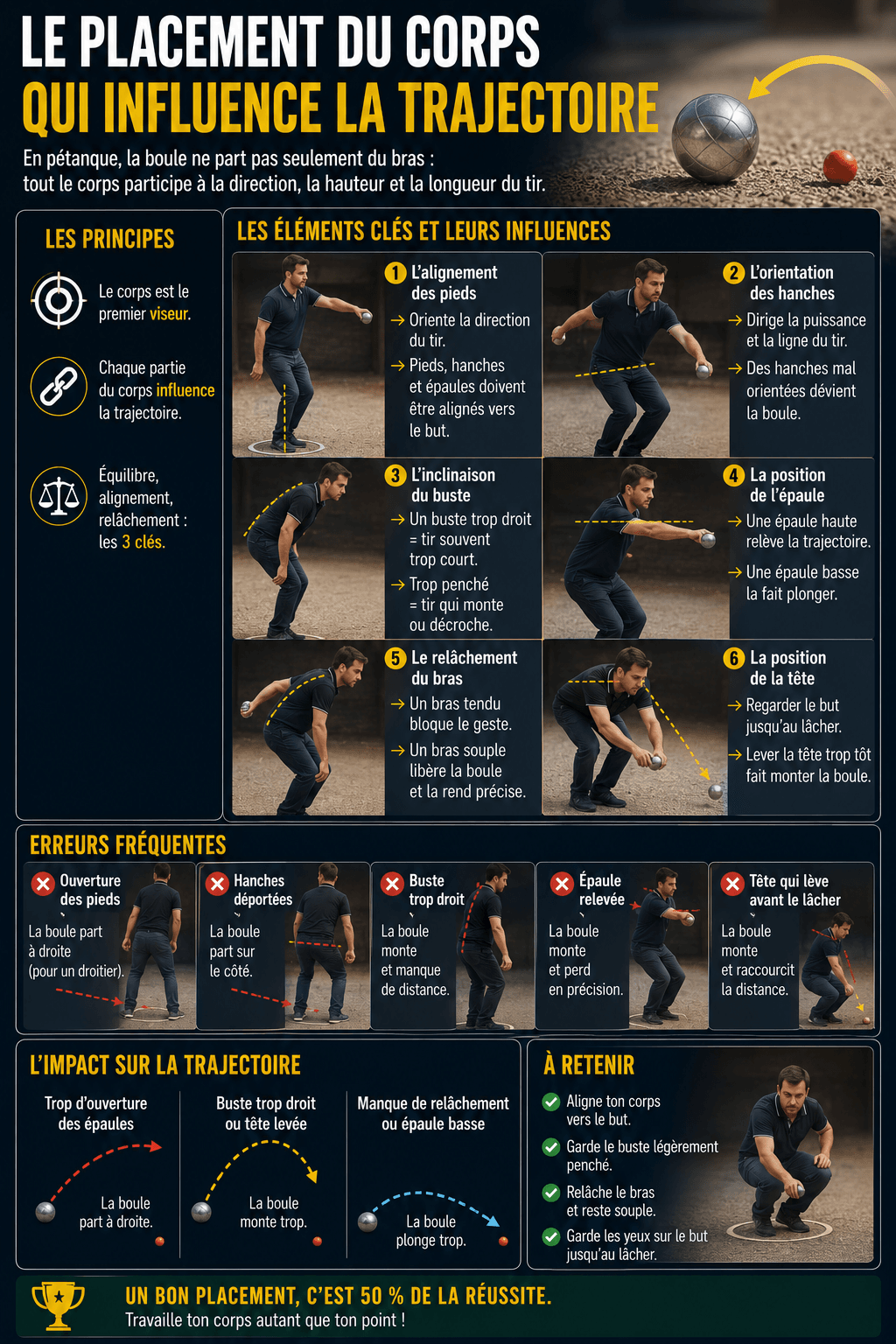
🧍 THE KINETIC CHAIN OF THE THROW — FROM FOUNDATION TO EXECUTION 🦶 FEET Foundation of the whole gesture. The orientation of the feet defines the base direction axis. A misoriented foot deviates the whole structure above. FOUNDATION 🦵 KNEES Transmit the stability or instability from the feet to the pelvis. Locked knees = rigid transmission of any imbalance. Slightly bent = cushioning. TRANSMISSION ⚙️ HIPS The axis of the hips determines the orientation of the pelvis, which orients the spine, which orients the throwing shoulder. One hip higher than the other tilts the pendulum axis. ORIENTATION 🧍 TORSO The tilt of the torso (forward/backward, left/right) changes the height of the throwing shoulder and therefore the starting height of the pendulum — with direct impact on the vertical trajectory. TILT 💪 SHOULDERS The axis of the shoulders is the main directing axis of the pendulum. The throwing shoulder must be in exact alignment with the target for the pendulum to sweep in the right plane. AXIAL 👁️ HEAD The position of the head influences the perception of the target and the signal the brain sends to the arm to calibrate the throw. Turned head = skewed perception of the axis. PERCEPTION 🎙️ PAQUITA ON THE BODY AND THE TRAJECTORY "I see a lot of players looking for their error in the hand or the wrist, for years, without ever finding it there. Because the problem isn't the hand — it's the shoulders that are crooked, or the feet pointing in the wrong direction. The boule does what the body asks of it. If the body says 'go left', the boule goes left — no matter how you position your wrist. Align the body first, always." — PaquitaThe 6 bodily parameters that influence the trajectory
🦶 1. The orientation of the feet — the compass of the throw FEET DIRECTION HOW THE FEET DEFINE THE DIRECTION The orientation of the supporting foot is the first determinant of the throw's direction — because the foot orients the knee, which orients the hip, which orients the shoulder, which defines the pendulum axis. A supporting foot pointing toward the jack automatically places the whole body in alignment with the target. A supporting foot deviated 5 degrees outward rotates the entire body structure 5 degrees off axis — producing a deviation of 40 to 60 cm over 8 meters, without the arm gesture having changed. → How to check: before entering the circle, explicitly look at the supporting foot and make sure it points directly at the target. This 2-second visual check is one of the most worthwhile corrections in pétanque. COMMON DRIFTS AND THEIR EFFECTS Foot turned outward (duck-footed): the boule deviates to the opposite side — slightly to the right for a right-hander with the right foot open. Foot turned inward: inward deviation. Supporting foot poorly positioned: creates lateral instability during the throw that results in a variation of direction with each boule. The drift of the feet sets in gradually under fatigue or distraction — without the player perceiving it, since he generally doesn't look at his feet during the throw. → Typical effect: boules that always deviate to the same side, over several consecutive ends, without the gesture having consciously changed. A diagnostic signal of a foot problem. → Fundamental rule: if the boules always deviate in the same direction over several ends, check the feet first — before looking in the arm, the wrist or the grip. That's where the error lies in 60 to 70% of cases of constant deviation. ⚙️ 2. The axis of the hips — the invisible orientation of the bodily chain HIPS BODY AXIS HOW THE HIPS INFLUENCE THE TRAJECTORY The pelvis is the central pivot of the kinetic chain — it receives the orientation of the feet and transmits it to the spine and the shoulders. A pelvis slightly rotated relative to the target axis changes the orientation of the whole structure above it. This rotation of the pelvis can come from a postural habit (one hip naturally more forward than the other), a muscular asymmetry, or a compensation for another poorly placed parameter. It is almost invisible from the outside but produces a constant deviation of the trajectory. → How to check: in the throwing position, place both hands on the hips and feel whether they are aligned perpendicular to the target. If one comes forward more than the other, the pelvis is rotated — correct it by pulling the forward hip back until aligned. THE ROTATION OF THE PELVIS DURING THE THROW Some players have a slight rotation of the pelvis during the throw itself — the pelvis turns forward at the end of the pendulum to "follow through" the boule. This rotation, if it is symmetrical and controlled, is neutral or slightly beneficial. If it is asymmetrical (stronger rotation on one side), it deviates the trajectory in the direction of the rotation. Becoming aware of this rotation during training allows you to identify and control it. → Remember: the hips are often the "forgotten" link of postural checking — you think feet, knees, shoulders, head — rarely hips. Yet a misaligned hip axis produces a deviation just as systematic as a misoriented foot. 💪 3. The axis of the shoulders — the directing plane of the pendulum SHOULDERS PENDULUM AXIS WHY THE SHOULDER AXIS IS CRITICAL The throwing shoulder is the pivot of the pendulum — it's from this point that the arm sweeps its arc. For the pendulum to sweep exactly along the target axis, the throwing shoulder must be in precise alignment with that target. If the shoulder is slightly outside or inside the alignment, the pendulum sweeps in a deviated plane — and the boule leaves in that deviated plane, regardless of the precision of the arm gesture itself. It's one of the most determining and least consciously worked parameters. → How to check: in the throwing position, check that the imaginary line passing through both shoulders is perpendicular to the target axis (not parallel). The throwing shoulder should be directly in the alignment of the target — neither too open, nor too closed. OPEN SHOULDER VS CLOSED SHOULDER Shoulder too open (throwing shoulder forward relative to the axis): the pendulum sweeps slightly inward — boule that deviates toward the center, or a shot that "pulls toward yourself". Shoulder too closed (throwing shoulder drawn back): the pendulum sweeps outward — boule that deviates outward. These deviations are subtle at short distances but amplify at long distances, where 1 degree of shoulder offset can produce 20 to 30 cm of deviation. → Video test: film yourself from the front during a throw. Observe whether the throwing shoulder is in exact alignment with the target or slightly offset. This offset, invisible to the player from his own viewing angle, is often the main cause of unexplained deviations. 🧍 4. The tilt of the torso — the effect on height and distance TORSO HEIGHT HOW THE TORSO INFLUENCES THE TRAJECTORY The tilt of the torso changes the height of the throwing shoulder relative to the ground — and therefore the vertical plane in which the pendulum sweeps. A torso tilted forward lowers the shoulder, which lowers the release point and produces boules that leave lower and further (or that dig into the ground prematurely). A torso tilted backward raises the shoulder, producing boules that leave too high or too short. The verticality of the torso is the condition for a trajectory calibrated to the desired height. → How to check: feel that the weight is centered (neither on the front of the feet, nor on the heels). If the weight is on the front, the torso has tipped — straighten up until you feel the weight on the central part of the foot. THE LATERAL TILT OF THE TORSO In addition to the forward/backward tilt, the torso can tilt laterally — one shoulder higher than the other. This vertical asymmetry creates a tilt of the pendulum plane : the pendulum sweeps in a slightly tilted plane, which deviates the boule laterally on impact with the ground. This parameter is particularly hard to perceive from the inside — it's detected more easily on video or with an outside eye observing the horizontal alignment of the shoulders. → Postural rule: the torso must be vertical in both planes (forward/backward and left/right). Any deviation in either plane alters the trajectory in the corresponding dimension — vertical for height/distance, lateral for direction. 🦵 5. The flexion of the knees — the dynamic stability of the throw KNEES STABILITY WHY THE KNEES INFLUENCE THE TRAJECTORY Slightly bent knees play a shock-absorber role in the kinetic chain — they absorb micro-imbalances and keep the center of gravity stable during the swinging of the arm. Knees locked in extension directly transmit every oscillation of the weight to the arm — without absorption, without filtering. A slight disturbance of the weight (deep breath in, ground imbalance) produces a visible shift of the trajectory in a player with locked knees, but is cushioned in a player with slightly bent knees. → How to check: in the throwing position, look for a feeling of lightness in the knees — no tension, no locking. A micro-bend of 5 to 10 degrees is enough. If the thighs are slightly active, the knees are well bent. THE KNEES AND THE HEIGHT OF THE THROW The flexion of the knees slightly lowers the center of gravity and therefore the height of the throwing shoulder. A player who bends his knees more than usual throws from a slightly lower position — which changes the height of the release point and produces boules that are slightly different in their vertical trajectory. Some players deliberately adjust their knee flexion to play lower or higher boules — an advanced technique that requires good body awareness. → Simple test: throw 5 boules with very slightly bent knees, then 5 boules with nearly locked knees. Observe the difference in consistency. The series with bent knees should be more consistent — because the micro-imbalances are absorbed and aren't transmitted to the throw. 👁️ 6. The position of the head — the axis of perception that guides the arm HEAD GAZE HOW THE HEAD INFLUENCES THE TRAJECTORY The position of the head influences the trajectory through two mechanisms. Physical mechanism: a head tilted laterally slightly alters the axis of the shoulder and therefore the plane of the pendulum — the brain instinctively compensates for the horizontality of the vision by adjusting the position of the body, which can shift the alignment. Perceptual mechanism: a turned head (not in the direct axis of the target) skews the perception of direction — the brain sends a direction signal based on a slightly off-center vision, which produces an arm that follows this skewed perception. → How to check: make sure the head is straight (not tilted laterally) and on the target axis (facing the target, not turned). The gaze should fall directly on the target without lateral movement of the eyes — if the eyes have to move laterally to see the target, the head isn't on the right axis. THE HEAD THAT ANTICIPATES THE RESULT One of the most frequent head-position errors is anticipating the result — the head that starts moving toward the target (to "follow" the boule) before the boule is even released. This head movement during the throw physically shifts the shoulder and disrupts the pendulum axis in the last centimeters before the release — the most critical for precision. The discipline of keeping the head still until after the release is both a position parameter and a timing parameter. → Rule of the head: straight, still, on the axis of the target. These three conditions can be checked in 2 seconds. Straight = no lateral tilt. Still = no movement during the throw. On the axis = the gaze falls directly on the target without lateral movement of the eyes. 🧍 The body first, the arm second — alwaysThe most important rule of body placement comes down to one sentence: align the body to the target, then let the arm naturally follow that alignment. A perfectly executed arm from a misaligned body will give a deviated boule. An approximate arm from a perfectly aligned body will give a reasonably precise boule. The body is the foundation — the arm is the tool that relies on it.
The effect of each parameter on direction, distance and height
↔️ PARAMETERS THAT INFLUENCE DIRECTIONSupporting foot poorly oriented: it's the main directional determinant. Even a 3 to 5 degree offset produces a measurable lateral deviation at long distances. Watch it first on any constant deviation in one direction.
Hip axis rotated: rotates the whole chain above — produces a consistent lateral deviation, often confused with a grip or wrist problem.
Open or closed shoulder: directly defines the plane in which the pendulum sweeps. Open shoulder → inward deviation. Closed shoulder → outward deviation.
Turned head: skews the perception of direction and produces an incorrect direction signal sent to the arm.
→ If the boule constantly deviates to one side: check feet, hips, shoulder in that order before any other parameter. ↕️ PARAMETERS THAT INFLUENCE DISTANCETorso tilted forward: lowers the shoulder, creates a longer and lower trajectory — long boules or ones that dig prematurely depending on the chosen trajectory.
Torso tilted backward: raises the shoulder — short boules (less pendulum range available) or too high.
Center of gravity too far forward: forces a compensation in the throw to maintain balance — often a sudden acceleration of the arm that produces long and imprecise boules.
Locked knees: produces distance variability through direct transmission of each micro-imbalance — boules at variable distances for no apparent reason.
→ If the boules are systematically short or long without a conscious change of force: check the torso and the center of gravity first. ⬆️ PARAMETERS THAT INFLUENCE TRAJECTORY HEIGHTForward/backward torso tilt: modifies the height of the release point — forward lowers the start, backward raises it. Produces flatter or higher trajectories than expected.
Shoulder higher or lower than usual: a shoulder raised by muscular tension (fatigue, stress) throws from a higher point — higher trajectory at equal force.
Knee flexion: more flexion = lower center of gravity = lower release point. Can be used deliberately to slightly lower the trajectory.
→ If trajectories vary in height without a change of intent: check the throwing shoulder height and the torso tilt. ⚠️ CUMULATIVE EFFECTS — WHEN SEVERAL PARAMETERS DRIFTDeviated foot + open shoulder: double directional deviation in the same direction — the boule goes noticeably off to the side. Often interpreted as an "arm problem" when it is entirely bodily.
Tilted torso + locked knees: imprecise distance in both directions (short and long alternating) — typical pattern of a fundamentally unstable posture.
Turned head + closed shoulder: amplified directional deviation — the perception distorted by the head sends a signal to the arm that reinforces the shoulder deviation.
→ When errors seem "random", look for cumulative drifts — often 2 or 3 parameters drift together, creating a complex combination of errors that masks each individual cause. 🔑The trajectory of a boule in pétanque is the result of 6 bodily parameters acting simultaneously. Correcting the arm without correcting the body is like straightening the antenna of a leaning house — it may seem to improve the signal, but the house keeps leaning and the antenna will return to its tilted position. Bodily alignment is the foundation; the arm gesture is what rests on it.
Trajectories that reveal body problems
↔️Constant deviation in the same direction All the boules in a series deviate in the same direction — always to the left, or always to the right — without variation or conscious explanation. This constant pattern is the signature of a static bodily problem — a parameter is stuck in a bad position and produces the same directional error on every boule. Variable problems (arm gesture, release) would produce random variations, not a constant error. → Diagnosis: poorly oriented foot, rotated hip axis, or chronically open/closed shoulder. Check in this order. ↕️All boules short or all long for no reason A series of boules systematically short or long with the same conscious force intent. When the distance is systematically wrong in the same direction despite identical force, look for a torso tilt or shoulder height problem rather than a force problem — the force has not changed, it is the vertical axis of the throw that has drifted. → Diagnosis: torso tilt (forward = long boules, backward = short boules) or abnormally high or low shoulder. 🎲Very different trajectories in the same series 5 boules in 5 different directions for no apparent reason — a chaos of trajectories. This chaos is characteristic of an unstable base : the bodily parameters (feet, knees, torso) change slightly on each boule, producing a different throwing axis each time. It is not a single error — it is a fundamental instability of the throwing posture. → Diagnosis: instability of the stance (locked knees), uncentered center of gravity, or variation in foot placement between throws. Work on postural stability before any other parameter. 📉Regularity that degrades over the course of a game The first ends are regular, the last ones are imprecise — with a progressive degradation and in a constant direction. This progressive degradation reveals a postural drift under fatigue — a parameter that holds well at the start of the game (well-oriented feet, flexed knees, straight torso) but drifts progressively under the effect of muscular fatigue. The parameter that drifts is always the one that requires the most muscular effort to maintain for that player. → Diagnosis: identify which bodily parameter is the hardest to maintain under fatigue — that is where the drift begins. Work on that specific parameter in training under fatigue conditions.The complete body check before throwing
🧍 COMPLETE BODY CHECK — FROM THE GROUND UP 6 checks in 8 seconds — before every important boule 🦶 1. Feet — oriented toward the target, weight centered Explicitly look at the stance foot. Is it pointing directly at the target? If not, adjust before entering the circle. Check that the weight is on the central part of the foot — neither on the toe, nor on the heel. 🦵 2. Knees — slightly flexed, not locked Feel the slight activation of the quadriceps — a signal that the knees are flexed and active. No tension in full extension. This micro-flexion sets in naturally if the weight is well centered on the feet. ⚙️ 3. Hips — perpendicular to the target axis Feel that both hips are at the same level and that neither one is forward relative to the other. A hand briefly placed on each hip makes it possible to check their alignment. The hips must be perpendicular to the line toward the target. 🧍 4. Torso — vertical in both planes Feel that the torso is straight — neither tilted forward, nor backward, nor to one side. The shoulders must be at the same level. If a correction is needed, it is done by repositioning the center of gravity over the feet, not by "forcing" the torso. 💪 5. Throwing shoulder — aligned with the target The throwing shoulder must be in the direct extension of the line toward the target — neither forward (open shoulder), nor back (closed shoulder). Lower the shoulder to release it, then check that it is in alignment. 👁️ 6. Head — straight, fixed, on the target axis The head is straight (not tilted), facing the target (not turned), and the gaze falls directly on it without lateral movement of the eyes. Make sure the head will not move during the throw. This is the last check — if everything else is in place, this final control confirms that the alignment is complete.Exercises to work on body placement
01 The "mirror" exercise — see yourself to correct yourself 📍 Solo filmed training ⏱️ 30 min 🎯 Identify the deviating bodily parameters with an external viewFilm yourself in the throwing position from several angles (front, side, from behind) and analyze each bodily parameter on the images. This external view reveals drifts that proprioception alone cannot detect.
Film 10 throws from a front angle (camera in front, at shoulder height). Observe the orientation of the feet, the symmetry of the shoulders, and the position of the head. A stake driven into the ground between the circle and the target can serve as a visual reference to check alignment. Film 10 throws from a lateral angle (camera on the side, at hip height). Observe the torso tilt, the knee flexion, and any movement of the center of gravity during the throw. The lateral view clearly reveals whether the torso tips during the throw. Watch the videos frame by frame on the preparation frames (before the throw). For each parameter, note: "correct", "slightly deviating" or "clearly deviating". Two or three "clearly deviating" parameters are often at the root of the majority of trajectory errors. Work on one parameter at a time — the one identified as the most deviating. Film again after 10 correction sets. Compare the before/after videos to validate the correction. Then move on to the next parameter if necessary. 02 The "reference stake" exercise — align the body on a visible axis 📍 Solo training with simple equipment ⏱️ 45 min 🎯 Develop precise bodily alignment on the target axisUse a stake (or a string, or ground markers) to create a visible axis line from the circle to the target. Aligning on this visible axis develops awareness of bodily alignment by providing immediate visual feedback.
Draw a visible line from the circle to the target (cord, tape on the ground, line of stakes). Stand in the circle and deliberately align the stance foot on this line — it must point exactly along the axis. Observe the difference in feel compared to the usual placement. With the foot aligned on the line, check that the hips are perpendicular to the line and that the throwing shoulder is on the axis. Correct each parameter in the order of the chain: feet → hips → torso → shoulder. Throw 20 boules from this carefully aligned position. Observe whether the regularity of the trajectories is better than with the usual placement. For most players, the answer is yes — because alignment on the line corrects several parameters simultaneously. Progressively, remove the visual aids and try to reproduce the alignment from proprioceptive memory. The feel of correct alignment — the way the body feels when everything is well aligned — is the information to anchor. With practice, this proprioceptive cue becomes automatic and no longer needs the line to trigger. 📐 The ideal trajectory begins before the first swingA perfect gesture from a bad bodily alignment will never produce a good boule — because the plane in which the pendulum swings is definitively wrong from the setup onward. Bodily alignment is not a preparation — it is already the trajectory. The boule is "thrown" in its direction as soon as the body is positioned in the circle. The arm merely executes what the body has already decided.
📚 PAQUITA'S BOOKS Progress in pétanque — Paquita's guides 🎯 TACTICS — MENTAL — GESTURE Play everywhere — from technique to on-field tactics Body placement and trajectory, kinetic chain of the throw, complete postural check, develop automatic bodily alignment in all conditions — the complete guide to progress on all dimensions of the gesture. 📦 Amazon 💥 SHOOTER — GESTURE — REGULARITY Become a formidable shooter Bodily alignment of the shoot, shoulder axis for directional accuracy, stance stability for shooting regularity, build a shooting gesture founded on impeccable body placement. 📦 Amazon 🎳 POINTER — AWARENESS — REFERENCE POINTS The art of pointing — precision and regularity Bodily parameters of precision pointing, alignment of feet and shoulders, torso tilt according to the aimed trajectory, develop proprioceptive awareness of placement — the guide for the pointer who controls their trajectory from the body. 📦 Amazon 🧠 MENTAL — ROUTINE — METHOD Pétanque by method Anchor the body check as an automatic routine, video analysis method for placement, correct the bodily parameters one by one with method — progress methodically on the foundations of the gesture. 📦 Amazon