Actualités · 6 June 2026
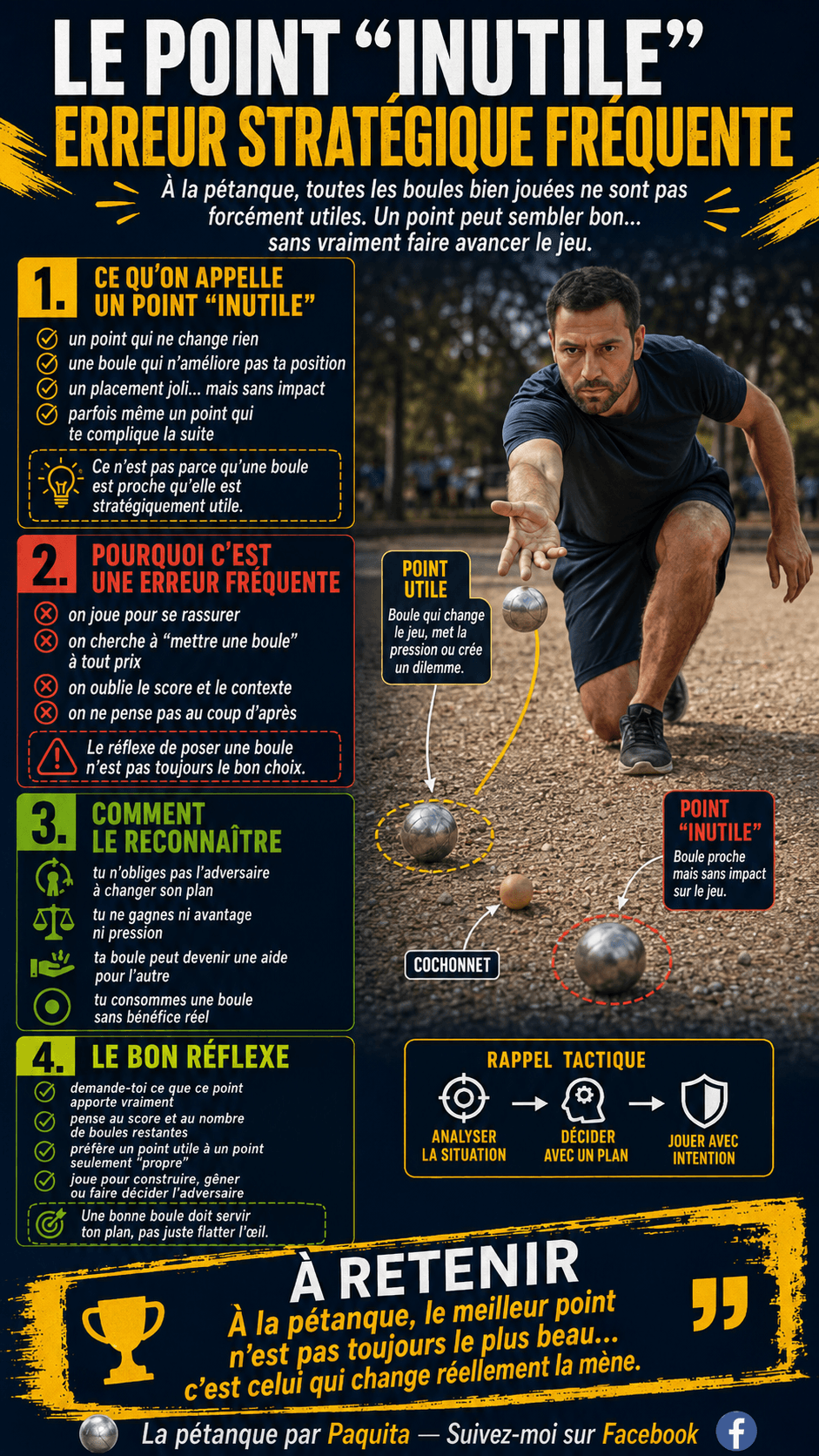
The "useless" point: a frequent strategic mistake
Pointing without thinking about what the boule will actually change — theWhat "useless" really means
♟️ THE VALUE SCALE OF A BOWL — WHAT IT REALLY CHANGES 🏆 MAX VALUE The bowl takes the head, eliminates the best opposing bowl, occupies the key zone of the terrain, or creates a direct hindrance to the opponent's options. It radically changes the situation. CHANGES EVERYTHING ✅ USEFUL VALUE The bowl improves the team's position, protects an existing bowl, or constrains the opponent's options. It isn't decisive but moves the situation forward measurably. IMPROVES 😐 NEUTRAL VALUE The bowl is well placed but doesn't fundamentally change the situation — it adds a presence on the terrain without altering the opponent's options or actively protecting what was already there. DOESN'T IMPROVE ⚠️ NEGATIVE VALUE The bowl, even well placed, offers a target, facilitates an opposing shot or involuntarily moves the jack. Its net result is negative for the team playing it. HARMS 💸 WASTED BOWL A resource spent that doesn't improve the situation and exposes the team. The useless bowl isn't a technical miss — it's played with no valid strategic reason. WASTED RESOURCE 🎙️ PAQUITA ON THE USELESS POINT "The worst bowl in pétanque isn't the missed bowl — at least with the missed bowl, you know you tried something. The worst bowl is the 'well placed for nothing' bowl. The one you play because it's your turn, because you're 'doing something', because the opponent pointed well and you had to answer. But if your bowl, even well placed, changes nothing about the situation — you've just consumed a resource with nothing in return. And at the end of the end, that bowl may be the one you miss." — PaquitaThe 6 forms of the useless point
🥈 1. The "second behind" bowl — pointing when it's already good STRATEGY VAGUE OBJECTIVE WHY THIS BOWL IS USELESS The team has a bowl 5 cm from the jack — the end is very advantageous. The player points a second bowl that lands 8 cm away. The situation hasn't changed: the bowl at 5 cm is still the best, the opponent will still have to eliminate it. The second bowl added nothing — it just confirmed an already maximal advantage. The resource is consumed with no real strategic gain. Even well pointed, this bowl had no objective that justified its use. → Useful alternative: if the end is already largely won, place the remaining bowl to hinder an opposing trajectory, close a shooting angle, or occupy the free zone around the jack. The bowl has more hindering value than confirming value. WHEN THIS BOWL MAKES SENSE There are situations where pointing "second" is justified: when the opponent still has bowls and could point even closer, when the jack is liable to be moved by a shot, or when angle protection is needed. The difference with the useless point is that in these cases, the bowl plays a precise and identifiable role. "I'm pointing second to block the opponent's shooting angle on my first bowl" is a valid intention. "I'm pointing second because I still have a bowl" is not. → Real cost: a consumed bowl that doesn't improve the position and that could have been used for active hindrance or kept as "insurance" against an unexpected opposing shot. → Test before playing: "if this bowl lands exactly where I want, what does it change for the opponent?" If the answer is "nothing more than what's already there", the bowl is probably useless. 🎭 2. The "automatic response" bowl — pointing because they pointed well REFLEX WITHOUT ANALYSIS THE IMMEDIATE-RESPONSE REFLEX The opponent pointed well. The instinctive reaction is to "answer" — to place a bowl to counter. But in some situations, the best response to a good opposing point is the shot — or even not playing at all (keeping the bowl for later). The reflex of pointing in response to a good opposing point short-circuits the tactical analysis — the player reacts to the opponent's action rather than deciding from the overall situation. → Useful alternative: before pointing in response, ask yourself: "is the best response to this opposing bowl a point? Or a shot? Or keeping my bowl to answer a more dangerous upcoming opposing shot?" WHY THE REFLEX TRIGGERS The response reflex is natural and often justified — but not always. It triggers all the more strongly the more impressive the opposing shot was — a fine opposing bowl creates a psychological pressure of "I have to do as well or better". This emotional pressure can lead to using a bowl for reasons of pride or reaction rather than for strategic reasons. The bowl played in reaction to the emotion of the opposing shot is almost always less well thought through than the bowl played from the situation. → Rule: never decide to play a bowl in response to what the opponent just did — decide from the overall situation of the end. These two decisions often give the same result, but not always. 📏 3. The "too far to hinder" bowl — a well-placed point but with no tactical reach TERRAIN NEUTRAL POSITION WHY POSITION MATTERS AS MUCH AS DISTANCE A bowl 20 cm from the jack in a neutral position can be worth less strategically than a bowl 35 cm on the opponent's shooting line. A bowl's value depends on what it changes in the opponent's options — not only on its proximity to the jack. A well-placed bowl but far from any opposing trajectory, outside any bounce zone, and with no visible protection is a bowl whose tactical value is almost nil despite its good apparent result. → Useful alternative: before aiming "as close to the jack as possible", identify the spot on the terrain that creates the most constraints for the opponent — even if it's slightly less close. A tactically positioned point almost always beats a centimetric point with no effect. THE MISTAKE OF EVALUATING ONLY BY CENTIMETRES Many players evaluate their bowls only by distance to the jack — "I was at 12 cm, that's acceptable". But 12 cm in a position that opens all the opponent's angles can be worth less than 25 cm on the shooting line. Distance is an indicator, not the sole measure of a bowl's value. The players who progress fastest are those who integrate the positional dimension into their evaluation — "where is this bowl?" as much as "how far is it?" → To remember: "well placed" doesn't mean "useful". A bowl can be at a good distance AND be in a strategically neutral position. Aim to place where it creates a problem for the opponent, not only where it's close. 📉 4. The "nothing to lose" bowl — accepting the useless point because "it costs nothing to try" MENTAL BAD CALCULATION THE BAD CALCULATION OF "WE HAVE NOTHING TO LOSE" "We're losing this end anyway, may as well point to see" — this reasoning is one of the most frequent sources of useless bowls. It rests on a calculation error: a bowl played "for nothing" in a lost end isn't free. It consumes a throw, it can alter the terrain (jack position, bounces off other bowls), and it deprives the team of a bowl that could have served another purpose. In pétanque, "it costs nothing to try" is almost always false. → Useful alternative: in a difficult end, the remaining bowl is sometimes worth more as an "influence bowl" (moving the jack, blocking an opposing bounce) than as a "result bowl" (attempting a placement miracle). WHEN POINTING "WITHOUT HOPE" CAN MAKE SENSE There are situations where pointing in a difficult end is strategically justified: to calibrate the terrain in the early ends of a game (information is worth more than the immediate tactical result), to force the opponent to shoot (one more opposing bowl consumed), or to occupy a zone that could be useful if the jack moves. In these cases, the bowl has an identifiable objective — even if that objective isn't "win this end". The difference with "nothing to lose by trying" is precisely that explicit objective. → Real cost: in an end at 4-0 to the opponent and 0 close bowls, pointing to "try" consumes a resource with no realistic probability of success. Identify the bowl's real objective — if it's "force an opposing shot", it's valid; if it's "hope for a miracle", no. → Test: "what am I trying to get with this bowl?" If the honest answer is "nothing specific, just to see", the bowl is probably useless and its use should be reconsidered. 🤖 5. The "mechanically applied role" bowl — pointing because it's your role, not because the situation calls for it ROLE AUTOMATISM WHEN THE ROLE BECOMES A BLIND AUTOMATISM The role (pointer, middle, shooter) is a useful structure — but it can become counterproductive when applied mechanically without reading the situation. A pointer who systematically points even when the situation calls for a shot, or a shooter who systematically shoots even when the end is already won, plays their role to the detriment of strategy. The role is a framework, not an absolute prescription. Role discipline is valuable; role automatism is strategic rigidity. → Useful alternative: ask yourself on every bowl whether the usual role is the right response to the present situation. "As a pointer, is pointing really the best thing to do here?" — and be able to deviate from the role when the situation clearly demands it. THE DIFFERENCE BETWEEN DISCIPLINE AND RIGIDITY Role discipline improves collective play by avoiding impulsive out-of-role decisions. But too rigid a role discipline can prevent the adaptations needed for exceptional situations. A good player knows their role, respects it in the vast majority of situations — and knows when to step outside it for the good of the team. This flexibility is a tactical maturity, not indiscipline. → Rule: the role defines the default decision. The situation can sometimes justify deviating from it. A player who never deviates from their role is predictable — and a predictable player gives advantages to the attentive opponent. 🎪 6. The "to show off" bowl — playing to impress rather than to build PRIDE PARASITIC MOTIVATION WHEN IMAGE TAKES OVER FROM STRATEGY Pointing very close to the jack when a less ambitious position would be strategically more useful. Shooting a bowl with no priority to "make a beautiful shot". Playing a difficult bowl with high image value rather than a simple bowl with high tactical value. These image-related motivations — your own or the one you want to project — produce bowls whose objective is aesthetic and not strategic. The useless "show-off" bowl can be the most beautiful of the end — and the least useful. → Useful alternative: evaluate every bowl by its strategic value, not by its difficulty or visual impact. "Does this shot, if it succeeds, really improve the situation?" takes priority over "will this shot impress?" PRIDE AS A SOURCE OF STRATEGIC ERROR Pride in pétanque often takes the form of a parallel competition — not "who wins the end" but "who plays the most beautiful shots". This parallel competition is a regular source of bowls with high aesthetic value and low strategic value. A player who realises they sometimes play "for their audience" (partner, spectators, opponents) rather than for the game situation has identified a mental drift that costs them bowls. Recognising this drift is the first step to correcting it. → Real cost: on top of the consumed resource, bowls played for image are often bowls played under emotional pressure (the desire to impress) that degrades the quality of the action. Tactical pride has a double cost: strategic AND technical. → Test: if you notice you feel pride or satisfaction after a successful difficult shot regardless of the result it brought to the end, that's a signal the image motivation was present. Observe whether it influences the shots chosen. ♟️ Every bowl is a resource — treat it as suchAt the start of an end, a team has a capital of bowls — 2 in doublette, 3 in triplette. Every bowl played reduces this capital for good. Treating every bowl as a precious resource to be used with an objective — and not as a bowl to "fill your turn" — is the difference between playing bowls and playing a strategy. The question "why this bowl?" before every throw is the question that distinguishes the tactical player from the mechanical player.
Useful point vs useless point — the concrete distinction
✅ A POINT HAS VALUE WHEN...It changes the hierarchy of the bowls: the bowl takes the head, or becomes the second-best bowl when none was in a favourable position. The overall situation of the end improves measurably.
It constrains the opponent's options: the bowl is placed so as to close a shooting angle, occupy a rolling lane, or occupy the free zone around the jack. The opponent must modify their initial plan.
It protects an existing bowl: the bowl plays a protection role — it closes the shooting angle on a previous bowl, or creates a bounce hindrance that worsens the consequences of a missed opposing shot.
It saves the opponent's resources: a well-placed bowl that forces the opponent to play two bowls to eliminate it instead of one has consumed more of the opponent's resources than its own.
→ A bowl's value is measured by what it changes in the situation — not by its distance to the jack. ❌ A POINT IS USELESS WHEN...It doesn't change the hierarchy: the team was in a favourable position before, it still is after — but with one fewer bowl. The opponent doesn't change their plan.
It constrains no opposing option: the bowl is in a neutral zone of the terrain — the opponent can point, shoot, place exactly as they would have done without this bowl.
It offers an extra target: the bowl created isn't the best but is in a position that facilitates an opposing "two-for-one" shot (shoots the positioned bowl and improves their situation).
It's played "because it's their turn": no analysis of the situation preceded the decision — the bowl is played to fill the time, by role reflex, or by emotional reaction.
→ The useless point consumes a resource without changing the situation. Its only "usefulness" is having been played. ❓ THE QUESTIONS TO ASK BEFORE EVERY BOWL"If this bowl succeeds exactly, what changes?" If the answer is "not much more than now", the bowl is probably useless.
"What's the best bowl to play in this situation?" — without assuming pointing is the answer. The answer can be to shoot, point, or keep the bowl.
"Am I playing this bowl for a strategic reason or for another reason?" The "other reasons" include: because it's my role, because the opponent played well, because it looks good, because we're losing anyway.
→ These three questions take 5 seconds. They eliminate the majority of useless bowls before they're played. 💸 THE REAL COSTS OF THE USELESS POINTReduced bowl capital: a bowl used needlessly in end 8 is a bowl potentially missing in end 12 — the shortage of bowls late in the game is often the consequence of needless spending early or in the middle.
Targets offered: every bowl on the terrain is a potential target for the opponent. A useless bowl in a bad position can be used against its own team by a "double" shot or a controlled bounce.
Complicated terrain: a terrain cluttered with low-value bowls can complicate the team's own options — trajectories shrink, bounces become unpredictable.
→ The cost of the useless point is often delayed in time — it's paid 3 ends later, at the moment when the saved bowl would have been precious. 🔑The useless point is the most difficult strategic mistake to eliminate because it leaves no visible trace. A well-placed bowl with no objective is identical to a good bowl in the statistics — but not in the result of the end. The only way to detect it is to ask the objective question before playing it, not after. A good bowl with no identifiable objective is still a useless bowl — whatever its technical quality.
The signals that reveal a bowl with no objective
⏰Decision made in under a second If the decision to point is made immediately — before even looking at the complete situation of the terrain — it's a sign the decision is automatic and not strategic. Automatic decisions are rarely optimal decisions. Even 5 seconds of reading the terrain before deciding significantly changes the quality of the decision. → Test: between every bowl, do you look at the full terrain before deciding? Or do you already know what you're going to do before you've seen the situation? 🔄Inability to explain why If after a played bowl, you can't clearly explain why you played it there — what the tactical intention was, what problem it was meant to solve or create — the bowl was probably useless. Bowls with a clear objective leave a trace in the memory of the decision. Bowls played mechanically or emotionally don't. → Test (to do after every training end): for every bowl played, explain in one sentence the tactical objective. If the explanation is vague or absent, the bowl perhaps deserved to be reconsidered. 📊Same play whatever the score Playing exactly the same way at 0-0 as at 11-8 or 8-11 is a sign the play is mechanical and not strategic. The score context fundamentally changes the value of every bowl. A useless bowl at 6-6 can be catastrophic at 12-11. A player whose decisions don't change according to the score plays bowls without taking their value in context into account. → Test: do you play differently at 11-9 and at 3-3? If not, your decisions don't take the score context into account — a frequent source of useless bowls at the wrong moments. 🎭Satisfaction at a beautiful missed shot Feeling satisfaction or pride after a technically beautiful but strategically impactless shot is a signal the bowl's motivation was aesthetic. Tactical pleasure should come from the shot that changes the situation — not from the shot that was beautiful. These two pleasures often coincide, but not always — and when they diverge, the aesthetic motivation has taken over. → Test: do you feel the same satisfaction after a tactically useful but technically ordinary bowl as after a beautiful tactically neutral shot? If not, image takes up space in the motivations.The question to ask before every bowl
❓ THE INTENTION PROTOCOL BEFORE EVERY BOWL 4 questions to make sure the bowl has an objective — in 10 seconds 👁️ 1. Read the complete situation — not only the closest bowl Look at the whole terrain: where all the bowls are (mine and the opponent's), where the jack is, which zones are free, which trajectories are open. This global read takes 5 seconds and is the condition for identifying a bowl with real tactical value. 🎯 2. Identify the problem to solve or to create What's the real tactical situation? Do I have to solve a problem (the opponent leads, you need to take the head or apply pressure) or create a problem (I'm leading, I need to complicate things for the opponent)? This identification directly steers the type of bowl to play and where to place it. ⚖️ 3. Ask yourself: "if this bowl succeeds, what changes?" That's the central question. If the answer is concrete and improves the situation (I take the head, I close the shooting angle, I occupy the free zone) — the bowl has value. If the answer is vague ("it'll be better") or absent — reconsider the decision to play this bowl in that spot. 🔄 4. Check whether there's a better use for this bowl Is the envisaged bowl the best use of this resource in the situation? Or would it be more valuable as a shot, as a hindrance bowl, or even kept to answer a more dangerous opposing shot? This quick check avoids burning a resource on the first option that comes to mind.Exercises to develop intentional play
01 The intention debrief — analysing every bowl after the end 📍 Training for 2 ⏱️ 2 min per end 🎯 Develop awareness of the tactical intention on every bowlAfter every training end, take 2 minutes to analyse the value of every bowl played. This exercise forces a retrospective awareness that, with practice, becomes a prospective awareness — before the throw.
After the end, verbally reconstruct the order of the bowls played (both teams). For every bowl, the player who threw it formulates in one sentence the tactical intention they had at the moment of playing it: "I wanted to take the head", "I wanted to protect the shooting angle", "I wanted to force an opposing shot"... The partner assesses whether the declared intention was valid and whether the bowl achieved it. Three categories: valid and achieved intention (good tactical bowl), valid but not achieved intention (good tactic, perfectible execution), or vague or absent intention (potentially useless bowl). This classification is factual — not a judgement on the player. Identify the bowls classified as "vague intention" and analyse what produced them. Was it a role reflex? An emotional reaction to an opposing bowl? A "we have nothing to lose"? Identifying the source of the absence of intention lets you target the mental work on decision-making. Over 5 to 8 sessions with this exercise, count the ratio of bowls with clear intention vs bowls with vague intention. The objective is to push this ratio toward 90% of bowls with clearly formulable intention. This figure is an indicator of the strategic quality of the play — independently of the technical results. 02 The "justified bowl" game — play only if you can formulate the objective 📍 Training for 2 or as a team ⏱️ 1 hr 🎯 Force the tactical intention before every throw via a declaration rulePlay a game with one extra rule: before every bowl, the player must declare out loud in one sentence the tactical objective of the bowl. If they can't formulate it, they can't play this bowl — they must re-analyse the situation until they find a valid objective.
Apply the rule strictly: no bowl without a prior declaration of intention. "I'm pointing to take the head" — valid. "I'm pointing" — invalid (no objective, just an action). "I'm pointing to force an opposing shot on my first bowl" — valid and precise. The precision of the formulation is an indicator of the quality of the decision. Observe what happens when you can't formulate the objective: either you find a valid objective by looking at the terrain better (the read was incomplete), or you conclude that no bowl has value in this situation (keep the bowl or shoot instead). Both discoveries are precious. After 3 to 5 games with this rule, observe whether the play has changed. Most players notice a reduction in the number of bowls played "by reflex" — the bowls played are fewer but all have an identifiable objective. The strategic quality of the play rises even if the technical play stays the same. Then return to normal play without mandatory declaration. The habit of formulated intention should persist partially — the players who have practised this exercise regularly report that they keep mentally asking themselves the objective question before every bowl, even without a formal obligation. That's the sign the habit is anchored. 🎓 Play fewer bowls but better bowlsA paradox of tactical pétanque: the best players don't necessarily play more bowls than the others — they play bowls that all have an objective. Playing 3 bowls with intention is strategically worth more than playing 6 bowls of which 3 are useless. The strategic density of the play — the ratio of useful bowls to the total — is a measure of quality far more relevant than the number of well-placed bowls. Developing this density is the work of the player who truly wants to progress.
📚 PAQUITA'S BOOKS Progressing at pétanque — Paquita's guides 🎯 TACTICS — MINDSET — ACTION Play everywhere — from technique to on-court tactics Intentional play, strategic reading of the terrain, the value of every bowl according to the situation, developing the strategic density of the play — the complete guide to playing with sense in every configuration. 📦 Amazon 💥 SHOOTER — ACTION — CONSISTENCY Become a formidable shooter Decide to shoot with a precise strategic reason, identify high-value shots vs reflex shots, build a shooting logic consistent with the situation of every end. 📦 Amazon 🎳 POINTER — AWARENESS — REFERENCE POINTS The art of pointing — precision and consistency Intentional and positional placement, every bowl with an identifiable tactical objective, the distinction between proximity pointing and strategic-value pointing — the guide for the pointer who thinks before throwing. 📦 Amazon 🧠 MINDSET — ROUTINE — METHOD Pétanque by method Intentional decision protocols, eliminating strategic automatisms, developing the habit of the objective before every bowl — progress with method on the strategic quality of the play. 📦 Amazon