News · 16 April 2026
The rolling shot in pétanque: Genius strategy or an admission of weakness?
News“He raids because he doesn’t know how to shoot.” We hear this phrase in almost every club. She says something right about shooting—and she also says something wrong. True: some players use the raid as a substitute due to lack of mastery of aerial shooting. False: the raid is a technique in its own right, with its own situations of use, its own tactical advantages, and its own mastery requirements. The best players have the roundup in their aExact definition — what the rolling shot is and isn't
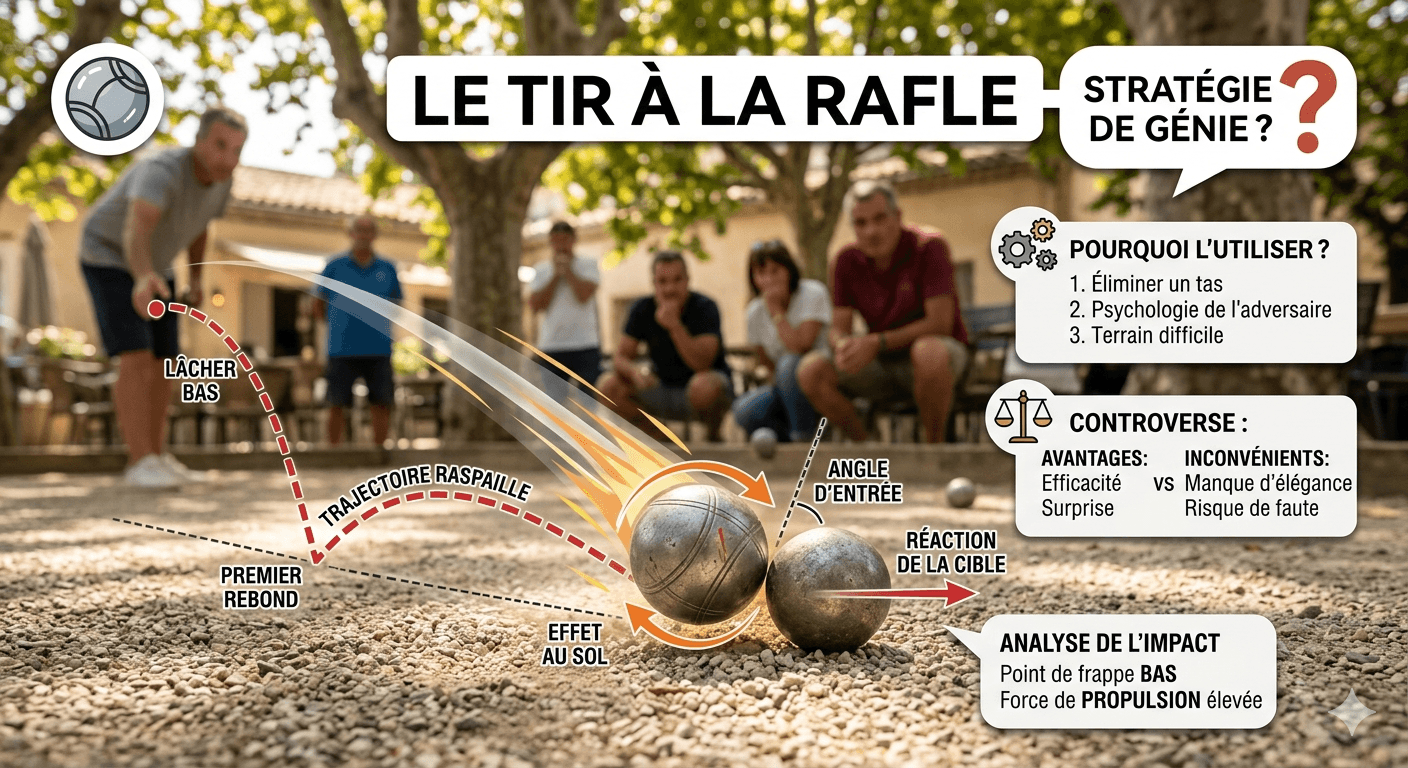
📖 TECHNICAL DEFINITION The rolling shot (or rolling shot) is a shot in which the bowl rolls along the ground for all or part of its trajectory before reaching the opposing bowl being aimed at. It does not follow the parabolic aerial trajectory of the high shot — it stays in contact with the terrain. The bowl "rolls" all the way to its target. The term comes from Old French rafler — to carry off, sweep, grab in passing.The rolling shot is neither a carreau nor a front shot — it is a way of moving the bowl to the target, which can end in a carreau (the rolling bowl stays in place of the opposing bowl) or in a displacement without a carreau depending on the speed and angle of impact.
High shot vs rolling shot — the two trajectories explained
🔵 HIGH SHOT — Aerial trajectory The bowl flies, striking the target bowl in the air or at the moment of ground impact near it. 🟢 ROLLING SHOT — Ground trajectory The bowl rolls along the terrain to the target bowl with no significant aerial trajectory.These two trajectories are not interchangeable — they answer different situations and have different effects on the targeted bowl and on the surrounding bowls. The high shot, arriving with a vertical component, generates a more "direct" impact and a straight-line displacement effect. The rolling shot, arriving horizontally, generates a flat-angle impact that displaces differently and interacts with the ground and surrounding bowls in a distinct way.
🎙️ Paquita on the status of the rolling shot "The rolling shot has a bad reputation in some clubs, as if it were a second-choice shot. That's a categorization error. The high shot is not 'better' than the rolling shot — it is suited to certain situations. The rolling shot is suited to others. A player who only masters the high shot is less complete than a player who masters both and knows when to use which. The question is not 'can I play the high shot' — it's 'is the high shot the best choice in this precise situation?'. Sometimes, the answer is no." — PaquitaThe real tactical advantages of the rolling shot
✓ REAL ADVANTAGES OF THE ROLLING SHOT 🌍Uneven terrains: on a bumpy, stony terrain or one with irregularities, the rolling shot takes advantage of the terrain instead of suffering from it. The bowl follows the ground and deflects off obstacles rather than being deflected by them after an unpredictable bounce. 🌬️Strong wind: a flying bowl is sensitive to the wind. A bowl rolling on the ground is far less so. In windy conditions, the rolling shot offers a more predictable, less disturbed trajectory. 🎳Bowl near the edge of the terrain: an opposing bowl placed near the boundary of the terrain can be protected from the usual aerial shooting angles. The rolling shot lets you arrive from a different axis, notably by skimming the boundary line. 🔄Controlled displacements: the rolling shot can be used to deliberately displace several bowls into a favourable configuration — the "horizontal" displacement produces different domino effects than the vertical displacement of the high shot. 📍Bowl behind an obstacle: if the target bowl is partially hidden behind other bowls at an intermediate height, the rolling shot can pass "under" the shielding bowls where an aerial shot would crash into them. 😌A less demanding gesture over distance: the rolling shot requires less height and angle calibration than a high shot. Over long distances (9–10 m), an imprecise high shot can miss completely; a well-executed rolling shot stays on line even with a slight variation of force. ✗ LIMITS AND DRAWBACKS ⚠️Bowls close to the jack: the rolling shot displaces everything in its path. If your own bowl is close to the jack, a poorly calibrated rolling shot risks displacing your own favourable bowls. ⚠️Reduced lateral accuracy: on uneven ground, the bowl can deviate sideways while rolling. A terrain with ruts or roots makes the rolling shot as unpredictable as the high shot on bumpy ground. ⚠️No guaranteed carreau: the high shot with good speed often leaves the bowl in place (carreau). The rolling shot, arriving horizontally, tends to displace both bowls or push the target bowl away without staying in place. ⚠️Bowls on a rise (mound): if the target bowl is on a slight rise in the terrain, the rolling shot struggles to reach it. The high shot passes over the irregularities; the rolling shot is blocked by them. ⚠️Trajectory visible to the opponent: the rolling bowl is visible from the start of its trajectory. The opponent sees the rolling shot coming and can sometimes anticipate its effect — psychologically different from the high shot, which arrives fast and hard. ⚠️Poor tactical image: in some clubs, playing the rolling shot is perceived as a sign of weakness, which can affect team dynamics. It's irrational but real.In which situations to choose the rolling shot
✅ Very uneven terrain — rocks, ruts, roots On a pitch with a chaotic surface, any aerial shot is random after the rebound. The roundup navigates the terrain by adapting to it — each pebble is a guide rather than an obstacle. The best players on difficult terrain systematically favor round-ups in these conditions. → Roundup highly recommended ✅ Strong side wind — exposed terrain A crosswind of 20–30 km/h can offset an aerial shot by 10 to 30 cm depending on the height of the flight. A scoop stays on the ground — aerodynamic resistance is minimal. On exposed terrain in the middle of the southern summer, good players automatically switch to roundup mode above a certain wind. → Raft recommended from wind > 20 km/h lateral ✅ Opponent ball protected by allied balls The target ball is surrounded by your own balls in a favorable position. An iron shot would hit the “wall” of your balls before reaching the opponent. A roundup can sometimes sneak between nearby balls on the ground, or use one of them as a calculated springboard to hit the target. → Roundup to consider depending on the exact configuration ⚠️ Long distance (9–10 m) — iron difficult to calibrate Over long distances, the margin of error for aerial fire increases exponentially. A well-aimed round stays on the target line even with a slight variation in force. It can be less spectacular but more consistent for players whose long-range shooting is inconsistent. → Depending on the level and regularity of the shooter ⛔ Opponent's ball closed from the jack with your balls in play This is the situation where the raid is the most dangerous. By arriving horizontally and with a large impact surface on the ground, the roundup often “sweeps” a wider area than a precise aerial shot. Anything in its path can be moved — including your best balls. → Favored iron — risk of moving your own balls ⛔ Soft, sandy or wet ground On soft ground, the sweep slows down very quickly — the ground absorbs the rolling energy quickly. The ball often does not reach its target or arrives there without sufficient force to move it. It's the opposite of what we're looking for. Iron retains its energy until the air impact. → Iron recommended on absorbent groundThe execution technique — what changes compared to the high shot
The rolling shot is not a poorly executed high shot. It's a distinct gesture with its own parameters. The four main differences from the high shot concern the release height, the speed, the aiming axis and the follow-through.
1 Very low release height Unlike the high shot, where the release is made at hip height or higher, the rolling shot requires a release low, very close to the ground — the bowl must touch the terrain within 50 cm to 1 metre after the release to start rolling immediately. A release that is too high creates too large a flight arc and the bowl bounces instead of rolling. 2 Calibrated speed — slower than the high shot The rolling shot travels by rolling, not flying — it loses energy to friction with every metre travelled. To reach the same bowl at the same distance, the initial speed must compensate for the friction loss. In practice, the rolling shot is thrown with slightly more force than intuition suggests, especially on hard terrain where the roll is long. 3 Aiming axis — aim for the edge of the bowl, not its centre For a carreau or a controlled displacement, the rolling shot generally aims at the lower side of the opposing bowl rather than its centre of mass. A bowl arriving horizontally and striking the centre tends to "push" the opponent in front of it. Striking slightly to the side generates a departure angle that moves the opposing bowl sideways — sometimes more useful tactically. 4 Follow-through — accompany toward the ground The follow-through of the high shot follows the bowl's trajectory forward and upward. For the rolling shot, the follow-through must accompany forward and slightly downward — guiding the bowl toward its skimming exit. A follow-through that is too high is often the cause of a bowl that takes off instead of rolling. 5 Position in the circle — further forward To make the low release easier, some shooters position themselves slightly further forward in the circle than they would for a high shot — this naturally lowers the release point at the end of the swing. This shift is subtle (5 to 10 cm) but significant for the bowl's exit trajectory.The 4 variants of the rolling shot
➡️ The direct rolling shotThe bowl rolls in a straight line from the circle to the target bowl, with no noticeable bounce. The simplest and most predictable trajectory. Works ideally on hard, flat, clear terrain.
🟢 Accessible ↗️ The half-range rolling shotThe bowl follows a very short arc before touching down at mid-distance, then rolls the rest of the way. A hybrid between the short high shot and the rolling shot — lets you clear a slight obstacle halfway while still finishing with a roll.
🟠 Intermediate ↪️ The angled rolling shotThe bowl is deliberately thrown on an axis slightly offset from the target bowl, using a bounce off the ground or an allied bowl to correct its trajectory and reach the target from an unexpected angle. Demands advanced terrain reading.
🔴 Expert 🔄 The clearing rolling shotThe bowl is thrown to deliberately sweep several opposing bowls in a line. Not a targeted carreau — a zone clearance. Used when the opponent has several bowls clustered together and you want to move them all at once with a powerful shot.
🟠 PowerOn which terrains the rolling shot excels
TERRAIN BEHAVIOUR OF THE ROLLING SHOT RATING 🪨 Dry, hard and compact terrain Long and predictable roll. Little absorption. The direct rolling shot is ideal — it keeps its speed up to the target and the impact is clean. ★★★★★ 🪨 Stony or uneven terrain The rolling shot navigates the irregularities better than the high shot, which bounces unpredictably. The stones deflect the bowl but also the opposing bowls. A typical terrain where the rolling shot outperforms the high shot. ★★★★★ 🌿 Short, compact grass Moderate roll with slight friction. The rolling shot holds its trajectory well. A slight increase in force is needed. A terrain that suits the rolling shot well, with calibration. ★★★★☆ 🟡 Fine sand or fine gravel Strong absorption. The rolling shot quickly loses its speed. Reaching the target at a normal distance takes excessive force that makes control difficult. The high shot is preferable on this kind of surface. ★★☆☆☆ 🌧️ Wet terrain after rain The mud slows things down sharply. The rolling shot gets bogged down halfway. The high shot is clearly better suited on waterlogged terrain — the bowl flies over the absorbent surface. ★★☆☆☆ ⬆️ Terrain sloping downhill The slope accelerates the roll — the rolling shot arrives fast and hard. With calibration, the downhill rolling shot is formidable because the bowl picks up speed naturally. Risk of overshooting if poorly dosed. ★★★★☆Decision tree — high shot or rolling shot?
🌳 DECISION TREE — CHOOSE YOUR SHOT 🌍 Is the terrain irregular or stony? → YES → ✓ RAFLE recommended NO → Next question ↓ 🌬️ Is there a strong side wind (>20 km/h)? → YES → ✓ RAFLE recommended NO → Next question ↓ 🎳 Is the opposing ball accessible from an angle on the ground? → NO → 🔵 IRON required YES → Next question ↓ 🌧️ Is the ground soft, sandy or wet? → YES → 🔵 IRON recommended NO → Next question ↓ ⚠️ Are your balls in play around the target ball? → YES → 🔵 IRON safer NO → ✓ FER or RAFLE depending on preference 🏆 The Complete Player's WeaponThe complete player doesn't ask himself "can I play the rolling shot?" — he asks "is the rolling shot the best shot for this precise situation?". That means having both in your arsenal at a high enough level to use them under pressure. Mastering the rolling shot isn't about using it often — it's about having it available when conditions demand it. The best shooters on uneven terrain are often excellent rolling-shot players. Not by default, but by adaptation.
An exercise to work on your rolling shot
01 The corridor rolling shot — working on axial accuracy 📍 Hard terrain ⏱️ 15 min 🎯 Accuracy and forceThe aim is to work simultaneously on axial accuracy (the bowl rolls on the intended axis) and on force calibration over different distances. The corridor imposes the lateral constraint that forces an aligned throw.
Set up the corridor: lay out two parallel rows of bowls (or two ropes) spaced 30 cm apart, over 5 to 8 metres in length. This corridor materialises the axis of the rolling shot — the bowl must travel through it without touching the edges. Place a target bowl at the end of the corridor. Throw aiming for a low release (hand close to the ground at the moment of release) and observe whether the bowl stays in the corridor throughout its trajectory. Analyse the corridor exits: if the bowl exits to the left, the arm's axis is deflected to the left. If it exits after 3 metres, the bowl may have bounced too much (release still too high). Adjust one parameter at a time. Vary the distances: start at 5 metres then lengthen to 7 then 9 metres. The same force doesn't suit all three distances — the exercise calibrates your feel for speed for each rolling-shot distance. Measure: out of 20 throws at 7 metres, count the percentage of bowls that reach the target while staying in the corridor. Initial target: 50%. Intermediate target: 70%. Consistency is the sign that the rolling shot is ingrained. ⚠ The rolling shot is no excuse for lacking a high shotWorking on the rolling shot is legitimate and useful. But it must not become a permanent substitute for aerial shooting. A player who only masters the rolling shot is limited in situations where the terrain is soft, where the high shot is mandatory, or where surgical precision on a single bowl is needed. The goal is to master both at a level usable in competition — the context will decide.
📖 PAQUITA'S BOOK Becoming a complete shooter — high shot, rolling shot and reading the gameHigh-shot technique, rolling-shot technique, terrain reading, the tactical decision tree, managing complex situations... Paquita's book covers it all with 100 numbered exercises and level-based protocols.
📦 Order on AmazonFAQ — Your frequent questions
Is the roundup legally authorized in official FFPJP competition? + Yes, without restriction. The FIPJP and FFPJP regulations do not impose any constraints on the trajectory of the ball after release — the only obligation is that the feet remain in the circle and that the ball is thrown from this circle. The roundup, the iron shot, the front shot, the half iron — all of these trajectories are legal. There is no rule requiring the ball to fly before reaching its target. The only rule is that the ball leaves the regulation circle. Can you make a tile with a cob? + Yes, but it is less systematic than with iron shooting. The diamond (the ball remains in the place of the opposing ball) is more difficult to achieve with a roundup because the ball arrives horizontally and tends to move the two balls or push the opposing ball in front of it. Scoring a bolt requires precise speed and centered impact — enough force to move the target, not enough to cause the sweeping ball to bounce far. It is technically possible and sometimes spectacular, but requires precise calibration. How to respond to teammates who criticize the raid? + The best answer is the result. If your roundup hits the target ball in a situation where the iron would have failed, no comment stands up to the score. Off the field, it can be useful to explain the tactical reasoning — "I chose the roundup because the terrain is irregular and the wind risked deflecting an iron." This explicit reasoning shows that it is a chosen decision, not a compensation. Cultural resistance to the raid is real in some clubs — confronting the objective results is the only solid argument. Does roundup work for scoring too? + What we call a “roundup” in shooting (rolling to the opposing ball) corresponds in scoring to the “rolling point” — the ball travels the majority of the distance by rolling rather than flying. This is the natural technique of pointers who “roll” rather than “lift”. The principles are the same: low release, grazing trajectory, hard and compact terrain so that it works well. On soft ground, rolling suffers for the same reasons as sweeping. See our article on the science of the throw. 📎 Related articles Equipment Choosing your bowls — hardness and behaviour on the rolling shot Equipment Top 3 best shooter boules 2026 Rules FFPJP rules — what's allowed in shooting Rules The one-minute rule — don't hesitate too long Rules 2026 playing distances — rolling shot and extreme distances Tools Free PetanqueLand tools© Pétanque by Paquita — petanqueland.fr · 📖 Paquita's book on Amazon