Actualités · 6 June 2026
Pétanque: The posture mistake to avoid when tired
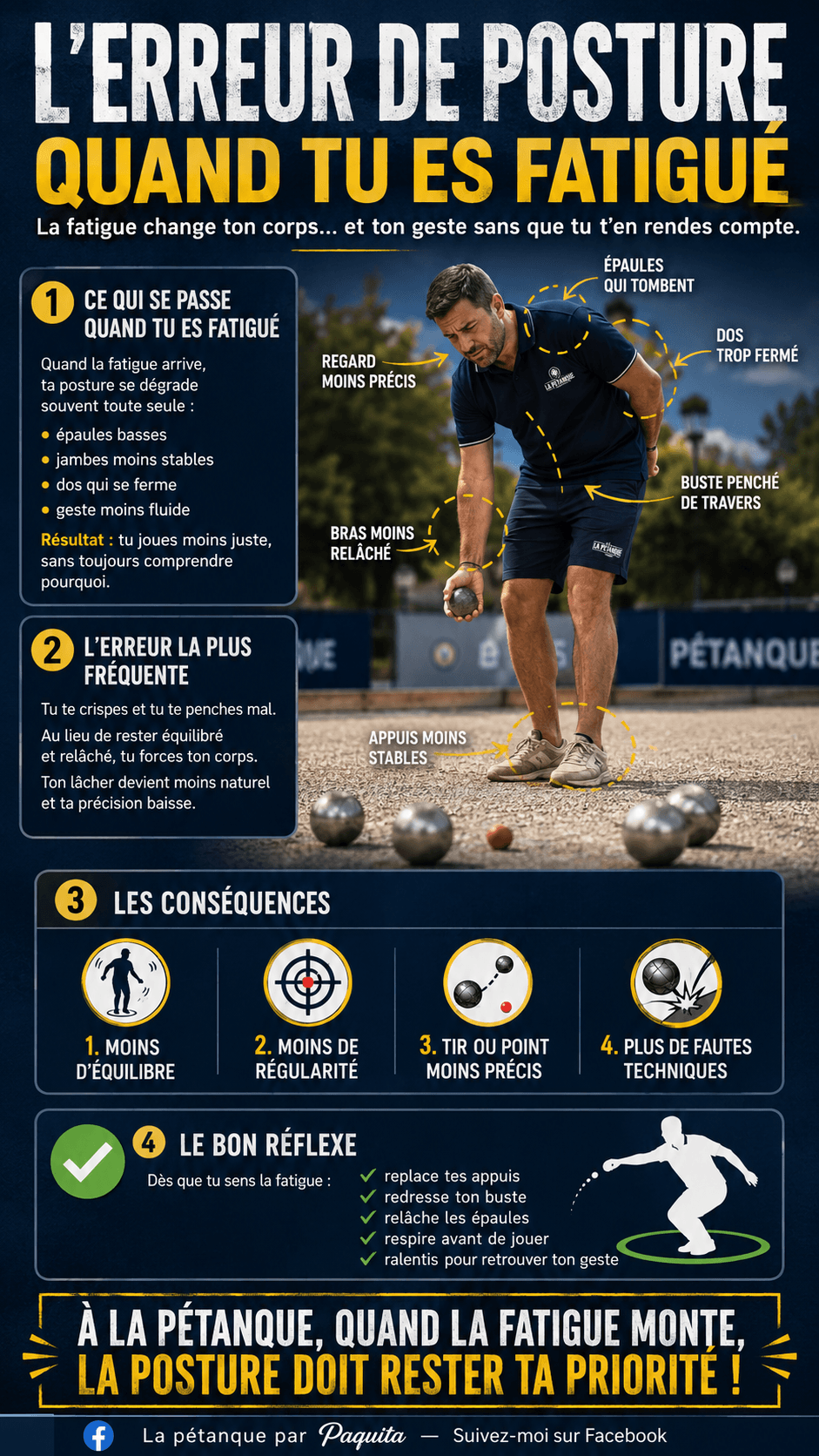
Fatigue alters the throwing posture even before the playerHow fatigue transforms posture — step by step
📉 TYPICAL TIMELINE OF POSTURE DEGRADATION OVER A LONG GAME 🧍 START OF GAME Reference posture. Relaxed, balanced body. The player naturally reproduces their usual motion — the one they developed in training. STABLE POSTURE 😐 MIDDLE OF GAME Slight muscular fatigue. The shoulders begin to rise imperceptibly. The torso tends to tip slightly. Results still correct but less consistent. EMERGING DRIFT 😤 END OF GAME Posture noticeably altered on 2 to 3 parameters. Errors increase. The player attributes their misses to "frustration" or "pressure" — without identifying posture as the cause. DEGRADED POSTURE 😩 LONG TOURNAMENT After several consecutive games, the posture collapses completely. The motion no longer looks like anything — the player "tries to find their arm" without understanding that it's their whole body that has changed. COLLAPSE 🔄 WITH METHOD A 30-second posture recalibration between ends can stop the degradation as soon as it starts — and maintain a stable level of play until the end of the tournament. POSSIBLE! 🎙️ PAQUITA ON POSTURE AND FATIGUE "When a player starts playing poorly at the end of a game, the first thing they look at is their arm. They change their grip, they adjust their release, they modify their speed. But their arm isn't the problem — it's their whole body that has sagged under fatigue. The shoulders have risen, the torso has tipped, the knees have locked. Their arm does 'the same' — but the same from a bad base gives a bad result. Before looking in the arm, look at the body." — PaquitaThe 6 posture mistakes produced by fatigue
⬆️ 1. Shoulders rising — the tension that creeps upward SHOULDERS TENSION WHY FATIGUE RAISES THE SHOULDERS When the muscles of the arm and forearm are tired, the body automatically recruits the upper back and trapezius muscles to compensate. This recruitment results in an involuntary rise of the shoulders — sometimes 3 to 5 centimeters from the resting position. This tension changes the axis of the pendulum and reduces the natural range of the arm's swing. → Correction: between two boules, consciously lower the shoulders by breathing out slowly. Feel the shoulder blades spread slightly apart in the back. Check that the shoulders are level on both sides before entering the circle. THE EFFECT ON THE THROW Raised shoulders stiffen the entire upper body. The pendulum can no longer swing freely from the shoulder — it starts from a tense position that shortens the range and alters the throwing axis. The boules consistently go off-target or short, without the player understanding why — since their arm "makes the same motion". The source of the error is 15 centimeters higher than where they're looking. → Warning sign: if you feel stiffness or pain in your neck or upper back during a game, your shoulders have risen. This physical signal often precedes the visible degradation of results by several ends. ↪️ 2. The torso tipping forward — reaching for distance with the body TORSO BALANCE WHY THE TORSO TIPS When the arm is tired, it produces less force at equal range. To compensate, the brain orders the torso to lean forward — which brings the release point closer to the target and creates the illusion of regaining the usual distance. This tipping happens gradually, a few degrees at a time, without the player consciously perceiving it. They believe they've kept an upright posture while they've leaned 10 to 15 degrees. → Correction: deliberately straighten up before each boule. Feel the body weight evenly distributed over both feet. If needed, touch your lower back with your free hand to check the verticality of your spine. THE EFFECT ON THE THROW A forward tip of the torso shifts the center of gravity beyond the support foot. The body is then in permanent imbalance during the throw — which produces unconscious compensations at the end of the motion (abrupt straightening of the torso at the moment of release, tensing of the wrist) to avoid falling forward. These micro-compensations alter the boule's exit axis unpredictably, end after end. → Warning sign: if your boules consistently end up longer than expected, or if you lose your balance slightly forward after the throw, the torso has tipped. It's not a strength problem — it's an axis problem. 🦵 3. Knees locking — losing the natural shock absorption LEGS STABILITY WHY THE KNEES LOCK Keeping the knees slightly bent requires continuous muscular effort from the quadriceps. When these muscles are tired after several games or a long tournament day, the body switches to an energy-saving position by locking the knees in full extension. This position is more muscular rest but it turns the legs into rigid pillars — removing the shock-absorbing and stabilizing role that slightly bent knees normally play in the throw. → Correction: before entering the circle, consciously bend the knees by about 5 to 10 degrees. This micro-bend doesn't take much energy but immediately restores the stability and shock absorption of the throw. THE EFFECT ON THE THROW Locked knees transmit the body's micro-imbalances directly to the arm with no absorption. Every slight oscillation of weight becomes a disturbance in the pendulum. Moreover, the straight-knees position tends to lock the pelvis in posterior tilt — which changes the orientation of the spine and therefore the natural axis of the pendulum. The motion feels "stiff" and the boules lack consistency in direction, not just in distance. → Warning sign: if you feel tension in your lower back or if your throw feels "blocked" with no fluidity, your knees are probably locked. The locked posture is also often accompanied by a feeling of lacking balance on uneven terrain. 🦶 4. The support foot pivoting — the shooting axis drifting without you knowing FOOT SHOOTING AXIS WHY THE FOOT PIVOTS UNDER FATIGUE Foot posture is one of the first things sacrificed under fatigue — because players don't think about it and its drift is perfectly invisible from their own point of view. A support foot that pivots 5 to 10 degrees outward orients the whole body slightly off the target axis. The arm swings in the same plane as before — but that plane has changed orientation. The result: boules that consistently drift to one side with no apparent explanation. → Correction: before each boule, explicitly look at your feet and check that the support foot points toward the jack. This check takes 2 seconds and eliminates one of the most frequent sources of directional error late in a game. THE MECHANICAL EFFECT OF THE PIVOT The orientation of the foot determines the orientation of the pelvis, which determines the orientation of the shoulders, which determines the axis of the pendulum. A 5-degree deviation of the foot translates to a 5-degree deviation of the throw — which represents about 40 to 50 cm of deviation on a boule thrown at 8 meters. That's the width of a boule to the side. This systematic and unexplained shift is one of the most frustrating errors late in a tournament — because it seems random when it's perfectly mechanical. → Warning sign: if your boules always drift to the same side late in a game with no variation, it's rarely an arm problem — it's almost always a foot or pelvis orientation problem. Check your feet before looking elsewhere. 👁️ 5. The head dropping — losing the visual reference point HEAD GAZE WHY THE HEAD DROPS UNDER FATIGUE Keeping the head straight and the gaze on the target throughout the throw engages the neck muscles. Tired, these muscles gradually relax their tone — and the head drops slightly, often at the moment of release. The gaze follows the boule downward instead of staying fixed on the target. This phenomenon, invisible from the outside, alters the perception of distance and direction that the brain sends to the arm at the precise moment of release. → Correction: deliberately fix the jack or the target zone with your gaze, and keep that gaze fixed throughout the throw — including after the release. Don't watch the boule leave. Gaze discipline is the simplest to correct but the hardest to maintain under fatigue. THE EFFECT ON PRECISION The pétanque throw is a visually guided motion — the gaze on the target provides real-time information about direction and distance that the brain uses to calibrate the motion. When the head drops before the release, the brain loses its visual reference and finishes the motion "blind" — relying on muscle memory instead of real-time vision. This loss of visual information for a few tenths of a second is enough to degrade precision, particularly on long-distance boules. → Warning sign: if you "watch your boules fall" instead of fixing your target during the throw, your head has dropped. The habit of watching the boule leave is a concentration drift amplified by fatigue. ⚖️ 6. Body weight shifting back — rear imbalance CENTER OF GRAVITY SUPPORT WHY THE WEIGHT MOVES BACK UNDER FATIGUE Counter-intuitively, fatigue doesn't always push the body forward — it can also push it backward. When the abdominal and gluteal muscles fatigue, the pelvis tends to retract slightly, and the center of gravity slides back toward the heels. This rear position is an unconscious resting position — the body "leans back" to save the effort of maintaining centered balance. It's hard to perceive because it doesn't produce an obvious feeling of imbalance. → Correction: consciously feel the weight on the middle part of the foot — neither on the toes, nor on the heel. Micro-bend the knees to reposition the center of gravity over the feet. This repositioning takes 5 seconds and immediately changes the quality of the throw. THE EFFECT ON THE THROW A rear center of gravity forces the arm to throw "on an uphill" from an unstable base — which produces boules that are consistently short or drop too early. Moreover, from a rear position, the arm has to compensate by amplifying its motion to reach the target distance — creating an overcorrection that produces errors in direction. It's a cascade imbalance: rear position → short boules → overcorrection → long boules → the player no longer understands their own results. → Warning sign: if your boules alternately fall short then go long with no logic, without you having consciously changed anything, the center of gravity is unstable. Check your support on the ground before each boule. 🧍 Posture before the arm — alwaysWhen play degrades under fatigue, the natural temptation is to look for the error in the arm. Before changing anything in the motion, spend 15 seconds checking posture from the bottom up : feet oriented, knees slightly bent, pelvis centered, torso vertical, shoulders low, gaze fixed. If one of these boxes is red, correct it first. The arm always comes last.
Physical fatigue vs mental fatigue — different effects on posture
💪 PHYSICAL FATIGUE — MUSCULAR DEFORMATIONSOrigin: exhaustion of muscle fibers after many games, a long tournament day, or significant physical effort before the game.
Characteristic deformations: knees locking (quadriceps energy saving), shoulders rising (recruitment of compensating muscles), torso tipping (arm too weak for the distance).
Evolution: progressive and monotonic — each end is slightly worse than the previous one, in the same direction. The degradation follows a steady curve.
→ How to correct: physical breaks, stretching of the affected muscle groups, voluntary reduction of the effort demanded of the arm (less force, higher). 🧠 MENTAL FATIGUE — ATTENTION DEFORMATIONSOrigin: drop in concentration at the end of a long session, emotional stress from a difficult game, sleep deficit, cognitive overload linked to score management.
Characteristic deformations: head dropping (loss of visual reference), foot pivoting (lack of support checks), unstable center of gravity (loss of conscious balance control).
Evolution: variable and unpredictable — better and worse boules alternate depending on attention levels. The degradation is inconsistent from one boule to the next.
→ How to correct: routine of checking reference points before each boule, slow breathing, slowing down the pace of play, focus on the process rather than the result. ⚡ BOTH AT ONCE — THE END OF THE TOURNAMENTTypical situation: last game of a long tournament, tight score, physical fatigue and stress accumulated since the morning. This is the context where posture mistakes multiply the fastest.
What happens: physical fatigue degrades the base posture, and mental fatigue prevents the player from detecting and correcting it. The two types of fatigue reinforce each other in a spiral that's hard to stop without a method.
Consequence: play collapses over several consecutive ends. The player looks for their motion in the arm while the problem is in the overall posture — and their corrections often make the situation worse.
→ This context requires a deliberate pause: stop, breathe, do the full posture check, and return to play with a conscious posture — even if it takes 30 seconds. ✅ PREPARING FOR FATIGUE — BEFORE IT ARRIVESBefore the game: minimal physical warm-up (5 minutes of mobilizing the shoulders, knees, pelvis) to start with ready muscles rather than cold and stiff ones.
During the game: systematic posture check at each new end — not only when things are going badly. The discipline of checking prevents the drift instead of correcting it too late.
Between games: sit down (legs), stretch the shoulders and neck, hydrate. These 5 minutes of recovery between two games maintain a stable posture level throughout the day.
→ Managing posture under fatigue is a skill that you prepare, not just a reaction when things go badly. 🔑The 6 posture mistakes produced by fatigue are not independent — they form a cascade system. Rising shoulders lead to tensing of the torso which causes an imbalance of the center of gravity which forces locking of the knees. Correcting a posture deformation at the bottom of the chain (the feet) can be enough to reset the entire posture above — like straightening the base of a leaning building.
The signals that reveal a degraded posture
📉Boules consistently short or long A constant directional trend over several consecutive boules — not an isolated error — is often the first visible sign of posture degradation. Short = torso leaning back or raised shoulders that shorten the pendulum. Long = torso leaning forward that amplifies the swing. This signal is often misinterpreted as a force or speed problem when it's structural. → Test: if 3 consecutive boules are all short or all long, don't correct the distance — check posture first. ↔️Boules drifting to the same side Boules that consistently go left or right almost always indicate an orientation problem — pivoting foot, crooked pelvis, one shoulder higher. This type of constant directional error is rarely caused by the arm — it comes from the overall axis of the body. Look in the feet and shoulders before looking in the motion. → Test: if your boules always drift to the same side for several ends, look at your feet and the orientation of your shoulders. 💪Feeling of forcing or stiffness The pétanque throw should be done with minimal conscious muscular effort — the pendulum is a fluid motion, not a propulsive effort. When the motion starts to require perceptible effort, it's often the posture that's preventing the pendulum from swinging freely. Locked knees, tense shoulders, rigid torso: each of these elements adds resistance to the natural movement of the arm. → Test: if you feel you're "sending" the boule instead of "letting it go", look for the stiffness in the body — not in the arm. 🔄Inconsistent results from one boule to the next Very different boules in the same end — one good, one short, one long — without anything having consciously changed signal an unstable posture that varies slightly between each throw. This inconsistency is characteristic of mental fatigue that no longer maintains the routine checks — the starting posture is different on each boule without the player realizing it. → Test: if your 3 boules in the same end are all at different distances with no logic, do the posture check before the next one.The posture recalibration protocol during a game
🔄 FULL POSTURE CHECK — FROM THE GROUND UP 6 points to check in 20 seconds before an important boule 🦶 1. The feet — orientation and support Explicitly look at the feet. Does the support foot point toward the jack? Is the weight distributed over the whole foot (neither on the toes, nor on the heels)? These 3 seconds of checking eliminate the most frequent directional error. 🦵 2. The knees — micro-bend Consciously bend the knees by about 5 to 10 degrees. Feel the slight muscular work of the quadriceps. This micro-bend restores the shock absorption and stability — and automatically repositions the center of gravity over the supports. ⚖️ 3. The pelvis — centered and stable Feel the body weight evenly distributed over both feet and over the middle part of each foot. Neither forward, nor backward. A micro forward/backward oscillation can help find the central point. 🧍 4. The torso — vertical Is the back straight? Is the torso neither leaning forward nor tilting back? If needed, feel the lower back with the free hand to check verticality. A straight torso places the shoulder in its natural position for the pendulum. 💨 5. The shoulders — low and relaxed Breathe out slowly, letting the shoulders drop. Feel the shoulder blades spread slightly apart. Both shoulders must be level. If one is higher than the other, it's a tension to release before throwing. 🎯 6. The gaze — fixed on the target Fix the target (jack or desired landing zone) and keep that gaze fixed throughout the throw, including after the release. Don't follow the boule with your eyes during the motion — the head stays still until the end of the arm's movement.Exercises to strengthen posture resilience
01 Systematic posture check — automating the verification 📍 Solo or 2-player training ⏱️ To integrate from now on 🎯 Making the posture check automatic before each bouleIntegrate the posture check as a mandatory step of the throwing routine — first consciously and verbalized, then gradually automatic and silent.
For 3 consecutive training sessions, quietly verbalize the 6 points of the check before each boule : "feet — knees — pelvis — torso — shoulders — gaze". This verbalization seems to slow down the game at first — that's normal and it's temporary. Observe the results. For the majority of players, simply checking posture before each boule immediately improves consistency — even without consciously changing anything. The check itself corrects slight deformations. Progressively, reduce the verbalization to 3 personal keywords — the 3 points where each player has their usual drift under fatigue. These 3 keywords become the personal pre-throw routine. They take 3 seconds and maintain posture throughout the game. Over a long training session (2 to 3 hours), note every 30 minutes whether the boules are degrading in distance or direction. If so, do the full check at that point. This tracking over time allows you to identify at what point of fatigue the first degradations appear — and to anticipate the check before results degrade. 02 The "posture at the end of fatigue" session — training to play tired 📍 Training after physical effort ⏱️ 30 min after 2 h of play 🎯 Developing posture awareness in the real state of fatigueDeliberately play after several hours of training, when fatigue is real — and use this context to personally identify which posture deformations appear first, and in what order.
After 2 to 3 hours of play, play a series of 20 boules applying the posture check before each throw. Identify which points of the check are hard to maintain in this state of fatigue. For some players it's the shoulders, for others the knees — everyone has their personal pattern. Then play 10 boules without a posture check. Observe the degradation. Compare the two series — with and without checking. For the vast majority of players, the series with a posture check produces noticeably more consistent results, even in an advanced state of fatigue. Identify the 2 points of the check that are most critical for you — the ones whose absence produces the fastest degradation. These 2 points become the absolute priorities of the quick check during the game, when time is limited and you can't do all 6 checks. Repeat this exercise once a month. Over time, maintaining correct posture under fatigue becomes less cognitively costly — because the muscles involved are more used to maintaining their tone, and because awareness of the deformations becomes faster to activate. ⚡ Fatigue is predictable — posture can be tooFatigue doesn't warn you. But its effects on posture are predictable enough to be anticipated. If you know you tend to raise your shoulders from the 8th end on, you can integrate a shoulder check from the 6th end on — before the degradation becomes visible in the results. Playing tired isn't inevitable. It's a manageable context for the player who knows their own posture degradation patterns.
📚 PAQUITA'S BOOKS Progressing in pétanque — Paquita's guides 🎯 TACTICS — MENTAL — MOTION Playing everywhere — from technique to on-terrain tactics Maintaining motion and posture over a whole tournament day, managing physical and mental fatigue, recalibration routines — the complete guide to progress in every dimension. 📦 Amazon 💥 SHOOTER — MOTION — CONSISTENCY Become a formidable shooter Postural stability of the shoot, maintaining the body base under fatigue, detecting posture drift when shooting, building a reproducible shooting motion even at the end of a tournament. 📦 Amazon 🎳 POINTER — AWARENESS — REFERENCE POINTS The art of pointing — precision and consistency Proprioceptive reference points for pointing, postural and body awareness in the circle, maintaining the reference posture under fatigue — the guide for the pointer who stays consistent from the first to the last throw. 📦 Amazon 🧠 MENTAL — ROUTINE — METHOD Pétanque by method Postural recalibration routines, managing mental fatigue in tournaments, automated verification protocols, developing physical and mental endurance over time. 📦 Amazon