Actualités · 10 July 2026
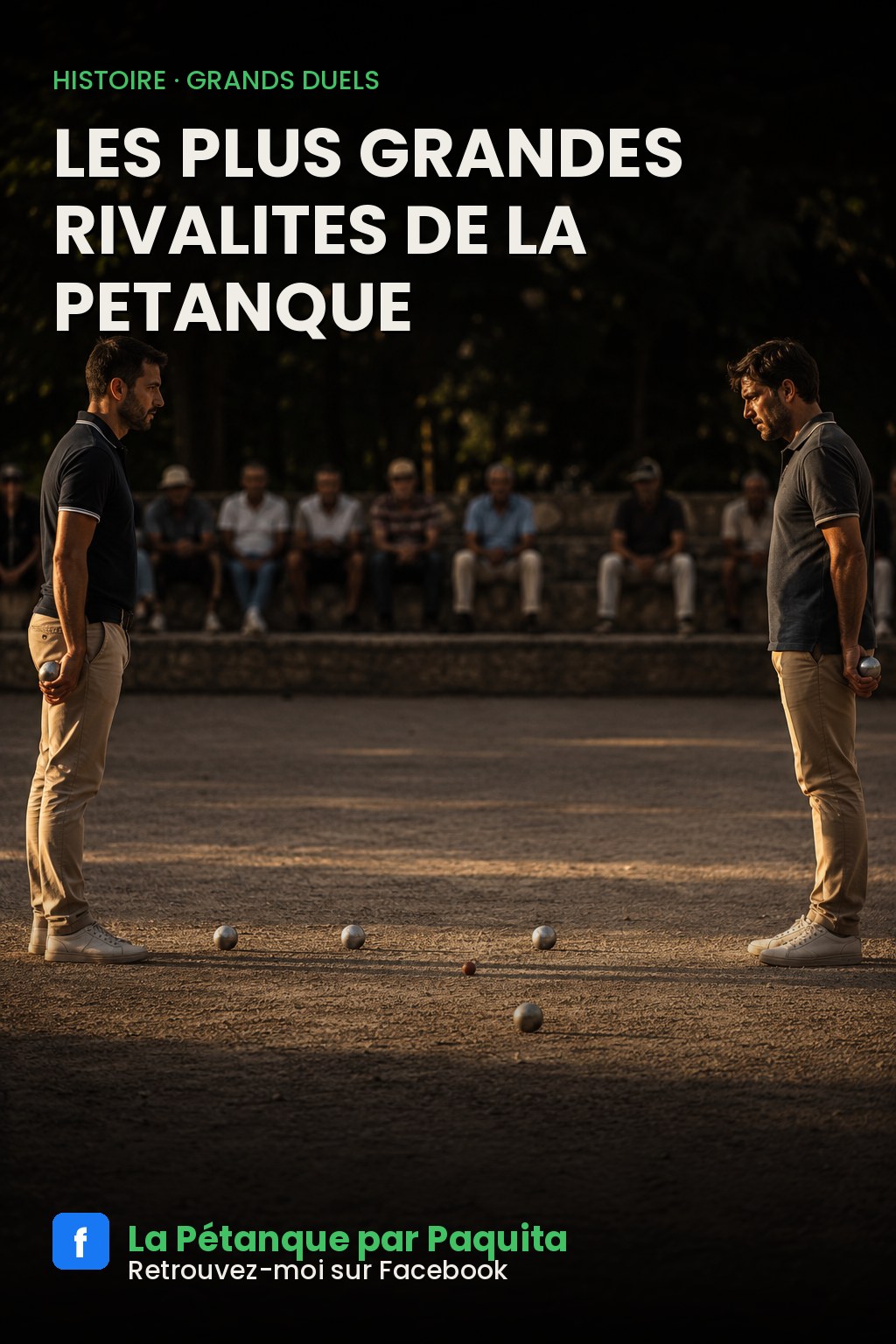
The greatest rivalries in the history of pétanque
Quintais–Foyot, Dylan Rocher against everyone, the Marseille–Lyon duel: the rivalries that have marked pétanque, what they say about the game, and why they1.Why rivalries make the game
A rivalry sets up a temporary hierarchy that everyone wants to see shaken up. In pétanque, the most striking rivalries are not only between players — they are between styles, between regional schools, sometimes between philosophies of the game. They structure the spectators' memory and they force champions to reinvent themselves. Without Foyot, Quintais might never have become Quintais.
In what follows, six rivalries that mattered — each telling something different about modern pétanque.
2.Quintais versus Foyot — the eternal rivalry
For more than two decades, two names dominated world pétanque: Philippe Quintais, the pointer-strategist, and Henri Lacroix in the early years, then Christian Fazzino, Bruno Le Boursicaud, and of course the encounters against Marco Foyot that live on in everyone's memory. Foyot is pure striking; Quintais is reading the game. When they meet in the final, it is not just a duel of players: it is a duel of visions of pétanque.
This duel also fed a school: for years, young players and coaches had to choose their side — become a pure shooter or a pointer-strategist. This polarization structured a whole generation.
What makes this rivalry unique: neither camp has ever truly won the war. Foyot won iconic battles, Quintais won more world titles than anyone. The verdict is split — and that is what makes the legend.
3.Dylan Rocher against a whole era
When Dylan Rocher reached the top, he posed a simple problem to all the other champions: his shooting was too pure, too consistent, too fast. For several seasons, the question among his opponents was no longer « how to beat him? » but « how to take a game off him? ». This one-sided domination created a particular rivalry: Rocher against the rest of the world.
This type of rivalry — one man against an era — is rare. It is found in Marco Foyot in the 90s, or in Christian Fazzino in certain seasons. It galvanizes the opposition: the other champions raise their level because they know they have no right to make mistakes.
4.The eternal rivalry of styles — pointer versus shooter
Beyond individuals, there is a deeper and more lasting rivalry: that of styles. Meticulous pointer versus instinctive shooter, reading the game versus pure striking, mindset versus gesture. Every team has to balance these two forces, and every training session in France looks like a mini-debate on the right mix.
| Style | Strength | Weakness | When it wins |
|---|---|---|---|
| Pointer-strategist | Reading, precision, mindset | Vulnerable against a perfect opposing shot | On technical terrains, long games |
| Pure shooter | Clean strike, intimidation | Terrain reading often less sharp | When you need to break a winning point |
| Parasitic rotation, bowl that leaves with involuntary effect | Adaptability | No area of excellence | Over the course of a championship |
| Instinctive player | Bold choices, creativity | Level variability | When pressure freezes the others |
| Methodical player | Consistency, management | Lack of decisive shots | Knockout tournaments |
5.Marseille versus Lyon — the war of the regional schools
Marseille long embodied a flamboyant, theatrical pétanque, where direct confrontation and risk-taking are part of the identity. Lyon developed a more rigorous, more structured pétanque, where precision takes precedence over the show. This clash of cultures produced legendary finals, press-room controversies, and above all an excellent level of play produced by each of the two schools.
Today, these cultural boundaries are fading — young players move around, train everywhere, but the legacy remains: you can still tell a « Marseille » team from a « Lyon » team by the way it manages the end, talks between shots, reacts to mistakes.
At the next national finals, look closely at the teams' regions of origin. You will see that some Southeast versus Southwest or Mediterranean versus Rhône-Alpes matchups still carry traces of these old rivalries, in more modern forms.
6.The men-women rivalry and its recent evolution
For a long time, women's pétanque was perceived as less technical. That was a perception, not a reality — female champions have always competed technically with their male counterparts. But the rivalry has shifted from an unbalanced comparison to a genuine confrontation since mixed tournaments and media broadcasts have put the two levels side by side.
Today, champions like Angélique Colombet or Anna Maillard are technical references for all genders. The rivalry has evolved: it is no longer condescending, it is sporting — and that is a major step forward for the game.
7.What these rivalries brought to the game
All these oppositions, whether individual, stylistic, or regional, share one thing in common: they have pushed the general technical level forward. A rivalry forces everyone to reinvent themselves, to close their gaps, to dare what they would not have tried alone. Without Foyot, today's shooting would not be so pure. Without Quintais, modern pointing would not have reached this precision. Without Rocher, shooting-on-the-move would not have been so widely popularized.
That is why, in 30 years, we will still talk about these rivalries — not as old disputes, but as engines of the game's evolution. See also our page home for other historical analyses.
Dive into pétanque as the great schools practiced and codified it: pointing, shooting, half-lob, difficult terrains, mental management. Five volumes to understand where the styles that still clash today come from.
📗 Discover the series