Actualités · 27 July 2026
The biggest surprises in the history of pétanque
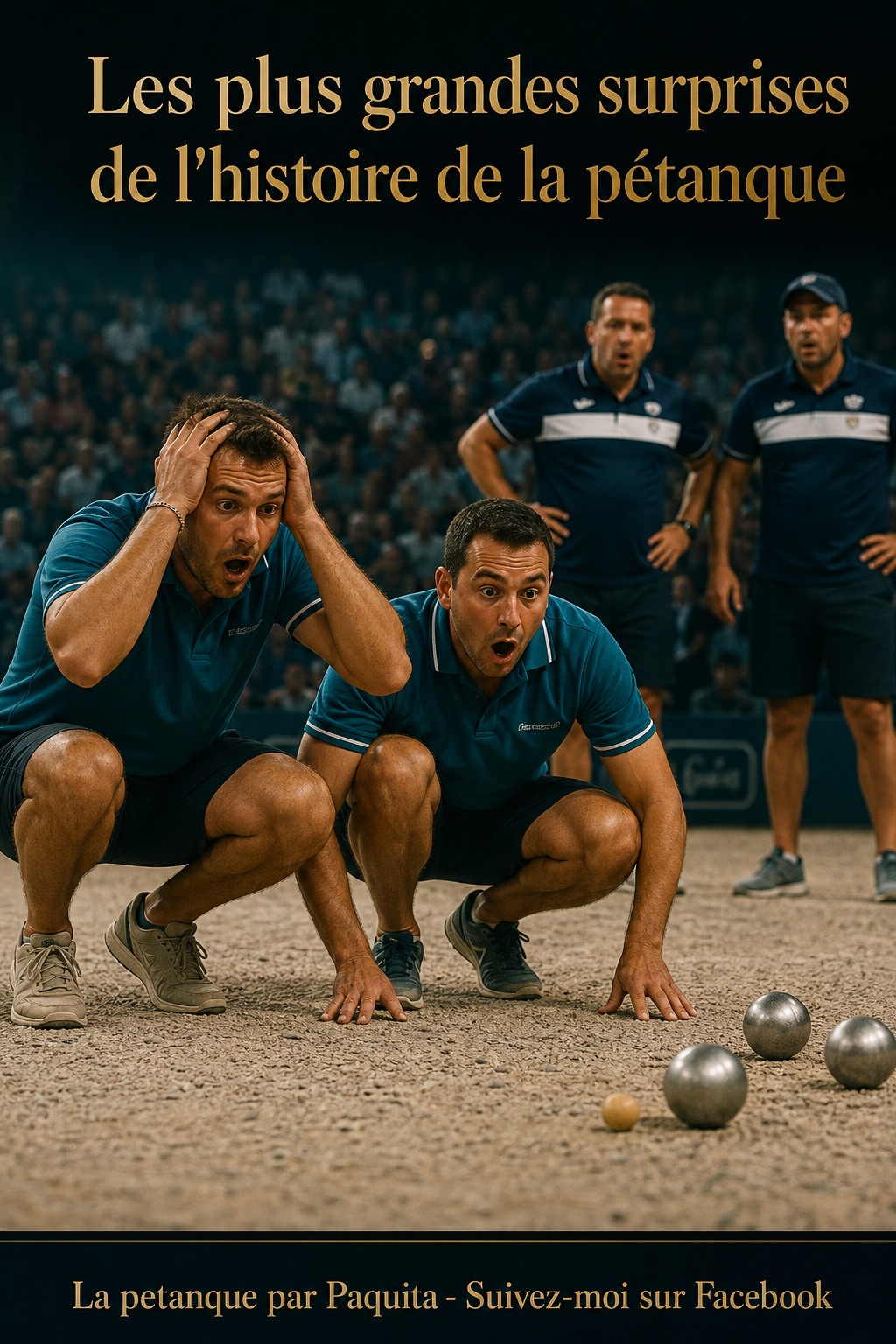
Les grandes surprises de la pétanque révèlent l'adaptation, la tactique et le mental qui font basculer une partie jusqu'au treizième point.The history of pétanque is not just a gallery of announced champions. It is also made up of overturned favorites, unknown teams that find the perfect match, ends that everyone thought were over and improbable balls that change a competition. These surprises are not all chance: they reveal what is most demanding about this sport.
01The first surprise: a new game born from an adaptation
Pétanque itself was born from a break with the habits of Provençal games. The principle of playing with fixed feet, from a circle, has made the practice more accessible while creating a new tactical discipline. This change seems natural today, but it represented a real surprise for players used to gaining momentum.
This origin already says something essential: history advances when someone agrees to modify the rule of movement, rhythm or space. The big sporting surprises follow the same mechanism. A team rarely wins by replicating exactly what the favorite expects. It imposes a distance, a pace or a way of constructing leads which forces the other to get out of their scenario.
The historical thread: Since its origins, pétanque has valued adaptation. A physical constraint transformed into a new way of playing has become the signature of a global sport.
02When the underdogs forget the names of the champions
In competitions, the most spectacular surprise remains the victory of a little-expected team against players with titles. The public speaks of an exploit; winners often describe something simpler: they played their game, without defending a reputation or anticipating comments. Their mental freedom reduces the weight of each mistake.
The favorite may feel that he has more to lose. After two upset leads, he sometimes tries to re-establish the hierarchy too quickly. He forces a shot, refuses a defensive point or changes an organization that was working. The outsider does not need to be superior throughout the match: he must stay close enough to transform this impatience into an opportunity.
03The lifts that no one sees coming
A game played extensively sometimes seems over before it is. However, the pétanque score is not a stopwatch: the team that is behind has as much time as it needs to come back. A lead of three or four points immediately changes the pressure. The dominant side begins to calculate what it must no longer concede, while the other finds a concrete target.
Historical comebacks are therefore not just a series of successful gestures. They are behavioral shifters. The leader shortens his gesture, speaks more, protects the score. The pursuer simplifies his decisions, accepts the risk and finally plays without hesitation. From there, each point won confirms a new story: the impossible becomes plausible.
04The terrain, a great maker of surprises
Difficult terrain sometimes narrows the gap between reputations. Technical automation becomes less reliable; you have to observe the fall zones, memorize the reactions and accept some dispersion. The player who reads the ground quickly can gain the advantage over a more skilled opponent who is attached to his usual trajectory.
The distance from the goal produces the same effect. A team can play a long game to break the opponent's rhythm, then suddenly shorten it when it detects a problem. Surprises often arise from this tactical mobility. The one who considers the field as a fixed data leaves to the other the power to choose the match.
| Unexpected element | Adaptable team | Frozen team |
|---|---|---|
| Very stony terrain | expands the data | find the perfect point |
| Goal moved | recalculates the balls | stay on the old plan |
| Unusual distance | change the height | force his gesture |
| Wind or light | creates a marker | suffers the embarrassment |
05The improbable ball that transforms a story
Every bowling memory contains a boule recounted years later: a decisive frame, a displaced cork, a lucky counter or a point which crosses a field of obstacles. These moves become legendary because they condense the entire game into one image. However, their importance also comes from what precedes them.
A team must have retained a ball, chosen a target and accepted a risky outcome. Even when a favorable rebound occurs, it rewards a possibility that the player was able to create. Reducing these moments to luck obscures the essential skill: remaining available long enough so that the unexpected can still help.
When a lead seems lost, don't immediately look for the miracle move. First look for the ball which maintains two possible outcomes: score now or greatly complicate the opponent's response.
06What big surprises teach
The first lesson is simple: never confuse probability with certainty. A favorite remains a favorite, but he still has to win every exchange. The second concerns team language. Formations capable of quickly saying “we change the distance”, “we limit it to one” or “we play the goal” lose less emotional time when the scenario changes.
The third lesson concerns training. Only repeating specific movements on familiar ground prepares you poorly for surprising stories. You have to create imbalances: start at 3-9, change position, play an end with one ball less, move the data or impose a shot on goal. These constraints build a team that does not feel betrayed by the unexpected.
Finally, the surprises remind us why pétanque fascinates. Precision matters, experience matters, strategy matters; but none completely closes the game. Until the thirteenth point, a courageous decision, a more careful reading or a single ball can still write another ending.
Recognize when the game changes sides
A toggle is not always visible on the scoreboard. It sometimes begins with an opposing ball which only gives one point, but which forces the favorite to use his last three balls. It can also come from a goal sent into an area that no one has yet tested. The attentive team perceives this change before the public: the pace of discussions lengthens, the choices become less natural and the players look more at the score than at the field.
At this point, the underdog must avoid two mistakes. The first is to celebrate too early and get out of your routine. The second is to want to accelerate the fall of the favorite with a disproportionate blow. A surprise is best built by repeating the decisions that created the doubt: the same quality of observation, the same simple announcements and the same commitment to the gesture.
Turning the story into a training exercise
To reproduce this tension, form two teams and artificially give one of them an eight-point lead. The led team must look for high-value leads without offering a big exit; the team in front must continue to play to score rather than to wait. Then reverse the roles. After each game, note the first moment the communication or gesture changed.
A second exercise consists of modifying the distance from the goal after each end, then imposing a different zone on the ground. Players thus learn that the identity of a party is never definitive. This skill seems discreet, but it explains many surprises: teams that accept change retain their resources, while others spend their energy regretting the previous scenario.
Work on technique, strategy and mentality to remain effective when the game no longer follows the planned scenario.
Discover the seriesTo turn these situations into progress, explore improving at pétanque and the basics of pétanque tactics.
07Frequently asked questions
Why does pétanque produce so many surprises?
Because a game is short, each lead redistributes the roles and a single ball can move the goal, open several points or render all the previous work useless.
Can a lesser-known team really beat champions?
Yes. On one side, reading the field, trust, complementarity and the quality of decisions can weigh more than reputation or track record.
Do surprises just come from luck?
No. Luck exists, but lasting reversals rely above all on adaptation, emotional control and the ability to quickly exploit an opposing error.
Which score is the most dangerous for the leading team?
There is no such thing as a cursed score. The danger appears when the team protects its lead, modifies its actions and stops making the choices that allowed it to lead.
How to train for unexpected scenarios?
By playing imposed situations: significant delay, moved goal, decisive last ball, changed field or unusual role. The goal is to learn how to recalculate without panicking.