Actualités · 6 June 2026
Pétanque: When should you absolutely not shoot?
Shooting when you shouldn't: theDecision-making logic — shoot or point?
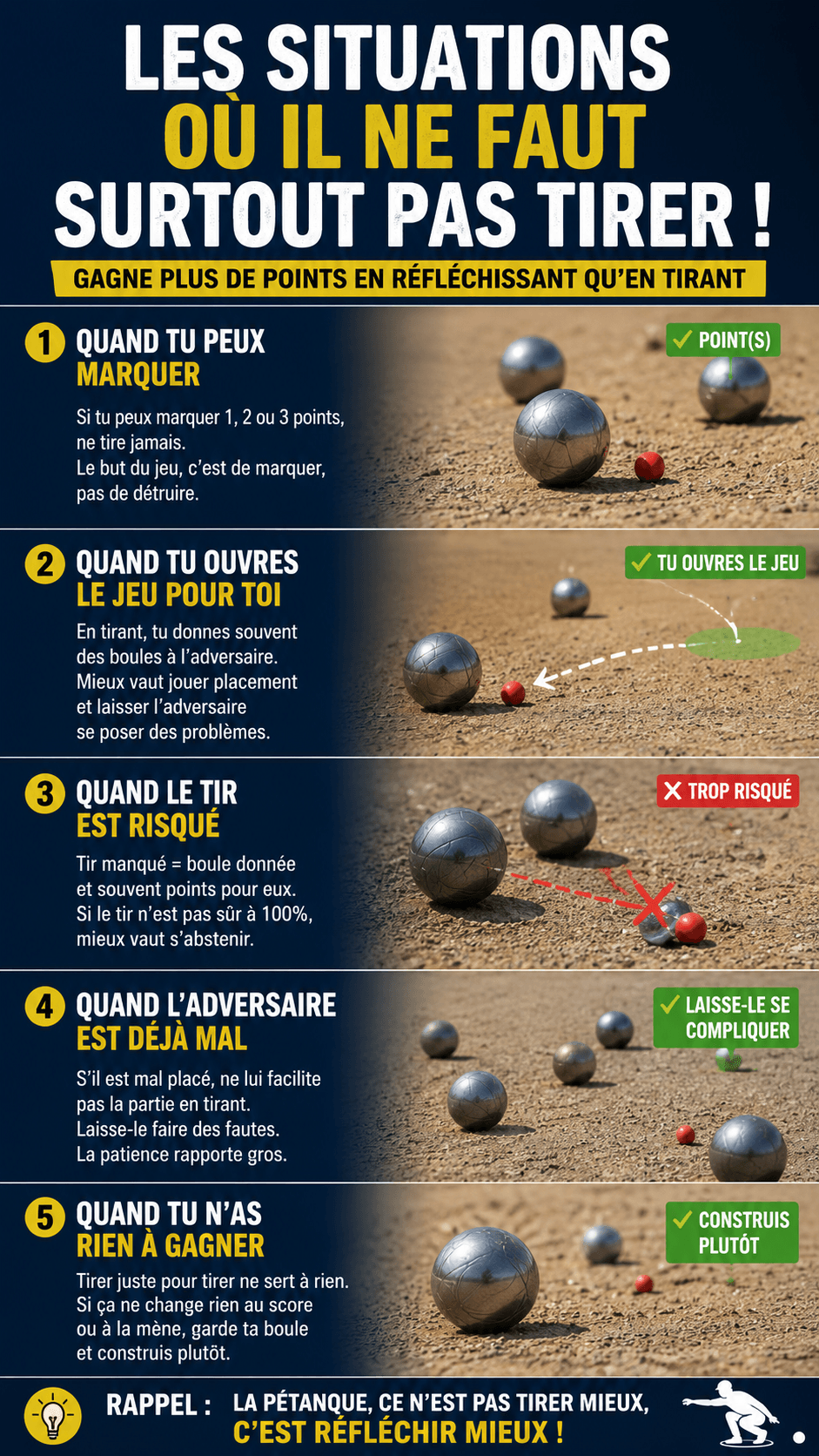
⚖️ HOW THE DECISION TO SHOOT SHOULD BE MADE — STEP BY STEP 👀 STEP 1 Read the situation: where is the jack, how many boules are in play, what is the score, and what is my role in the team? READING 🎯 STEP 2 Assess the risk of the shot: target difficulty, distance, terrain and the state of your technique at the time of the decision. ASSESSMENT ⚖️ STEP 3 Compare: what happens if the shot misses? If it succeeds? If I point instead? Which scenario carries the least risk? COMPARISON 💥 COMMON MISTAKE Deciding to shoot out of reflex, desire or pressure from the score — without assessing the true risk of failure. AVOID ✅ GOOD DECISION Shoot only when it is the strategy whose risk/reward ratio is objectively better than pointing in the given situation. RATIO! 🎙️ PAQUITA ON THE DECISION TO SHOOT "Shooting an opponent's boule means taking a risk. Sometimes that risk is fully justified — when the situation demands it and the shot is within your ability. But it becomes a tactical mistake as soon as you shoot out of habit, pride or because you have not taken the time to read the situation. The boule you missed and left in front of the jack is often a gift you have handed to your opponent yourself. Before shooting, ask yourself just one question: are the consequences of a miss acceptable compared with what I gain if the shot comes off?" — PaquitaThe 7 situations where you should definitely not shoot
🎳 1. You are the team's pointer — and it is not your turn to shoot ROLE TEAM DISCIPLINE WHY IT IS A MISTAKE The division of roles in pétanque is not an arbitrary convention — it is a tactical optimisation. The pointer has developed a technique for placing boules, not hitting them. An improvised shot by the pointer exposes the team to two problems: a high probability of failure, and a shooter who faces an already worsened situation if the shot misses and leaves a boule in a good position. → Alternative: tell the shooter about the situation and let them decide whether to shoot — that is their role and they are prepared for it. WHAT ACTUALLY HAPPENS The pointer shoots "because the opponent's boule is there and it would be a shame not to". The shot misses and the boule comes to rest against the opponent's well-placed boule. The shooter now faces a worse situation than before. The team loses the end even though it was well placed before the ill-advised shot. This scenario occurs several times per game in teams that do not maintain discipline over their roles. → Warning sign: if you regularly shoot "outside your role", it's often a team communication problem — agreeing before the game on who shoots and under what conditions prevents most of these mistakes. 📍 2. The opposing boule is glued to the jack — a miss would make things worse TACTICS GAME READING WHY IT'S A MISTAKE An opposing boule glued to the jack is a difficult target. A missed shot that deflects the jack toward the opposing boules can turn an unfavorable end into a catastrophe. The closer the target boule is to the jack, the higher the risk of the jack moving in an unfavorable direction — and this risk increases proportionally with the difficulty of the shot. → Alternative: point tight to create a situation where the opposing shooter will have to risk the shot themselves — and turn the pressure back on the opponent. THE RISK CALCULATION Before shooting at a boule glued to the jack, assess three scenarios: successful shot (boule knocked out, jack unmoved) — short miss (boule missed, nothing changed, one boule lost) — missed shot deflecting the jack (jack moved toward the opposing boules, catastrophic situation). The third scenario is more common than people think, especially under pressure. An honest assessment of its probability is essential before the decision. → Tactical rule: the closer the opposing boule is to the jack, the higher the mastery threshold required to shoot safely. If you're not 80% sure of making the shot, pointing is statistically the best option. 🏆 3. You already have several well-placed boules — the end is won SCORE END MANAGEMENT WHY IT'S A MISTAKE When your boule is 5 cm from the jack and the opponent has none left, the end is practically won. Shooting then "to clean up" or "to score more points" is tempting but dangerous. A missed shot deflecting the jack can hand the end to the opponent on a situation that was comfortably won. The rule is simple: when the end is won, don't take unnecessary risks. → Alternative: keep your remaining boules as insurance. If the opponent still has boules, they'll have to take risks themselves to take back the end. THE PITFALL OF GREED Some players shoot from a favorable position to "try to score more points". This logic ignores that going from 2 points to 1 point lost is a net loss of 3 points on an end that was won. The calculation is asymmetric: the marginal gain of a successful shot (1 more point) is less than the risk of losing the end (loss of 2 or 3 points). A won end is protected, not gambled on. → Warning sign: if you find yourself shooting when your boule is the closest, ask yourself whether the potential gain of the shot justifies the risk of losing what's already secured. The answer is almost always no. 🌍 4. The terrain is unfavorable for shooting — soft ground, uphill slope, difficult angle TERRAIN ADAPTATION WHY IT'S A MISTAKE Some terrains specifically penalize shooting: soft or sandy ground that absorbs the energy of the shot boules and stops them before the target — slightly sloping terrain that deflects the trajectory sideways — opposing boule at a difficult angle relative to the circle (too far to the side). Under these conditions, the chances of a successful shot drop noticeably, often without the shooter taking it into account in their decision. → Alternative: on soft ground, pointing is often more reliable than shooting because a rolling boule adapts better to irregularities than a boule on an arcing trajectory. HOW TO READ THE TERRAIN BEFORE DECIDING Observe the shots already taken during the game on this terrain. Do the shot boules arrive at the right height or do they sink in? Are the trajectories straight or deflected? These observations made during the first ends give a reliable picture of what shooting will be like in the following ones. Don't wait until you've missed 3 boules to understand that the terrain penalizes shooting that day. → Tactical rule: adapt your game to the terrain, not the other way around. A good player changes their decisions based on real conditions, not on their usual habits. The terrain dictates. 📏 5. The distance is outside your effective shooting range TECHNIQUE TACTICAL HONESTY WHY IT'S A MISTAKE Every shooter has an effective shooting range — a distance bracket in which their success rate is significantly higher than at their limits. Shooting outside this range without admitting it is a self-assessment error, not a lack of technique. A shot at 12 meters for a player whose effective range is 7–10 meters is statistically unreliable — regardless of motivation or the pressure of the moment. → Alternative: if the distance is too great to shoot with confidence, point short to bring the jack closer or let the game develop until a favorable distance. IDENTIFYING YOUR TRUE SHOOTING RANGE During training, objectively measure your success rate at different distances: 7 m, 8 m, 9 m, 10 m, 11 m, 12 m. The effective shooting range is where the success rate exceeds 50–60% under neutral conditions. Below that, pointing has every chance of being a better decision. This objective measurement, taken outside the heat of the game, is the basis of an honest tactical decision. → Warning sign: if you systematically miss your shots beyond a certain distance but keep shooting at that distance in competitions "because you have to", it's a self-assessment problem — not a lack of technique. 📊 6. The score demands caution — you're well ahead SCORE SCORE MANAGEMENT WHY IT'S A MISTAKE At 11–5, every end won ends the game — but every end lost puts the opponent back in the game. Asymmetric score management radically changes the risk/benefit ratio of each shot. A risky shot at 4–4 (balance: lose or win) is a different tactical mistake from a risky shot at 11–5 (asymmetry: the miss is more costly than the success of the shot would be beneficial). Playing cautiously when leading isn't fear — it's mastery. → Alternative: in a strong position on the score, systematically opt for the safe point. Force the opponent to take the risks — and wait for them to offer up mistakes themselves. THE ASYMMETRY OF THE SCORE The value of a won end isn't identical across all score situations. At 11–5, winning another end is the norm — losing one is the start of a comeback. At 5–5, winning an end is an advantage — losing one is neutral. This asymmetry should change tactical decisions: the bigger the lead, the more rationally justified caution is. It's not playing small — it's optimizing the probability of winning. → Score management rule: the leading team plays not to lose — not to score more. The trailing team plays to turn the situation around — and can therefore take risks that the leading team shouldn't take. 😤 7. You're in a degraded emotional or physical state MENTAL TECHNIQUE STATE WHY IT'S A MISTAKE Shooting is technically the most demanding pétanque action in terms of precision and reproducibility of the technique. It's also the most sensitive to negative emotional states: anger after a mistake, frustration from several lost ends, fatigue at the end of a long game. In these states, the probability of a successful shot drops well below its normal value — often without the player being aware of it at the time. → Alternative: recognize the degraded state and deliberately choose pointing until you regain a stable state. It's a decision of an experienced player, not an admission of weakness. THE SIGNS OF A DEGRADED STATE Urge to "avenge" a bad previous shot with a new shot. Shooting decision made in less than a second, without assessment. A motion that speeds up and loses its fluidity. Sensation of "forcing" in the arm. These signs indicate that the shooting decision is driven by emotion rather than tactics. Under these conditions, even a good shooter exposes themselves to an abnormally high failure rate. Recognizing the state is the skill that distinguishes experienced players. → Warning sign: if your urge to shoot is fueled by a negative emotion (frustration, irritation, desire to "recover" a lost point), it's precisely one of the situations where shooting is most risky. Point, take a breath, let the situation develop. 🎯 The 3-second rule before shootingBefore each shot, give yourself 3 seconds to mentally answer this question: "What happens if I miss?" If the answer is "it seriously worsens the situation", reconsider. If the answer is "it doesn't change much", then the shot is defensible. This single reflex eliminates the majority of unnecessary shots — the ones you'll still regret at the end of the game.
Quick decision guide in the circle
Before deciding to shoot, mentally run through this grid in less than 10 seconds. If more than two "shoot" boxes give a negative answer, pointing is the best decision.
💥 CONDITIONS FAVORABLE FOR SHOOTINGRole: you're the team's designated shooter or the situation clearly calls for it.
→ Key word: "adjust" — identify the gap, correct proportionally, regain fluidity. Not compensate, not make up for. 🎯 THE INFORMATION TO EXTRACT FROM THE FIRST BOWL the opposing boule is within your effective shooting range (the one where you succeed more than 60% in training).
Terrain: hard, flat terrain, clear trajectory with no obstacles in front of the target.
Risk of a miss: if you miss, the situation doesn't significantly worsen — the end is already unfavorable or the missed boule remains neutral.
→ If these 4 conditions are met: shooting is the right decision. 🎳 CONDITIONS FAVORABLE FOR POINTINGPosition: you already have a boule close by — pointing an extra boule consolidates the position without risk.
Winning situation: the end is favorable or already won — shooting is an unnecessary risk.
Score: you're comfortably ahead — forcing the opponent to shoot is more profitable than shooting yourself.
State: you're tired, emotional or your technique has drifted — pointing is more resistant to these states than shooting.
→ If one of these conditions is present: pointing is the safest decision. ⚠️ BORDERLINE CASES — SHOOT ONLY IF CONFIDENTBoule glued to the jack: shooting possible only if the usual success rate on this type of target is high AND if the terrain is favorable.
Limit distance: at the upper limit of the effective range, shoot only if a miss doesn't move the jack into a worse position.
→ These situations call for an honest assessment of your abilities, not a decision under pressure. 🛑 NEVER SHOOT IN THESE CONDITIONSScore: you lead 12–X and you're not the designated shooter. The potential miss is too costly.
State: you feel like "making up for" a previous missed shot. Emotional revenge is the worst reason to shoot.
End already won with an opposing boule remaining and the jack free — every shot risks moving the jack toward the opponent.
→ In these situations: point, systematically, without exception. 🔑The real tactical skill isn't knowing how to shoot — it's knowing when not to shoot. A shooter who shoots well in the right situations is more effective than a shooter who shoots often in every situation. Tactical discipline — refusing to shoot when the conditions aren't met — is a skill that's built deliberately, not an innate character trait.
The most common game-reading mistakes
🎭The pride of the situation Shooting because "not shooting here looks bad". This motivation has nothing tactical about it. The shooting decision should be guided by what maximizes the chances of winning the end, not by what maximizes the player's image. The best players shoot when it's the right decision, point when it's the right decision — with no consideration for image. → Test: if your decision to shoot would be different without an audience, then pride is influencing your tactics. 🔄The immediate-response shot The opponent just pointed well, you shoot immediately without taking the time to assess. This immediate-response reflex short-circuits tactical assessment. The fact that the opponent played well isn't in itself a valid reason to shoot — if pointing instead is safer in the situation, pointing is what you should do. → Test: did you assess the consequences of a miss before deciding to shoot, or did the decision impose itself automatically? 🧱The "bothersome" boule that isn't so bothersome Shooting at an opposing boule that's "a little" in the way without assessing whether pointing over or around it isn't simpler. Not every opposing boule deserves to be shot. A boule 15 cm from the jack isn't the same threat as a boule 3 cm away. Calibrate the urgency of the shot to the reality of the opposing threat. → Test: is the boule you want to shoot really an obstacle to a good point, or are you shooting out of an elimination reflex? 🎲The "let's see" shot Shooting without really believing in it, "just in case it goes in". This stance abandons the decision to chance. A shot without real conviction is almost always a missed shot — an under-invested motion produces unpredictable results. If you don't have confidence in the shot when you step into the circle, it's a clear sign it's not the right choice. → Test: before throwing, do you really believe you'll make this shot? If the answer is "maybe", point.Exercises to improve your reading of the game
01 The decision journal — analyzing your shots after the game 📍 After each game or competition ⏱️ 5–10 min 🎯 Identify the shots that shouldn't have been attemptedDevelop a post-game habit of analyzing shooting decisions — not the results, but the decisions themselves — to identify patterns of poor game reading before they become automatic.
Right after the game, mentally note (or on paper) the 2–3 shots that had the most negative consequences on the game. For each: what was the situation, what was the decision, and what was the result of the miss? For each identified shot, ask yourself the question: "In these exact conditions, should I have shot?" Apply the 7 situations listed above as an assessment grid. Was it a glued boule? An already-won end? A degraded emotional state? Identify the recurring pattern. Do the bad shooting decisions cluster around one type of situation? Unfavorable terrain? Won ends? Distance too great? This personal pattern is the basis for targeted work on tactical decision-making. In the next game, set a simple goal linked to the identified pattern: "today, I don't shoot at a boule glued to the jack unless I'm at 8 m or less and on favorable terrain". A single decision goal per game is more effective than a list of general rules. 02 The "no shooting" drill — developing confidence in pointing 📍 Training in pairs or as a team ⏱️ 1 h 🎯 Force game reading and the development of pointing in difficult situationsPlay a series of games with a simple rule: shooting is forbidden, whatever the situations. The goal isn't to "win without shooting" — it's to develop the ability to read the game and build favorable situations solely through pointing.
Play 3 complete games with no shooting allowed. Every bothersome opposing boule must be worked around with a more precise point — point behind, to the side, place a boule between the obstruction and the jack. These constraints force a tactical creativity that systematic shooting doesn't develop. Observe how the game unfolds differently. The situations that seemed to "require" a shot are often manageable with a good point. This observation changes the perception of what truly constitutes an urgent situation compared to a situation that can be played differently. After the 3 "no shooting" games, play a normal game with shooting allowed. Compare the shooting decisions made after the drill with the ones usually made. Most players shoot less and better after this drill — because they've developed concrete alternatives to instinctive shooting. Repeat this drill once a month. Over time, ease in pointing in complex situations increases — and the decision to shoot becomes more deliberate, less automatic. The freedom not to shoot is what makes the chosen shots far more effective. 🧠 Shooting is a weapon — not a reflexA shooter who shoots in every situation is predictable and drains their team with mistakes. A shooter who shoots in the right situations is formidable — because their shots are prepared, decided, and they've assessed the risk before stepping into the circle. Restraint in shooting is a skill — it's trained just as seriously as the shooting technique itself.
📚 PAQUITA'S BOOKS Progressing at pétanque — Paquita's guides 🎯 TACTICS — MENTAL — TECHNIQUE Playing everywhere — from technique to on-field tactics Game reading, decision management in the circle, role discipline in a team, development of pointing and shooting in all conditions — the complete guide to progressing in every dimension. 📦 Amazon 💥 SHOOTER — TECHNIQUE — CONSISTENCY Become a formidable shooter Stability of the shooting motion, identification of good shooting situations, decision routines in the circle, building a reproducible shot and solid tactical reading in all conditions. 📦 Amazon 🎳 POINTER — AWARENESS — LANDMARKS The art of pointing — precision and consistency The proprioceptive reference points of pointing, building favorable situations through placement, micro-adjustments — the guide for the pointer who masters their game in every configuration. 📦 Amazon 🧠 MENTAL — ROUTINE — METHOD Pétanque through method Decision protocols under pressure, managing emotional states in the circle, tactical discipline and developing automatic reflexes — progressing with method to be more effective in competitions. 📦 Amazon