Actualités · 6 June 2026
The importance of timing in the throw
The timing of the throw in pétanque — the moment of release, the synchronisation of the pendulum, the coordination between the body and the arm — is theThe anatomy of timing — the phases of the throw
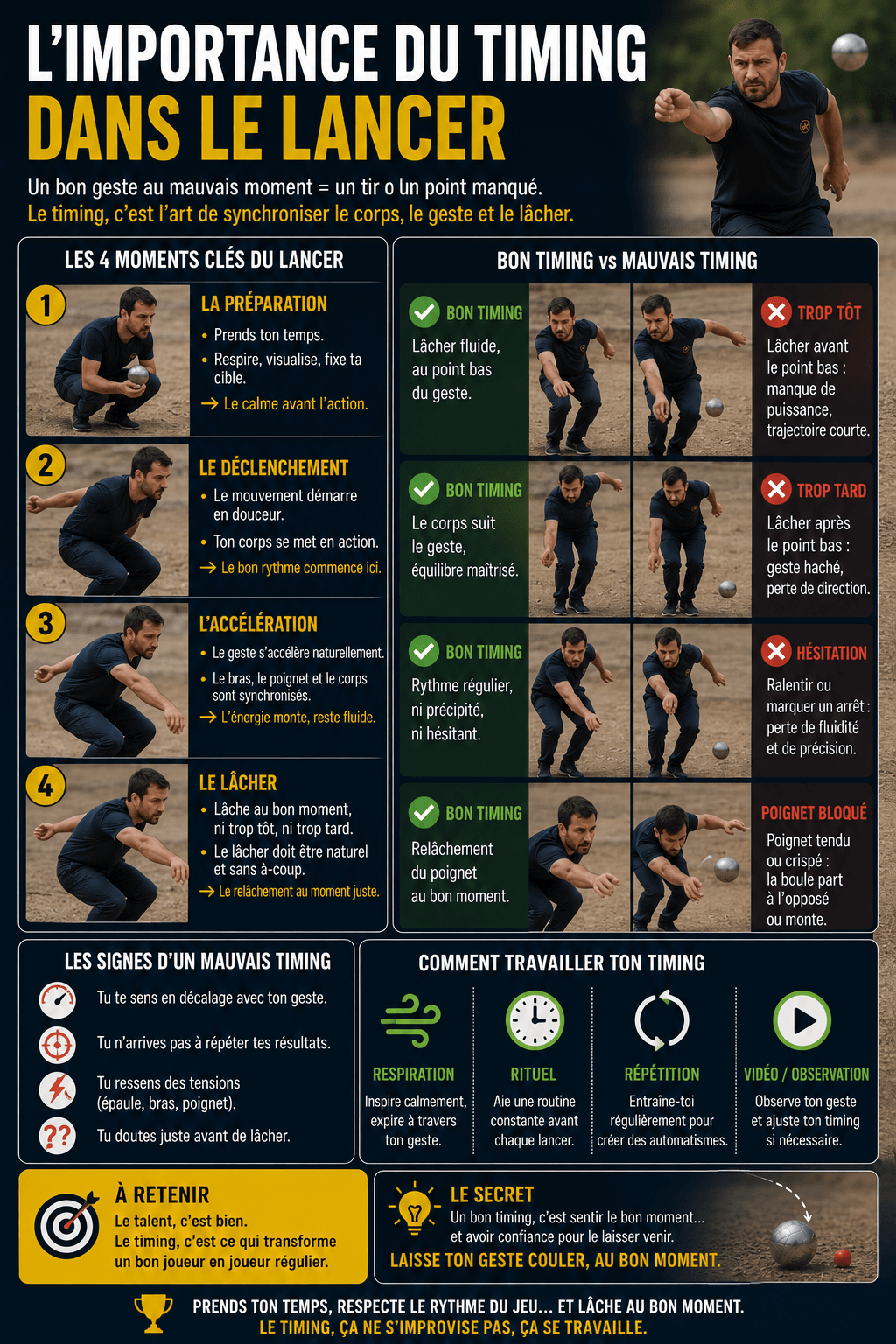
⏱️ THE PHASES OF THE THROW — EACH WITH ITS CRITICAL TIMING 🧍 SET-UP Entering the circle, positioning the feet, establishing balance. Timing starts here — a rushed set-up compromises everything that follows. FOUNDATION 🎯 FOCUSING THE GAZE The gaze locks onto the target. This moment of focus is the starting signal for the motion — the swing should only begin once the gaze is stable. START SIGNAL 🔄 BACK SWING The arm moves backward. The amplitude and speed of this movement directly determine the force available for the throw. Too short = short boule. LOADING ⬆️ HIGH POINT BACK Brief moment of suspension at the high point back. This natural "pause" is the moment of transition — too short and the motion becomes a whip; too long and it freezes. TRANSITION ⬇️ FORWARD SWING The arm accelerates forward. The regularity of this acceleration determines reproducibility. Any sudden or irregular acceleration shifts the optimal moment of release. ACCELERATION ✋ RELEASE The critical moment — the boule leaves the hand. A few tenths of a second too early or too late: direction and distance change. This is where everything is decided. CRITICAL MOMENT 🎙️ PAQUITA ON THE TIMING OF THE THROW "People think that playing pétanque well is about having a good arm. That's not wrong — but a good arm that releases the boule at the wrong moment still produces a missed boule. Timing is the glue between the motion and the result. Two players who make exactly the same swing can get very different results if one releases at the right moment and the other a fraction of a second too early or too late. It's that fraction of a second that makes the difference between a good player and a very good player." — PaquitaThe 6 dimensions of timing
✋ 1. The moment of release — the instant that defines the trajectory RELEASE ACCURACY WHY THE RELEASE IS SO CRITICAL The boule travels its trajectory in the exact extension of the arm's direction at the moment of release. A release 5 to 10 cm before or after the optimal point changes the launch angle by 1 to 3 degrees — which represents a deviation of 15 to 50 cm on a boule thrown at 8 meters. The optimal release window is narrowly limited: a few centimeters in the arm's trajectory, corresponding to a few tenths of a second. This is precisely why release timing is so hard to correct under pressure — the window is too short for a conscious correction. → How to work on it: in training, do series of throws while deliberately varying the moment of release — earlier, at the right moment, later. Observe the difference in trajectory for each one. This sensory awareness of the right moment is the basis of work on the release. THE OPTIMAL RELEASE POINT For a high-lob point, the optimal release point is located when the arm is approximately in line with the desired trajectory — neither too far back (boule that leaves too low), nor too far forward (boule that leaves too low or that deviates). For a shot, this optimal point is slightly different depending on the chosen shooting height. Each player develops their own optimal release point through experience — but it can be disrupted under pressure, fatigue or excitement without the player being aware of it. → Common error: releasing the boule "as it comes" instead of releasing at the precise point of the optimal axis. This passive release produces variable results from one boule to another — the boule follows the arm wherever it is at the moment the fingers open, not necessarily where it should be. → Test: on a series of 10 boules, observe whether they leave with different trajectories (some skim the ground, others leave too high) without the motion having consciously changed. This variation in trajectory is often caused by a release whose timing varies with each boule. 🔄 2. The synchronization between the back swing and the forward swing SWING RHYTHM WHY SYNCHRONIZATION IS CRITICAL The pétanque swing is a continuous movement — the back swing naturally continues into the forward swing. The quality of this transition defines the consistency of the acceleration toward the release. A back swing that is too short followed by a forward swing that is too fast produces an unbalanced motion whose optimal release point is hard to reproduce. A well-ampled back swing, followed by a fluid transition forward, creates a regular rhythm that makes it easier to reproduce the release at the same moment on every boule. → How to work on it: train with a metronome set to a comfortable tempo. Back swing over 1 beat, transition over 0.5 beats, forward swing and release over 1.5 beats. This rhythmic work develops the synchronization and consistency of the swing. THE CONTINUITY OF THE SWING AS A CONDITION The effective swing is continuous — without a sudden stop at the high point back, without sudden acceleration in the forward phase. Any discontinuity in the movement produces a change in the arm's trajectory that shifts the optimal release point. Players who "stop" at the high point before moving forward again often have trouble finding the right release timing — because the stop breaks the mechanical continuity of the swing and forces an "artificial" restart of the movement. → To remember: the fluidity of the swing is not an aesthetic goal — it is a mechanical condition for the consistency of release timing. A fluid swing maintains the rhythm and makes release at the same point easier. A jerky swing makes timing unpredictable. 👁️ 3. The synchronization between the gaze and the motion GAZE COORDINATION HOW THE GAZE DRIVES THE TIMING The gaze fixed on the target provides in real time the information that the brain uses to calibrate the release. When the gaze comes off the target before the release — to follow the arm, look at the ground, or anticipate the flight of the boule — the brain loses its calibration reference and the release is produced from incomplete information. This phenomenon is particularly common under pressure: the player "watches their boule leave" before it has even left, which shifts the release by a few crucial thousandths of a second. → How to work on it: impose the rule of keeping the gaze on the target throughout the motion, including after the release. The gaze does not follow the boule — it stays on the target. This gaze discipline improves release timing because it keeps the visual feedback loop active right to the end. THE PARADOX OF THE ANTICIPATORY GAZE Many players "watch their boule land" before it has even left their hand — a visual anticipation of the result that precedes the release. This anticipation is a manifestation of anxiety about the result — the brain wants to see the result before it happens, and the gaze anticipates accordingly. This visual detachment at the moment of release deprives the motion of its final visual guidance and systematically produces inaccurate boules. Recognizing it is the first step to correcting it. → Test: after a series of boules, note whether you remember when your boule left your hand or whether you "watched it leave" without feeling the release. If you watch it leave without feeling it, your gaze came off before the release — that is the sign of imperfect visually-guided timing. 🌬️ 4. The coordination between breathing and the release BREATHING BODY WHY BREATHING AFFECTS TIMING Breathing creates micro-muscular movements in the torso, shoulders and arms — movements that are seemingly imperceptible but enough to slightly alter the axis of the swing. Throwing on the inhale (torso rising) or on the exhale (torso falling) creates slightly different conditions for the release. Most consistent players throw naturally at the end of the exhale or in a slight breath-hold — that moment when the body is mechanically most stable. This breathing timing is often unconscious in good players but lost under pressure. → How to work on it: exhale slightly before entering the circle and throw during the slight natural pause between the exhale and the next inhale. This "breathing hollow" is the moment of maximum body stability. BREATHING UNDER PRESSURE Under pressure, breathing is disrupted: it speeds up, locks up, or becomes irregular. A player who has been holding their breath for 5 seconds before throwing will end up releasing the boule at the moment their body releases the breathing tension — which is not necessarily the right moment for the release. This breathing/release desynchronization is a frequent source of errors under pressure that players attribute to "the pressure" without identifying the precise mechanism responsible for it. → To remember: breathing is a timing parameter in its own right — not just stress management. Integrating a breathing routine into throw preparation (an exhale before entering the circle, throwing during the natural pause) improves body stability and timing consistency. 🦶 5. The coordination between the foot placement and the throw — the kinetic chain BODY FOOT PLACEMENT THE KINETIC CHAIN OF THE THROW The pétanque throw is not only an arm motion — it is a kinetic chain that runs from the ground up to the boule. The feet on the ground transmit stability to the leg, which transmits it to the hips, which transmit it to the shoulder, which sends it into the arm. Any break in this chain at the wrong moment disrupts the timing of the release. A micro-imbalance of weight forward just before the release, a parasitic contraction of the legs — each of these elements imperceptibly alters the axis of the arm at the critical moment. → How to work on it: train while deliberately feeling both feet on the ground throughout the throw — not only when entering the circle. Awareness of the foot placement during the motion keeps the kinetic chain active and stable right up to the release. WHEN THE FOOT PLACEMENT DESTABILIZES The foot placement destabilizes under the effect of muscular fatigue (knees locking), excitement (weight transfer forward in anticipation of the result), or rushing (entering the circle without a proper set-up). Each of these imbalances alters the kinetic chain and shifts the optimal moment of release — often without the player noticing, because they are focused on their arm and their target, not on their feet. → Chain rule: the timing of the release is conditioned by the stability of the whole body — not just the arm. An arm that swings perfectly from an unstable base will produce a release as unstable as its foot placement. 🎵 6. Personal tempo — finding and maintaining your optimal throwing rhythm RHYTHM ROUTINE EVERY PLAYER HAS AN OPTIMAL TEMPO The optimal tempo of the throw is the rhythm in which the synchronization of all the timing elements (swing, breathing, gaze, foot placement) occurs naturally and repeatably. This tempo is personal and stable for a given player — it changes little between training sessions, even over years. What changes under pressure is the ability to maintain this tempo: rushing speeds it up, fear slows it down or blocks it. Knowing your optimal tempo is the condition for detecting when it drifts. → How to find your tempo: record yourself on video during a pressure-free training session. Measure the time between entering the circle and the release over 10 to 15 boules. The median of these measurements is your natural tempo. Any significant deviation from this median is a drift signal. HOW TEMPO DRIFTS UNDER PRESSURE Two forms of drift: acceleration (the boule leaves faster, under the effect of anxiety or perceived urgency — the release is then premature), and slowing/blocking (the player hesitates, lengthens the swing, ends up releasing "to get it over with" rather than at the right moment). In both cases, the release is no longer at the optimal point — it is at the point where emotion has brought the body. Recognizing the drift is the first response: naming "I'm accelerating" allows a conscious correction to be triggered before the boule leaves. → Practical tool: give yourself a personal keyword for each drift — "too fast" for acceleration, "breathe" for blocking. These keywords, practiced in training, allow a quick correction in competition without needing to analyze the situation at length. 🎵 Good timing is felt — it is not calculatedA good release is not consciously "aimed" on every throw — that would be too slow and too costly in attention. It is felt: a feeling of a "natural exit" of the boule at the right moment, with no effort to hold back and no rushing. It is this feeling — soft, fluid, without resistance or abruptness — that is the sensory signal of good timing. Training it means learning to recognize this feeling and to distinguish it from the feelings of a "forced" or "rushed" release.
Too early vs too late — the two release errors
↖️ RELEASING TOO EARLY — THE CONSEQUENCESWhat happens: the boule leaves the hand before the arm has reached the optimal axis. It leaves with an excessive upward component — too high, too far, or deviating to the side depending on the exact position of the arm at the moment of the premature release.
Typical result: long boule (leaves with too much momentum), or high boule that bounces hard and slides beyond the target. In shooting: a boule that goes over the opponent's boule or that arrives at too shallow an angle to produce the intended impact.
Frequent cause: anxiety that triggers the opening of the fingers before the right moment, or an arm that has locked before the end of the back amplitude and "bounces" prematurely forward.
→ Proprioceptive signal: a feeling that the boule "escapes" from the hand — you feel it leave before you have decided to release it. ↘️ RELEASING TOO LATE — THE CONSEQUENCESWhat happens: the boule leaves the hand after the arm has passed the optimal axis. It leaves with a downward component — toward the ground, too short, or with an unwanted shallow trajectory.
Typical result: short boule (has lost momentum beyond the optimal point), or boule that hits the ground prematurely and stops before the target. In shooting: a boule that digs in front of the opponent's boule instead of hitting it directly.
Frequent cause: tensing of the fingers that holds the boule until the last moment, or hesitation in the motion that makes you "miss" the right moment and continue until the boule falls.
→ Proprioceptive signal: a feeling that the boule "resists" before leaving — you hold it an instant too long, as if the fingers did not want to open. ✅ GOOD TIMING — THE REFERENCE FEELINGWhat happens: the boule leaves the hand exactly when the arm is in line with the desired trajectory. The opening of the fingers occurs naturally, without restraint or rushing.
Typical result: a boule that follows exactly the intended trajectory — distance, height and direction match the intention. Surprise is absent: you "knew" it was going to go well.
Characteristic feeling: an impression of "continuity" between the motion and the result — the boule seems to be a natural extension of the arm's movement, not a thrown object but an object "sent" with intention.
→ This feeling is the internal calibrator of good timing. Identifying it and seeking it is the proprioceptive work of timing. ❌ THE SIGNS OF VARIABLE TIMINGBoules with very different trajectories: some skim the ground, others leave too high — without the motion having consciously changed. This is the signature of an unstabilized release timing.
Lack of consistency over the same distance: boules sometimes short, sometimes long on the same target without any conscious change of force. The release varies, which changes the exit angle and therefore the distance.
A feeling of "luck" or "chance": the impression that good boules arrive for no reason and bad ones too. This impression of chance is the signal of unmastered timing — the results are random because the release is too.
→ The apparent chance in the results is almost always the sign of a variable release timing — not an incoherent motion. 🔑The timing of the throw is the parameter that is hardest to correct through verbal instruction — "release earlier" or "hold longer" are inefficient cues because the release happens too fast for conscious control. The effective path is sensory: learn to recognize the feeling of the good release, then seek to reproduce that feeling on every boule. It is proprioceptive work, not cognitive work — and it is only done in training, not under the pressure of competition.
The signs of degraded timing
📉Results systematically in the same direction of error All the boules in a series short, or all long, or all slightly to the left — without any visible variation in the motion. This constant directional pattern is almost always caused by a release that is consistently shifted in the same direction. It is not a problem with the overall motion — it is a problem with the release point. The consistency of the error is paradoxically reassuring: it indicates a stable motion with only one parameter to adjust. → Test: if all the boules in a series land on the same side or at the same error distance, the motion is consistent — it is the release timing that needs micro-adjusting. 🎲Totally random results despite a consistent motion Boules that land in all directions and at variable distances — without any identifiable pattern. This apparent chaos is often the signal of a very variable release timing — each boule is released at a different moment of the swing, producing different trajectories. Paradoxically, this is harder to correct than a constant error because the cause lies in the stability of the timing, not in its direction. → Test: if the 5 boules of the same series land in 5 very different spots without a clear explanation, work on the consistency of release timing before working on the motion itself. ⚡Boules that leave "with a snap" or "with a slide" A feeling that the boule "snaps" at the moment of exit (abrupt release, too fast) or that it "slides" slowly out of the hand (late release with fingers opening slowly). These two feelings of abnormal release reveal synchronization problems between the opening of the fingers and the swing — one occurs too early relative to the other, or too late. The feeling of a "natural exit" of good timing is absent. → Test: ask this question after each throw — "did the boule leave my hand naturally or did I feel something abnormal at the release?" The honest answer guides the correction. 📊Timing degradation toward the end of a game The boules of the first ends are consistent, those of the last ends become inaccurate — without any apparent change in the motion. Fatigue degrades timing before it degrades the motion — the fine synchronizations (gaze-release, breathing-release, foot placement-release) gradually desynchronize under muscular and mental fatigue, producing increasingly variable releases. → Test: compare the consistency of trajectories between the first and last ends of a competition. A progressive degradation indicates a problem of maintaining timing under fatigue — a specific area to work on.Anchoring timing — how to automate the right moment
🎯 ANCHORING GOOD TIMING — 4 PROGRESSIVE STEPS From sensory discovery to automation under pressure 🔍 1. Identify the feeling of the good release — in pressure-free conditions In training alone, throw series of boules while focusing all attention on the feeling at the moment of release. What is the difference between the boules that leave well and those that do not leave well? Where in the swing does the release occur on the good boules? This proprioceptive identification takes several sessions but produces a lasting sensory reference. 🎵 2. Associate the good timing with a sensory anchor On the boules with the good timing, note what is felt in the hand, the arm, the shoulder, the breathing. Choose a short sensory descriptor — "fluid", "natural", "supple" — that captures the feeling. This word becomes an anchor: before each throw in competition, seek to reproduce this feeling rather than to reproduce a conscious technical motion. 🏋️ 3. Practice under progressive pressure Reproduce the good timing under conditions of increasing pressure — first alone with a simulated stake, then in a training game, then in a friendly competition. The goal is for the anchored feeling to remain accessible under pressure — which requires repeated exposure to stressful conditions while keeping the focus on the feeling of the release rather than on the result. 🔄 4. Restore timing after a drift — recovery protocol When timing drifts (irregular boules, a feeling of abnormal release), perform 2 to 3 empty throws (swing without a boule) while seeking the natural rhythm, then resume with the boule while seeking the anchoring feeling. This short protocol allows you to regain optimal timing without interrupting the game for long.Exercises to work on timing
01 The "metronome" exercise — developing the rhythmic consistency of the swing 📍 Solo training ⏱️ 20 min 🎯 Stabilize the swing tempo and anchor the release timingUse a metronome app on a smartphone (set to 60-80 BPM according to your natural tempo) to synchronize the pendulum to a stable external rhythm. This exercise develops the rhythmic regularity of the pendulum and stabilizes the release point.
Set the metronome to 70 BPM. Align the backswing with one beat and the release with the next beat. At first, the rhythm feels like it constrains the throwing motion — that's normal. The goal is not to play to a metronome in competition, but to develop rhythmic awareness of the pendulum by isolating the tempo factor. Play 20 boules to the metronome. Observe whether the trajectories are more regular than usual. Most players notice a significant improvement in the regularity of the trajectories — because the metronome forces a stable tempo that stabilizes the release point. This direct observation confirms the importance of rhythmic timing. After the metronome series, play 10 boules without the metronome while trying to internally reproduce the rhythm developed with the metronome. Observe whether the regularity holds. With practice, the internal rhythm replaces the metronome — the timing has become autonomous. Test different tempos (60, 70, 80 BPM) on different series. Identify the tempo that produces the best boules — that is your personal optimal natural tempo. This tempo is the reference to maintain and to return to when the timing drifts in competition. 02 The "feel the release" exercise — developing proprioceptive awareness 📍 Solo training ⏱️ 30 min 🎯 Develop sensory awareness of the optimal release momentThis exercise develops proprioceptive awareness of the release by forcing exclusive attention on the sensation at the moment the boule leaves the hand — not on the trajectory, not on the result, only on the feel of the hand and arm at the exact moment of release.
Throw 15 boules while closing your eyes after fixing on the target and throwing from the mental image of the target. This constraint forces attention toward proprioceptive sensations rather than toward vision. The boules will be less accurate — that is acceptable for this exercise. For each boule, mentally note immediately after the release: "natural release", "released too early" or "released too late". Open your eyes to see the result. Check whether the sensory classification matches the observable result: "released too early" → long boule? "released too late" → short boule? This sensory/result calibration is the heart of the exercise. After 15 boules, assess the correlation between the reported sensation and the observed result. If the correlation is strong, the proprioceptive awareness of the release is functional — it can be used as a guide in competition. If the correlation is weak, continue the exercise over several sessions until it develops. Once the correlation is established, reopen your eyes and throw while keeping your attention on the sensation of the release rather than on the trajectory. Aiming guides the direction, sensation guides the timing. This sharing of attention between vision (target) and proprioception (release) is the condition for throwing at a high level of regularity. 🏆 Timing is what separates levels of playTwo players can have the same overall technical level but very different timing levels — and it is often timing that makes the difference in the results. A player with an average throwing motion but stable timing will be more consistent than a player with an excellent throwing motion but variable timing. Timing is the least visible and most differentiating component of the throw. Working on it explicitly — proprioception, rhythmic regularity, resistance to pressure — is one of the most worthwhile training investments for genuinely improving.
📚 PAQUITA'S BOOKS Improving at pétanque — Paquita's guides 🎯 TACTICS — MENTAL — TECHNIQUE Play anywhere — from technique to on-ground tactics Throw timing, consistency of the throwing motion under pressure, developing proprioceptive awareness of the release, maintaining the optimal tempo throughout a game — the complete guide to improving in every dimension. 📦 Amazon 💥 SHOOTER — TECHNIQUE — CONSISTENCY Become a formidable shooter Shooting timing, the optimal release moment for each type of shot, timing consistency under pressure, building a shooting motion whose timing is stable from the first to the last boule. 📦 Amazon 🎳 POINTER — AWARENESS — REFERENCE POINTS The art of pointing — precision and consistency Release timing in pointing, proprioceptive awareness of the optimal moment, gaze-release-breath synchronization, developing a pointing timing that is reproducible in all conditions. 📦 Amazon 🧠 MENTAL GAME — ROUTINE — METHOD A methodical approach to pétanque Sensory anchoring of the right timing, protocols for recovering your rhythm after it drifts, maintaining timing under maximum pressure — a methodical way to improve the most decisive aspect of the throwing action. 📦 Amazon