News · 27 April 2026
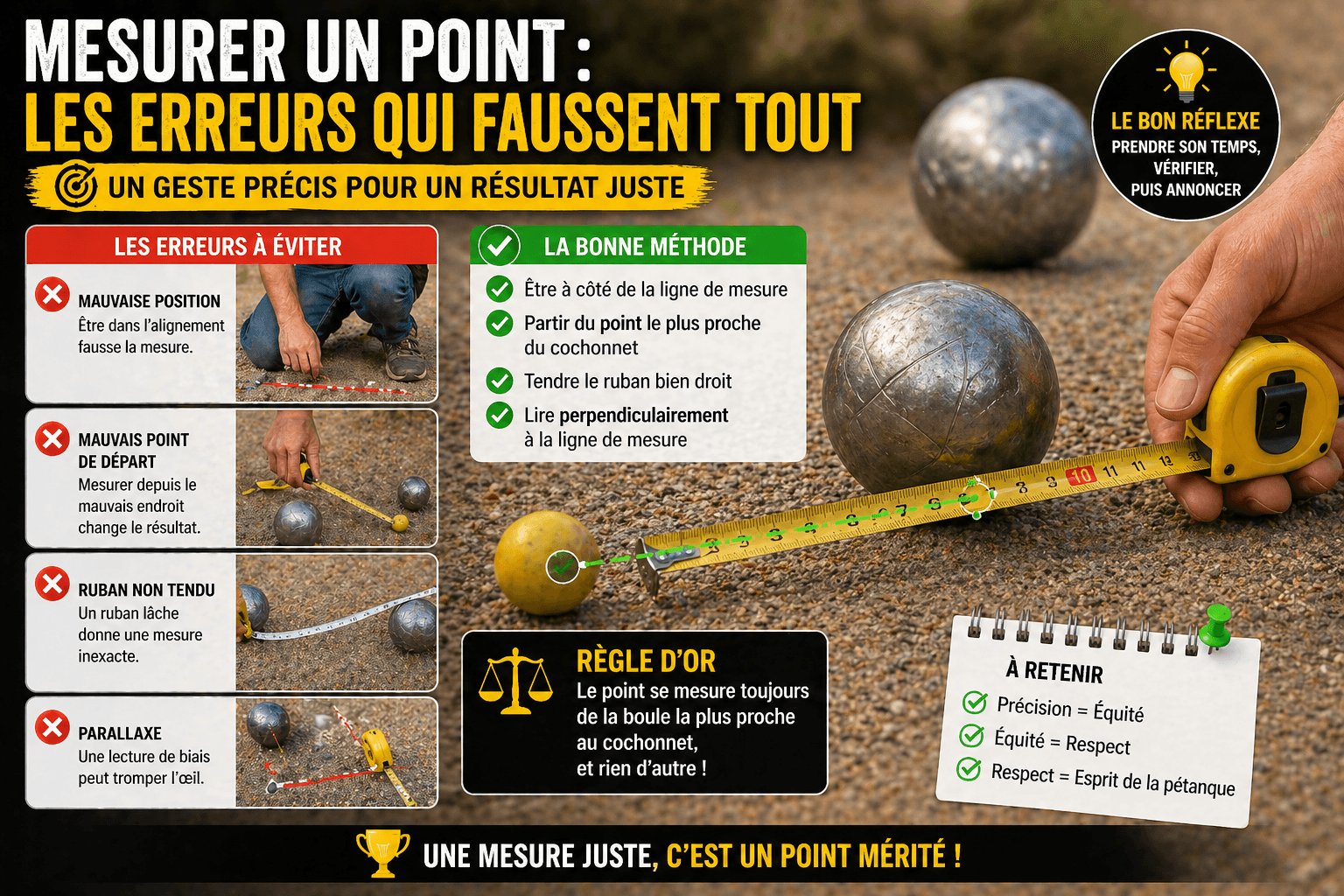
Measuring a point: the mistakes that skew everything
NewsThe tape measure placed badly, the ribbon that bends, the measurement taken in the wrong place... Measuring a point seems simple but is full ofThe principle of measuring — what we really measure
Before talking about mistakes, let's clarify what we measure. Measuring in pétanque determines which boule is closest to the jack. For that, we measure the distance between the point of the boule closest to the jack and the point of the jack closest to this boule. These are the two outer surfaces — never the centres.
📐 EXACT DEFINITION What we measure: two tangent surfaces
The boule and the jack are two spheres. The correct measurement is the distance between their outer surfaces at the point of closest approach — that is, the shortest distance between the two objects, in a straight line. This distance is called the edge-to-edge or surface-to-surface distance.
In practical terms: if you draw an imaginary line passing through the centre of the boule AND the centre of the jack, the correct measurement is the length of this line between the two surfaces — not between the centres, and certainly not by passing over or under the objects.
The 9 mistakes that skew the measurement
1 〰️ The measure's tape bending between the two boules HIGH IMPACTIt's the most frequent mistake and one of the most significant. The measure's tape, if not kept taut horizontally, sags slightly under its own weight between the two boules. The displayed length then corresponds to a curved line — longer than the actual straight line between the two surfaces.
The concrete effect: the displayed measurement is slightly greater than the true distance. If the two boules are very close to the jack and both curved measurements are taken in the same way, the error cancels out. But if one measurement is taken with the tape taut and the other with the tape curved, the result can be reversed.
❌ CURVING RIBBON Sagging tape = overestimated distance ✓ TENSIONED RIBBON Straight line = exact distance CORRECT METHOD Keep the tape taut and horizontal between the two contact points. If the distance is long (more than 50 cm), use the tape's lock function to keep it rigid. Never let the tape hang freely between the boules. 2 ↗️ The measure placed at an angle — not in the horizontal plane HIGH IMPACTWhen two boules are slightly different in size (one is bigger), or when the person measuring doesn't keep the measure perfectly horizontal, the tape goes at an angle — higher on one side than the other. The measured distance is then greater than the true horizontal distance.
This problem is amplified when the boule and the jack have very different diameters — the boule (70–77 mm) is noticeably bigger than the jack (30 mm). The natural tendency is to lay the measure on top of the boule and on top of the jack — which creates an upward angle towards the jack.
❌ OBLIQUE — TOP OF OBJECTS Oblique = overestimated distance ✓ HORIZONTAL — NEAREST SURFACES The closest points are at ground level CORRECT METHOD Place the measure touching the outer surfaces of the two boules at the point of closest approach — it's always at ground level, where the two spheres are closest. Kneeling down to see the contact point at ground level makes precision easier. 3 🏔️ The measure passing over an intermediate boule HIGH IMPACTBetween the boule to be measured and the jack, other boules may be in the path of the measure. The temptation is to pass the tape over these intermediate boules — which creates an upward curved path, far longer than the true direct distance.
The correct measurement always takes the direct distance in a straight line between the two surfaces, regardless of obstacles. The measure can pass between close boules, but never over them — which would impose a non-straight path.
CORRECT METHOD Find the shortest path between the two surfaces that stays in a straight line at ground level. If intermediate boules block the tape's passage, slide the tape between them delicately — without moving them. If the passage is genuinely impossible without moving the boules, use a taut string or a circular-wire type measuring compass. 4 🎯 The measure placed at the wrong point on the boule's surface HIGH IMPACTThe boule is a sphere. The regulatory contact point for measuring is the point on the boule's surface that is closest to the jack — not just any point. If you lay the measure on the side of the boule or on its top instead of its point closest to the jack, you measure a distance greater than the actual distance.
This mistake is subtle but produces measurable discrepancies: on a 74 mm diameter boule, measuring at the wrong point can add up to 10 to 15 mm to the measured distance — enough to reverse the result on a close end.
CORRECT METHOD The contact point on the boule is determined by the imaginary boule-jack axis. It's the point on the boule on this line, on the jack side. In practice: mentally align the boule and the jack, and lay the measure at the spot on the boule's surface that faces directly towards the jack — not on the side, not on the top. 5 📌 Placing the measure's zero on the boule's surface instead of next to it MEDIUM IMPACTSome players lay the end of the measure against on the surface of the boule (the zero touches the surface). Others lay it at the surface (the zero starts exactly at the edge of the boule). These two approaches seem identical but can introduce a discrepancy of a few millimetres depending on the measure used — notably if the metal hook at the end of the tape has a significant thickness.
CORRECT METHOD The zero of the measure must be positioned exactly at the outer surface of the boule — neither short of it (measuring air), nor inside it (measuring from inside the boule). The outer surface of the boule is the starting point. Same precaution on the jack side. Always use the same reference point for the two boules being compared. 6 ↩️ The tape not taking the direct path between the two objects MEDIUM IMPACTThe tape is laid but its path is not in a straight line between the two surfaces — it goes slightly diagonally, passes beside the jack instead of going straight at it, or makes a slight arc. Any deviation from the direct straight line overestimates the distance.
This problem often occurs when the person measuring is poorly positioned — standing instead of kneeling, or at an angle to the boule-jack axis. The viewpoint of the measurement influences the precision of the measure's path.
CORRECT METHOD Kneel or bend down to ground level to see the alignment head-on. Position your eye along the boule-jack axis to check that the tape is perfectly aligned. A side observer can also confirm that the tape is straight. 7 👁️ Reading the number in the wrong place — graduation error MEDIUM IMPACTThe tape is well placed, the path is straight, but the number is read with parallax — the eye is not directly above the contact point on the jack side. Result: you read a neighbouring graduation (1 or 2 mm offset) because of the viewing angle.
Over distances of less than 5 cm between two boules, a reading error of 2 mm can represent 5% error — enough to reverse the result if the boules are very close.
CORRECT METHOD Place your eye directly above the contact point on the jack side, along the vertical axis. The viewing angle must be perpendicular to the tape's graduation. In disputed cases, two people can measure independently and compare their readings. 8 🔀 Measuring the wrong boule — confusion over which is closer MEDIUM IMPACTWhen several boules from both teams are close to the jack, the eye can be mistaken about which appears closest. You start by measuring boule "b" when it's boule "a" that looks closest visually — and you conclude that "a" wins because the measurement of "b" is greater. But if you had correctly measured "a" first, you would have found that it's closer than the visual reading suggested.
CORRECT METHOD In situations with several close boules, measure all the boules that are candidates for the point — not just the one that looks closest to the eye. Visual estimates over distances of less than 3–4 cm are unreliable. Measure, confirm, then compare. 9 ✏️ Measuring without having marked the boules beforehand INDIRECT IMPACTIt's not a measuring error as such — it's an omission that makes any correction of the measurement impossible. If the measure slightly moves a boule during measuring and its position has not been marked, putting it back correctly is impossible.
CORRECT METHOD Before measuring, always mark the position of all the boules that are candidates for the point. This 10-second gesture protects against any accidental movement during measuring. See the full article on marking boules.The correct method step by step
✓ MEASURING PROTOCOL — 6 STEPS The method that leaves no room for doubt Mark the relevant boules before touching anything. A chalk mark, a marker, a coin placed behind the boule. Also the jack if the end is in its final phase and shots could move it. Kneel down to ground level, at the height of the boules to be measured. The top-down view distorts distances — only the side and head-on view gives a correct perception of the alignment. Identify the boule-jack axis visually — the imaginary line that passes through the centre of both objects. It's along this axis that the measure must be laid. Lay the zero of the measure exactly at the surface of the boule — at the point on the surface that is on the boule-jack axis, on the jack side. Neither inside, nor outside. Stretch the tape in a straight line up to the surface of the jack, at the corresponding point on the axis (boule side). Check that the tape doesn't bend and that it doesn't pass over any intermediate boule. Don't release the tension during the reading. Read the figure with your eye perpendicular to the tape, directly above the point of contact on the jack side. Announce the measurement out loud for both teams. Repeat the measurement if either team disputes it — without moving the boules. 🤝 The two-person measurement — best practice in a tight endFor critical measurements (decisive end, boules within 5 mm of each other), do the measurement with two people: one player from each team holds one side of the tape. This setup creates mutual oversight — neither team can accuse the other of measuring wrongly. If the two disagree on the reading, call an umpire. Never let a single player measure the opposing team's boules alone.
Measuring several boules at once — the right method
When several boules from both teams are close to the jack, the measurement must establish how many boules from one team are ahead of the other team's first boule. This count determines the number of points scored.
❌ COMMON MISTAKE — WRONG SEQUENCE →Measuring all the boules at once with no order of priority →Concluding the order without having measured all the candidate boules →Removing boules from play before all the comparative measurements are done →Mixing the measurements of the two teams without comparing them clearly →Deciding the number of points without having measured the opposing team's first boule ✓ CORRECT METHOD — 3-STEP SEQUENCE →Step 1 : visually identify which boule appears closest to the jack (across all teams) →Step 2 : measure that boule, note the distance. Measure the closest opposing boule. Compare. →Step 3 : with the winning boule identified, measure each subsequent boule of the winning team and compare it to the opposing team's first boule until you find the first opposing boule that "beats" a boule of the winning team. →The number of winning-team boules that "beat" the opposing team's first boule = the number of points for the end. →Announce the precise score before anyone removes or moves the boules.Measuring tools — a comparison
📏 Flexible tape measure (2–3m)The recommended standard tool. Flexible enough to pass between the boules, graduated in mm, with a tape lock. Suitable for 99% of situations.
RECOMMENDED 🧵 Circular thread compassA thread that pivots around a boule to measure the radial distance. Used by professional umpires for very close measurements. Eliminates errors from a curved tape.
EXCELLENT FOR ≤ 5MM 📐 Short rigid rulerUseful for very short distances (under 15 cm) — no risk of curvature. But limited in reach and hard to position correctly on round boules.
USEFUL AS A SUPPLEMENT 📱 Smartphone AR appAugmented-reality measurement. Accuracy of ±5 mm in the best conditions. Not recognized as an official measurement but useful for a quick indication.
UNOFFICIAL 🤚 Measuring by hand / "by eye"Comparing with the naked eye, without an instrument. Acceptable for obvious gaps (over 5 cm). Unacceptable for disputes — too subject to individual perception.
TO AVOID IN DISPUTES 🔴 Rigid builder's tape measureToo rigid to pass between close boules without moving them. Risk of distorting the layout. Graduations sometimes less precise in mm.
NOT RECOMMENDEDWhat to do when the two teams measure differently?
⚠️ DISPUTE PROTOCOL — DO NOT MAKE IT WORSEWhen two measurements give different results, the worst thing to do is repeat the measurement several times with the same method — if the method is wrong, it will give the same wrong result. The first action: identify which measurement is wrong and why, not just which of the two figures is "the right one".
⚖️ PROTOCOL IN CASE OF DISAGREEMENT 4 steps to resolve a measurement dispute Do not move the boules during the disagreement. If the boules were not marked and the measurement moved them slightly, the situation is compromised — call an umpire immediately. Identify the source of the disagreement : did both teams use the same point of contact on the boule? Was the tape taut in both cases? Does one of the measurements have a visible problem of curvature or obliquity? Measure together : one player from each team holds the tape. Agree on the exact point of contact before reading. Read together — if both teams see the same figure, the disagreement is resolved. Call an umpire if the disagreement persists. The umpire has final authority and the official instruments. Their measurement is final. Do not "just play on" hoping the next end will make the question moot — the precise score must be established before continuing. 📖 PAQUITA'S BOOK Every mastered gesture — technique and rulesMeasuring, marking, umpiring, stance, swing... Paquita's book covers every gesture of the game with the same rigour as the technique, with 100 numbered exercises to ingrain the right reflexes.
📦 Order on AmazonFAQ — Your frequent questions
Does a player have the right to refuse to allow an opponent to measure and insist that it be the referee? + Yes. In official competition, any team can request that the measurement be made by the referee — this is a regulatory right. The referee cannot refuse a request for a measure from a team. In practice, in games without a referee, players measure themselves, ideally with a representative from each team holding one side of the meter. Refusing to allow an opponent to touch his balls to measure alone is a good practice in disputes — but he must then accept that a representative of the opposing team observes the measurement closely. How accurate is a standard petanque tape measure? + A standard quality tape measure has a graduation accuracy of one millimeter. But the actual accuracy of the measurement depends on how it is used — all the errors described in this article can introduce deviations of 1 to 15 mm. For very short distances (less than 10 mm between two balls), standard tape measurement reaches its practical limits. High-level referees use wired circular compasses or specialized instruments for these situations. For the vast majority of club games, the accuracy of properly used standard tape is more than sufficient. Can a slightly off-center ball (impact mark, deformation) distort the measurement? + Theoretically yes — a ball that is no longer perfectly spherical (impact marks, chipping) may have its closest point to the jack slightly different than it would on a perfect sphere. In practice, deformations due to normal wear are so small (a few tenths of a millimeter in general) that they have no measurable impact on the measurement. A ball exhibiting visible and significant deformation that alters its spherical shape may be challenged as non-compliant and excluded from play — but this is an extremely rare situation. Can you measure with any object — a sheet of paper, a stick — if you don't have a meter? + In official competitions, the measurement must be made with an appropriate instrument — a measuring tape. An unscaled piece of paper or a stick are not valid measuring tools in a formal dispute. On the other hand, in a friendly game or to give a quick indication, using a sheet of paper as a "template" (placing it between the two balls and the jack to see which hits first) is a practical method of relative comparison - but it does not give an absolute distance, only a comparison. This is sufficient for informal parties but not for competitive litigation. 📎 Related articles Rules Complete FFPJP rulebook 2026 Rules Ground marks — how and why to mark your boules Rules The little-known rules of pétanque Rules Smartphone video umpiring Rules The one-minute rule Tools Free PetanqueLand tools© Pétanque by Paquita — petanqueland.fr · 📖 Paquita's book on Amazon