News · 16 April 2026
Organising a wild and friendly tournament
NewsNo licence, noBefore the tournament — the decisions to make
A wild tournament is prepared by answering six questions before the big day. These decisions shape everything else — the length, format, logistics and atmosphere.
1 How many participants? That's the first question — it determines the whole format. Estimate a realistic number (not the number invited, the number who will actually show up). Plan for backup teams for last-minute dropouts. The rule: if 16 people say yes, plan for 12 and you'll end up at 14. If 10 say yes, plan for 8 and you'll end up at 9–10. Simple tool: a WhatsApp group with a "Yes / Maybe / No" poll. Count only the "Yes" answers. 2 Doublette or triplette? For a friendly tournament, the doublette (2 players per team) is often better: teams are smaller and easier to form, games are faster (30–40 min), and with uneven headcounts (9, 11 players...) it's easier to distribute. The triplette works better with exactly 12, 15 or 18 players. A mix is possible if the headcount is odd. For non-players in the group, the doublette lets everyone play without feeling "lost" in a triplette whose roles they don't yet understand. 3 Participants' level A mix of beginners and experienced players? That's the most common case in a family or friends tournament. The solution: intentional mixed draw — each team must have at least one experienced player. It balances the levels and lets beginners learn alongside better players. Before the draw, identify the 3–4 best players and spread them manually across different teams before drawing the rest at random. 4 Desired length An afternoon (2pm–6pm) → 3 to 4 pool games + final. A summer evening (6pm–10pm) → 2 to 3 games + final + drinks. A full day → a more structured format with more games. Don't overload the schedule — 3 well-played games and a memorable final beat 6 games where everyone is exhausted by the 4th. Allow 40 to 50 min per doublette game, 50 to 60 min per triplette game, plus 15 min of transition between games. 5 Available court(s) How many courts do you have? One court = two teams playing at once. To avoid making people wait, ideally you need as many courts as simultaneous matches. With 16 players in doublette = 4 teams playing = 2 courts minimum. With 24 players = 6 teams = 3 courts minimum. If short on courts, alternate matches but make sure waiting teams have something to do (entertainment, refreshments, a score to follow). 6 Prizes, giveaways or symbolic? Not mandatory but highly recommended to create a stake that boosts the atmosphere. Symbolic and humorous prizes are often more fun than real cash. A cardboard trophy, a bottle of rosé for the winners, a box of jacks for the last-place finishers... The symbolic stake is enough to create healthy competition. Also plan a "special" prize for the best shot of the day or the finest boule — it creates memorable moments outside the official standings.The 4 formats by headcount
👫 The intimate tournament 6–12 players 2–3hSimple pool format: 3–4 teams of 2 players face off in a round-robin (each team plays all the others). The final pits the top two teams from the final standings against each other.
Ideal for: family, close-knit group of friends ✓ Everyone plays often — no long waits ⚠ If fewer than 4 teams: each team plays too little 🎯 The Mêlée (Swiss) 12–20 players 3–4h All levelsMêlée format (Swiss system): after each game, teams with the same record meet. Winners play winners, losers play losers. After 3–4 games, the overall standings are set. Final between the two best teams.
Ideal for: varied groups with skill gaps ✓ No one plays an opponent who is too strong/weak after 2 games ⚠ Requires a bit more bracket management 🏆 Double elimination 8–16 players 3–5hSingle-elimination bracket with a losers' bracket: a loss drops you into the "losers" bracket but you're only eliminated on your second loss. The two brackets cross over in the final. More games for everyone than single elimination.
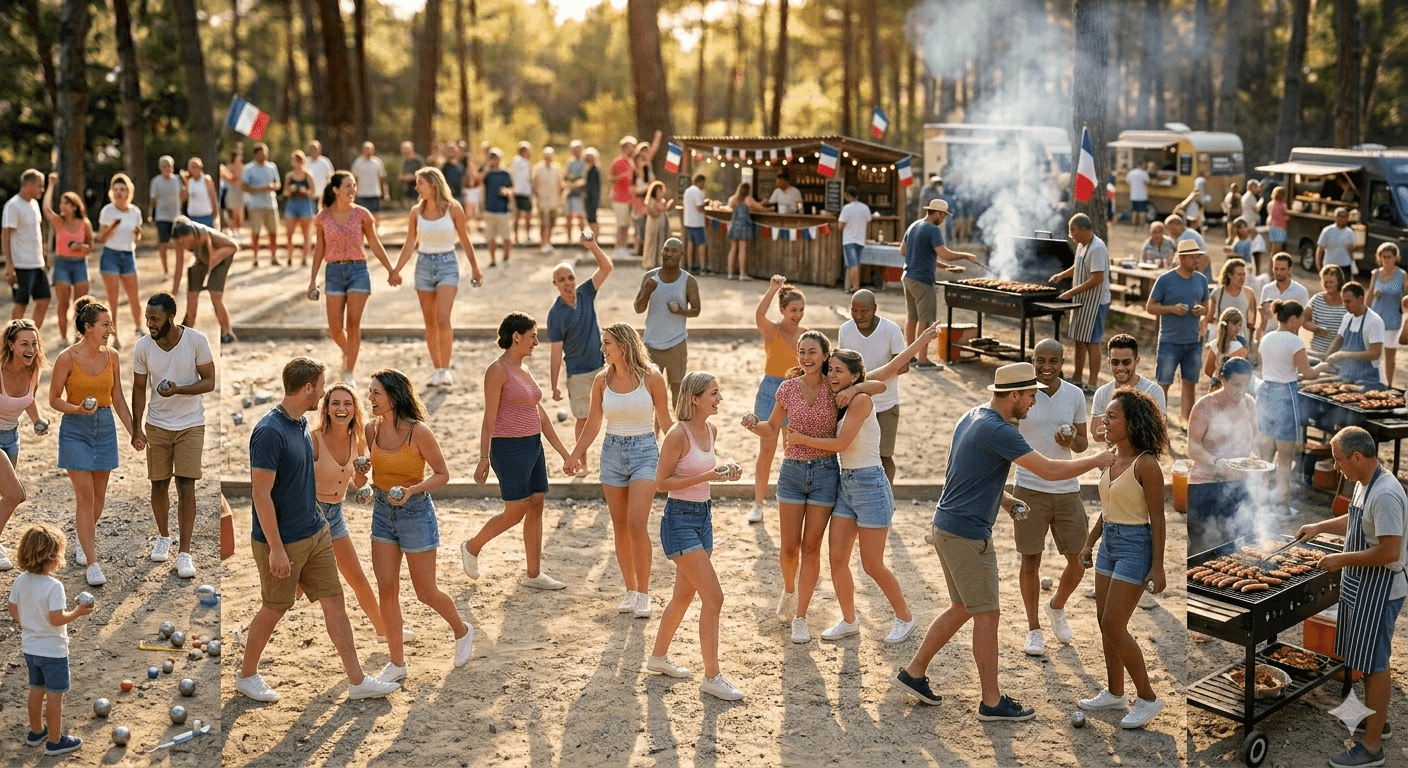
Ideal for: competitive groups who want to play for a long time ✓ You play more — a single loss doesn't kill you ⚠ More complex bracket — plan for a physical bracket 🎲 The Mix tournament 12–24 players 2–3h Pure friendlinessFor each game, teams are redrawn. No one plays with or against the same people twice. At the end, an individual points standings. It encourages mixing and breaks up "cliques" — ideal for integration.
Ideal for: company events, integration tournaments ✓ Maximum mixing — the friendliest of all ⚠ Less team cohesion — less competitiveQuick guide — format by headcount
| Participants | Recommended format | Teams | Min. courts | Estimated length |
|---|---|---|---|---|
| 6 players | Round-robin pool | 3 teams of 2 | 2 courts | 1h30–2h |
| 8 players | Pool + final | 4 teams of 2 | 2 courts | 2h–3h |
| 12 players | Mêlée 3 games | 6 teams of 2 | 3 courts | 2h30–3h30 |
| 15 players | Mêlée + triplettes | 5 teams of 3 | 3 courts | 3h–4h |
| 18 players | Mêlée 4 games | 6 teams of 3 | 3 courts | 3h30–4h30 |
| 20–24 players | Mix or pools + final | 8–12 teams of 2 | 4–6 courts | 3h–5h |
Forming and drawing the teams
🎲 THE ART OF THE FRIENDLY DRAW Balancing the levels without saying so A purely random draw in a mixed group (beginners + experienced players) creates unbalanced matches from the first game — demotivating beginners and frustrating good players. The solution: the invisible weighted draw.Before the draw, the organizer mentally identifies (or on a hidden slip) the 3–4 best players in the group. They "reserve" them to place manually on different teams. Then they draw the rest at random and distribute the best players across the teams thus formed. The result: each team has at least one solid player, matches are balanced, and the draw looks completely random to everyone.
Alternative: the snake draft — participants are ranked by presumed level (1 = best, N = last) and teams are formed snake-style: team 1 = player 1 + player N, team 2 = player 2 + player N-1, and so on. A guaranteed balanced result. 🎫 The festive draw — the hat method
For a friendly tournament, the "hat method" draw always creates a highlight: write each first name on a slip, fold it, drop it in a hat (or a turned-around cap). The organizer draws two names per pull for doublettes, three for triplettes. The suspense, the reactions as people discover their partner, the affectionate "oh no, not him!" — it's a moment of friendliness in itself. Don't underestimate the ritual value of the draw.
Recommended wild rules
In a wild tournament, the official FIPJP rulebook can be simplified or adapted. Here are the most common adaptations and their rationale.
📏Simplified scoringPlay to 11 or 13 points (instead of 13) depending on the time available. Dropping to 11 speeds up games by 15–20 min and allows more games in the day.
⏱️Time rule per endThe official one-minute rule can be relaxed to a "2-minute" rule for beginners — less stress, more fun, and the natural progression toward 1 minute comes with experience.
🤝Amicable measuringOn a measuring dispute, both teams measure together and accept the result. No referee = no appeal. Friendliness beats the millimeter. If disagreement persists, replay the end.
🎯Jack out of boundsIf the jack goes off the court, two options depending on the group: replay from the same circle, or place the jack at an agreed distance (3m from the edge). The key: decide the rule BEFORE the tournament and apply it uniformly.
👶Flexible circle for childrenFor children under 12: allow an advanced circle at 4–5 meters from the jack instead of the 6-meter minimum. Or allow playing from any point within a zone. Pétanque must be accessible from the youngest age.
🔄No boule inspectionIn a wild tournament, no approval checks. If someone plays with supermarket boules, that's their choice — they won't do them any favors but it doesn't ruin the party. Unless the organizer wants a minimum of rigor.
🍺The drinks ruleA popular option: on every "carreau" (the boule lands exactly in the opponent's boule's place), the opposing team buys a round. Adapt it to age and context — replace with "the opposing team picks up the boules for the next end" in alcohol-free tournaments.
🏳️Conceding an endIf a team is clearly hopeless at the end of an end (opponent with 5 boules, 3 on the jack), allow the end to be conceded rather than playing 15 minutes to confirm an obvious result. It speeds up play and preserves dignity.
📋The most important rule in a wild tournament: the rules are decided BEFORE the first throw and apply to everyone the same way. The worst scenario isn't having rules slightly different from the official ones — it's applying them differently depending on the team or changing them mid-tournament after a protest.
Court logistics — what to prepare
1 The tournament bracket — visible and kept up to date A physical bracket (slate, whiteboard, large sheet on the wall) visible to all participants is essential. It must display at all times: the matches in progress, the upcoming matches, and the live standings. The lack of a bracket creates confusion and forces the organizer to answer "who do we play next?" 40 times. Download a tournament management app (Challonge, Braacket, Jeu-de-pétanque.com) — they auto-generate matches and standings. Display on a screen or print the bracket after each game. 2 The boules — managing loans In a friendly tournament, not everyone has their own boules. Plan a stock of loaner boules — at least one triplette's worth per available court. Clearly identify the borrowed boules (labels, colored tape, marker) to avoid mix-ups at the end. Nothing is more frustrating than finding three mismatched boules at the end of the day. Inventory the boules BEFORE the start and AFTER the finish. 5 minutes that prevent arguments. 3 Marking out the courts If the courts aren't already marked, mark the boundaries with string, cones, sticks or chalk. The boundaries must be visible from both ends of the court. A court without boundaries generates disputes over "was the boule out or not?" — especially when the score is tight. Recommended minimum length: 12 meters. Minimum width: 3 meters. On a natural terrain, even stones laid on the ground are enough to mark the boundaries. 4 Enough tape measures and jacks Plan for one tape measure per court and a stock of spare jacks. Jacks get lost easily in grassy or gravel areas. A stock of 5–6 jacks for a day-long tournament is reasonable. Paint the jacks bright red or mark them with a fluorescent marker — they get lost far less. 5 Shade area and refreshments In summer, a shaded area with chairs and a cooler is a necessity, not a luxury. Waiting teams must have a comfortable spot. A team that waits 30 minutes in the sun at 35°C arrives in poor shape — and the organizer will hear about it. If the venue has no natural shade, a parasol or shade sail is enough. Plan the location in advance.Running the tournament in real time
🎙️ Paquita on organization "I've organized dozens of wild tournaments. The golden rule I learned the hard way: appoint someone else as 'bracket manager'. The organizer can't manage the bracket AND play AND answer questions AND check that games are moving. If you're playing, delegate the bracket. If you want to manage the bracket, don't play. Those two roles are incompatible at the same time in a tournament of more than 8 teams." — Paquita ⚑ Make sure everyone is playing The golden rule of the friendly tournament: no one should wait more than 20 minutes without playing. After 15 minutes, if a team is waiting, it's an alarm signal. Either a previous match is running too long (step in), or there's a bracket error (fix it immediately). ⚑ Handling game delays If a game runs too long and blocks the bracket, two options: 1) Set a time limit (e.g.: at 1h30, the game stops and the leading team wins). 2) Play to 11 points for subsequent games if playing to 13 creates delays. Announce the time rule BEFORE the tournament to avoid mid-game protests. ⚑ Announcing matches out loud At each new round, announce matches clearly out loud: "Red team against blue team — court 2!" Participants absorbed in conversation don't necessarily watch the bracket. A whistle blow + a verbal announcement avoids the 10 minutes lost tracking down where everyone went.Common problems and their solutions
❌ PROBLEM ✓ SOLUTION ❌Odd number of participants at the last minute — a "bye" creates a team that doesn't play. ✓Plan a "phantom" team (the bye) that gives a forfeit win to the team it meets. The team with the bye counts a 13–0 win. It rotates — each team only gets it once. ❌Dispute over a measurement that can't be settled without a referee. ✓Replay the entire end. It's the "doubt = replay" rule — less unfair than an arbitrary call and it keeps the mood good. ❌A very strong player who crushes everyone and creates pointless matches. ✓Impose a "friendly handicap" — the strong player plays with one hand behind their back for some boules, or their team plays 2 boules against 3. Present it with humor as a "mark of respect for their level." ❌Last-minute dropout that unbalances the teams. ✓Have 1–2 informal "substitutes" in the group (people who would come if asked). As a last resort, the organizer can play with the understrength team to balance things out. ❌Games that drag on and overrun their slot. ✓Set the time rule from the start (max 50 min per game). Or drop to 11 points. Or limit to 3 games with no final if time is short — a short evening that ends well beats a long one that ends in exhaustion. ❌Conflict between two players over a rule's interpretation. ✓The organizer decides — their decision is final for that game. Announcement: "In this tournament, I'm the referee and my decision is final. We're here to have fun, not to plead." A clear, firm decision beats a debate that poisons the atmosphere.The atmosphere and the little details that make all the difference
🎵 Background musicA light, cheerful playlist in the background completely changes the atmosphere. Moderate volume — enough to set the mood, not enough to interfere with conversations and announcements. Avoid playlists that are too personal and please half the group while boring the other.
🏅 The prize ceremonyEven symbolic, a real prize ceremony creates a highlight. Prepare a few humorous words about each team, an improvised podium, a "presidential" speech for the winners. These 10 minutes are worth the whole day.
📸 Photos and memoriesDesignate an unofficial photographer or set up a tripod with a self-timer for group photos. A photo album or a shared-photo WhatsApp group after the tournament extends the pleasure for several more days.
🎯 Side contests"The finest carreau of the day," "the most spectacularly missed shot," "the boule closest to the jack on the day" — micro-contests within the contest create sharing moments and value players who aren't at the top of the main standings.
🍾 The mid-tournament drinks breakA collective drinks break at the halfway point (after 2 games) releases the pressure, encourages discussion between teams that haven't crossed paths yet, and creates a moment of group cohesion. 20 minutes well spent for the second half.
📋 Humorous statsWhen announcing the results, a few light stats: "the team that played the most ends," "the team with the biggest point difference," "the player who walked the farthest to pick up their boules"... These little details show the organizer was paying attention.
The organizer's checklist
✅ COMPLETE CHECKLIST — WILD TOURNAMENT 📅 1–2 WEEKS BEFORE ☐Invitations sent, number of participants confirmed ☐Tournament format and rules decided ☐Reserved or confirmed land (boulodromès, garden, park) ☐Balls on loan listed if necessary ☐Lots or symbolic prizes prepared 🌅 ON THE D-DAY — BEFORE THE PLAYERS ARRIVAL ☐Demarcated and marked terrain ☐Tournament table prepared and displayed ☐Loan balls available and identified ☐Piglets in stock (minimum 4–5) ☐Tape measures available (1 per lot) ☐Refreshments and shade area installed ☐Music and speaker ready (if provided) 🎯 DURING THE TOURNAMENT ☐Rules briefing to all participants before the first match ☐Teams drawn (hat or weighted method) ☐Table updated after each game ☐Monitoring waiting times (person > 20 min without playing) ☐Mid-tournament aperitif break (if planned) 🏆 AT THE END ☐Awards ceremony prepared and announced ☐Collective group photo ☐Inventory of balls borrowed and returned ☐Terrain cleaned and markings recovered ☐Sharing photos on the tournament group 📖 PAQUITA’S BOOK Pétanque from A to Z — technique and convivialityRules, technique, tactics, organization... Paquita's book covers every dimension of pétanque with 100 numbered exercises to improve while keeping the fun in playing.
📦 Order on AmazonFAQ — Your frequent questions
Is authorization required to organize a tournament in a public park? + It depends on the municipality and the park. For a purely private tournament between friends without entry fees, most municipalities do not require formal authorization for occasional use of a public pétanque court. On the other hand, if you wish to install equipment (tables, tents, amplified speakers), block off the land for a long period of time, or practice an activity with an entry fee, a request for permission from the town hall is necessary. For club bowling courts, ask the club for permission to use them — a small fee is often required. How to manage a group with a mix of adults and children? + Two approaches depending on the age of the children. If the children are 10–14 years old and understand the rules: integrate them into mixed adult/child teams — the adult plays their two balls normally, the child plays from an advanced circle (4–5 meters). If the children are younger (6–9 years old): organize a parallel mini-tournament on an adjacent field with ultra-simplified rules, while the adults play the main tournament. Children love having "their own tournament" with a medal at the end. Are there mobile apps to manage the wild tournament table? + Yes, several. Challonge.com (free, web app) automatically generates single-elimination brackets and group management. Braacket.com offers similar formats. For pétanque specifically, some clubs use pre-formatted Excel sheets for scrum – there are models that can be downloaded for free from pétanque federation sites. The simplest method is a whiteboard or slate with the results updated by hand — anyone can read it without having to take out their phone. How to deal with participants who don't know the rules at all? + Plan a 5-minute briefing before the first match - no more, the essential rules can be explained in less than 5 minutes. The essential elements: how we throw the jack (distance, visibility), how we throw the balls (regulation circle, feet on the ground), how we count the points (the balls closest to the jack), how we win the lead (first to 13 points). Everything else is learned during the games. Put beginners with experienced players and let them explain the rules in a real situation — it's 10 times more effective than a theoretical explanation. 📎 Related articles Rules FFPJP rulebook — the official reference Rules The one-minute rule — explained simply Regulations 2026 regulation playing distances Equipment Choosing your first boules — a beginner's guide Competitions Official 2026 calendar — to go further Tools Free PetanqueLand tools© Pétanque by Paquita — petanqueland.fr ·
📖 Paquita's book on Amazon
For official competitions with FFPJP rankings, check with your departmental committee or the official calendar. This article is intended for private, unofficial tournaments.