News · 28 April 2026
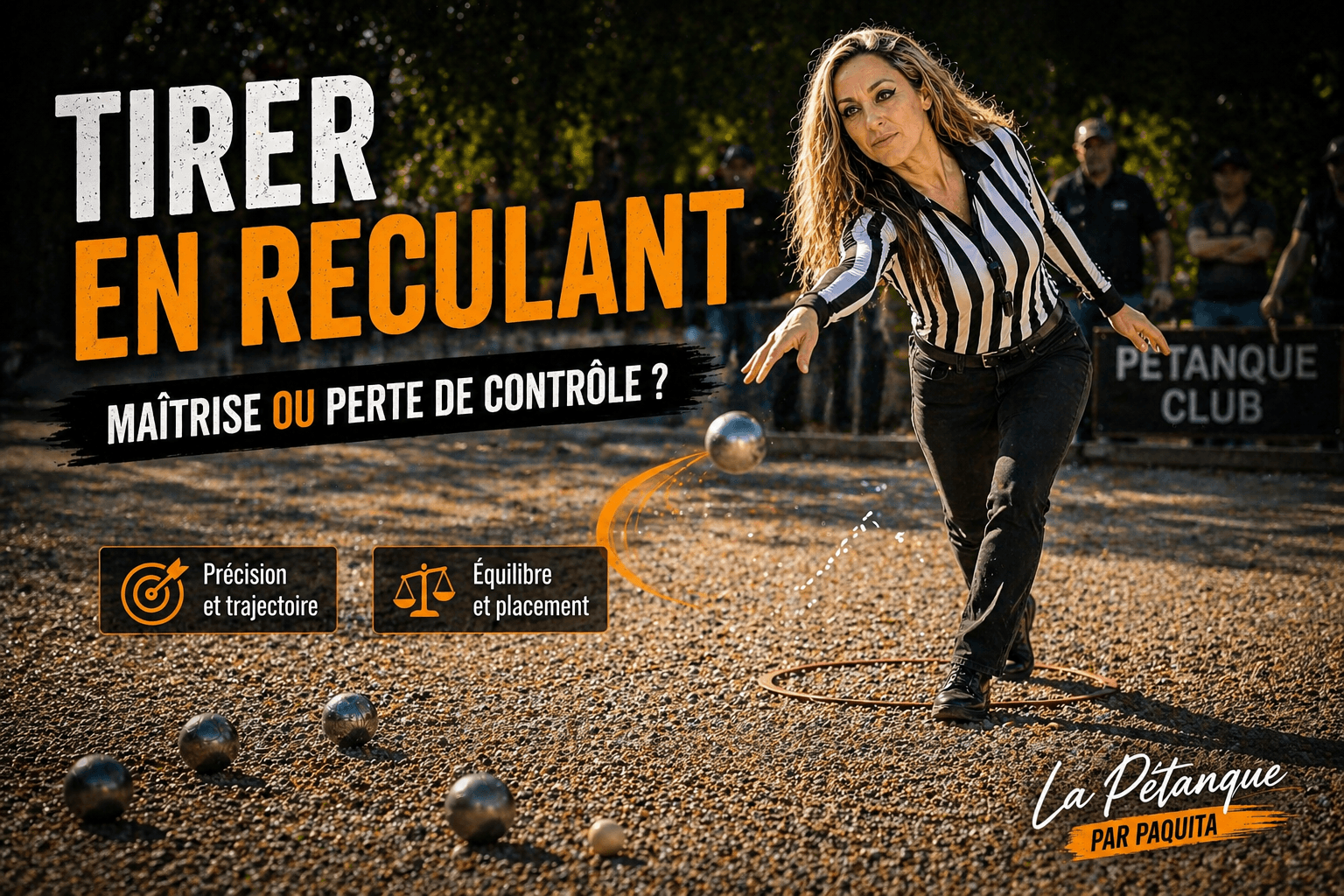
Pétanque: How to master shooting while stepping back?
NewsSome top-level shooters step back during or after their shot. Is it a deliberate technique, a fault to correct, or an inevitable consequence ofThe direct answer — three cases, three analyses
✅ Case 1 — Controlled recoil after the release MASTERYThe boule leaves the hand, the feet leave the circle immediately afterwards, the player steps back one or two paces in a smooth and balanced way. This recoil is a natural follow-through of the motion's momentum — the body continues in the direction of its motion once the constraint of the circle is lifted.
This recoil is perfect under the rules: the boule is already released, the feet can move freely. It is also technically neutral or even beneficial: it indicates that the player hasn't "blocked" their momentum before the release — which would have introduced tension that degrades accuracy.
PHYSICS When a player throws with power, their center of mass is projected forward during the swing. To balance this forward movement, the legs naturally seek to step back after the release. This recoil is the conservation of momentum — it's physics, not a flaw. VERDICT Controlled and balanced recoil after the release = a sign of a smooth, unheld motion. Valid under the rules. Technically positive if the recoil is symmetrical and doesn't reveal a forward imbalance. ⚠️ Case 2 — Violent and unbalanced recoil WARNING SIGNAfter the shot, the player stumbles backward, loses their balance, has to catch themselves with their arms or takes several uncontrolled backward steps. This isn't a smooth follow-through — it's an actual loss of control of the center of gravity.
This type of recoil signals that the player's center of gravity was too far forward during the swing — they "overextended" their forward swing, going too far forward. The violent recoil is the body's attempt to rebalance itself after an excessive forward projection.
PHYSICS When the torso leans too far forward during the swing (excessive angle), the center of mass passes beyond the base of support (the feet in the circle). Once the boule is released, the body is in a forward imbalance — the legs have to step back quickly to avoid falling. The stronger the forward imbalance, the more violent and uncontrolled the recoil will be. VERDICT Valid under the rules if the release took place before the feet came out. Technically problematic: the forward imbalance creates instability in the axis of the motion during the release itself, which degrades accuracy. This is a recoil to correct. 🚫 Case 3 — Leaving the circle before the boule touches the ground REGULATORY FAULTThe player throws their boule then leaves the circle (or lifts a foot out of the circle) before the boule has touched the ground. It doesn't matter whether the boule was already released from the hand — as long as it hasn't touched the ground, the feet must stay in the circle or not cross its boundaries.
This is the key regulatory distinction: the release from the hand is not the end of the obligation to stay confined within the circle. The boule must have touched the ground before the feet can come out.
PHYSICS This rule is designed to prevent players from lunging out of the circle to gain momentum (which would give them an unlawful advantage by effectively moving the circle forward). VERDICT A regulatory fault under the FIPJP rules. The thrown boule can be cancelled on the opponent's claim. If the boule moved opposing boules on impact, the opponent can choose to validate the situation or restore it to its initial state.Exactly what the FIPJP rules say
📜 FIPJP RULES — ARTICLE 6 (EXCERPT ON THE FEET) "The player's two feet must remain inside the circle, flat on the ground, without overstepping the line, until the thrown boule has touched the ground." Source: FIPJP rules, article 6 — the exact wording "has touched the ground" is the key. It's not "has left the hand" but "has touched the ground". ⚖️The wording "has touched the ground" is important and often misinterpreted. Throughout the boule's flight — between the release and the first contact with the terrain — the feet must stay in the circle. For a direct shot at short distance where the boule touches the ground quickly, it's a fraction of a second. For a lofted shot at long distance, it's longer. In both cases, the rule is the same.
🎙️ Paquita on recoil and the rules "The confusion comes from the fact that the release from the hand and the first contact of the boule with the ground happen less than 0.3 seconds apart on a normal shot — and often less. It's hard to see with the naked eye whether the foot moved during that time. In a competition with a video umpire, it can be checked precisely. In a competition without an umpire, it's settled in good faith between players. What I recommend: don't 'hold back' your momentum in the circle after the release — move off naturally once the boule is on the ground. The temptation to 'sprint' out of the circle the moment you release is risky under the rules." — PaquitaThe physics of recoil — where does the backward momentum come from?
⚛️ CLASSICAL MECHANICS Conservation of momentum The recoil after a pétanque shot is explained by Newton's third law (action-reaction) and the conservation of momentum. When the arm projects the boule forward with force, the rest of the body receives a backward reaction. On a stable surface, the legs absorb this reaction — with no visible recoil. But when the swing's momentum is large and the torso has shifted forward, the body-boule system has a significant forward momentum that the legs can't entirely absorb.Recoil is therefore proportional to:
— The mass of the boule × its throwing speed (the "momentum" transferred)
— The angle and amplitude of the swing (the greater the momentum, the higher the forward momentum)
— The rigidity of the posture during the release (a mobile torso transfers more momentum than a rigid torso)
So what recoil reveals: a player who steps back a lot generally has a large momentum and a relatively mobile torso. This isn't necessarily an advantage — power can also come from an ample swing with a stable torso, without recoil.
The 5 types of recoil — decoding what they reveal
↩️ SMOOTH SYMMETRICAL RECOILTwo steps back, balanced, smooth. The player stays upright during the recoil. A motion mastered from start to finish.
Sign of mastery ↪️ SINGLE BACKWARD STEPA single backward step with the leading foot, immediate stabilization. Minimal and controlled recoil. A sign of good balance during the throw.
Perfectly valid 🔀 ASYMMETRICAL RECOILThe player steps back but more to one side than the other. The torso rotates slightly during the recoil. Indicates a slightly deviated throwing axis or a postural asymmetry.
To watch 💨 FORWARD RECOIL"Recoil" toward the front — the player takes a step forward after the release. Can indicate a late release (the body was still in forward motion at the moment of release).
Late release? 💥 VIOLENT UNBALANCED RECOILSeveral uncontrolled backward steps, stumbling, arms used to catch balance. Excessive forward imbalance during the swing.
To correctWith recoil vs without recoil — what changes for accuracy
A fair question: is it better to step back or not? The answer depends entirely on the cause of the recoil — a natural and controlled recoil isn't a problem, a recoil that signals an imbalance during the motion is.
⚠️ RECOIL WITH FORWARD IMBALANCE →Torso too far forward during the swing → instability of the axis at the moment of release →The body tries to rebalance itself DURING the release → disruptive micro-movement →The aiming axis can be altered by the ongoing imbalance →Accuracy is degraded because the release isn't stable →The violent recoil can distract the player and affect their concentration ✓ CONTROLLED RECOIL AFTER FULL RELEASE →Stable torso during the swing → release with a stable axis →The recoil begins AFTER the boule has left the hand →The natural follow-through of the motion doesn't influence the boule's trajectory →Accuracy isn't affected — recoil is a consequence, not a cause →The smooth recoil leaves the full motion free of holding-back tension 💡 The question to ask yourselfThe real question isn't "am I stepping back?" but "am I stepping back because my motion is unbalanced, or because my motion is smooth and my body naturally follows the momentum?" The first cause needs correcting. The second is perfectly acceptable. To find out: if you can stop in a stable balance immediately after stepping back one pace → it's a natural recoil. If you have to take several steps not to fall → it's an imbalance to correct.
Correcting an unbalancing involuntary recoil
If your recoil is violent or unbalanced, here are the most common causes and their corrections.
🏃 Cause: torso leaning too far forward during the swing CORRECTThe player leans excessively forward during the swing — unconsciously trying to "accompany" the boule or gain momentum. The center of mass passes beyond the feet. The recoil is inevitable and violent.
CORRECTION Work in front of a side mirror. Observe the angle of the torso during the swing: it should stay nearly vertical or slightly inclined forward (10–15° max). An angle of more than 20–25° will create recoil. Exercise: place your back lightly against a wall during the backswing — feel that your back stays close to vertical throughout the motion. ⚡ Cause: swing momentum too large for the posture ADJUSTThe swing is very ample (which generates power) but the base posture doesn't allow the momentum to be absorbed without losing balance. The solution isn't to reduce the amplitude of the swing but to adapt the posture.
CORRECTION Widen the stance slightly within the circle (to the extent permitted by the rules). A slightly wider stance lowers the center of gravity and increases stability. Bend the knees slightly before the throw — this prior flexion creates a "spring" that absorbs the momentum better after the release. 🤔 Cause: holding back the motion until the last moment then a sudden release CORRECTThe player blocks their swing to stay in the circle, then releases everything at once at the end of the motion. This holding-back creates accumulated tension that is released in a final explosion — generating a brutal and unpredictable recoil.
CORRECTION Let the motion unfold smoothly without artificial holding-back. The swing should be continuous and smooth from back to front, with no moment of artificial "blocking". Train with a continuous-motion swing — imagine the arm is a swing that oscillates freely and is never held back. ⚠️ THE TRAP: "BLOCKING" THE RECOIL TO AVOID LEAVING THE CIRCLESome players, aware of their tendency to step back, try to "block" their recoil by tensing their legs after the release. This blocking is technically counterproductive — it creates tension in the lower body that travels back up into the swing and degrades the accuracy of the release. The right approach: don't block the recoil after the release (it's legal), but correct the cause of the forward imbalance before the release.
Exercises to anchor balance after the shot
01 The one-legged shot — a balance diagnostic 📍 Training ⏱️ 15 min ⚖️ Identify and correct the forward imbalanceAn extreme proprioceptive exercise to reveal and correct posture imbalances in the shot.
Shoot 10 boules normally. Observe and note the amplitude of your recoil (none, 1 step, 2 steps, violent). This is your baseline. Shoot 10 boules standing only on the leading foot (the foot on the side of the throwing arm), the other foot raised 5 cm off the ground. This isn't legal in competition — it's a diagnostic exercise only. Observe: if balance is very hard to maintain, your center of mass was largely in front of your leading foot during your usual shot. If it's manageable, your forward balance is good. Return to the normal two-foot shot, trying to reproduce the feeling of balance on the leading foot. The goal is to feel that the weight is centered on the leading foot, not projected in front of it. 02 The controlled follow-through — anchoring the smooth recoil 📍 Training ⏱️ 15 min ⚖️ Making the recoil natural and controlledFor players whose recoil is involuntary and disorderly — teaching them to properly "follow through" the motion.
Shoot 5 boules deliberately trying to completely block any recoil after the release — stay still, feet in the circle. Observe how it affects accuracy (often negatively — tension from holding back). Shoot 5 boules deliberately letting the leading foot take a single controlled backward step after the release — stop immediately on that step, in balance. Feel the difference in smoothness compared with total blocking. Repeat 20 times, systematically aiming for that "single controlled step". The goal is to make this follow-through natural and automatic — the motion ends cleanly, the body follows with one step, everything stops in balance. Compare the accuracy of your shots with the "one controlled step" vs your usual disorderly recoil. The difference in accuracy measures the impact of the imbalance you corrected. 📖 PAQUITA'S BOOK Posture, balance and accuracy — the foundations of the complete shotRecoil, posture, wrist, release, rules, mental game... Paquita's book builds the complete shooter with 100 numbered exercises from beginner to experienced level.
📦 Order on AmazonFAQ — Your frequent questions
If my opponent leaves the circle during the flight of the ball, can I claim even if the ball has hit its target? + Yes — leaving the circle before the ball has touched the ground is a legal infraction regardless of the outcome of the shot. You can claim and request the cancellation of the ball. In practice, in the absence of a referee and video refereeing, proof is difficult to establish because the event occurs very quickly. Good practice: if you think you have observed an exit before landing, report it immediately (before the following balls) and ask the referee. If no referee is available and the two teams do not agree, the decision may be left to a neutral observer or resolved by re-throwing the disputed ball. Do not let the dispute take place after several additional balls played. Do professional shooters recoil less than amateur players? + Not necessarily — some champions take a step or two back in a fluid, controlled manner, others shoot while remaining virtually motionless. It is not a question of level but of morphology, style and individual technique. What distinguishes professional shooters is not the absence of recoil but the quality of the recoil: when they recoil, it is smooth, symmetrical and balanced — never disordered or violent. Balance after the shot is an indicator of overall mastery of the movement, not recoil itself. Can stepping back during the shot (before release) help generate more power? + No — and it is legally prohibited. Feet must remain in the circle during the entire throw, including during the swing. Movement of the feet during the throw (before release) is an infraction. Basically, the power of a pétanque shot must come from the swing of the arm and the momentum of the trunk — not from a bodily movement. Players who feel like they are pulling harder by "throwing" forward are indeed increasing their power momentarily, but at the cost of a loss of accuracy and a regulatory infraction. My recoil is to the side (not back) — what does that reveal? + A sideways move—to the left or right instead of backwards—indicates an asymmetry in the pendulum. If you systematically move backwards on the same side, it is because your center of mass moves laterally during the swing (the arm "comes out" of its natural vertical axis). This lateral recoil is often associated with a reproducible lateral deviation in the ball's trajectory — the same imbalance that causes the ball to recoil to the side also changes the release axis. This is a useful diagnosis: filming your recoil from the front reveals whether your line of fire is symmetrical or not. 📎 Related articles Rules Complete FFPJP rulebook 2026 Rules Rigid circle — 2026 requirements Equipment Top 3 best shooter boules 2026 Equipment Choosing your boules — matching them to your shooting style Rules The one-minute rule Tools Free PetanqueLand tools© Pétanque by Paquita — petanqueland.fr · 📖 Paquita's book on Amazon