Actualités · 10 March 2026
Petanque and Couple: <span style="color: #ff4d4d;">The Survival Guide</span> to Not Divorcing in the Field
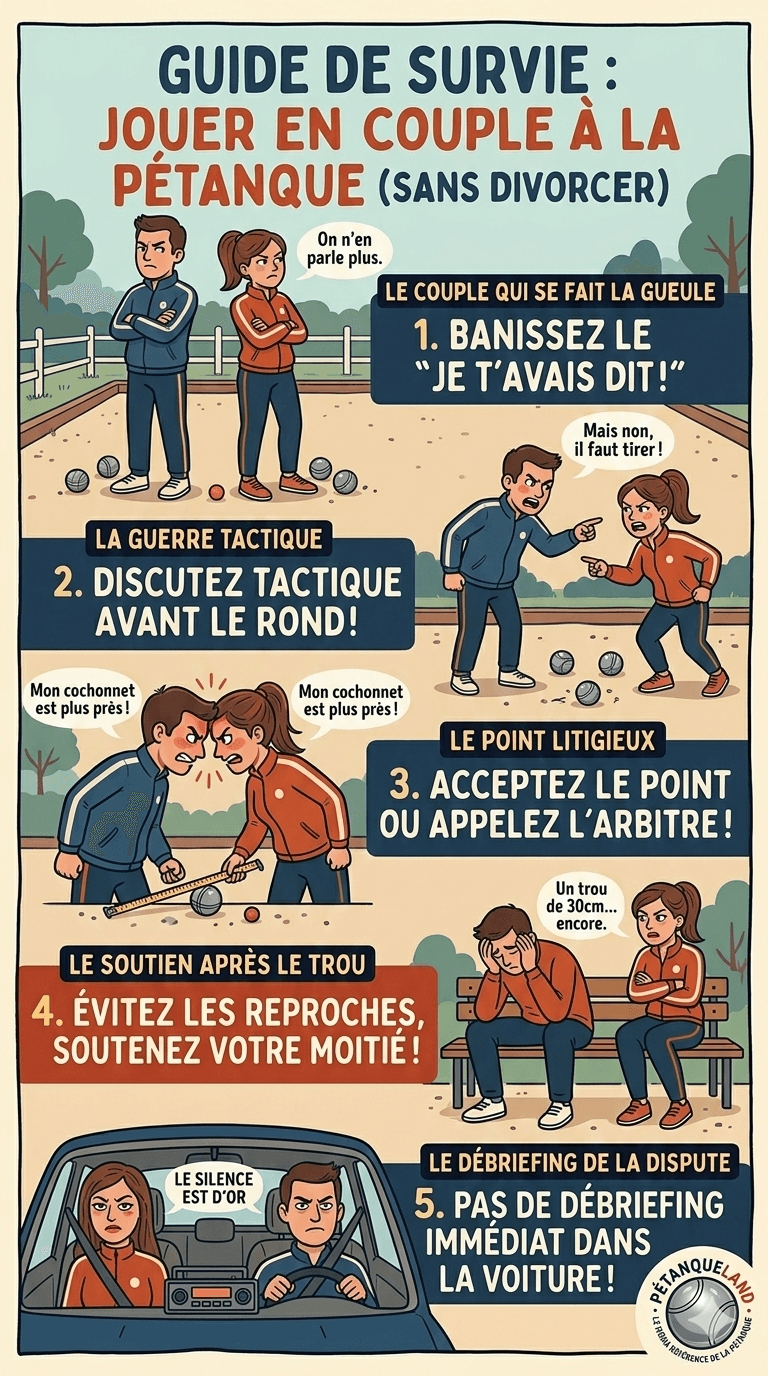
Mixed doublette, tensions on the terrain, a missed shot, a disputed call... Paquita shares her rules ofIt's the most fatal phrase of all. When your partner fluffs it or loses the point, they know it already — believe me. Piling on with a "I told you to point to the left" will only increase their nerves, their annoyance... and the chances of going home alone in a taxi.
⛔ Never to be said "I told you so!" — "That's a rubbish shot!" — "Even I would have pointed there..." — "You always do the same thing!" — "We'd have won if you'd shot." 💛 Paquita's advice Replace the reproach with a solution: "No worries, we'll fix the shot together next end." Six more words. One less divorce. Marital danger 9.2/10The phrases that destroy vs. the phrases that save
💣 Divorce-inducing version "I told you not to shoot, we had the point!" Effect: a minimum 45-min silence in the car. 💚 Survival version "No worries, you took a risk — that's why we play together!" Effect: your other half breathes, resets, and scores the next one. 💣 Divorce-inducing version "Even you can see it's your boule that's behind?" Effect: an immediate argument about the measure and 15 years of marriage. 💚 Survival version "Shall we measure? I've got a doubt, call the referee!" Effect: tension transferred to the referee. Your couple is safe. 💣 Divorce-inducing version "With the way you're shooting at the moment, we're losing anyway..." Effect: a demotivated partner, a sunk team, a cold night guaranteed. 💚 Survival version "Don't worry, we're in this together. Come on, this end is ours!" Effect: an immediate boost of energy. And sometimes, a surprise carreau. 2 Tactics: a democracy before the circle The pétanque terrain isn't a dictatorship 🗳️The decision to shoot or point must be a consensus reached before the player steps into the circle. Once in the circle, your other half must have a clear mind and feel supported, not judged. And absolutely not hearing "no no, wait, actually shoot!" from the sidelines.
The 2026 rules impose 30 seconds to play once you're in the circle. That's short. No question of adding a couple's debate on top. Decide before — and trust each other.
💛 Paquita's advice Invent a system of discreet signals: one pointed finger = we point, a closed fist = we shoot. As effective as semaphore, far less humiliating than a public row at the boulodrome. Marital danger 6.5/10 3 The measure and the referee: your peacemakers A disputed point isn't a couple issue, it's a matter of a tape measure ⚖️We all tend to see our darling's boule as closer than the opponent's. It's human. It's touching. It's also the start of a dispute that can last until dessert. Don't fight ever each other over a disputed point.
The referee is sacred. Their verdict is neutral and final. The role of the referee in 2026 has moreover been strengthened by the FFPJP — their decision binds everyone, including the tightest couples on the circuit. Let them bring calm and justice back to your game.
⛔ Scenario to avoid A two-metre tape, flat on your belly on the gravel, to prove your boule is in front. Your pride takes a knock. Your knees too. Call the referee. 💛 Paquita's advice Keep a pocket tape measure on you — not to measure between the two of you, but to agree that you disagree, and call in someone neutral. Our complete guide on laser measuring and video refereeing explains how it works in equipped clubs. Marital danger 7.5/10 👑 Paquita's Secret for a united couple"Have a code word or a complicit gesture when the tension gets too high. A wink, a hand on the shoulder — it defuses a conflict before it blows up. We play for the passion and for the shared memories. The final score, no one remembers it after the apéritif. The shared laugh over a missed shot, that lasts forever."
4 Lose together, win together In pétanque as in life, you're a team 🤝If one of you is "in a rut" — boules that won't obey, lost feel, a blank spell — it's up to the other to carry the team. Not to pile it on. The Beautiful Game is also knowing how to reassure your partner when they lose their feel.
A good shooter doesn't change boules to change their level — and a good teammate doesn't change partner at the first miss. Trust is built over time, not over a single end.
💛 Paquita's advice Set yourselves a team goal unrelated to the score : "Let's hit at least 3 beautiful carreaux together tonight." You shift the stakes to something you can control as a pair. The rest is luck and terrain. Marital danger 3/10 5 The Debrief: not before the apéritif! The golden rule of post-match reconciliation 🍷Don't replay the game in the car if tempers are still running hot. The drive home isn't a tactical analysis room. It's too cramped, the doors lock, and the silences stretch out at the speed of red lights.
Wait until you're settled. With a glass in hand, a bit of perspective, and your stomach starting to speak up. With a smile and a relaxed atmosphere, all the criticism goes down better. Even "you could have shot the 4th one" becomes acceptable if it's said between two olives.
💛 Paquita's advice Start with the "what we did well together" stage before getting to the criticism. Two positive points for every point to improve. It works in management, in parenting, and at the boulodrome. Marital danger 1.5/10The warning signs to spot
Some behaviours on the terrain are real indicators of marital tension. Paquita has drawn up the clinical picture of couples at risk of permanent disputed measure:
🦗 The icy silenceYour partner only answers your "Come on, it's fine!" with a nod of the head. Orange-level danger.
🎯 The punitive shotThey systematically shoot instead of pointing, even when it's tactically absurd. It's not play — it's expression.
📱 The phone between endsShe gets her phone out between each game. Either she's looking for a lawyer, or she's texting her mates about your latest missed shot.
👥 The public comparison"Did you see how he points, him?" said in front of the whole club. Red level. Call marriage mediation before the next end.
🚶 The solo exitHe/she goes home without warning you at the end of the game. Either it's an emergency. Or you said "I told you so!" once too often.
🤐 The forced agreement"Whatever you want" said in a tone that clearly means the opposite. You know that tone. The whole boulodrome does too.
🏳️ The 3-ends ruleIf the tension runs over 3 consecutive ends without being defused, call an informal time-out. Go and get a glass of water together. Come back. Breathe. Pétanque will still be there. So will your couple, if you play this end well.
📋For couples who want to take on an official competition together: make sure both your licences are up to date before registering. Our guide FFPJP Licence 2026 step by step explains it all — with no possible argument over who was supposed to sort it out.
💬 It's over to you!
What's the worst thing your partner has ever said to you on a terrain?
Tell us in the comments — Paquita wants to hear your stories and your solutions for keeping the Beautiful Game alive!
FAQ — Your frequent questions
Is it better to avoid playing with your partner in competition? + Not at all! Mixed doubles can be one of the most rewarding experiences in pétanque. The condition: having previously had calm conversations (off-field) on how you want to manage tensions. Couples who play together and thrive usually have a clear communication code and a “no criticism during game” rule. Try playing a friendly game first before jumping into a competition. What should I do when my level is clearly higher than that of my partner? + This is the most classic trap. If you are the "good" player in the couple, your role is not to constantly compensate — it is to raise the other's level through encouragement, not through constant correction. Progress in pétanque is made through confidence, not under pressure. And remember: your partner plays for the pleasure of being with you. It's already a good level. Can the referee intervene in the event of a dispute between partners? + Yes. A FFPJP referee has full power to intervene if an argument disrupts the smooth running of the game, even between partners. He can warn or even disqualify a team in the event of unsporting behavior. The regulations do not distinguish between disputes between opponents and disputes within a team. Which competitions allow you to play in mixed doubles? + Most open competitions and bowling alleys accept mixed doubles as a leisure activity. In official FFPJP competition, there are specific categories depending on the levels. Check out our official 2026 competitions calendar to find mixed competitions near you. My partner refuses to play together since an argument. How to convince him/her again? + Start by acknowledging the argument — not minimizing it. A simple “I was too harsh that day, I want to try again differently” works wonders. Propose clear rules for next time (no criticism during the game, code sign if things get heated). And choose a no-stakes game — a friendly game between friends, not a competition. The relaxed context helps to rediscover the pleasure of playing together. 📎 Related articles Refereeing Refereeing videos — understand everything about in-game decisions Rules Complete FFPJP rulebook — the rules that count Refereeing Laser measuring: video refereeing is coming to your clubs 2026 rules 30 seconds on the clock — what it changes for couples in a hurry Admin Dematerialised FFPJP 2026 licence — step-by-step guide Video Why changing boules doesn't change your level? Competitions Official 2026 calendar — find a tournament to play together 2026 rules The return of "wild" pétanque — terrain and adjustments© Pétanque by Paquita — petanqueland.fr
A humorous and well-meaning article — Paquita champions respect and the Beautiful Game on every terrain of life.
Continuer sur PetanqueLand