News · 6 May 2026
Pétanque: playing against stronger opponents, the mistakes to absolutely avoid
NewsAgainst a stronger team, most players make the same mistakes — and lose faster thanThe reality of the balance of power — what it really is
📊 ANALYSIS What "stronger" really means When we say a team is "stronger", it means it has a higher probability of winning. Not a certainty. Pétanque is a game with an irreducible element of chance — every boule can deviate, every shot can miss, every end can turn for unpredictable reasons.In concrete terms, a team that is "twice as good" doesn't win 2 times out of 2 — it might win 7 times out of 10. The 3 times out of 10 that it loses, it's often because the opposing team played without major mistakes, forced the opponent into difficult situations, and capitalised on the rare weaknesses.
The correct strategy against a superior opponent is not "to win" — it is to set up all the conditions for those 3 out of 10 to happen today. That means avoiding the mistakes that reduce those 3 chances to 1, and exploiting every opportunity without creating artificial ones. 🎙️ Paquita on matches against stronger teams "I've won matches against far better teams. Not often, but it has happened to me. Each time, the victory wasn't due to a sudden surge of talent on my part. It came from a combination of factors: the opponent had played below their level, luck had been on my side at a few key moments, and above all — I had played my own game without changing it, without panicking, without trying to invent a miraculous technique. What I hadn't done was flee into despair or into pointless grand gestures. I had played solidly, end after end." — Paquita
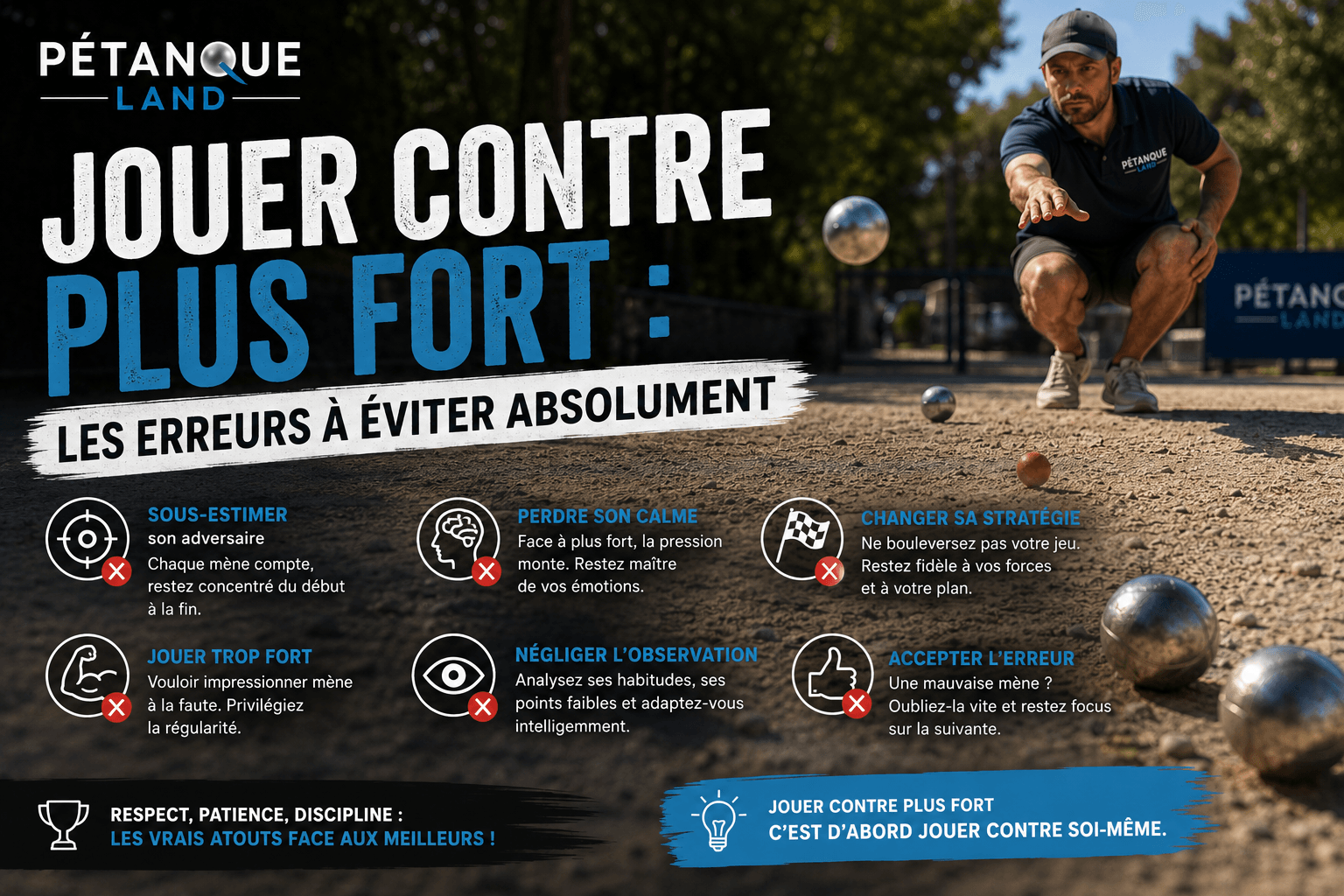
The 8 mistakes you absolutely must avoid
1 💀 Giving up mentally before the game begins FATALIt's the most widespread and most destructive mistake. "We've got no chance", "they're too strong", "we're going to lose 13–0". These phrases, spoken or merely thought before the game, constitute a pre-emptive surrender. They contaminate everything: concentration, risk-taking, commitment to every throw.
What makes the problem worse: this pre-match resignation is often passed from player to player within the team. Once the captain has said "we don't have much hope", the other two players unconsciously dial down their level of commitment.
CONSEQUENCE A resigned team plays below its own level. It doesn't maximise the 3 chances out of 10 it had — it reduces them to 0 or 1 through its own disengagement. STRATEGY Formally ban resignation phrases within the team before and during the match. Reframe it: "We're going to play our best game and see what happens." This phrasing isn't denial — it's the commitment to put every chance on your side. 2 🎭 Radically changing your style of play against a stronger team FATALAgainst a superior team, the temptation to play differently is strong — to innovate, to surprise, to step out of the usual comfort zone. The usual pointer tries shooting to "change the momentum". The team that normally plays defensively attempts aggressive offensive strategies it doesn't master.
This mistake is paradoxical: players abandon precisely their strengths at the moment they need them most — and end up playing with less-mastered techniques or strategies, against an opponent who masters theirs to perfection.
CONSEQUENCE The stronger opponent plays their best game. You play an unfamiliar, poorly-mastered game. The real gap in level is amplified rather than reduced. STRATEGY Play your own game — the techniques and strategies you master best — with rigour and consistency. That's the only way to maximise your real performance. Any deviation towards an unmastered game mechanically lowers your level of play. 3 🎲 Multiplying desperate shots and excessive risks FATALWhen the score deteriorates, the temptation to "force fate" by attempting improbable shots or risky strategies is strong. The player tells themselves: "We're losing anyway, might as well try something." This reasoning is a probability error.
A shot with a 20% success rate that misses only makes the situation worse — the opposing boule stays in play or the opponent benefits from the outcome. Multiplying low-probability attempts guarantees accelerating the defeat, not turning it around. The same boule played as a conservative point at an 80% success rate preserves the situation and buys time.
CONSEQUENCE Desperate shots accelerate the opponent's score. A possible 13–10 defeat becomes 13–3 because of a series of uncalculated risks that all failed. STRATEGY Maintain quality shots with an acceptable success probability. Don't increase the risk because the score is against you — increase your commitment and execution quality at constant risk. 4 📊 Obsessing over the overall score instead of playing end by end FATALAgainst a strong team, the score can deteriorate quickly. If a player thinks "we're at 3–9, we need 10 points to win and they only need 4 more", their mind is somewhere other than on the next boule. This mental distraction degrades execution quality exactly when it must be at its peak.
CONSEQUENCE Playing under the pressure of the overall score generates anxiety that degrades the gesture. Ends played with the score in mind are systematically less well executed than ends played in the present. STRATEGY The only valid unit of time: the current end. Win the current end. Then the next one. The overall score takes care of itself. "End by end" isn't a cliché — it's a concrete method for managing attention. 5 😲 Admiring the opponent's play and letting yourself be intimidated SERIOUSA spectacular shot from the opponent at 9 metres. "Wow, they're really good." This reaction is human — and very costly. Admiring the opponent during the game shifts attention from your own performance to the opponent's performance, and creates an additional psychological inequality.
Excessive compliments to the opponent ("what a beautiful shot", "impressive") during the game give them extra confidence — and you, an extra feeling of inferiority. The result is a psychological amplification of the real gap in level.
CONSEQUENCE The opposing team plays with the confidence of someone you admire. Your team plays with the timidity of someone who has put themselves in an inferior position. STRATEGY Observe the opponent's play to extract useful information (which shooter is the most dangerous, what technique they use, what their usual throwing zones are) — not to admire it. Tactical curiosity replaces unproductive admiration. 6 🟡 Neglecting jack tactics against the strong team SERIOUSAgainst a superior opponent, some teams abandon any jack-placement tactics — they play "naturally" without trying to create difficult configurations for the opponent. This is a fundamental mistake: the jack is the only real tactical lever available to balance an unfavourable balance of power.
A strong opponent will play well on any jack — but they'll play better on an easy jack. Placing the jack in unusual positions, at extreme distances (6 metres or 10 metres), behind boules, in less comfortable zones, forces the opponent to play less-repeated situations — which mechanically lowers their success rate.
STRATEGY Systematically exploit the jack as a tactical weapon. Vary the distances, lateral positions, areas of terrain. Force the opponent to adapt rather than offering them their preferred configurations. 7 💬 Arguing or blaming each other for mistakes within the team SERIOUSUnder the pressure of an impending defeat, tensions within the team rise. One player misses a decisive boule — another makes a remark. Loaded glances, audible sighs, heavy silences — all of this degrades team cohesion exactly when it is most precious.
Against a strong opponent, the team that divides itself is the team that condemns itself twice over. Internal solidarity is a performance multiplier — especially in the difficult moments when each player needs to feel the team's support to dare play their best boule.
CONSEQUENCE A player who has made a mistake and receives blame plays the following boules under additional pressure that degrades their accuracy. The series of mistakes snowballs. STRATEGY Simple team protocol: zero blame during the match. Mistakes are discussed afterwards, never during. Between ends: a supportive or neutral phrase — never an accusation. Unity is the only resource the opponent cannot take from you. 8 ⚡ Rushing — playing too fast under score pressure SERIOUSWhen the score is against you, an acceleration of the tempo often sets in: players enter the circle faster, observe less, throw more quickly. This rushing is an emotional response to stress — it compresses time to "do something, anything".
The result is invariably: lower-quality boules. Rushing reduces the time to calibrate the gesture (see the article on the first missed boule), the quality of the aim, and postural stability. It produces exactly the opposite effect from the one sought.
CONSEQUENCE Boules played quickly are on average less accurate than boules played calmly. Rushing accelerates the deterioration of the score instead of correcting it. STRATEGY Deliberately maintain your usual tempo — even (especially) when the score is against you. The one-minute rule gives you the right to take the time you need. Use it fully on every important boule, whatever the urgency you feel.The underdog's 6 positive strategies
Avoiding the 8 mistakes is a necessary but not sufficient condition. Here are the 6 active strategies that genuinely increase your chances against a superior opponent.
⏱️ Slow down the tempoThe strong opponent is often used to a high tempo. Deliberately slowing down the game (within the limits of the one-minute rule) disrupts their rhythm and increases your execution quality.
→ Double advantage: more precision for you, less comfort for them 🎯 Play conservativelyOn terrain familiar to the opponent, a conservative game — close and safe points, shots only when the target is perfectly exposed — reduces mistakes and forces the opponent to play more boules to score.
→ The opponent has to work harder for every point 🟡 Vary the jacksExtreme distances (6m or 10m), unusual lateral positions, behind boules — every unusual jack forces the opponent to step out of their usual routines and recalibrate.
→ Forces adaptation even among the best 🧠 Exploit the observed weaknessesNo team is perfect at everything. Observe the first 2–3 ends to identify the opponent's weak points: a pointer less comfortable at long distance, a shooter who drifts on a slope. Systematically exploit these weaknesses.
→ Put the opponent in their discomfort zones 🛡️ Protect your boulesAgainst a good shooter, place boules that protect each other — several close boules around the jack create configurations that are hard to shoot without risking improving the opponent's situation.
→ Forces more complex shots even for the best 🔥 Celebrate every point wonAgainst a stronger team, every end won or point scored is a partial victory. Celebrating sincerely (not ostentatiously) maintains the team's energy and motivation — and reminds everyone that the opponent is not invincible.
→ Maintains commitment throughout the game ⚔️ The small victories ruleAgainst a superior team, redefine what a victory is. Winning an end is a victory. Forcing the opponent to play all their boules to score is a victory. Holding a tight score for 6 ends is a victory. These micro-victories maintain the energy and motivation needed for real turnarounds to happen. A team that celebrates its micro-victories plays better than a team that only awaits the final victory.
Reactions after a large score gap
The score is 2–9. Or 1–11. These situations happen — even in the best matches. How you react at that precise moment determines whether the game ends 3–13 or 9–13.
❌ REACTIONS THAT MAKE EVERYTHING WORSE →"It's over, we might as well go for a drink." Verbal surrender = real surrender. →Attempting desperate low-probability shots to "make up for it". →Blaming a player for lost ends instead of preparing for the next ones. →Radically changing strategy because "the usual one isn't working". →Rushing to "catch up" the score — rushing = degraded quality. →Stopping talking as a team, each player playing on their own. ✓ REACTIONS THAT MAINTAIN YOUR LEVEL →"There are 4 or 5 ends left. We can win 3 of them. Let's focus on the next one." →Maintaining shots and points at an acceptable success probability — quality before quantity. →Supporting the team: "good boule", "that's good", even on correct but imperfect boules. →Sticking to your usual strategy — what works in training should work here too. →Respecting your tempo — the one-minute rule exists to be used, even in an emergency. →Active communication: "I'm going to do this", "you cover", — the team stays a team.Mental management — the central challenge
🧠 SPORTS PSYCHOLOGY Why the mental game matters more than technique against a stronger team Against an opponent of equal or lower level, technique is often the decisive factor. Against a superior opponent, technique is already at a disadvantage — you can't suddenly exceed your real level. What can make the difference is the mental game — your own management of pressure, uncertainty and frustration.A superior opponent playing against a resigned team plays below their level — they aren't challenged enough to stay in their optimal performance zone. A team that plays solidly, without collapsing, forces the opponent to maintain their high level over time — which is more tiring and creates weaknesses.
The best way to beat a stronger team is to impose a game that lasts as long as possible at a high level. Tight late-game situations favour the teams with the most stable mental game — not necessarily the most talented ones. 🏆
The history of sport is full of examples of less-talented teams that have beaten favourites through mental resilience, tactical rigour and team solidarity. In club pétanque, these turnarounds happen regularly. Every game against a stronger team is an opportunity to trigger them — provided you don't prevent it yourself.
FAQ — Your frequent questions
Is it tactically useful to adopt a very slow game to “break the rhythm” of a strong opponent? + Yes, to some extent — and it's legal within the confines of the one-minute rule. An opponent accustomed to a high pace may be slightly destabilized by slower play. But beware of two pitfalls. First, artificially slowing down your game to the point of breaking out of your usual routine can degrade your own accuracy — your automated gesture is calibrated to your natural rhythm. Second, a very strong opponent quickly adapts to the rhythm. The “breaking the rhythm” effect is real but generally short-lived. Slowing down to take the time necessary for better execution is always justified. Slowing down just to annoy your opponent, to the detriment of your own quality of play, is counterproductive. Should we tell our teammates that we are playing against a “much stronger” team before the game? + It's a delicate decision. Informing the opposing team about the opposing team's level can be helpful in calibrating expectations — but how it's said matters a lot. Saying "they are very strong, we will struggle but let's play our best game" is different from "they are too strong, we have no chance". The first formula prepares without discouraging. The second sets up resignation before even starting. If the opponent's level is visible on the field from the first lead - and it often is - there is no need to "warn" in advance. Letting the team play without prior labeling may even be more psychologically effective. How far can you “hold out” tactically against a clearly superior team? + In pétanque, the gap in level generally widens over the duration of a game but remains attenuated by tactics. A technically "twice as good" team can be put in difficulty on specific ends if the weaker team plays without errors and exploits favorable configurations. In practice, resisting a clearly superior opponent (regional champion against standard club player) can allow you to maintain an honorable score (7–13 or 8–13 instead of 0–13 or 2–13). Final victory remains unlikely — but the honorable outcome is possible and depends largely on avoiding the 8 mistakes described in this article. If we win a match against the stronger side, should we change strategy or stick with what works? + Stick with what works — absolutely. The temptation after a winning lead is to “keep the momentum going” by trying something even more ambitious. This is a mistake: the lead was won because you played your usual game well. This usual game remains your best option. The question to ask yourself after a match won against the strongest: “what did we do well in this match?” — and reproduce it identically. Not “what’s the most ambitious thing we can do now?” 📎 Related articles Rules The one-minute rule — taking time even under pressure Equipment Top 3 best shooter boules 2026 Equipment Choosing your boules — the right equipment for every level Tournaments Official 2026 calendar — find tournaments Competition Referees and officials — understanding their role Tools Free PetanqueLand tools© Pétanque by Paquita — petanqueland.fr · 📖 Paquita's book on Amazon