News · 28 April 2026
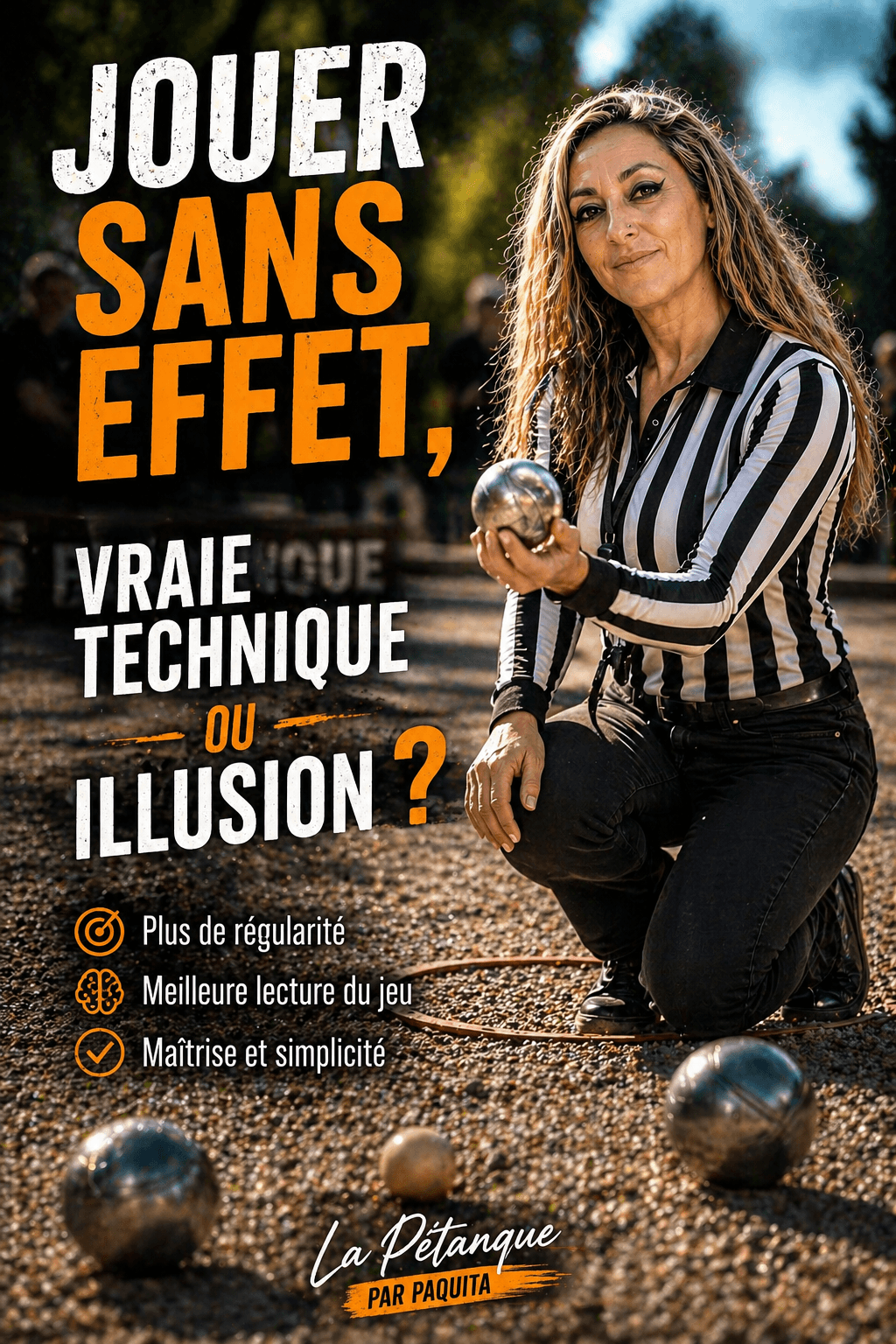
Pétanque: Playing without spin, is it a real winning technique?
NewsCan you really play without transmitting anyThe physics: why zero spin is impossible
⚛️ PHYSICS OF CONTACT Finger friction always imparts a rotation When a boule leaves the hand, there is a transition moment where the boule is still in contact with the fingers but already beginning to move away. During this moment — which lasts a few milliseconds — the fingers exert a tangential friction force on the surface of the boule.This friction force depends on the relative speed between the fingers and the surface of the boule at the moment of contact. If the fingers move downward relative to the moving boule, friction creates backspin. If they move upward, it creates topspin. If they move sideways, it creates sidespin.
To obtain strictly zero spin, the fingers would have to leave the boule simultaneously and in a direction perfectly aligned with the boule's trajectory — without any relative sliding. In practice, this would require neuromotor mastery impossible to achieve bare-handed. Even the best players in the world impart a rotation to their boule.
The important nuance: the amount of spin imparted can be minimised to a level where its consequences on the trajectory are negligible — this is what we call in practice a “neutral” release. 🔬 THEORY — ZERO EFFECT REQUIRED →Perfectly simultaneous contact of all fingers at the start →No relative slip between fingers and surface of the ball →Finger movement vector exactly parallel to the trajectory →Surface of the ball completely dry (no micro-adhesion) →Perfect finger rigidity (no micro-flexion upon release) ✅ PRACTICAL — WHAT CAN BE ACHIEVED →Almost simultaneous release of fingers — error <10ms →Minimum friction — a few revolutions/second of residual rotation →Release axis close to the trajectory — deviation <2° →Surface dry enough to limit parasitic adhesion →Negligible residual rotation over playing distances (6–10m)
The spectrum of spin — from intention to reality
A boule's spin is not binary (with spin / without spin). It is a continuous spectrum. Understanding this spectrum helps you locate your own release and progress toward the desired point.
STRONG BACKSPIN ↩️ ≈ NEUTRAL 🎯 STRONG TOPSPIN ↪️ The yellow needle marks the zone "near-neutral" — what players call "playing without spin" is in reality reaching this zone 📊On this spectrum, each type of throw naturally sits in a precise zone : the rolled point with palm-up naturally generates a slight backspin. The iron shot with a front grip produces a release close to neutral. The lifted point with finger closure generates strong backspin. "Playing without spin" is reaching the central zone — which requires active control of the release, not an absence of gesture.
🎙️ Paquita on "playing without spin" "When a player tells me 'I play without spin', I ask them to throw 5 boules on hard ground, lifted, and observe how they behave after landing. If they stop quickly — they have backspin, so spin. If they keep rolling for a long time — they have topspin or a neutral release. And if they deviate slightly after landing — they have sidespin. In 90% of cases, players who 'play without spin' actually have a release with slight backspin or slight topspin that they don't perceive because the spin is too small to show up strongly. The hard-ground test doesn't lie." — PaquitaWhat a "near-neutral" release really is
The near-neutral release is not the absence of a gesture — it is a precise gesture that minimises friction between the fingers and the boule surface at the moment of release. Several conditions converge to achieve it.
✓ OPERATIONAL DEFINITION The near-neutral release — 3 simultaneous conditions 1. Rapid finger release — The speed at which the fingers move away from the boule is inversely proportional to the spin imparted. The faster the release, the less time the friction-surface contact has to impart a rotation. A "smooth and fast" release imparts less spin than a "controlled and slow" release.2. Finger motion along the trajectory axis — When the fingers separate from the boule in the same direction the boule is travelling (forward), friction is minimal along the perpendicular axis. This is the condition that avoids sidespin and reduces backspin.
3. Symmetrical exit of all fingers — Index, middle finger (and possibly ring finger) must leave the boule at the same moment and with the same residual pressure. Any asymmetry creates uneven friction that encodes sidespin.
The 4 techniques that minimise spin
1 Shooters' "front pincer" grip — the naturally most neutral release The front grip — boule held by the tips of the fingers, in front of the palm — naturally produces the release closest to neutral. The boule is propelled "forward" by the fingers which, uncurling, follow the trajectory rather than rubbing perpendicularly. This is the reason why iron shots generally produce less spin than points — the grip and release technique is different, even for the same player. → Residual spin: very slight backspin or near-neutral depending on the player 2 The "forward" release — fingers following the trajectory Active technique for reducing spin: at the moment of release, the fingers "follow" the boule forward instead of closing underneath it. This gesture pushes the fingers in the same direction as the trajectory, minimising perpendicular friction. The boule receives a forward push, not friction underneath (backspin) or on top (topspin). → Reduces the natural backspin of palm-up — approaches neutrality 3 The "side thumb" grip — increased control of the release axis Placing the thumb on the side of the boule rather than underneath reduces the thumb's influence on vertical spin. This grip gives more control over the lateral axis of the release — which avoids unintentional sidespin. It is not directly a "no-spin" technique but it helps to achieve a more predictable and reproducible spin, close to neutral. → Reduces sidespin, helps achieve a more consistent release 4 The "dry surface" release — the state of the boule affects spin A slightly damp boule (clammy hand, damp terrain) grips the fingers more at release — friction is higher, so more spin is imparted. A dry boule "slides" off more easily at release. Players who want to minimise their spin do well to keep their boule and their hands dry. Wiping the boule with a dry cloth before each throw is a technical precaution, not just a matter of comfort. → Dry boule = less friction = less spin impartedWhy some players believe they play without spin
🎓 Imperceptible spin at short distanceAt 4–5 metres, even a slight backspin does not show up visibly. The player concludes "no spin" because the boule behaves normally — but at 9m the same release reveals its spin.
Actual: slight backspin not perceived 🧲 Spin compensated by the terrainA slight topspin is compensated by the friction of the terrain on packed clay — the boule rolls "normally". On concrete (less friction), the same release reveals excessive rolling.
Actual: slight topspin masked by terrain friction 🤲 Feel of the gesture vs physical realityThe player "feels" they are not imparting spin because their gesture seems neutral to them. But proprioceptive feel does not measure the rotation imparted to the boule — only the boule's behaviour reveals it.
Actual: gesture perceived as neutral ≠ neutral boule 📱 Lack of slow-motion observationWithout slow-motion video, it is impossible to see the rotation of a steel boule. The player observes the trajectory and if it is straight, they conclude "no spin" — but the rotation can exist and cancel itself out.
Actual: rotation invisible to the eye, revealed in slow-mo 🎯 Stable and reproducible spin mistaken for "no spin"A player whose backspin is constant on every throw thinks they "play without spin" — their boule always behaves the same. But consistency is not neutrality: it is a mastered spin.
Actual: reproducible backspin, not zero 🌡️ "Favourable" conditions that mask the spinIn dry and warm weather, the boule slides better at release — the spin imparted is naturally weaker. The player plays "without spin" that day. In damp conditions, their "no-spin" release turns out to carry much more spin.
Actual: spin varies according to weather conditionsWhat the best really do
🏆 OBSERVATION OF THE BEST PLAYERS Not "without spin" — but "mastered and reproducible spin" 🎯 They have a precise and stable spin — not zero The best pointers in the world generally have a constant slight natural backspin on every throw. They don't call it "without spin" — they call it "my natural gesture". This slight backspin is so constant and so reproducible that it is built into their distance calibration. Mastery is reproducibility — not neutrality. 🔄 They consciously choose their spin according to the terrain A good pointer does not play with the same spin on smooth ground and on muddy ground. On smooth ground → minimal backspin to let it roll more. On muddy ground → stronger backspin so the boule stops short. This conscious modulation of spin is an advanced skill — not a lack of spin. 📐 Their "neutral spin" is the right position on the spectrum for their technique For a shooter playing iron with a front grip, their natural release is already close to neutral. For a palm-up pointer, their "natural neutral" is slightly backspin. Seeking "zero spin" for a palm-up pointer would be unnatural and would degrade their precision — because their automated gesture is calibrated with that slight backspin. 🧠 They know their spin and work on it, they don't suppress it Champions work to understand their spin, to make it reproducible, and to use it to their advantage. They do not seek to eliminate spin from their release — they seek to turn it into a stable tool. This approach is fundamentally different from the idea of "playing without spin".Table — spin according to pointing and shooting technique
| Technique | Usual grip | Natural spin of the release | Behaviour after landing | Suitable terrain |
|---|---|---|---|---|
| Rolled point | Palm up | Slight backspin | Rolls normally, stops gradually | Flat and smooth terrain |
| Lobbed point | Palm on top + closing | Strong backspin | Stops short after landing | Varied terrain, obstacles |
| Half-lob | Palm on top, intermediate angle | Moderate backspin | Lands and rolls a little then stops | Irregular terrain, mid-distance |
| Shooting on the iron | Forward pincer grip | Near-neutral | Little roll after impact | All terrains |
| Rafle | Palm on top, low angle | Neutral to slight topspin | Continues to roll after landing | Flat terrain for rolling |
| Deliberate "forward" release | Variable | Near-neutral | Natural roll, predictable behaviour | Hard terrain, concrete |
| Intentional topspin | Fingers underneath | Strong topspin | Accelerates and rolls very far after landing | Downhill terrains |
On hard terrain (concrete or synthetic), throw 5 boules in a normal lobbed point then observe the behaviour after landing. Stop quickly (less than 20 cm of residual roll after the bounce): natural backspin — your "natural" spin is backspin. Roll for a long time (more than 50 cm): neutral to topspin release. Deviates sideways after landing: involuntary side spin — the axis of your release is slightly off. This test takes 2 minutes and reveals exactly where you stand on the spin spectrum.
Exercises to measure and reduce your spin
01 Map your natural spin 📍 Hard terrain ⏱️ 15 min 🔬 Identify your real spinBefore trying to change your spin, understand precisely where you stand on the spectrum. This exercise gives an objective map of your current release.
On hard terrain (concrete, synthetic or very compact beaten earth), place a cochonnet at 7 metres. Throw 10 boules in a lobbed point with your usual throwing motion, without trying to change anything. Observe and record for each ball: (A) rolling distance after landing (in approximate cm), (B) direction of residual rolling (right, slightly left, slightly right). Calculate the average. Interpretation — Rollover <20cm: strong backspin. Bearing 20–40cm: light backspin. Bearing 40–70cm: almost neutral. Bearing >70cm: topspin. Lateral deviation: side effect present. Repeat with your rolling and shooting gesture to have the complete map of your effects according to the techniques. These data are the objective basis of any work to improve the release. 02 Releasing it “forward” — reducing natural backspin 📍 Workout ⏱️ 20 mins 🔬 Approaching neutralityFor pointers who want to reduce their natural backspin — especially on terrains where a longer roll is desirable.
Resume your usual throw. Then consciously modify the final motion: instead of letting the fingers close underneath the boule at release, push the fingers slightly forward in the direction of the throw — as if "flicking" forward. Observe on hard terrain: the residual roll after landing should increase (less backspin). Find the amount of "forward push" that produces the desired behaviour. Repeat 30 times, trying to make this "forward" motion automatic. The goal is not to exaggerate it — just to find the desired neutrality between closing (backspin) and forward push (neutral/slight topspin). Important: do not "chase neutral" if your natural motion is a stable, reproducible backspin. Backspin is often your ally — it stabilises the boule on a lobbed point. Only change it if your boule's behaviour causes you concrete problems (for example: a boule that always rolls too much on smooth terrain). 📖 PAQUITA'S BOOK Complete technique — from release to resultSpin, release, backspin, topspin, neutrality... Paquita's book covers every component of the throwing motion with the same rigour, with 100 numbered exercises to build a solid, conscious and reproducible technique.
📦 Order on AmazonFAQ — Your frequent questions
If my natural release is light and constant backspin, should I try to neutralize it? + No — if your backspin is light, consistent and integrated into your calibration, it's a quality, not a defect. Light backspin is the natural effect of the palm-over point and it is useful: it stabilizes the ball, reduces roll after landing and provides predictable behavior. Seeking to remove it to "play neutral" will disrupt your automated gesture for no real gain. On the other hand, if your backspin is strong and inconsistent (varies a lot from one ball to another), reducing and stabilizing it will improve your consistency. The target is not neutrality — it’s consistency. Does playing with pétanque gloves change the effect? + Yes, significantly. Gloves change the coefficient of friction between the fingers and the surface of the ball. A natural leather glove has moderate friction — close to dry skin. A smooth synthetic glove reduces friction — and therefore reduces the transmitted effect. Some players use gloves precisely to homogenize their release (the friction conditions are more stable with a glove than with skin whose sweating varies). Others find gloves bothersome because they reduce proprioception. Gloves are a valid option if your hands become very sweaty — they stabilize the friction conditions and therefore the effect. Does a “perfect” shot at the frame (a ball that stays exactly where the opponent’s ball is) require a particular effect? + The perfect frame requires the shooting ball to exactly transfer its energy to the opposing ball and stop in its place. Physically, this assumes a central impact and a near-neutral release — a release with strong backspin would cause the shooting ball to move backwards after impact, a strong topspin would cause it to move forward. The quasi-neutral release (or slightly backspin) with a precise impact in the center of the opposing ball are the conditions of the frame. This is why the shooters' forward grip, which naturally generates a release close to neutral, is particularly suitable for the frame. This is not a coincidence — it is a direct physical consequence. Does the hardness of the ball influence the effect transmitted? + Indirectly. The hardness of the ball does not fundamentally change the friction between the fingers and the surface at the time of release — what matters is the surface of the ball (smooth or ribbed) and the condition of the fingers. On the other hand, the hardness of the ball influences the behavior after landing, which can give the impression that the effect has changed. A semi-soft ball absorbs more energy at impact and rolls less afterward — which can look like "more backspin" without the release having changed. To isolate the effect of release, always use the same ball in observation exercises. 📎 Related articles Equipment Choosing your boules — smooth or grooved, the influence on spin Equipment Inox vs carbone — behaviour on impact Video Why changing bowls does not change your level Equipment Top 3 best shooter boules 2026 Rules The one-minute rule Tools Free PetanqueLand tools© Pétanque by Paquita — petanqueland.fr · 📖 Paquita's book on Amazon