Actualités · 6 June 2026
Pétanque: Why do some teams win without being better?
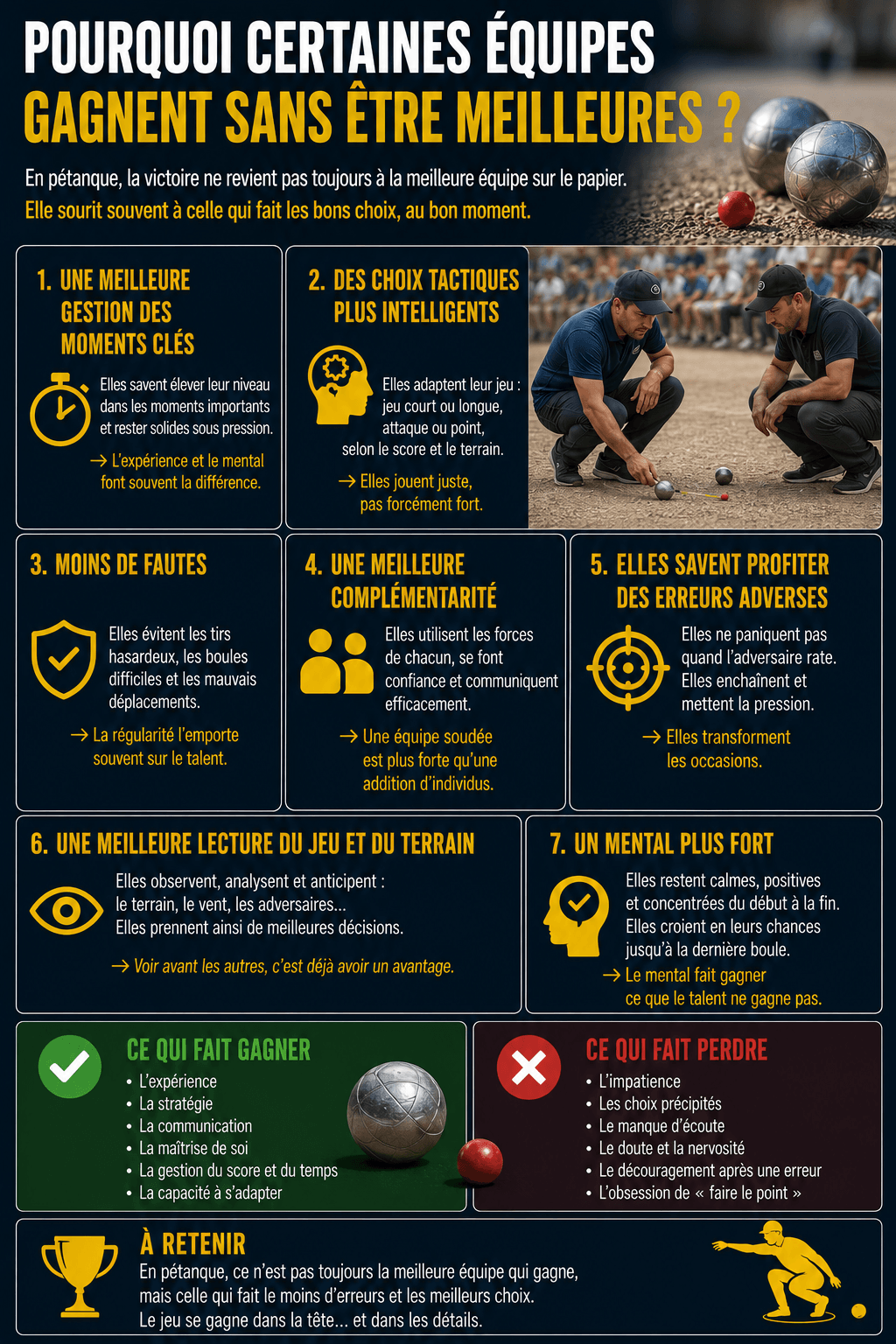
Some teams regularly beat technically superior opponents. ItWhat creates the invisible gap between teams
🏆 THE PERFORMANCE LEVELS OF A TEAM — BEYOND INDIVIDUAL TECHNIQUE 👤 INDIVIDUAL The technical level of each player taken separately. This is what's measured in individual tournaments. Necessary but insufficient to predict a team's result. VISIBLE 🤝 COORDINATION The synchronisation of decisions between players — who points, who shoots, in what order, how the reading of the terrain is shared. Good coordination can be worth 20 to 30% more in level. PARTIALLY VISIBLE 🧠 REGULATION The collective ability to manage emotions, the score, pressure. Teams that regulate well don't collapse — they maintain their level throughout the whole game. LITTLE VISIBLE 🔥 MOMENTUM The collective energy that builds on good sequences and holds up on bad ones. Teams with good momentum keep the pressure on even when they're playing less well. INVISIBLE 🏆 CULTURE The set of shared habits, rituals and values that define how the team plays, behaves and recovers from setbacks. Team culture is the most stable factor over time. VERY INVISIBLE 🎙️ PAQUITA ON TEAMS THAT OVERPERFORM "I've played against teams where both players were clearly better than us bowl for bowl. And we beat them anyway. Not because we got luckier — because we knew exactly what we were doing in every end, we'd look at each other without speaking and understand each other, and when things went wrong we never turned on each other. They were playing two solos side by side. We were playing a team. That's the difference." — PaquitaThe 6 collective advantages of teams that overperform
🤝 1. Silent tactical synchronisation — deciding without speaking COHESION COMMUNICATION WHAT IT IS AND WHY IT WINS A tactically synchronised team makes its decisions in a few seconds, without long verbal discussion — because both players read the terrain the same way and have the same tactical reflexes. This synchronisation saves time, reduces hesitations visible to the opponent, and produces more fluid decisions. It translates concretely into a more sustained pace of play — a team that doesn't deliberate maintains a pressure the opponent has to endure without being able to reorganise. → To develop: play together regularly, talking out loud about your decisions during training. Gradually, shared readings develop and verbalisation becomes unnecessary — it's been integrated into the silent synchronisation. HOW THE OPPONENT FEELS IT Faced with a synchronised team, the opponent feels a form of diffuse pressure: the shots follow one another quickly, the decisions seem instantaneous, the team seems to "read" the situation before they do. This impression of synchronicity creates a sense of inferiority that can affect the opponent's confidence — even if technically the players are better. A weaker but better-synchronised team gives the impression of "knowing what it's doing" — which is psychologically destabilising. → Synchronisation indicator: in a game, count the number of decisions made quickly (under 5 seconds) versus long decisions (over 15 seconds). A highly synchronised team has a clearly higher ratio of fast decisions. 🔥 2. Active momentum management — building and maintaining the run MOMENTUM COLLECTIVE ENERGY MOMENTUM — A MEASURABLE REALITY Team momentum is the collective energy that builds when several good bowls follow one another — a dynamic that improves confidence, fluidity of motion and quality of decisions. Teams that understand and actively manage their momentum don't just suffer it — they make different decisions depending on whether momentum is with them or against them. On positive momentum: sustained pace, fast decisions, bold shots. On negative momentum: deliberate slowdown, refocusing on the fundamentals, waiting for the opponent to make mistakes. → To develop: explicitly identify the momentum during the game ("we're on positive momentum" / "we've lost the momentum") and adapt decisions accordingly. This active awareness of momentum turns a passive state into a managed variable. HOW TO BREAK THE OPPONENT'S MOMENTUM Faced with a team on positive momentum, certain strategies let you break their run without waiting for it to fizzle out on its own. Deliberately slowing the pace of play, forcing a visible discussion break (even a brief one), asking for a measure — these actions interrupt the opponent's flow and give them time to "cool down". It's not negative play — it's a real-time reading of the collective dynamic. → To counter the opponent's momentum: a single good end played calmly and methodically is often enough to reverse the momentum. Quality beats speed when the opponent's run needs to be stopped. → Remember: teams that don't manage their momentum suffer their play — their results fluctuate with the "waves" of confidence without understanding why. Teams that manage momentum play with an extra variable the opponent doesn't control. 📊 3. Intelligent reading of the score — playing differently depending on the situation SCORE ADAPTIVE STRATEGY THE SCORE CHANGES THE RULES OF THE GAME Playing the same way at 0-0, at 8-4 up and at 4-8 down is a strategic mistake — yet a very common one. Teams that read the score intelligently adapt their risk-taking, their style of play and their tactical priorities to the reality of the score in every end. Comfortably ahead: cautious play, pointing to secure, forcing the opponent to take the risks. Behind: bolder play, calculated risks, looking to create unbalanced situations. These strategic adaptations to the score are often the difference between teams that "play well" and teams that "play smart". → To develop: before each game, agree on an adaptive game plan: "if we're up by 4 or more, we play cautious; if we're down by 4 or more, we take tactical risks". This simple plan avoids misreading the score context. THE TRAPS OF A BADLY READ SCORE Playing "for nothing" when well ahead — wasting bowls on needless risky shots. Playing too cautiously when behind — never taking the risks needed to turn things around. These two misreadings of the score cost games that could have been won or saved. A technically inferior team that reads the score better than a superior team will win ends and games it "shouldn't" have won on technical level alone. → Score exercise: after each game, analyse the ends played "out of score context" — needless risky shots when leading, overly cautious play when chasing. These ends identify the score-reading mistakes to correct. 🛡️ 4. Collective resistance to errors — not collapsing together RESILIENCE ERROR MANAGEMENT WHY COLLECTIVE RESILIENCE WINS All teams make errors — including the best. What separates teams that recover from teams that collapse is their collective ability to "digest" the error without letting it contaminate the following bowls. A resilient team doesn't have fewer errors — it suffers them for less long. When a partner misses an important bowl, the other absorbs the emotion, maintains their own level, and stops the negative spiral. This collective resistance is often more decisive on the final result than raw technical level. → To develop: agree before the game on a collective recovery protocol — an agreed signal (word, gesture) meaning "it's behind us, we move on". This signal short-circuits the emotional spiral before it has time to set in. THE DIFFERENCE WITH INDIVIDUAL RESISTANCE Individual resistance (a player who isn't affected by their own errors) is valuable but insufficient. Collective resistance adds a dimension: a player's ability not to be affected by their partner's errors — and vice versa. In fragile teams, one player's error often degrades the other's play through emotional contagion. In resilient teams, each player shields the other from their own emotional reaction, creating a collective safety net. → Resilience indicator: observe the level of play of the 3 bowls after a significant error. If the level systematically drops after an error, collective resilience needs work. If the level holds or rises (a "response" effect), resilience is solid. 🎭 5. The tactical element of surprise — being unpredictable collectively TACTIC UNPREDICTABILITY WHY UNPREDICTABILITY DESTABILISES An opponent who can systematically anticipate the opposing team's decisions plays in "prepared response" mode — they already know what they're going to do before the situation has even arisen. An unpredictable team — one that points when a shot is expected, that changes axis, that plays short when long is expected — forces the opponent to rebuild their decision on every bowl. This extra cognitive cost gradually degrades the quality of the opponent's decisions, particularly under pressure. → To develop: have explicitly in the team's tactical arsenal some "unexpected plays" — situations where the team can deliberately do the opposite of what the opponent expects. Decide them in advance, not in the heat of the moment. THE DISCIPLINE OF BEING UNPREDICTABLE Unpredictability isn't chaos — it's a deliberate strategy. A team that changes its decision "because it doesn't know what to do" isn't unpredictable — it's indecisive. A truly unpredictable team makes unexpected choices from a position of tactical strength — it knows why it's doing the opposite of what's expected, and that "opposite" has a clear logic. The difference between unpredictability and improvisation is preparation: the "surprise" plays are planned in training, not on the spot. → Remember: unpredictability is a collective advantage — not an individual one. It assumes both partners know the team's "surprise" plays and recognise them in the situation. A surprise for the opponent must not be one for the partner. ⚙️ 6. Team rituals — creating consistency and regularity RITUAL REGULARITY WHY TEAM RITUALS WORK Team rituals — the way players greet each other before the game, the phrase they use between ends, the gesture they make after a good bowl — seem anecdotal but have documented effects on cohesion and performance. They create a collective identity ("we're that team"), reduce pre-competitive anxiety through their repetitive and predictable nature, and signal to each player that they're in their team — a feeling of safety that frees up mental resources for play. → To develop: identify 2 to 3 simple team rituals — one before the game, one between difficult ends, one to celebrate. These rituals build organically over the course of games but can be initiated deliberately if the team wants to develop them. RITUALS UNDER PRESSURE — WHEN IT REALLY MATTERS The true value of team rituals shows up in tough moments — under maximum pressure, after several lost ends, at the end of a tight game. At those moments, a familiar ritual brings the team back to its usual way of functioning — it temporarily cancels the pressure by creating a parenthesis of normality. Teams with solid rituals hold up better under pressure because they have behavioural "anchors" that bring them back to their optimal state whatever the situation. → Remember: team rituals aren't superstition — they're applied psychology. Creating behavioural consistency in difficult moments is one of the most useful functions rituals fulfil. 🏆 The weaker team that always gets away with itThere's this type of team in every tournament — the one that doesn't impress on technical grounds but always comes back, never collapses, and seems to find the opponent's mistake at the right moment. It's not repeated luck — it's the product of the 6 advantages described here, cultivated consciously or instinctively. The good news is that these advantages can be trained. A team that decides to work on them deliberately can quickly exceed its apparent technical level.
Superior team vs inferior team — what really sets them apart
❌ THE "SUPERIOR" TEAM THAT LOSESTwo solos playing side by side: each player makes their decisions independently, with no shared reading of the terrain. The sum of individual talents doesn't convert into collective intelligence.
Same play whatever the score: the same style of play at 0-0 and at 11-8 — no strategic adaptation to the context. Technical advantages are wasted on shots unsuited to the situation.
Visible emotional reaction to errors: each miss generates visible tension or recrimination — collective confidence degrades from the first errors and never recovers.
Erratic pace: very fast ends (on positive momentum) and very slow ends (on doubt) — with no conscious management of pace as a tactical tool.
→ These technically superior teams underuse their potential because they haven't developed the collective advantages. ✅ THE "INFERIOR" TEAM THAT WINSA shared game system: both players read the terrain the same way and have the same tactical priorities — the decision on every bowl is predictable for the partner but surprising for the opponent.
Adaptive play to the score: caution when ahead, boldness when behind — a strategic flexibility that maximises the odds in every score situation.
Silent resilience: errors are absorbed quickly, with no visible reaction — the team doesn't give the opponent the signal that its errors had an emotional impact.
Pace managed as a tool: sustained when momentum is favourable, slowed when the opponent's run needs to be broken — a conscious management of the collective tempo.
→ These teams maximise their collective potential — and sometimes exceed it thanks to their invisible advantages. 🔨 THE ADVANTAGES YOU CAN BUILDTactical synchronisation: develops by playing together and verbalising decisions in training. 10 to 15 sessions are enough to develop a solid shared reading.
Collective resistance: is built through explicitly agreed recovery protocols, practised in training under simulated pressure.
Momentum management: develops by explicitly naming the momentum during the game and adapting decisions accordingly — a habit that takes hold quickly.
Team rituals: build organically over time or deliberately in 2 to 3 sessions if the team explicitly agrees on them.
→ These advantages are developable in weeks, not years — unlike technical qualities. 🎲 THE LIMITS OF THE COLLECTIVE ADVANTAGEToo wide a technical gap: collective advantages don't make up for a 3- to 4-level technical gap — they can make up a one-level gap, sometimes two in good conditions.
The opponent who has both: a technically superior AND collectively solid team is almost unbeatable for an inferior team. The collective advantage works best against technically superior but collectively fragile teams.
Consistency: collective advantages fluctuate with the day, the partners, the conditions. A good collective team can have days of desynchronisation — and lose games it should win.
→ The collective advantage is a powerful lever — but not an absolute guarantee. It optimises the odds, not the result. 🔑The real question isn't "how to be better technically" — it's "how to play better than my level". Collective advantages are the shortest path between your current level and results above your current level. An investment of a few weeks in synchronisation, resilience and momentum management can produce wins that no technical work of the same duration would have produced as quickly.
Signs of a team that underuses its collective potential
🗣️Too much discussion during ends Long and frequent consultations before every bowl signal an absence of a shared reading of the terrain. Decisions that should be obvious for a synchronised team require debate — which slows the pace, exposes the hesitations to the opponent and consumes mental energy that should go into the motion. → Test: how much time passes between the end of one bowl and the start of the next? If it's often more than 20-30 seconds with discussion, synchronisation needs work. 😤Visible reactions after a partner's errors Sighs, eyes to the sky, low-voiced comments — these reactions signal fragile collective resilience. Every visible reaction to a partner's error transmits pressure to the player who just missed, degrades their confidence for the next bowl, and signals to the opponent that the error had the intended effect. → Test: observe the quality of the 2 bowls that follow a significant error. If they're systematically worse, emotional contagion needs work. 📊Same play whatever the score situation Pointing and shooting the same way at 8-2 up and at 2-8 down. This absence of strategic adaptation to the score signals that the team is playing its game rather than playing the game. The opportunities for calculated risk (when behind) and conservative play (when ahead) are missed for lack of reading the context. → Test: does the team take more risks when behind? Does it play more cautiously when comfortably ahead? A "no" on both sides signals an absence of adaptive strategy. 🎢Very inconsistent results from one game to the next Easily winning some games and collapsing in others with no clear technical explanation. This inconsistency in results is often the sign of a team dependent on its individual momentum — it wins when both players are "hot" at the same time, and loses when one or the other is having a bad day. Collectively solid teams compensate more for individual dips. → Test: compare the results of "both in form" games vs "one in form, the other less". If the gap is very large, collective compensation is insufficient.Building collective advantages deliberately
🔨 COLLECTIVE DEVELOPMENT PLAN — 5 AXES IN 8 WEEKS Turning an association of two players into a real team 🗣️ Weeks 1-2: Verbalise decisions in training Before every training bowl, one of the two players announces the tactical intention out loud and the other validates it or suggests an alternative. This practice seems to slow the game down — it's temporary. In 2 weeks, the shared reading of the terrain develops and the verbalisations become shorter, then spontaneously silent. 🛡️ Weeks 3-4: Practise the collective recovery protocol Agree on a recovery signal (word or gesture) and use it systematically after every significant error in training. Impose the rule of not commenting on errors verbally — only the recovery signal. This rule, practised for 2 weeks, anchors the quick-recovery reflex that will work in tournaments. 📊 Weeks 5-6: Play with an explicit score plan Before every training game, define a score plan: "if we're up by 3 or more, we play defensive; if we're down by 3 or more, we take risks." Apply this plan strictly for 2 weeks, even when it seems counter-intuitive. The habit of adapting play to the score takes hold through repeated practice. 🔥 Weeks 7-8: Name the momentum in real time During games, get into the habit of naming the momentum between ends: "we're on positive momentum, we keep the pace" or "we've lost the momentum, we slow down and refocus on the fundamentals." This verbalisation of momentum turns a passive state into a managed variable — and develops the collective awareness of the game's dynamic. ⚙️ Ongoing: Develop 2-3 team rituals Identify organically or deliberately propose 2 to 3 rituals that punctuate the games: one before starting, one after a good end, one for the decisive end. These rituals create a team identity and behavioural anchors that work under pressure. They don't need to be formal — a word, a discreet gesture, or a phrase is enough.Exercises to develop collective cohesion
01 The "no talking" game — forcing non-verbal synchronisation 📍 Training in pairs ⏱️ 1 h 🎯 Develop a shared reading of the terrain without verbal communicationPlay whole games without communicating verbally — no decisions, no comments, no encouragement. Only looks and gestures. This exercise forces the development of non-verbal synchronisation and reveals the situations where the shared reading is insufficient.
Play 3 full games in total silence. Observe the situations of visible disagreement — when one player is about to play a bowl and the other clearly has a different intention (posture, gaze, movement). These situations reveal the gaps in synchronisation. After the silent games, a 10-minute debrief: note the situations where the two players had different readings. These situations are the work priorities — either a simple tactical rule to agree on (for example "the pointer never shoots except by explicit verbal agreement"), or extra training on the specific situation. Replay these specific situations in silence after the debrief. See whether synchronisation is better with the explicitly agreed rule. If yes, the rule is acquired. If no, the situation needs more work — or a different rule. Over 3 to 5 repetitions of this exercise, the list of disagreement situations should gradually shrink. When almost all situations resolve without words — with just a look to confirm — non-verbal synchronisation is developed. This skill remains present even in games where verbal communication is allowed. 02 Collective pressure simulation — practising resilience as a team 📍 Training with 4 (two teams) ⏱️ 1 h 30 🎯 Develop collective resistance under simulated pressurePlay games with an unfavourable starting score (start at 0-8 or 0-10) to simulate a high-pressure situation. The goal isn't to "come back" but to maintain the collective level of play and cohesion under the maximum pressure of an unfavourable situation.
Start each game with an 8-point handicap (0-8). Observe how the team reacts collectively to this situation : does the play change? Does communication degrade? Does risk-taking increase in a disorderly way or in a strategically coherent way? Deliberately apply the collective recovery protocol on every error — regardless of the handicap pressure. The 8-point handicap amplifies the emotional pressure of every error — it's precisely this heightened-pressure environment that trains resilience. Observe whether the team "forgets" the handicap after a few ends and plays end by end — or whether the starting score weighs psychologically on every decision. Playing end by end whatever the overall situation is the mental goal. The handicap tests whether this goal is truly reached or only theoretical. After the series of handicap games, play a normal game (0-0). Observe whether the collective behaviours developed under the handicap pressure (resilience, cohesion, shared reading) remain present in normal conditions — or whether they disappear without the pressure. Their presence in normal conditions is the sign of real integration. 🤝 A team is more than two players playing togetherTwo players playing side by side, each in their own head — that's an association. A team is two players who share a reading of the terrain, a management of emotions and a collective identity. The transition from association to team doesn't happen automatically with time — it requires deliberate work on the 6 advantages described here. But once that transition is made, the team produces results that the individual levels alone would never have been enough to reach.
📚 PAQUITA'S BOOKS Improving at pétanque — Paquita's guides 🎯 TACTIC — MENTAL — TECHNIQUE Play everywhere — from technique to on-terrain tactics Team cohesion, tactical synchronisation, collective momentum management, shared reading of the terrain — the complete guide to playing as a team rather than as two individuals side by side. 📦 Amazon 💥 SHOOTER — TECHNIQUE — CONSISTENCY Become a fearsome shooter Shooting within the team's collective system, synchronising with your partner on shooting decisions, individual resistance that protects the team — building a shooting motion that strengthens collective cohesion. 📦 Amazon 🎳 POINTER — AWARENESS — REFERENCE POINTS The art of pointing — precision and consistency Placement at the service of the collective system, a shared reading of the terrain with your partner, adapting your pointing play to the team strategy — the guide for the pointer who plays for the team. 📦 Amazon 🧠 MENTAL — ROUTINE — METHOD Pétanque by method Develop collective resilience, team rituals, momentum and pressure management, build the invisible advantages that make you win without necessarily being better — a method to progress collectively. 📦 Amazon