News · 16 April 2026
Pointing with the left hand in pétanque: Why (and how) to train?
NewsYou're right-handed. The game configuration forces you to point from the left. You lose the point. This situation arises in every competition. ItThe scenario that costs you points without you realizing it
📍 COMPETITION SCENARIO — END 8, SCORE 8–7 The jack that forces you to point from the left side The jack is placed on the left, against the boundary. The natural throwing angle from the circle forces the right-handed pointer to go around an opponent's boule on the right or to aim at an impossible landing spot from their usual position. Opposing captain"He'll have to point from the left or shift his axis. Either way, he's less comfortable." Your captain (in a low voice)"Can you point from the left?" You shake your head. You point awkwardly from the right at a forced angle. The boule stops at 40 cm. You lose the end. Opposing captain"That's exactly what I wanted."This scenario repeats in every serious competition. An opponent who knows your game can provoke it deliberately — by placing the jack in positions that force you to point from an unfavorable side. And if you can only play from one side, you're predictable. Predictability is the enemy of the competition pointer.
The 5 good reasons to train with your non-dominant hand
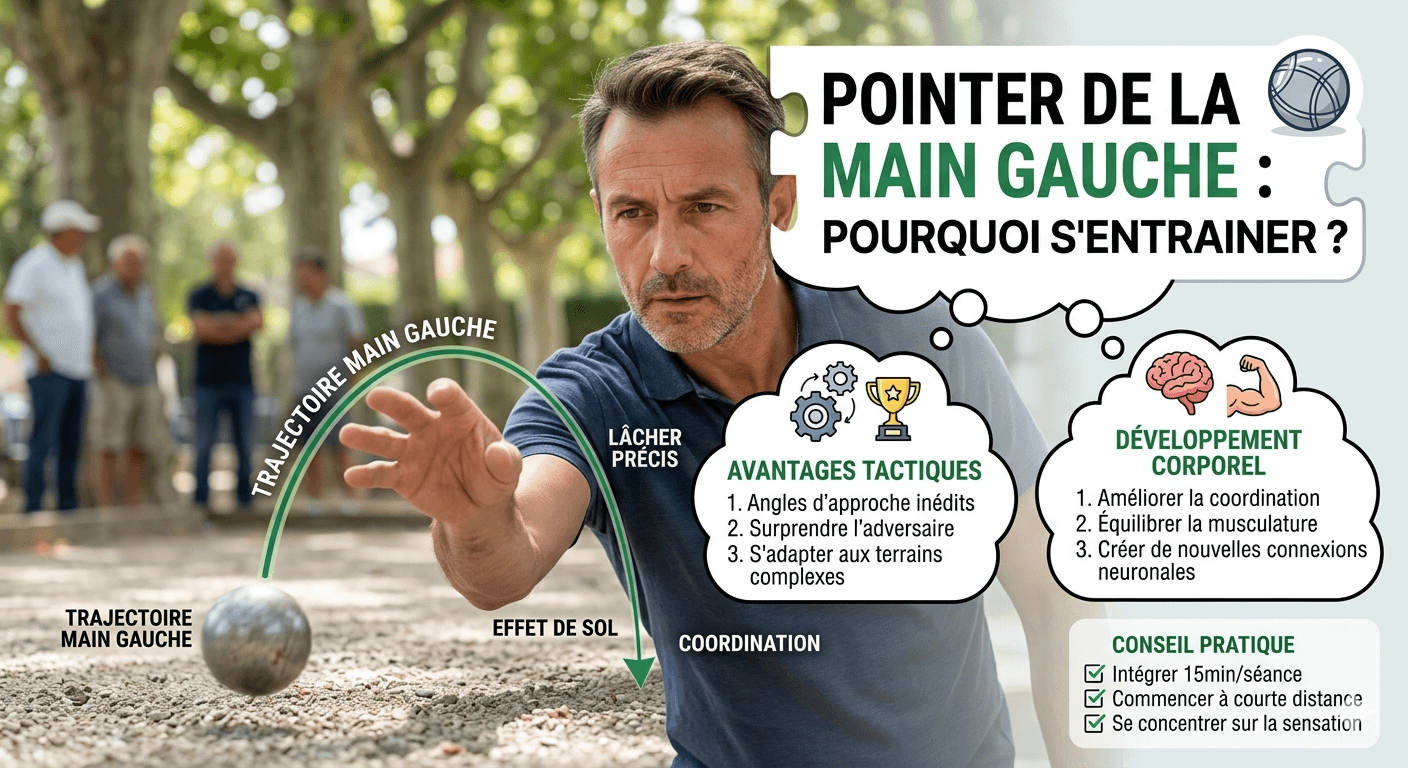
1 🎯 Access all anglesA boule near the left boundary, an off-center jack, an obstacle to go around — dozens of configurations give a naturally better angle of attack for the left hand. Having access to it doubles your tactical options on every end.
2 🎭 Become unpredictableAn opponent who knows you only point with one hand organizes their defensive strategy accordingly. A player able to point from both sides is much harder to counter — their options are doubled, their strategy is unreadable.
3 🧠 Better understand your own deliveryLearning to point with the non-dominant hand forces a conscious analysis of the delivery that the dominant hand performs automatically. This fresh look at your own biomechanics often identifies flaws in the "usual" delivery that you had never noticed.
4 🏥 Continuity in case of injuryTendinitis in the right elbow, a sprained wrist, shoulder pain — common problems among regular players. If the non-dominant hand is sufficiently trained, a minor injury doesn't end a season.
5 🔄 Develop overall proprioceptionAmbidextrous training develops the motor neural circuits of both brain hemispheres. This activity improves general coordination, body awareness, and — directly — the accuracy of the dominant hand through cross-skill transfer.
What neuroscience says about ambidextrous training
🧠 SPORTS NEUROSCIENCE The brain that learns with one hand improves the other The science of motor control has documented a phenomenon called "intermanual transfer" : when you learn a precise motor skill with one hand, part of that learning spontaneously transfers to the other hand — even without direct training of it. The mechanism is known: the motor representations in the cerebral cortex are partially bilateral for precise movements.In practical terms for the pétanque pointer: working the left hand's delivery improves the brain's representation of the swing in general — which directly benefits the right hand. Players who have seriously worked on their non-dominant hand often report an unexpected improvement in their dominant hand in parallel. It's no coincidence — it's applied neuroscience. 🎙️ Paquita on ambidexterity "I started training with my left hand after tendinitis in my right elbow that immobilized me for 3 weeks. Two months later, not only could I point from the left in simple situations, but my right elbow was better and — inexplicably at first — my right hand was more consistent. I looked into why. The answer lay in neuroscience: by working on the delivery on both sides, I had better integrated what the delivery was supposed to be. My right hand benefited from the clarification that my left hand had forced me to make." — Paquita
The concrete situations where the left hand changes everything
📍 Jack placed against the left boundary The jack is 15 cm from the left boundary of the terrain. Pointing from the right involves an oblique angle of attack that makes the situation hard to control. Pointing from the left gives a natural axis perpendicular to the boundary — it's the simplest and most precise angle for this configuration. → The left hand gives access to the optimal axis without changing your position in the circle 🎳 Opponent's boule blocking the right axis An opponent's boule is placed exactly in your natural throwing axis from the right. Either you go around it with a forced angle that reduces your accuracy, or you point from the left on a clear axis. The second option is often better — but it requires having the left hand available. → Going around an obstacle without changing axis — the axis switches sides 🔄 Series configuration — three consecutive ends on the same side The jack lands three ends in a row in the left zone of the terrain. You point three times from your right at an unfavorable angle. Muscular fatigue builds up in the same muscle group. An ambidextrous player alternates and distributes the load — without loss of accuracy. → Muscle preservation over long games 🌬️ Crosswind from the right A strong side wind coming from the right pushes the boules to the left — which favors throws from the left whose natural trajectory compensates for the wind. The ambidextrous pointer chooses their hand based on the wind — the one-handed pointer suffers the wind regardless of its strength. → Exploiting the wind instead of suffering it ⚡ Deliberate tactical surprise In competition, bringing out the non-dominant hand in a situation where the opponent believes you're limited is a real psychological shock. He had placed the jack to force you into a difficult angle. You calmly switch hands and place a clean boule. The effect on his morale — and on yours — is tangible and lasting. → A psychological weapon as much as a technical oneCommon misconceptions — what's false about pétanque ambidexterity
❌ MISCONCEPTION ✓ REALITY ❌"You have to be naturally ambidextrous for that — I'm just not wired that way." ✓Athletic ambidexterity can be trained — it isn't innate for 99% of people. The few rare naturally ambidextrous people are the exception. The non-dominant hand improves with structured training, like any other motor skill. ❌"It takes years — it's not a realistic investment for a club player." ✓A "competition-usable" level on simple situations (point at 6–7 metres on open terrain) is achievable in 6 to 10 weeks of regular 15-minute training. It isn't the dominant hand — but it's enough to cover 80% of the situations that arise. ❌"Training the left hand will disrupt my right-hand delivery." ✓False — it's actually the opposite. Training the non-dominant hand generally improves the understanding and consistency of the dominant hand through skill transfer. The only precaution: don't mix the two in the same targeted training session. ❌"Others will mock me if I point with my left hand and miss." ✓In a serious club, a player who works on their game on both sides is respected — not mocked. And if you pull off a clean point with your left hand in a difficult situation, the way people see you changes instantly. Others' opinion evolves with the results. ❌"It's only useful for very high-level players — not for me." ✓It's exactly the opposite of reality. At the top level, players adapt through other, very sophisticated means. At club and regional level, a basic ambidextrous player creates a real difference against opponents whose strategy doesn't account for this option.What's different technically
The basic delivery is identical in its principles — pendulum, arm-leg synchronization, release, follow-through. What differs are the neurological adaptations and the specific points of vigilance for the non-dominant hand.
✋ DOMINANT HAND (right) Automated delivery — little awareness needed Developed proprioception — you feel the release Natural force and range Subtle errors — hard to identify Withstands pressure well (if delivery is ingrained) 🤚 NON-DOMINANT HAND (left) Conscious delivery — every phase requires attention Proprioception to develop — release often too early or too late at first Reduced force — requires distance adaptation at first Visible errors, quickly identifiable Pressure resistance to build gradually ⚠️The main point of vigilance with the non-dominant hand: the release. The non-dominant hand lacks fine proprioception in the fingers — the brain doesn't "feel" the exact moment of release as well. The boule can come out too early (open release, boule that drops to the side) or too late (a "stuck" boule that goes inward). The first training sessions should target release quality exclusively before working on distance and accuracy.
The 8-week program to get started
WEEKS 1–2 Phase 1 — Discovering the release Single objective: learn to release the boule cleanly from the left hand — without aiming, without distance, without a target. Throw toward a wall or an unimportant area from 3 metres. The only question: does the boule go in the direction I chose? 15 minutes per session, 3 sessions per week. Ignore distance and accuracy completely. Objective: controlled release 7/10 WEEKS 3–4 Phase 2 — Distance and force Start working on force calibration over a short, fixed distance (5 metres). Place a target object on the ground and count the boules within a 50 cm radius. Don't aim for lateral accuracy yet — only distance. 15 minutes per session. Use the same basic exercises as for the right hand, adapted to the reduced distance. Objective: 50% within the 50 cm radius at 5 metres WEEKS 5–6 Phase 3 — Accuracy and axis Work on lateral alignment at 6–7 metres. Lay two cords or markers 30 cm apart on the playing axis — the boule must stay within this corridor. Combine lateral accuracy and distance at the same time for the first time. Accept the temporary regression — combining two parameters is difficult at first. Objective: 50% within the corridor at 7 metres WEEKS 7–8 Phase 4 — Integration and pressure Introduce the left hand into real practice games — only in situations where it's clearly the most suitable option (jack on the left, right axis blocked). Observe behavior under slight pressure. Don't use it on every end — only where it's tactically justified. Objective: use in a real game, 3 situations per competition3 foundational exercises
01 The hand mirror — copying your own delivery 📍 Anywhere ⏱️ 10 min 🧠 Neurological transferBefore even touching a boule with your left hand, consciously make the left hand reproduce the same delivery as the right hand — performing them simultaneously. It's the exercise that most quickly activates intermanual transfer.
Perform your usual swing with your right hand, without a boule, in slow motion. Mentally observe each phase: start, backswing, low point, forward swing, follow-through. Repeat the same motion with both hands simultaneously — a right swing and a left swing in mirror image. Both arms move at the same time. Do 20 repetitions in slow motion. Then, perform the motion of the left hand alone — the brain now has a clear reference of what the delivery should be. Mentally compare with what you do with your right. Introduce a light boule (or even a tennis ball) in your left hand and repeat the motion. Observe whether the release is clean — does the boule go in the desired direction? 02 Distance gradation — building force progressively 📍 Terrain ⏱️ 15 min ⚡ Force-distance calibrationBuild the force/distance relationship of the left hand starting from very short and lengthening progressively. Never move to the next distance before the previous one is mastered at 70%.
Distance 1 — 3 metres: 10 throws. Objective: 7 boules within a 30 cm radius of the target. Don't move on before reaching this objective over 2 consecutive sessions. Distance 2 — 5 metres: same objective (7/10 within 40 cm). The feeling of force will radically change — accept the adaptation period. Distance 3 — 7 metres: objective 6/10 within 50 cm. This is the target distance for use in competition. Don't move on to 9 metres before mastering 7 metres. Distance 4 — 9 metres: objective 5/10 within 60 cm. This distance isn't essential for most players — 7 metres covers 90% of tactical situations. 03 The alternating duel — one right-hand boule, one left-hand boule 📍 Terrain ⏱️ 20 min 🔄 Integration of both handsConsolidation exercise — alternate one boule from the right and one boule from the left on the same jack. It compares the results, identifies the gaps, and forces awareness of both deliveries simultaneously.
Place a jack at 7 metres. Throw a boule with your right hand, observe its position. Then throw a boule with your left hand to the same spot. Compare the two positions. Note the average gap between the position of the right and left boules over 10 sets. The objective is to reduce this gap gradually — not to eliminate it (that's unrealistic) but to bring it down to under 25 cm. Vary the jack's position — central, shifted to the left, shifted to the right. On a jack shifted to the left, observe whether the left hand produces better results than the right. That's the sign the training is working. 🔁 UNEXPECTED BENEFIT What the left hand teaches the right hand A phenomenon regularly reported by players who seriously train their non-dominant hand: after 4 to 6 weeks, their dominant hand becomes more consistent and more aware. The explanation is neurological. By working the left hand in a deliberate and conscious way, you force a detailed analysis of the gesture that the right hand was performing automatically and sometimes imprecisely. The awareness brought to the left hand feeds back to the right hand. The subtle flaws of the dominant gesture — slightly visible in the non-dominant hand — are identified and corrected in turn. 💡 The realistic goal — not perfect symmetryThe goal is not to reach the right hand's level with the left hand. It's pointless and unrealistic barring several years of intensive training. The goal is to reach a level sufficient to cover the tactical situations that arise in competitions — that is, 60 to 70% of the dominant hand's precision on simple configurations. That's enough for the great majority of tactical uses, and it's achievable in a few weeks of structured work.
📖 PAQUITA'S BOOK The method to become the complete playerBiomechanics, non-dominant hand, game reading, competitive mindset... Paquita's book covers all the dimensions of the complete player with 100 numbered exercises and programs adapted to each level.
📦 Order on AmazonFAQ — Your frequent questions
Is changing hands during the game permitted by the rules? + Yes, totally. The FIPJP and FFPJP regulations impose no constraints on the hand used for throwing. A player can throw with the right hand on one end and with the left hand on the next — or even on two different balls of the same end — without any restriction. The only obligation is that the ball starts from the regulation circle with both feet inside. The throwing hand is never mentioned in official texts. I'm left-handed — should I work my right hand for the same reasons? + Absolutely, and for exactly the same reasons. The left-hander faces the same tactical situations as the right-hander, just in the other direction — jack on the right which favors the right hand, left axis blocked, etc. All arguments and exercises in this article apply symmetrically. The only nuance: left-handers represent around 10–12% of the population, bowling and opposing strategies are often less “optimized” to counter them — which gives a natural advantage to left-handers in certain configurations. I play in triplets — can I freely choose which player points with the left hand? + In the triplet format, each player plays with their own balls in their own role. If you are the designated pointer, the left hand question concerns you directly. On the other hand, it's not a collective decision — you choose how you throw, and your captain may suggest that you point left on certain configurations, but you are the one who executes it. The ideal: that the team pointer has worked his non-dominant hand, so that the captain has this option available in his tactical arsenal. Which ball to use to train with your left hand? + Ideally, the same ball as the one used in the right hand — so that the force calibration is directly transferable. In practice, especially at the beginning, the non-dominant hand struggles to hold the ball in the usual way if the weight is high (700g+). If you feel discomfort or instability in your grip, start with a slightly lighter ball (650g) while your left hand gains grip strength. After 4-6 weeks, return to usual weight — strength has developed sufficiently. 📎 Related articles Equipment Choosing your boules — weight suited to the non-dominant hand Equipment Top 3 best shooter boules 2026 Rules FFPJP rules — what you can and can't do Rules The one-minute rule — deciding quickly which hand to use Video Why changing bowls does not change your level Tools Free PetanqueLand tools© Pétanque by Paquita — petanqueland.fr · 📖 Paquita's book on Amazon