Actualités · 14 July 2026
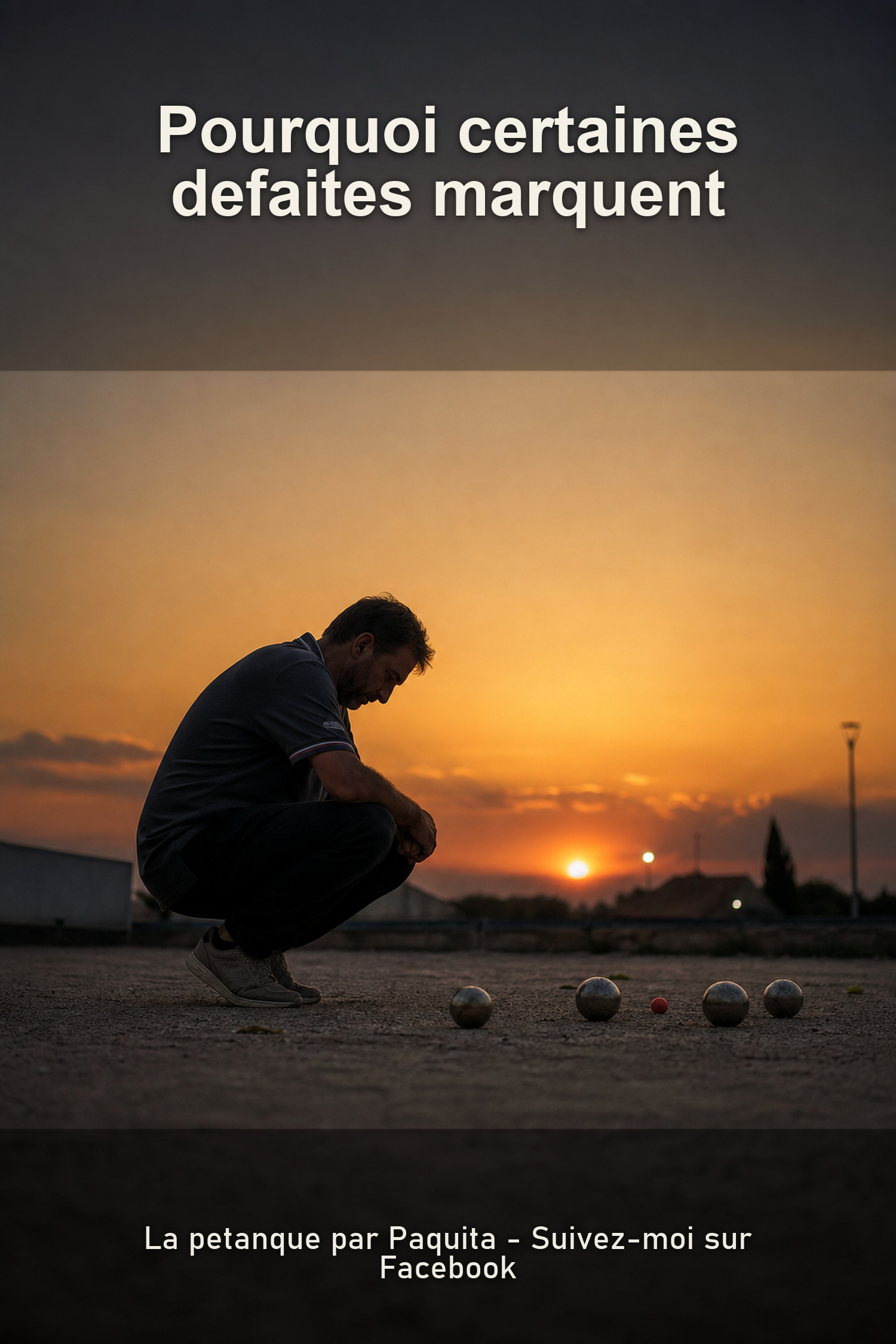
Why some defeats mark a pétanque player's life
Some defeats stay etched for years. Here is why they mark a pétanque player so much and how to take something from them.1.Why some defeats linger
A defeat becomes memorable when it attaches to something bigger than itself: a promise, a family expectation, a competition targeted for months, a team you cared about, or the feeling of having let “the” moment slip away. The score alone cannot explain the mark. What marks you is the story your brain connects to that game.
Added to this is the brutality of the contrast. When you felt close to a great result and everything collapses in a single mène or on a poorly handled choice, your memory records a shock. The greater the gap between hope and outcome, the more the memory sticks. It's a normal emotional mechanism, not a character flaw.
A defeat leaves a lasting mark when it touches the stakes of the moment, your self-image, and the story you build afterwards.
2.The weight of the moment and the stakes
Losing in a friendly game and losing in the final stages of a competition do not carry the same symbolic weight. The stakes give depth to the memory. If the game represented a rare opportunity, a rematch, an expected milestone, or a goal worked on for a long time, the defeat doesn't just close a match: it closes a scenario the player had already begun to live in their head.
That is why a narrow defeat can mark you more than a heavy thrashing. In a severe score, the gap speaks for itself. In a defeat by a single boule, the brain spends days replaying the variations. It imagines the point you should have taken, the shot you could have declined, the words you should not have said. This inner theater keeps the mark alive.
3.When the defeat touches self-image
Some defeats hurt because they attack an identity. The player who thought they were solid cracks. The one who believed they were a good closer misses the decisive boule. The one who wanted to prove they had crossed a threshold discovers they are still fragile. It is no longer just the match that hurts: it is the contradiction between the result and the inner portrait you had been maintaining.
That is where the post-match talk becomes decisive. If the player reduces all their worth to this one game, the defeat widens and invades other areas: confidence, desire to play again, choice of partners, relationship with pressure. If, on the other hand, they distinguish what the game reveals occasionally from what it does not say about them, the wound stays more localized and easier to digest.
4.The story we tell ourselves after the match
The same defeat can produce two very different stories. One says: “I ruined everything, I'm not made for those moments”. The other says: “I paid for a specific choice in a specific context, and I will work on it”. The memory does not disappear, but its power changes completely. In the first case, it becomes evidence against yourself. In the second, it becomes a demanding archive.
The danger often comes from absolute phrases: never, always, incapable, done. They give the defeat an excessive scope. Returning to the facts limits this drift: what was the score? which choice carried weight? what truly depended on me? This return to the concrete prevents emotional memory from swallowing everything.
5.How to debrief without destroying yourself
The first debrief should be short. In the heat of the moment, three clear observations are better than a forty-minute inner tribunal. Note what turned the match, what genuinely existed despite the defeat, and what will require real work later. That is enough to close the day without lying to yourself or beating yourself up.
The next day or the day after, you can come back more precisely: choice of shot, team language, tempo management, reading the terrain. By separating the emotional time from the analytical time, you protect your mental state. Many players suffer more from the destructive debrief than from the match itself.
| After the defeat | Destructive reflex | What to avoid |
|---|---|---|
| Replaying the last mène on a loop | Endless rumination | Isolating the real turning point of the match |
| Defining yourself by the game | I am incapable | I paid for a specific point |
| Debriefing in the heat of the moment for an hour | Emotional exhaustion | 3 observations then a break |
| Changing nothing afterwards | Sterile memory | A concrete action to work on |
If a defeat haunts you, give it a practical outlet: a specific training focus. The brain more easily lets go of what has found some form of usefulness.
6.Turning defeat into future strength
A memorable defeat becomes useful when it leads to a concrete change: a refocusing routine, a team verbal protocol, specific work on the decisive boule, or better pre-match preparation. Without a practical translation, the memory loops. With a clear translation, it changes status: it does not become pleasant, but it ceases to be sterile.
The goal is not to forget at all costs. The goal is to no longer be governed. The strong player is not the one who has never been marked. It is the one who knows how to extract from their defeats a more precise user manual for themselves. When this work is done, the memory remains, but it no longer crushes the future.
To better handle the end of games, understand what pressure awakens, and prevent a narrow defeat from leaving an unnecessary scar.
Discover now