Actualités · 24 June 2026
Why some players change completely in pétanque competitions
Excellent in training, unrecognisable in competition: why the gap? The mechanics of the competition player, what really changes, and how to find your true level again.1.The training/competition gap
Coaches have a term for this: the loss of signature. The Tuesday player has a clear signature — his throw, his routine, his tempo. The Saturday player has lost this signature; he "looks like" another player, more tense, less fluid. The talent is intact, the equipment too; what has changed is theecosystem around the throw: the pressure, the gaze, the noise, the score that really counts.
The good news is that we can break this phenomenon down into identifiable factors — and therefore workable ones.
2.First factor: the gaze of others
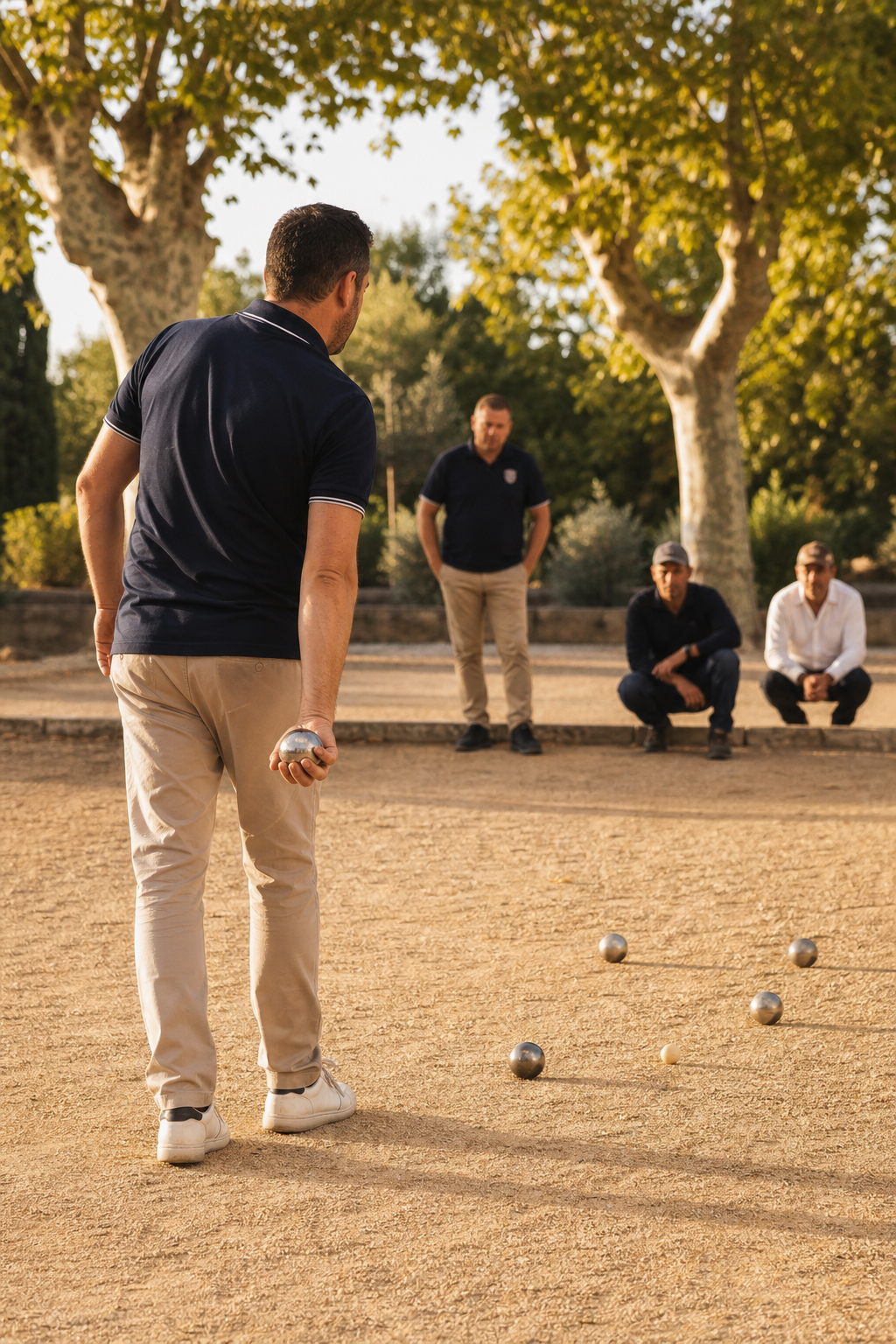
In training, no one really watches. In competition, everyone watches: teammates, opponents, sometimes 30 spectators around the terrain. The brain is sensitive to this gaze, even without realising it. The consequence is mechanical: the muscles tense up, which slightly modifies the throw — especially the wrist, which is the most sensitive link. A rotation lost by one degree, an imperceptible tension, and the boule comes out differently.
👁️Tip: before a competition, play a few boules with someone explicitly watching you. It's uncomfortable, but it gets the body used to it. The discomfort of the gaze diminishes through exposure, like a muscle.
3.Second factor: the stakes of the result
In training, losing an end = nothing. In competition, losing an end can mean losing the game, therefore losing a place, therefore going home. The brain registers the stakes and increases the stress level, regardless of how aware you are of it. The higher the stakes (quarter, semi, final), the more the behaviour gap between training and competition widens.
4.Third factor: the imposed tempo
In training, you take your time. In competition, the rhythm is imposed by the opponent and by the tournament: the next game starts in 20 minutes, the opponent is moving fast, you don't want to look slow. Many players speed up their routine without realising it. A routine of 5 seconds instead of 8 is enough to change the result — the throw misses the mental "stabilisation point" that gave it its quality.
5.The same player, two versions
Let's quantify the difference:
| Element | "Training" version | "Competition" version |
|---|---|---|
| Routine duration | 8-10 seconds stable | 4-6 s under pressure |
| Wrist tension | Supple, natural | Tense, imperceptibly |
| Gaze before release | Fixed on the target | Jumps between opponents and target |
| Tactical choice | Calculated risk | Too cautious / too bold |
| Team voice | Calm, short | Rushed or silent |
Before each boule in competition, count the steps of your routine in a very low voice — "one, two, three, release". The goal is not the pace, but tooccupy your mind with a count that prevents stress from taking over. You'll regain your training tempo, mechanically.
6.Material organisation and preparation
Part of the gap comes simply from organisation. On the morning of the competition, you sleep less, you eat differently, you arrive late or far too early, you register under pressure — as many micro-stresses that pile up before the first throw. Preparing all your equipment the day before (boules, cloth, dry), arriving 45 minutes early, eating as on a normal day, gains you a real level.
For organisers and team captains, the quality of managing a competition also clearly influences the players: a clear draw, a held timing, clean communication reduces the effect of collective stress. This is precisely what a good competition management tool solves. See also our free tools and the page of little-known rules.
7.How to find your true level
Three concrete levers, to work on in this order:
1. Reproduce the stress in training
Play regularly internal competitions simulated at the club, with a score that counts, a minimum audience, and a stake (a drink for the loser, an in-house ranking). The brain gets used to associating pressure with familiar conditions.
2. Standardise the routine
Count your routine over three training boules, measure it. Impose this same duration in competition, even if you feel the pressure. Consistency beats inspiration.
3. Pre-program the breathing
A slow nasal inhalation, two seconds, before each entry into the circle. Trivial, but it's what calms the heart rate and gives access back to the fluid throw. To practise 2 minutes a day at home so that it becomes automatic in competition.
Impact of levers on lag reduction (out of 10) Reproduce stress in training · 9/10 Acclimatization by exposure. The most powerful lever. Standardized routine + breathing · 7/10 Mechanical lever, quick to set up. 💻 THE CLUB TOOL The PétanqueLand competition & melee softwareA well-run competition starts with clean organisation: a clear draw, balanced mêlées, displayed schedules, up-to-date rankings. The PétanqueLand software handles all the management so that your players focus on pétanque, and not on the paper charts that are taking on water.
🖥️ Discover the softwareFAQ — Your frequent questions
Why do I play better in training than in competition?+ Because the mental environment changes. In training, no stakes, no gaze, no imposed tempo: the movement is free. In competitions, these three elements add up and slightly modify your actions without you being aware of it. The technique is not the issue, the environment is. Can competition stress really be worked on?+ Yes, like everything else. The method is graduated exposure: reproduce conditions of moderate stress at the club (internal mini-competition, audience of one or two players, score that counts) then increase gradually. The brain gets used to it, and the gap narrows until it almost disappears. Why does my wrist tense during competitions?+ Because it is the link most sensitive to mental tension. Under pressure, the body tries to “hold” the ball better, which results in a harder wrist. Result: less rotation, therefore different trajectory. Conscious breathing before each ball is the best antidote. Should you play more competitions to get used to it?+ Not necessarily more, but better. Three competitions per month, well analyzed (what was missing, what worked) are worth ten competitions taken. Keep a mini-notebook after each participation: three words on your mind, your tempo, your tactical choice. That’s enough to structure progress. Does material preparation really matter?+ Much more than we think. The equipment ready the day before, the arrival 45 minutes before, the standard morning meal, the water carried: so many micro-decisions that reduce stress before the first throw. A competition starts the same morning, not the drawing. 📎 Related articles GameThe lesser-known rules of pétanque ToolsFree PetanqueLand tools SoftwareCompetition & scrum software© Pétanque by Paquita — petanqueland.fr ·
📘 Discover my books on PetanqueLand
Psychological and organisational article. The mechanisms described are frequent; each player must identify those that concern them most in order to correct them.