Actualités · 10 July 2026
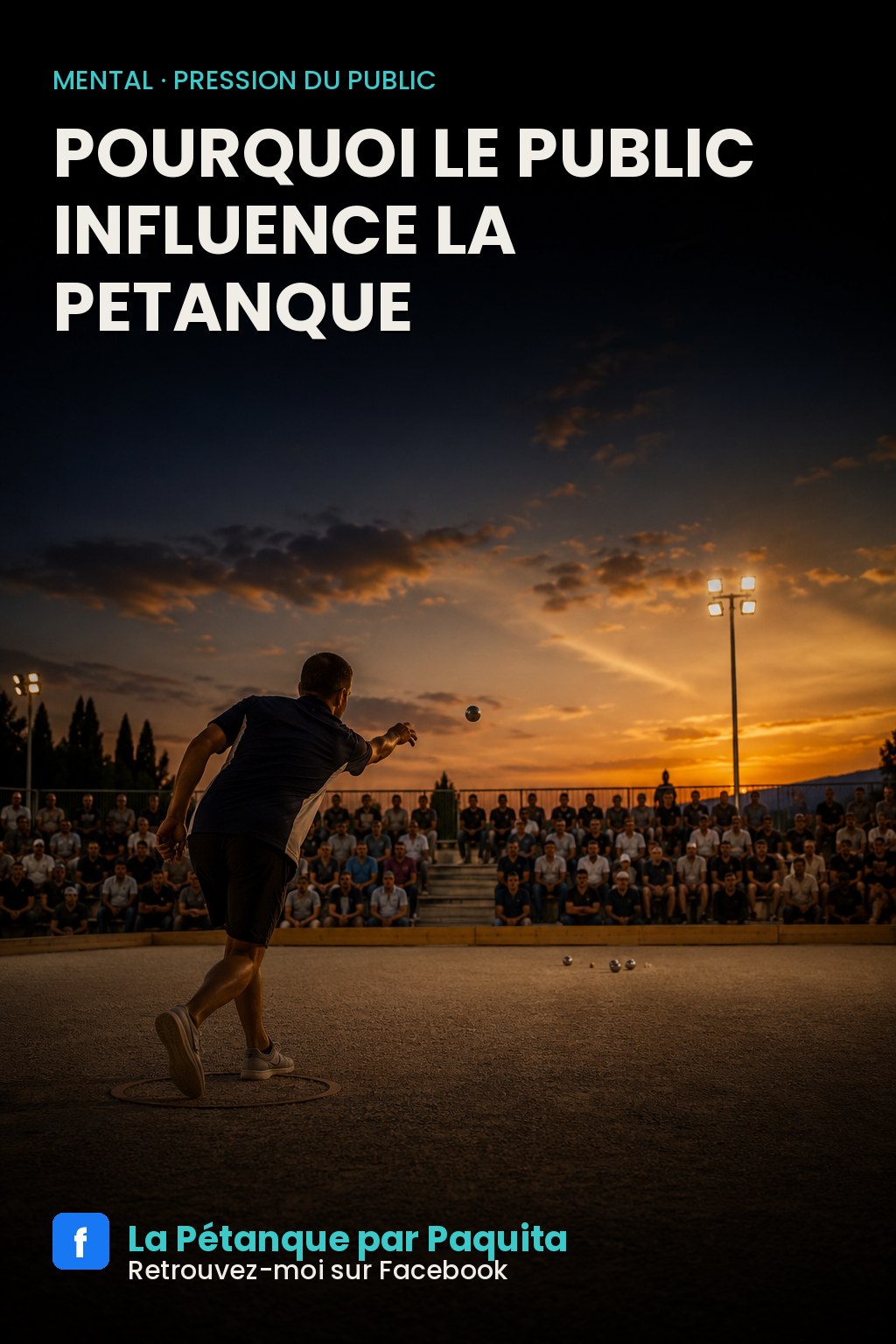
Why the crowd has a huge influence on pétanque
The crowd doesn't just watch: it weighs on the rhythm, confidence, and decisions. Here are the 6 mechanisms by which the crowd really changes the flow1.The crowd's silence is not neutral
In pétanque, the crowd's silence creates an unusual effect: every detail becomes perceptible. The sound of the gravel underfoot, the metallic ring of the bowl, the breathing. For a player unaccustomed to it, this silence amplifies everything — including their own negative thoughts. It's the internal sounding-board effect: with no noise to distract, the mind loops.
Players who often play in competition learn to see this silence as a protective bubble. Others experience it as a spotlight that never goes out.
Paradox: a noisy crowd can be easier to manage than a silent one. The noise is distracting, sure, but it also distracts the negative mind. Absolute silence lets the mind self-sabotage.
2.The crowd changes the pace of play
Under the crowd's gaze, players take on average 3 seconds more per bowl. Not an eternity, but multiplied by 30 ends and 12 bowls, it amounts to several minutes per game, and above all it changes the team's overall breathing. This slowing down isn't a strategic calculation: it's a reflex. You check twice, re-measure, hesitate a little more.
For some teams (the methodical ones), this slowing down is beneficial: it puts them in their tempo. For others (the instinctive ones), it breaks their natural fluidity and makes them lose their best level.
3.The applause effect and the murmur effect
Two signals have an immediate effect on the mind:
Applause
A well-played point applauded by the crowd massively reinforces confidence — the effect is as powerful as a coach. But it has a downside: you then try to reproduce the applauded shot, sometimes to the detriment of the right shot.
The murmur of surprise
More discreet, but more dangerous. When a bowl misses in an unusual way, a murmur runs through the crowd. For the player, this murmur amounts to public criticism. The next bowl bears its mark, almost always.
In competition, some champions impose a protocol on themselves: hear yesterday's applause as a memory, never as an expectation. This cuts the need to reproduce the applauded shot and frees up the next end. It's mental-imagery work that's prepared outside competition.
4.The home crowd and the neutral crowd — two very different pressures
Not all crowds weigh the same. The home crowd — the club's, friends, family — exerts a pressure of expectation. The neutral crowd — that of a big national tournament — exerts a pressure of judgement. The two affect you differently:
| Type of crowd | Dominant pressure | Possible positive effect | Frequent negative effect |
|---|---|---|---|
| Home (club, friends) | Expectation of a certain level | Galvanising, support | Fear of disappointing, over-control |
| Neutral (big tournament) | Judgement, comparison | Protective anonymity | Stage fright, blocking |
| Opponent (visiting crowd) | Contained hostility | Galvanising through challenge | Distraction, loss of focus |
| Mixed (national finals) | Many-voiced | Ambient energy | Hard to filter mentally |
5.Why some players love the crowd
About 30% of players in competition say they play better with a crowd than without. For them, the crowd isn't a pressure but a driver. Several reasons:
Firstly, they need a stake to mobilise their maximum concentration; in training, they stay in under-drive. Secondly, they have a rather extroverted personality; playing in front of others awakens a social pleasure. Thirdly, they have long worked on their exposure to the crowd — it has become a comfort zone through habituation.
For these players, the crowd is an invisible teammate. For others, it's an extra layer to manage mentally.
6.The champions' mental safeguards
The very best players have almost all developed mental safeguards against the crowd. These safeguards aren't improvised — they're habits built up over years:
The attention tunnel
They impose a narrow cone of attention that excludes the crowd. For 5 seconds before each bowl, they see only the corridor between the circle and the jack.
The isolation ritual
A gesture or an inner word that marks the switch into competition mode. It can be adjusting your shirt, tapping the bowl twice, saying an inner word. The ritual cuts the ambient noise.
The presumption of indifference
They decide a priori that the crowd isn't judging their mistakes. It's a willing belief — not a truth — but it frees them mentally. See our game analyses.
7.When the crowd becomes a judge — the ultimate trap
The worst scenario for a player is to mentally turn the crowd into a jury grading every shot. This projection is very common in a final and it's almost always unfair: the vast majority of spectators admire the level of play, they don't grade it. This confusion between benevolent observation and harsh judgement is a mental trap that seasoned players have learned to dismantle.
Simply remembering that the crowd is there for the show and not to grade you is enough, for many, to untangle the tension of the final stretch.
The complete method for neutralising the pressure of the crowd, the stakes and competition: pre-match protocols, attention tunnels, isolation rituals, error management. What champions took 10 years to build, in one book.
📗 Discover the book