Actualités · 26 July 2026
Why silence is scary to certain petanque players
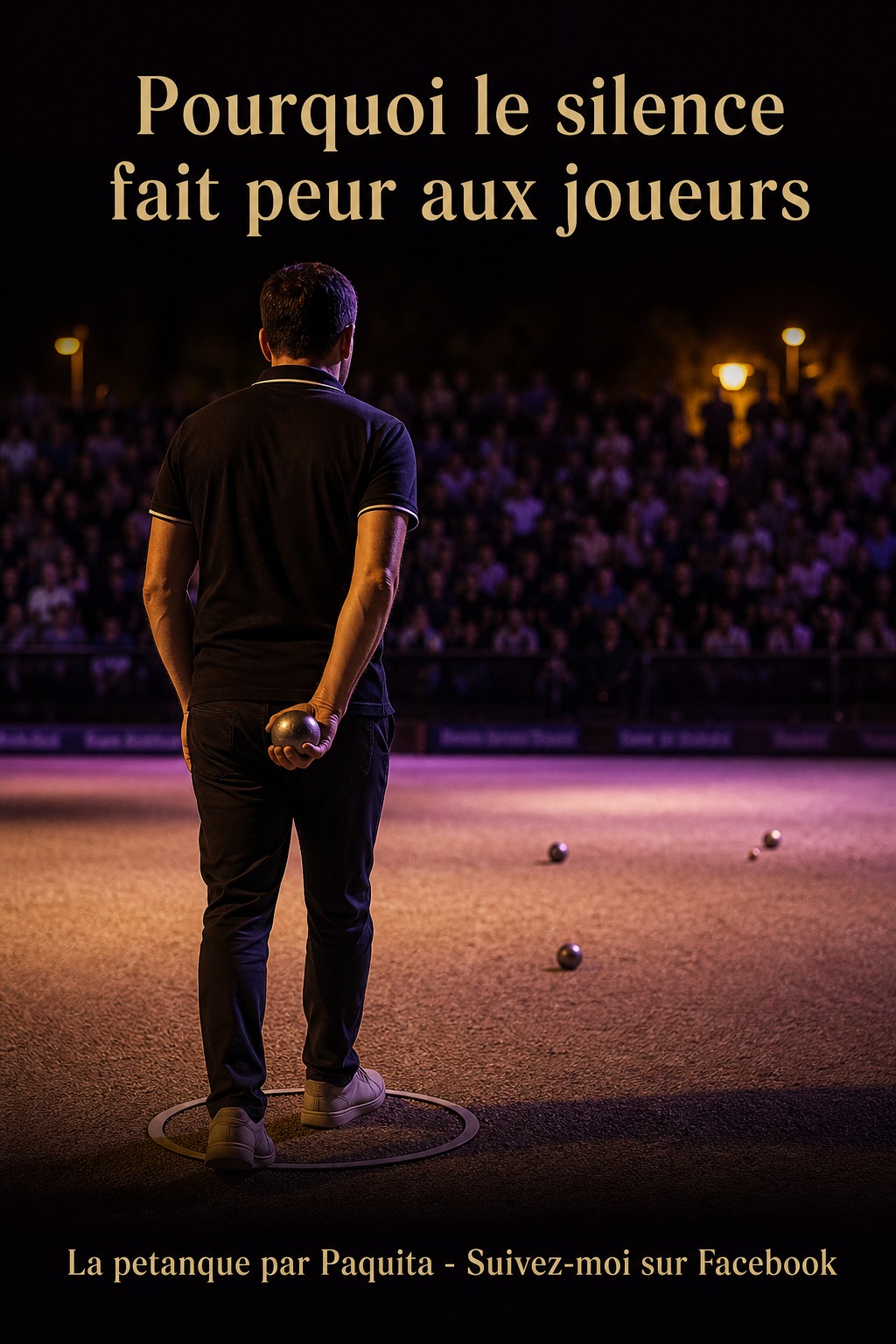
When the noise disappears, attention returns to the gesture, the look of others and the possible consequences of the throw.01Silence amplifies inner dialogue
In a busy game, noises distract attention. When they stop, the player hears more of his own predictions: don't miss, everyone is watching, this ball is decisive. Silence is therefore not the direct cause of fear; it makes already present thoughts audible.
An expert decision remains verifiable: it takes into account the score, the remaining balls, the terrain and the profile of the players. It does not promise to remove uncertainty; she chooses the most favorable uncertainty. In training, verbalizing this reasoning allows the team to build a common vocabulary and avoid vague debates at the decisive moment.
02The group's gaze becomes heavier
A silent assembly can be interpreted as judgment, even if spectators simply respect the throw. This social reading increases muscle tension and sometimes speeds up the routine. The player then responds to an imaginary threat rather than real information from the field.
An expert decision remains verifiable: it takes into account the score, the remaining balls, the terrain and the profile of the players. It does not promise to remove uncertainty; she chooses the most favorable uncertainty. In training, verbalizing this reasoning allows the team to build a common vocabulary and avoid vague debates at the decisive moment.
To observe: the value of a ball depends as much on the situation it creates as on its final distance to the goal.
03Why some people seek small talk
Talking, joking or commenting can regulate emotion and maintain a collective feeling. But if chatting becomes essential, the sudden silence breaks the rhythm. The objective is not to become austere: it is to be able to maintain your bearings with or without atmosphere around the game.
An expert decision remains verifiable: it takes into account the score, the remaining balls, the terrain and the profile of the players. It does not promise to remove uncertainty; she chooses the most favorable uncertainty. In training, verbalizing this reasoning allows the team to build a common vocabulary and avoid vague debates at the decisive moment.
04Create active silence
Useful silence is not empty. We occupy it with breathing, a look at the data and a feeling of pendulum. These cues direct attention towards a controllable action. The more precise they are, the less space the brain has to construct a catastrophic scenario.
An expert decision remains verifiable: it takes into account the score, the remaining balls, the terrain and the profile of the players. It does not promise to remove uncertainty; she chooses the most favorable uncertainty. In training, verbalizing this reasoning allows the team to build a common vocabulary and avoid vague debates at the decisive moment.
05Expose yourself gradually in training
Start by playing five balls while partners remain silent, then add a score and a light consequence. Then alternate noise and calm without warning. This gradual exposure teaches the nervous system that silence does not necessarily announce an exceptional or dangerous moment.
An expert decision remains verifiable: it takes into account the score, the remaining balls, the terrain and the profile of the players. It does not promise to remove uncertainty; she chooses the most favorable uncertainty. In training, verbalizing this reasoning allows the team to build a common vocabulary and avoid vague debates at the decisive moment.
06A team can protect the player
Before the throw, a partner can confirm the decision with a short sentence, then remain silent without staring intently at the player. After the result, it resumes normal communication. This predictable framework prevents silence from being experienced as a withdrawal of support at important times.
An expert decision remains verifiable: it takes into account the score, the remaining balls, the terrain and the profile of the players. It does not promise to remove uncertainty; she chooses the most favorable uncertainty. In training, verbalizing this reasoning allows the team to build a common vocabulary and avoid vague debates at the decisive moment.
| Time | Useful question | Trap |
|---|---|---|
| Before | What are the facts? | Anticipate failure |
| In the circle | What unique intention? | Fix everything |
| After | What did the land do? | Observing |
When the ground is silent, do not try to chase away your thoughts. Instead, give a specific mission to your eyes and your breathing.
Dig deeper into the game and turn these principles into solid habits.
Discover the guide