Actualités · 10 July 2026
Why close games are the hardest to win at pétanque
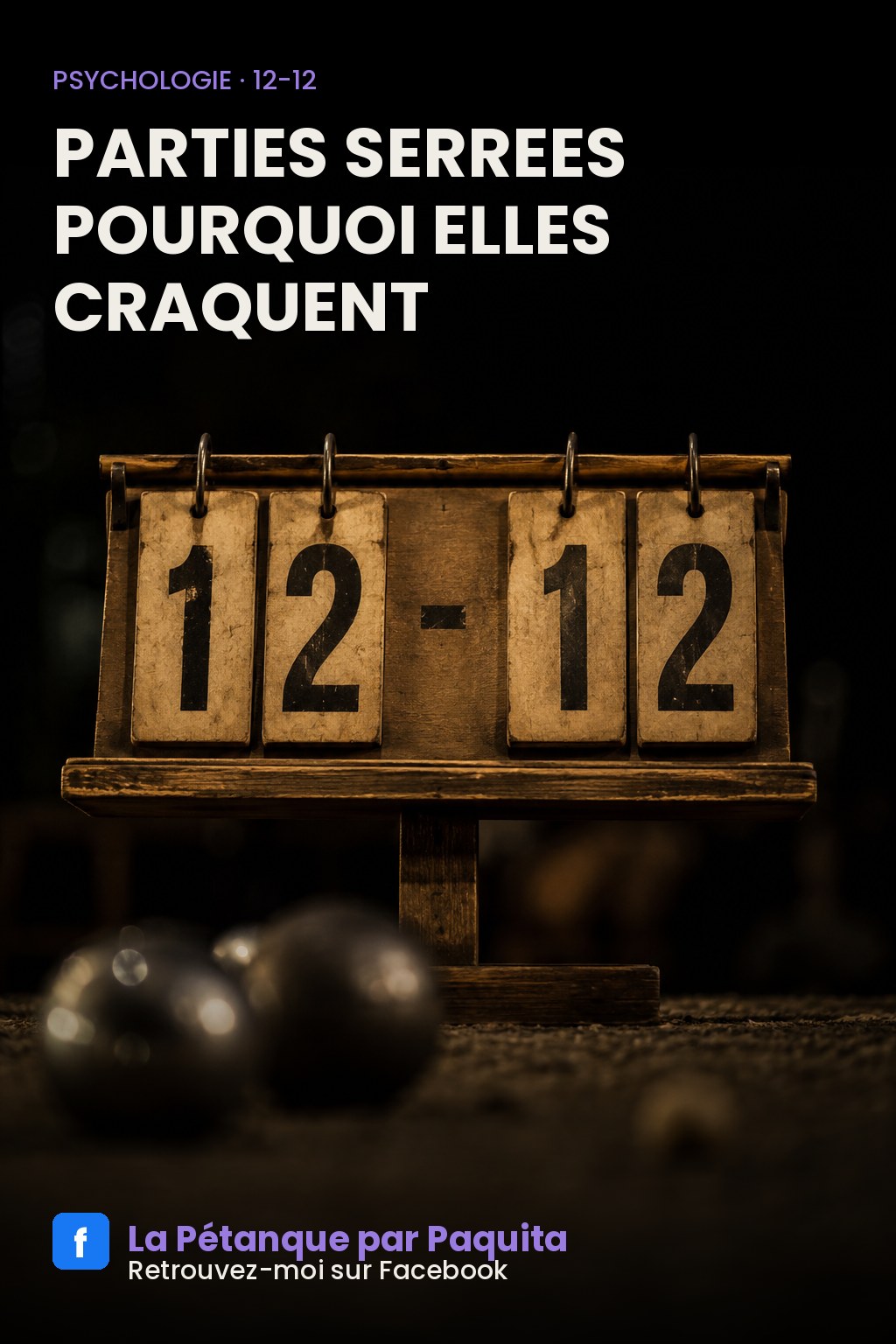
At 11-11 or 12-12, pétanque changes nature. Why tight games are more exhausting than others, and how champions get through these ends of the game1.Why a close game changes everything
When you lead 11-3, the game unfolds normally: you breathe, you take risks, you accept mistakes. When you lead 11-10 or 12-11, each boule takes on disproportionate emotional weight. The same boule, played in the morning at training, weighs nothing. In the evening, at 12-12, it weighs an entire season. This difference in emotional weight is what makes close games so difficult: the motion stays identical, but the mind has to handle 10 times more.
We then see mistakes appear that the same players would never have made earlier in the game. Boules in the middle of the court, weird tactical choices, hesitations unlike them. It's not a technical drop: it's a mental overload.
2.The 5 psychological mechanisms at play
A close game combines several effects that amplify each other. Seen individually, each effect is manageable; combined, they overwhelm most players.
| Mechanism | What happens in the head | Impact on the boule |
|---|---|---|
| Loss aversion | Losing 1 point hurts more than gaining 1 point feels good | Over-control, tense motion |
| Cognitive overload | Increased calculations, multiple scenarios | Slowing down, hesitation |
| Projection onto the result | We already see the defeat (or the victory) | Detachment from the present moment |
| Amplification effect | Every detail takes on disproportionate importance | Biased reading of the ground |
| Cumulative mental fatigue | Sustained concentration for 1h30 | Unusual basic mistakes |
Loss aversion has been documented in psychology for 50 years: we give roughly twice as much weight to loss as to gain. Concretely, at 12-12, losing the point hurts twice as much as winning it feels good. That's why we play tense.
3.The spiral of mistakes at the end of a close game
A mistake in a normal game has no consequence: the game continues. A mistake at 12-12 has a triple consequence: it potentially gives the point, it dents confidence, and it fuels doubt for the next boule. This is what we call the spiral of mistakes : one mistake causes two more, which cause three more.
Tournament statistics confirm this phenomenon: the quantity of mistakes observed in the last three close ends is 45% higher than those observed in the first three ends of the same game. It's not the technique that drops: it's the mind that gradually cracks.
4.The choice of play hardens
In a normal game, players make varied choices: you point when it's playable, you shoot when it's useful. At the end of a close game, choices polarize to the extreme: either you become ultra-cautious (you point short, you keep the boule), or you become ultra-risky (you shoot at all costs). Both extremes are equally bad.
The right choice remains that of balance — pointing in the safety zone when it's playable, shooting when you have to break a winning point — but this balance requires a lucidity that mental pressure quickly erodes.
Before the game, decide out loud what your choice rule will be in the final ends ("we systematically point the first one, we shoot if the opponent sticks"). At the end of the game, you replay this rule instead of having to choose under pressure. It's a decisive mental saving.
5.The internal clock factor
A pétanque game rarely lasts less than an hour; in competition, it can reach two and a half hours. At this stage, sustained concentration gives way to specific mental fatigue, which resembles physical fatigue but affects judgement, ground reading, motion control. Neuro-psychologists speak of "decision exhaustion": by constantly making micro-decisions, the brain ends up operating in economy mode.
This fatigue manifests itself through basic oversights (wrong boule choice, wrong shot attempted unnecessarily, neglecting to observe the landing zone). Many defeats in close games are actually decision-exhaustion defeats, not pure technique ones.
6.How champions cope with close games
Very good players also lose close games — but much less often than others. Not by luck: by mental protocols. Three are systematic in them:
The end as the unit
They don't think about the score. They think about the current end. One end at a time. It's a difficult discipline: at 12-12, there's a natural urge to calculate. They refuse to calculate.
Breathing between boules
Three deep breaths between two boules. It doesn't serve to oxygenate — it serves to reset the nervous system. The technique comes from elite sports (archery, golf, diving).
Acceptance of the mistake
They've decided once and for all that a mistake at the end of a game is not a drama. It's integrated as possible. This prior acceptance relaxes the motion — paradoxically, they make fewer of them.
7.Training for close games
You don't learn to handle a close game by reading an article: you learn it by exposing yourself to it. Three very useful drills:
Start being led. In training, start at 11-11. Force yourself to play immediately in end-of-game mode. Do it 10 times a week for a month — your mind ends up considering this score normal.
The mental timer. Impose a fixed pre-boule routine (8 seconds) throughout the game. You accustom your brain to a constant tempo, which doesn't collapse at 12-12.
The commented game. During a free training session, state your choice out loud before each boule. You work on decision-making lucidity, the one that cracks first at the end of a game.
How not to crack at 12-12: pre-boule routines, tempo management, acceptance of the mistake, breathing under pressure. The complete method to turn close games into games you win.
📗 Discover the book