News · 27 April 2026
Why you miss the easy shots (and pull off the impossible ones)
NewsThe perfect carreau on a protected boule. The inexplicable miss on an open boule at 6 metres. This paradox has a name in neuroscience. Paquita explains the mechanism and the techniques to neutralise it.The name of the phenomenon — and the science behind it
🔬 SPORTS PSYCHOLOGY Overthinking orparalysis by analysis This phenomenon is known in English as "paralysis by analysis" or "overthinking" — paralysis by analysis. It has been documented since the 1980s in the sports psychology literature, notably in Timothy Gallwey's work on "the inner opponent" and Roy Baumeister's on "choking under pressure".
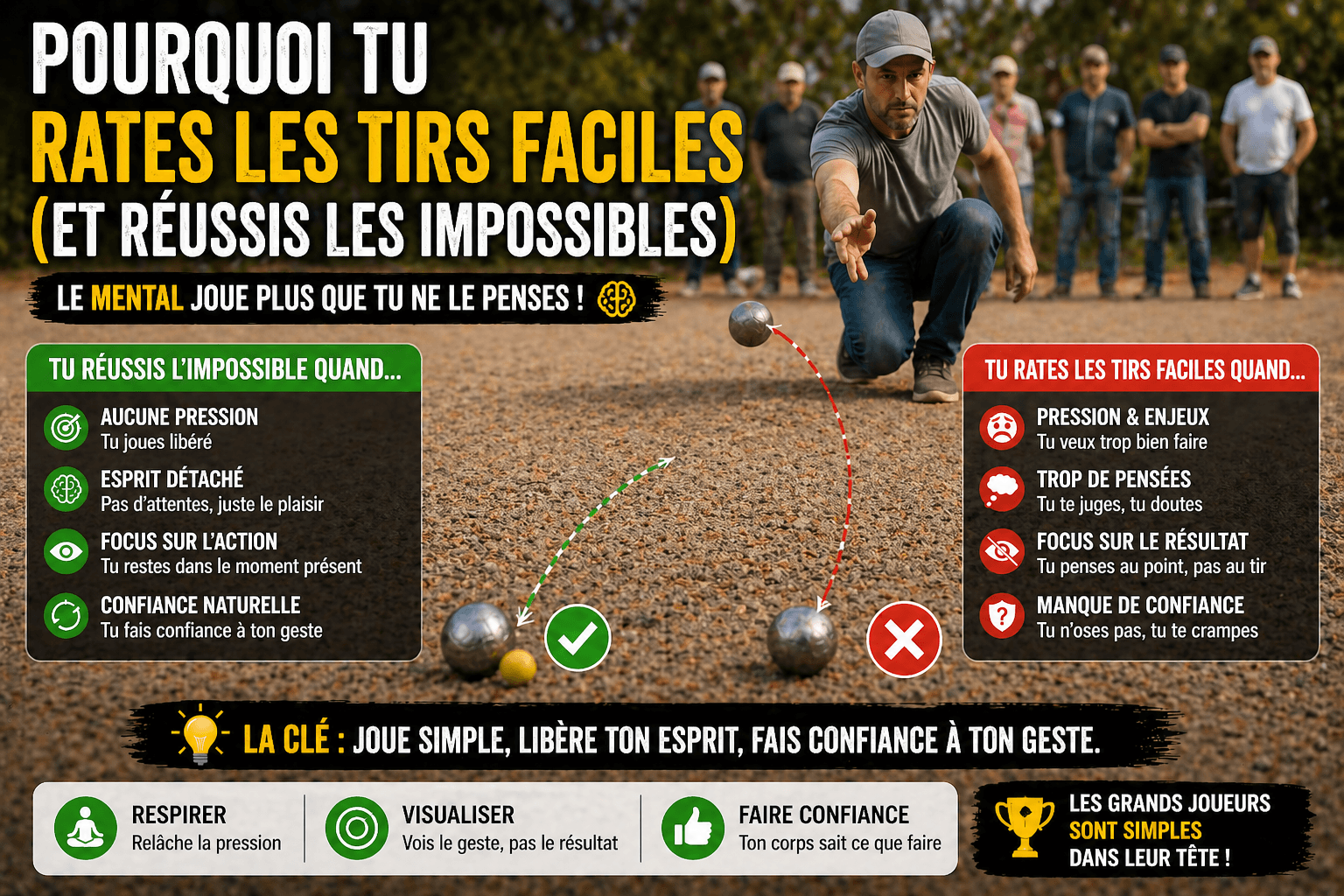
The core mechanism: when a learned gesture is over-analysed consciously at the moment of its execution, the automatic circuits that reliably produce it are disrupted by conscious activity. The gesture that "comes out on its own" on hard shots (because the conscious mind doesn't believe in success and doesn't interfere) is the same gesture that consciousness blocks on easy shots by trying to "control" it.
In neuroscience: the prefrontal system (analytical, conscious, slow) comes into conflict with the basal ganglia (procedural, automatic, fast). On easy shots, the prefrontal system activates too much — it wants to "help". It helps badly.
The neurological mechanism — two systems at war
🧠 DECISION FLOW ACCORDING TO SHOT TYPE STEP 1 👁️ Perception of the situation: "easy shot" or "hard shot" STEP 2 ⭐ ⚡ Assessment of the stakes — "easy" → high pressure / "hard" → low pressure STEP 3 🧩 Activation of systems according to pressure: analytical (easy) vs automatic (hard) STEP 4 🎯 Result: disrupted gesture (easy) vs fluid gesture (hard) ★ Step 2 is the key — that's where everything is decided, even before the gesture begins ⚡Research in movement neuroscience has established that automatic motor circuits (basal ganglia, cerebellum) produce precise, fluid gestures — but only when the prefrontal cortex doesn't interfere. This interference occurs exactly when the brain perceives high stakes. On an "easy" shot, the perceived stake is at its maximum — missing would be an inexcusable "mistake". The prefrontal cortex activates to "monitor" the gesture. And it is precisely this monitoring that degrades it.
🎙️ Paquita on overthinking "It took me a long time to understand why my best shots always came when I didn't believe in them. A half-hidden boule at 9 metres: I thought 'okay I'll give it a go, nothing to lose' — perfect carreau. The next end, an open boule at 6 metres: I thought 'this is the moment to win the end' — missed by 25 cm. The difference between the two throws wasn't in my fingers. It was between my two ears." — PaquitaThe 6 causes that trigger the miss on an easy shot
1 Excessive perceived stakes — "I can't miss this" When a shot is perceived as "easy", missing it is felt as an inexcusable fault — a shame. This anticipated fear of missing activates the prefrontal cortex in monitoring mode. The brain decides to "pay attention" — and that attention interferes with the automatic motor programme. The natural gesture is replaced by a conscious gesture, less effective. It is the most frequent and most documented cause. → Antidote: reframe the target. "I'm aiming at the left edge of the boule" rather than "I have to make this shot". 2 The conscious gaze on the boule — too precise, for too long On an easy shot, the player stares at the opponent's boule for a very long time and very consciously — as if to "imprint" the target. Paradoxically, the longer you stare at a target in analytical mode, the less efficiently the automatic system works. The optimal gaze is brief, confident and "soft" — a quick intake of information, not a prolonged analysis. Good shooters "see" the boule in 1–2 seconds, not 5–10. → Antidote: limit the gaze to 2–3 seconds maximum. After 3 seconds, trigger the throw. 3 The inner monologue during the gesture "Aim well", "don't force it", "keep the arm straight" — instructions given consciously to the body during execution of the gesture. Every conscious instruction during the throw is a disruption to the automatic system. The pétanque gesture is too fast and too complex to be directed consciously in real time. The instructions always arrive 300 ms too late — the gesture has already begun when the conscious thought formulates the correction. → Antidote: all technical decisions are made BEFORE entering the circle. In the circle: mental silence. 4 Preventive negative visualisation — "what if I miss?" Before the easy shot, a thought settles in: "what if I miss?". This thought triggers a micro-anxiety that alters muscle tone. The muscles tense slightly — and tension, even slight, changes the timing of the release. Preventive negative visualisation physiologically prepares the very failure it seeks to avoid. It is one of the clearest examples of unintentional self-sabotage. → Antidote: identify the negative thought and immediately replace it with a concrete action ("I'm aiming at the right edge", not "I mustn't miss"). 5 The expectations of others — social pressure Teammates, opponents, spectators: everyone is waiting for the result of an "obvious" shot. This perceived social pressure amplifies the personal stakes. The player then plays "not to disappoint the others" rather than to "play well" — two mental states that produce very different gestures. The first is defensive and tense. The second is offensive and fluid. → Antidote: create a mental bubble — "no one else exists during the 3 seconds of my gesture". A pre-shot routine that excludes awareness of the outside gaze. 6 Over-preparation of the gesture — too many swings On easy shots, some players make 3, 4, 5 preparatory swings instead of 1 or 2. Each additional swing is an opportunity for conscious thought to intervene and alter the gesture. More swings ≠ more precision — after 2–3 swings, the motor energy is already calibrated. The extra swings only increase the exposure time to conscious interference. → Antidote: fix a number of swings (1 or 2) and stick to it — whatever the perceived difficulty of the shot.Why the hard shots succeed — the paradox explained
⚡ THE PARADOX EXPLAINED The hard shot activates the right systems by neutralising the wrong ones On a hard shot — partially hidden boule, tight angle, long distance — the brain makes a quick calculation: "the probability of success is low". This calculation has a paradoxical effect: it switches off the pressure of the result.Without result pressure, the prefrontal cortex doesn't activate in monitoring mode. The basal ganglia and the cerebellum — the automatic circuits that manage acquired motor skills — operate freely. The player "lets the gesture happen". And the gesture, built by thousands of repetitions, comes out clean.
The magic phrase of the player who makes the impossible shots: "Right, I'll give it a go, nothing to lose." This phrase isn't resignation — it is involuntarily the removal of result pressure. It frees the automatic system. It is the antidote to "I can't miss this".
The aim of all mental work in pétanque is to deliberately reproduce this "nothing to lose" state on EVERY shot — including the easy ones.
Two player profiles — who suffers most
🔴 AT-RISK PROFILE — Frequent overthinking →Perfectionist — the miss is experienced as a personal failure, not as information →Strong sense of team responsibility — "I must not let the others down" →Analytical — thinks a lot before and during the motion →Strong memory for misses — "I always struggle on this type of shot" →Long preparation time in the circle — on important shots ✓ RESILIENT PROFILE — Less affected by the paradox →Process-oriented — focus on the motion, not the result →Emotional detachment from the score — "it's a shot, nothing more" →Stable pre-shot routine — same preparation whatever the stakes →Constant preparation time — neither more nor less on important shots →Short memory for misses — "that was the previous boule, this boule is new" 🔑 The good news — it's a skillThe resistant profile isn't a personality — it's a skill that can be learned. The players least affected by the paradox aren't naturally "calmer" — they've developed mental routines that neutralise overthinking. These routines are learned exactly like technical routines. The difference is that nobody teaches them in training.
The 6 techniques to neutralise the paradox
🎯 Aim at a precise point, not "the boule"Replace "I'm shooting the opponent's boule" with "I'm aiming at the left edge of the opponent's boule". The precise target occupies the prefrontal cortex with a technical task — and frees it from result pressure. The brain cannot simultaneously "analyse" and "worry".
Technical focus = frees the automatic system 🔵 The single trigger wordChoose a trigger word that signals to the brain "switch to automatic mode". A neutral, short word — "go", "now", "there". Say it mentally just before throwing. This word gradually conditions the brain to switch into execution mode without analysis.
Conditions the analytical → automatic switch 🧘 The reset breathA slow exhalation before entering the circle. The exhalation activates the parasympathetic nervous system — it physically reduces cortisol and the activation of the prefrontal cortex. It's a technique used by elite shooters, surgeons, pilots. It works in 2 seconds.
Physiological reduction of conscious activation 🔄 Treat every shot as "trivial"Deliberately adopt the inner language of the hard shot for all shots. "I'll have a go" rather than "I have to make it". "We'll see" rather than "this matters". It isn't indifference — it's the voluntary deactivation of the result pressure that blocks the automatic system.
Mentally simulates the "nothing to lose" ⏱️ Fixed preparation time — always the sameImpose the same preparation time for each shot, whatever its level of difficulty. If you usually take 5 seconds on hard shots, apply 5 seconds on easy shots. Equalising the time removes the "this shot is special" signal sent to the brain.
Breaks the "this shot is different" signal 📸 The pre-throw mental snapshotTake a "mental snapshot" of the layout before throwing — opponent's boule, jack, obstacles — and "imprint" it in 2 seconds. Then close your eyes for a second, visualise the carreau. Then throw without looking again. This sequence engages the automatic visuospatial circuits rather than conscious analysis.
Engages the automatic visuospatial systemThe pre-shot routine against overthinking
🧠 PRE-SHOT ROUTINE — NEUTRALISING OVERTHINKING IN 5 STEPS Analysis outside the circle 3–5 sec From outside the circle: identify the exact point of contact on the boule (right edge, left edge, centre), mentally note the angle and the distance. All the analytical work is done here — before entering. Once in the circle, no new analysis is needed. Slow exhalation — physiological reset 2 sec A slow exhalation, mouth slightly open. Feel the shoulders drop. Active reduction of prefrontal cortex activation. Do not breathe in deeply beforehand (inhale = activation, exhale = deactivation). Enter the circle — trigger word 1 sec Place your feet in the circle while mentally saying the chosen trigger word. This word signals the switch from "analysis mode" to "execution mode". From this moment on, the analytical brain is in passive mode. Brief glance at the point of contact — 2 seconds max 2 sec Look one last time at the precise point aimed at on the opponent's boule — 2 seconds, no more. Not an analysis: a confirmation. Not "am I going to make it?" but "there's where I'm aiming." Throw within 3 seconds ≤ 3 sec After the last glance, throw within the following 3 seconds. No extra swing, no reconsideration. The gesture is produced by the automatic system — trust it. Any hesitation after this point reactivates the prefrontal cortex and rebuilds the overthinking. 📖 PAQUITA'S BOOK Mind, technique and tactics — the complete playerPressure management, pre-throw routine, confidence under stress, gesture/mind consistency... Paquita's book integrates the psychological dimension into each of its 100 numbered exercises.
📦 Order on AmazonFAQ — Your frequent questions
Does experience and seniority solve this problem naturally? + Partially — experience reduces the intensity of emotions in pressure situations, which can reduce overthinking. But it's not automatic. Many very experienced players continue to suffer from this “crucial” shot paradox — because they have never worked on the mental routines specifically. Experience without deliberate mental work often consolidates bad habits along with good ones. Players with 20 years of experience may have less effective mental routines than 3-year players who have worked specifically on this aspect. Does this phenomenon also affect the pointer — or only the shooter? + It affects both, but differently. For the shooter, the paradox clearly manifests itself in easy vs. difficult shots — the examples in this article. For the pointer, the equivalent mechanism is the "decisive point" — the moment when you have to point 10 cm to win the lead, and where the pointer misses when he usually succeeds in similar situations. The mechanism is identical: the perceived issue activates conscious analysis which disrupts the automatic gesture. The techniques described in this article apply entirely to the pointer in these situations. How to specifically train resistance to overthinking? + Three practical approaches. 1) Training under simulated pressure : betting forfeits or challenges on shots in training — artificially creating pressure to practise managing the activation of the prefrontal cortex. 2) Profile video : filming yourself on important shots vs trivial shots and comparing preparation time, swings, body behaviour. This objective comparison reveals over-preparation habits. 3) Practising the mental routine in training — systematically apply the pre-shot routine on every training throw, not just in competition. It is in training that routines are anchored, not in competition. Can we “think about not thinking” while shooting, or is this contradictory? + This is the fundamental tension of all mental work. “Trying not to think” activates the prefrontal cortex which monitors whether we are thinking — it is self-refuting. The solution is not “not thinking” but “thinking about something else” — a specific, technical task that occupies the prefrontal cortex without interfering with automatic gesture. “Aim for the left edge of the ball” is a thought — but it’s a technical thought that replaces “will I succeed?” and releases the automatic system. The difference: thoughts about the outcome activate monitoring mode. Thoughts about a specific technical detail activate execution mode. 📎 Related articles Rules The one-minute rule — playing within the allotted time Equipment Choosing your boules — the right tool frees the gesture Equipment Top 3 best shooter boules 2026 Video Why changing bowls does not change your level Competitions Official 2026 calendar — training under real conditions Tools Free PetanqueLand tools© Pétanque by Paquita — petanqueland.fr · 📖 Paquita's book on Amazon