News · 23 July 2026
These improbable bounces in pétanque and the official rules which govern them
NewsBoule qui revient, obstacle touché, rebond inattendu : les règles officielles à connaître pour juger correctement les rebonds improbables à la pétanque.1.An improbable rebound remains a game rebound
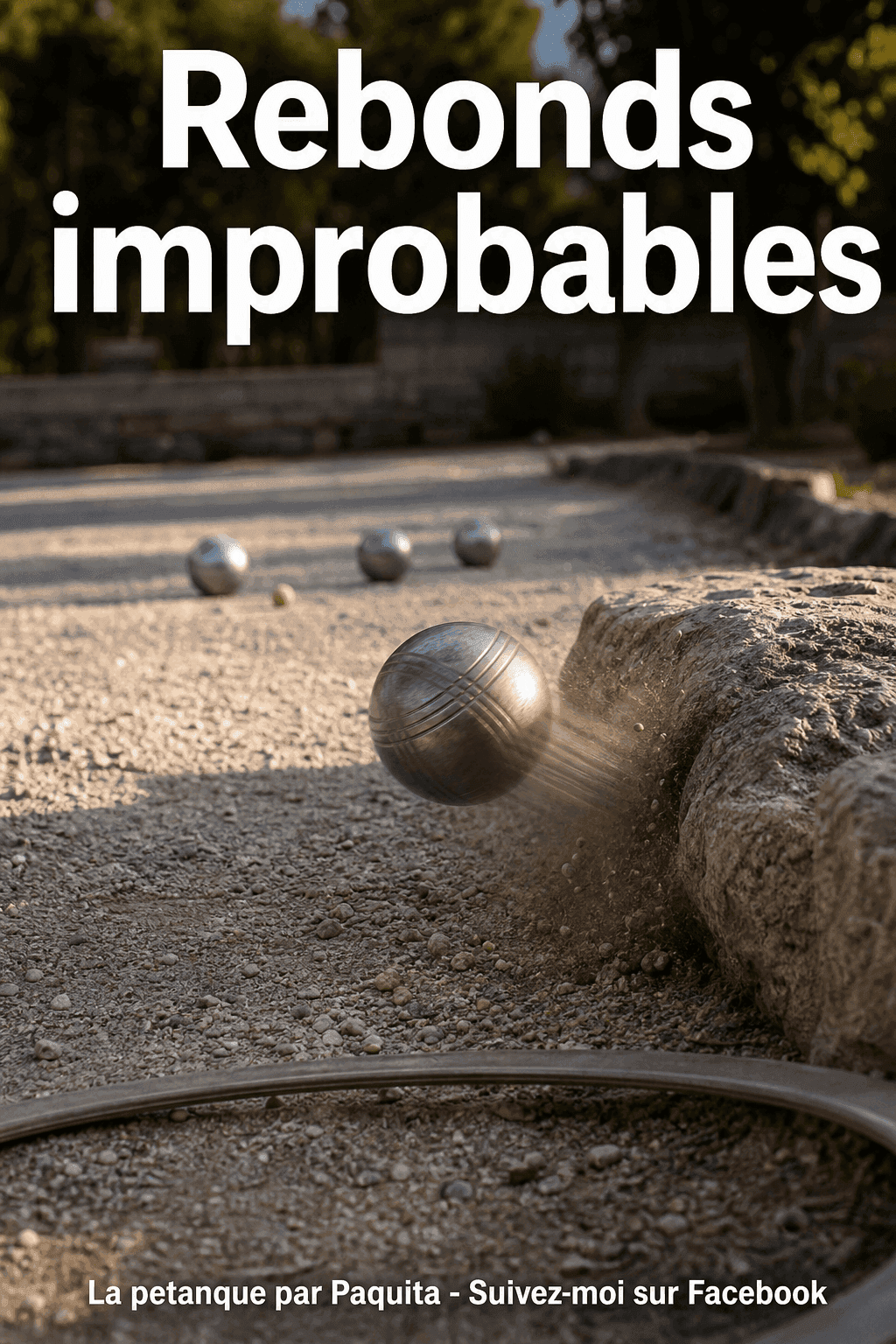
A ball can follow a strange trajectory without leaving the regulatory framework. If it touches a stone, an irregularity in the ground or a fixed border, then returns to the game, its final position is observed. Spectacular character is not a criterion. What matters is the validity of the ball and the absence of external intervention.
This logic protects the very essence of pétanque: the terrain matters. The player accepts the visible reliefs when he chooses his trajectory. So a lucky ball can become excellent, and a good ball can be punished by the ground.
The useful sentence: "where did the ball come to rest?" She is better than “where should she have gone?”.
2.Ball returned to the player: foul or not?
A ball which returns towards the player after a bounce is not automatically at fault. It can return to the playing zone, come close to the circle or stop very far from the goal. If it is not zero and if the player has not hindered his movement, it remains in play. The regulations do not set a compulsory forward trajectory.
The fault appears if the player voluntarily stops the ball, touches it, or if it crosses a loss limit before returning via an invalid element. In these cases, we are no longer talking about a simple rebound but about a precise regulatory situation.
3.Obstacle touched: the key point is the nature of the obstacle
The same rebound can receive two different readings depending on the obstacle. A fixed border, a crosspiece or a stone integrated into the terrain is generally a game. A foot, a bag, a bottle or a tool placed by mistake is an external intervention. The regulation is therefore as much concerned with the origin of the contact as with its effect.
In competitions, good behavior is to freeze positions and call the referee if the discussion concerns an external object. Once the balls have been moved, everyone rebuilds the scene to their advantage.
| Contact | Usual effect | Decision to check |
|---|---|---|
| Fixed border | Normal game | Final validity |
| Foot of a spectator | External incident | Umpiring |
| Stone from the field | Hazard accepted | Ball in play or void |
4.Why the rules do not reward intention
A player may have wanted to point and make an involuntary shot after a rebound. He can also completely miss his data and miraculously end up on point. The intention does not modify the brand. Petanque judges the result of the regularly played shot. This explains why some leads seem unfair but remain perfectly valid.
The opposite also exists: a technically superb ball can hit a relief and come out. The regulations do not compensate for the quality of the gesture. It maintains a common rule, readable by all, even when success seems capricious.
When the rebound surprises everyone, take a breath before speaking. The first ten seconds often decide whether the discussion will be regulatory or only emotional.
5.Compare a valid ball and a void ball
The vocabulary must remain precise. A valid ball is a ball that can still count in the end. A void ball is withdrawn or considered out depending on the case. Between the two, there is often a simple annoyance: ball far away, misplaced, returned to a useless area, but still present.
6.The protocol to apply without making a mistake
After a disputed bounce, check four points: has the ball crossed a limit? Was it hit by a player or an external object? Is its final position measurable? Has the goal been moved or made void? These questions are sufficient in the majority of cases.
If the answers remain contradictory, do not turn the game into a tribunal of memories. In official competitions, the referee is there to decide. In free play, applying this protocol already avoids most arguments.
We must also accept that an improbable rebound could completely change the situation. A ball returned in front of the goal can block the opposing game, a ball that goes too hard can save the point by hitting a crossbar, and a ball that seemed lost can remain valid a few centimeters from a line. The regulation does not evaluate the beauty of the shot: it provides a framework for observing the result. This coldness protects the game, because everyone knows that the same grid will be used for the next rebound, even if this time luck changes sides.
Understanding bounces, carries and ground reactions improves your technical choices. The half-range becomes more reliable when it is linked to a real reading of the terrain.
Discover