News · 14 July 2026
These petanque terrain rules that even umpires sometimes forget
NewsPétanque court: lines, frames, obstacles, assigned courts, and edge cases. The FFPJP rules that many players apply incorrectly.1.The terrain is never neutral
In pétanque, many discussions start with a simple phrase: “whose turn is it to play?” or “is this boule valid?”. The FFPJP rules were not written to complicate games, but to prevent each club from inventing its own answer. The right approach is to identify the real situation, then apply the official logic without adding any makeshift arrangement.
The first reflex is therefore to slow down. As long as the next boule has not been thrown, you can check the point, observe the boundary, recall the order of play or request a measurement. Once the throw is on its way, the situation becomes more delicate, because the court has changed. That is why experienced players never rush in borderline cases.
2.Official dimensions and local adaptation
Errors rarely come from obvious bad faith. They are born rather of habit: you think you know the rule, you apply what is done at the club, or you confuse a leisure rule with a competition rule. On a cramped court, with noise around and a tense score, this approximation is enough to trigger a conflict.
Key point: the rules protect the continuity of the end. You do not replay because the situation inconveniences a team; you act only if the rule provides for a correction or a decision.
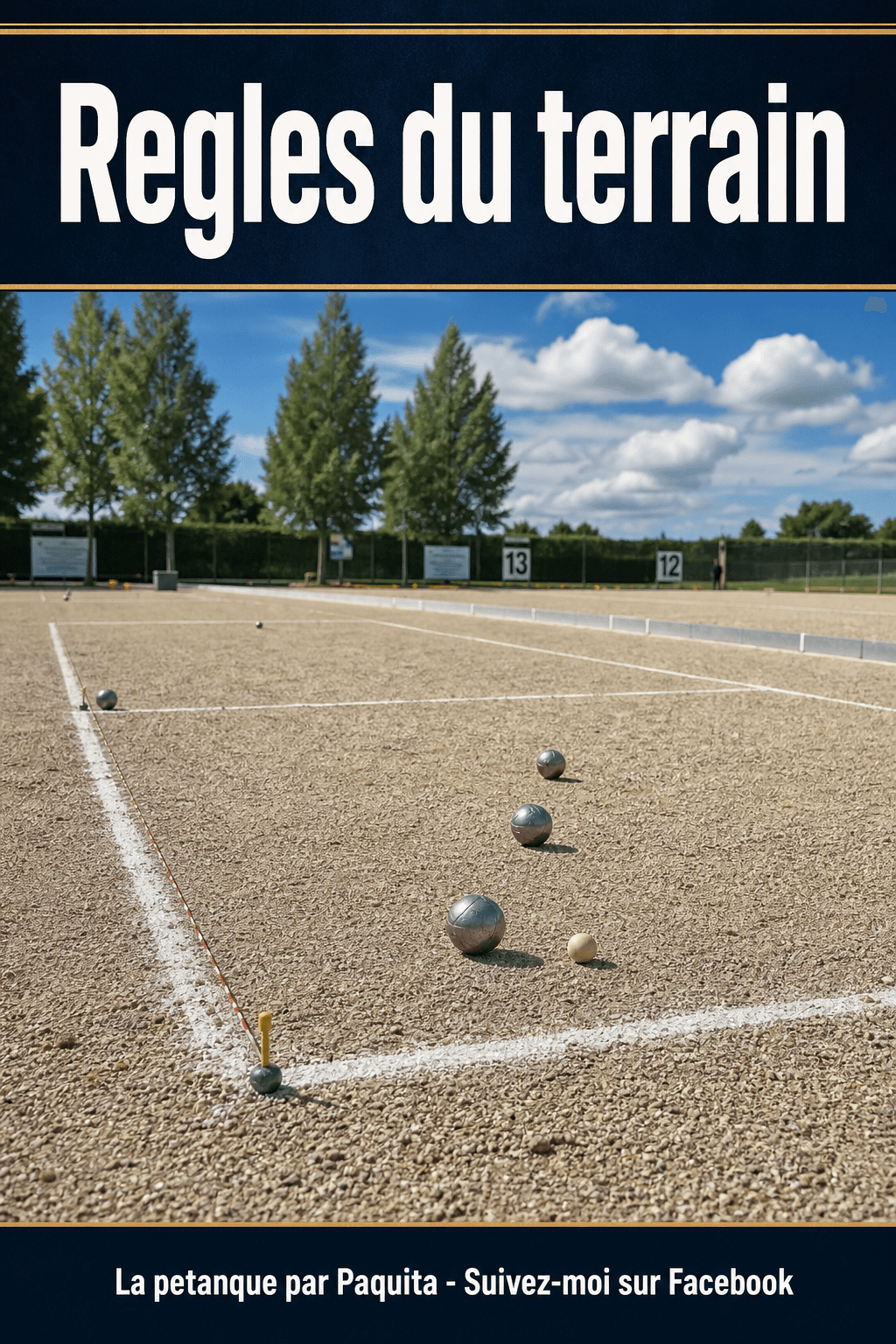
3.Dead lines: what becomes dead
Before announcing a penalty or a replacement, three questions must be answered: was the initial position known? was the action voluntary or accidental? was the boule or the jack moved by a player, by a played boule, or by an outside element? These three answers guide almost the entire decision.
When in doubt, measuring and marking are your best allies. A boule marked on the ground, a jack whose position is known, or a line checked before the throw avoid contradictory accounts. Conversely, when no one has observed the starting position, the referee often has to decide with incomplete information.
4.What the practical cases show
The diagrams below summarise the difference between a well-controlled game and one played on instinct. They do not replace the umpire, but they set the right mental order: observe, check, decide, and only then resume play.
| Frequent case | Good reflex | Mistake to avoid |
|---|---|---|
| Dead line | Spot it before the throw | Discover it after a dispute |
| Neighbouring frame | Know whether the boule stays valid | Declare it dead too quickly |
| Fixed obstacle | Apply the terrain rule | Move the obstacle |
5.Obstacles, strings and physical boundaries
In an official competition, the umpire is not called only when everyone is shouting. They step in as soon as a regulatory decision goes beyond a simple agreement between the teams. Their role is not to “prove right” the most self-assured player, but to restore a consistent application of the rules.
A good player makes this work easier: they do not touch the boules before the decision, they point out the marks if there are any, and they explain the facts without replaying the whole game. This calm attitude saves time and prevents a technical dispute from turning into a personal conflict.
If you sense a collective hesitation, simply say: “let's check before we play”. This short sentence avoids 80% of the mess, because it comes in before the end has been altered.
6.Paquita's method for reading the terrain before the end
The most reliable method comes in four steps. First, stop play without touching anything. Next, identify what has actually moved or what is in question. Then check the available reference points: marks, lines, distance to the jack, order of play. Finally, resume only once the decision is shared or umpired.
This method seems simple, but it transforms the atmosphere of a game. Players stop arguing over impressions and come back to the facts. To progress in this reading, also consult the official dimensions of the terrain and the rule for a boule accidentally displaced.
For competition organizers, disputes decrease when games, terrains, teams and results are properly tracked. The PétanqueLand software helps organize draws, brackets and rotations without improvising.
Discover the software