News · 12 July 2026
Pétanque court in official competition: what the FFPJP rules require
NewsDimensions, boundaries, marking, assigned courts: what the FFPJP rulebook requires for a pétanque court in an official competition.1.An official court must first be readable
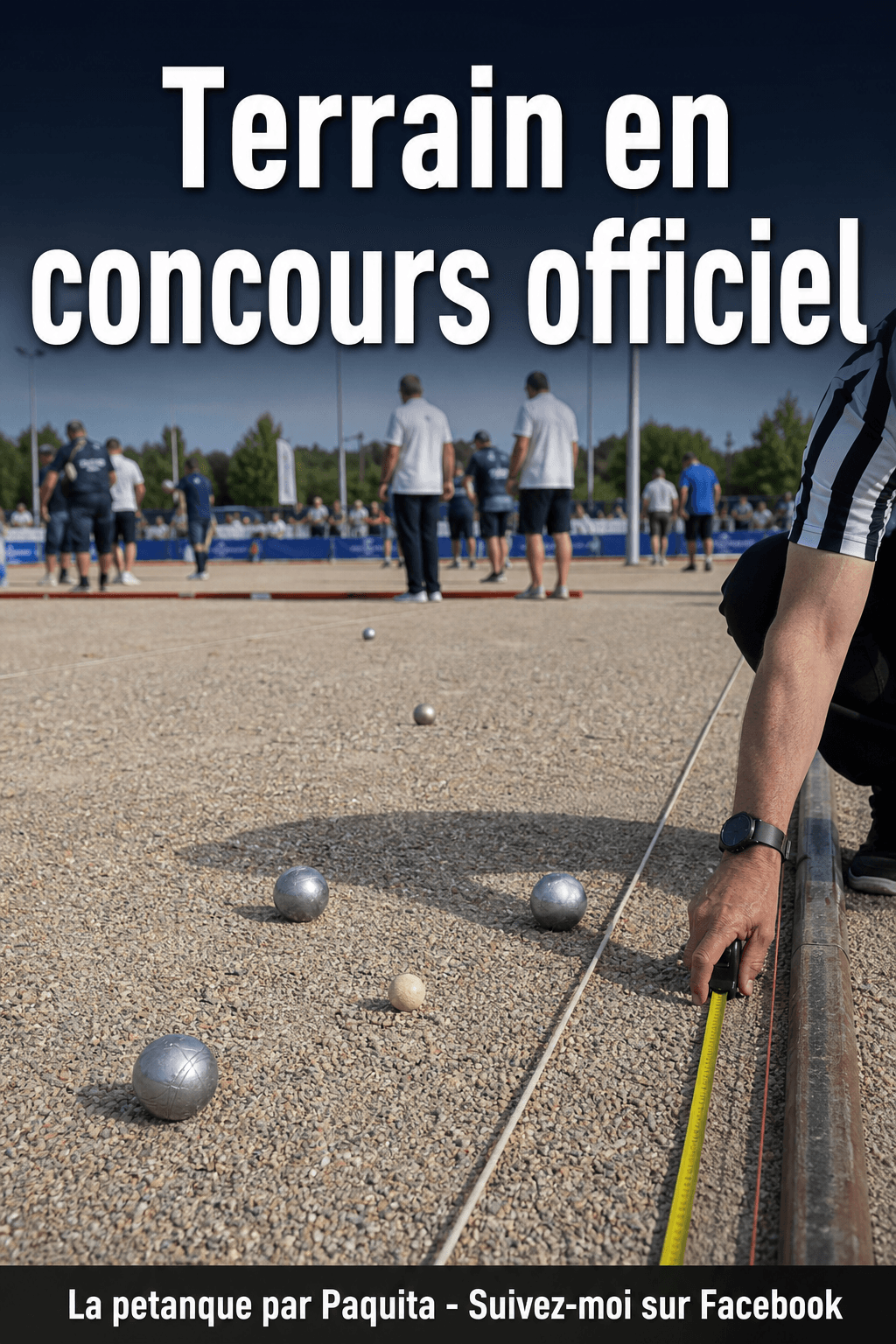
Readability comes first. Players must know where the playing court begins and ends. In competition, the boundaries may be marked out by strings, lines, barriers, boards or references set by the organisation. What matters is that the boundary is identified before the dispute arises. This precision may seem slow in the moment, but it avoids cobbled-together decisions. In competition, properly applying the rules doesn’t mean shouting louder than your opponent: it means reconstructing the facts, protecting the useful positions and resuming the end within a framework that both teams can understand.
Before an important game, check the lines, the strings, the dead zones and the obstacles. This check prevents disputes.
2.Dimensions: the rule and the reality of competition
The official dimensions serve as a reference, but not all competitions take place in an ideal boulodrome. Depending on the level of the event, the space available and the number of games, the organisation can work with the existing facilities. That doesn’t allow for vagueness: the allocated courts must remain consistent and sufficiently readable. This precision may seem slow in the moment, but it avoids cobbled-together decisions. In competition, properly applying the rules doesn’t mean shouting louder than your opponent: it means reconstructing the facts, protecting the useful positions and resuming the end within a framework that both teams can understand.
3.Boundaries, obstacles and dead zones
An edge, a wall, a net, a gutter or a string don’t all have the same status depending on the court. Some elements are boundaries, others mere obstacles. In official competition, this distinction must be announced or made obvious by the organisation.
At the start of the game, show your partner the sensitive boundaries: back of the court, sides, obstacle behind the jack. A team that shares the same map of the court makes better decisions.
4.The role of the organisation and the referee
The organisation must prepare playable pistes, allocate the courts and make the references visible. The referee steps in when the boundary, the obstacle or the validity of a position is disputed. The player, for their part, must avoid modifying the court or moving references without authorisation. This precision may seem slow in the moment, but it avoids cobbled-together decisions. In competition, properly applying the rules doesn’t mean shouting louder than your opponent: it means reconstructing the facts, protecting the useful positions and resuming the end within a framework that both teams can understand.
5.Why the court influences the rules
The court isn’t just a technical backdrop. It influences the validity of the jack, the survival of the boules, the choice to point or shoot and the way certain situations are measured. A rule applied without knowing the court’s boundaries quickly becomes approximate.
| Situation | Sound decision | Mistake to avoid |
|---|---|---|
| Visible boundary | Have it confirmed at the start | Wait for the dispute |
| Allocated court | Respect the announced framework | Play on the neighbouring court |
| Nearby obstacle | Identify its status | Treat it as a boundary without proof |
| Displaced string | Call the referee | Put it back yourself |
For clubs, a clear court starts with clear organisation: registrations, draws, pools, allocated courts and properly tracked brackets.
Discover