Actualités · 6 June 2026
Can a boule get in the way without touching?
A bouleWhat "hindering" really means in pétanque
🎳 THE 5 LEVELS OF A BOULE'S INFLUENCE ON THE OPPONENT'S GAME 📍 LEVEL 1 Neutral boule: neither close to the jack, nor on a useful trajectory. Hinders nothing, protects nothing. A purely passive presence on the ground. NEUTRAL 🚧 LEVEL 2 Trajectory boule: placed on the opponent's natural approach line. Forces the opponent to go around or change trajectory to point. TRAJECTORY HIND. 🧱 LEVEL 3 Zone boule: controls the space around the jack. Any opponent's boule arriving in the zone risks bouncing off it — creating uncertainty about the result. ZONE HIND. 🔒 LEVEL 4 Shooting-lock boule: closes the opponent's natural shooting angle. Shooting straight at the target becomes impossible — the opponent must shoot at an angle or change strategy. SHOOTING HIND. 🎯 LEVEL 5 Active protection boule: protects the jack from a shot or a precise point while being well placed itself. Combines proximity and hindrance to the opponent. MAXIMUM HIND. 🎙️ PAQUITA ON THE BOULE THAT HINDERS WITHOUT TOUCHING "Many players think a boule is only useful if it's close to the jack or if it touches an opponent's boule. But a well-placed boule on the ground can completely change the opponent's plan without touching anything. It closes an angle for them, it blocks a trajectory, it forces them to play a shot they hadn't planned. Tactical pétanque isn't just about pointing close — it's about pointing where it creates a problem the other has to solve." — PaquitaThe 6 forms of indirect hindrance
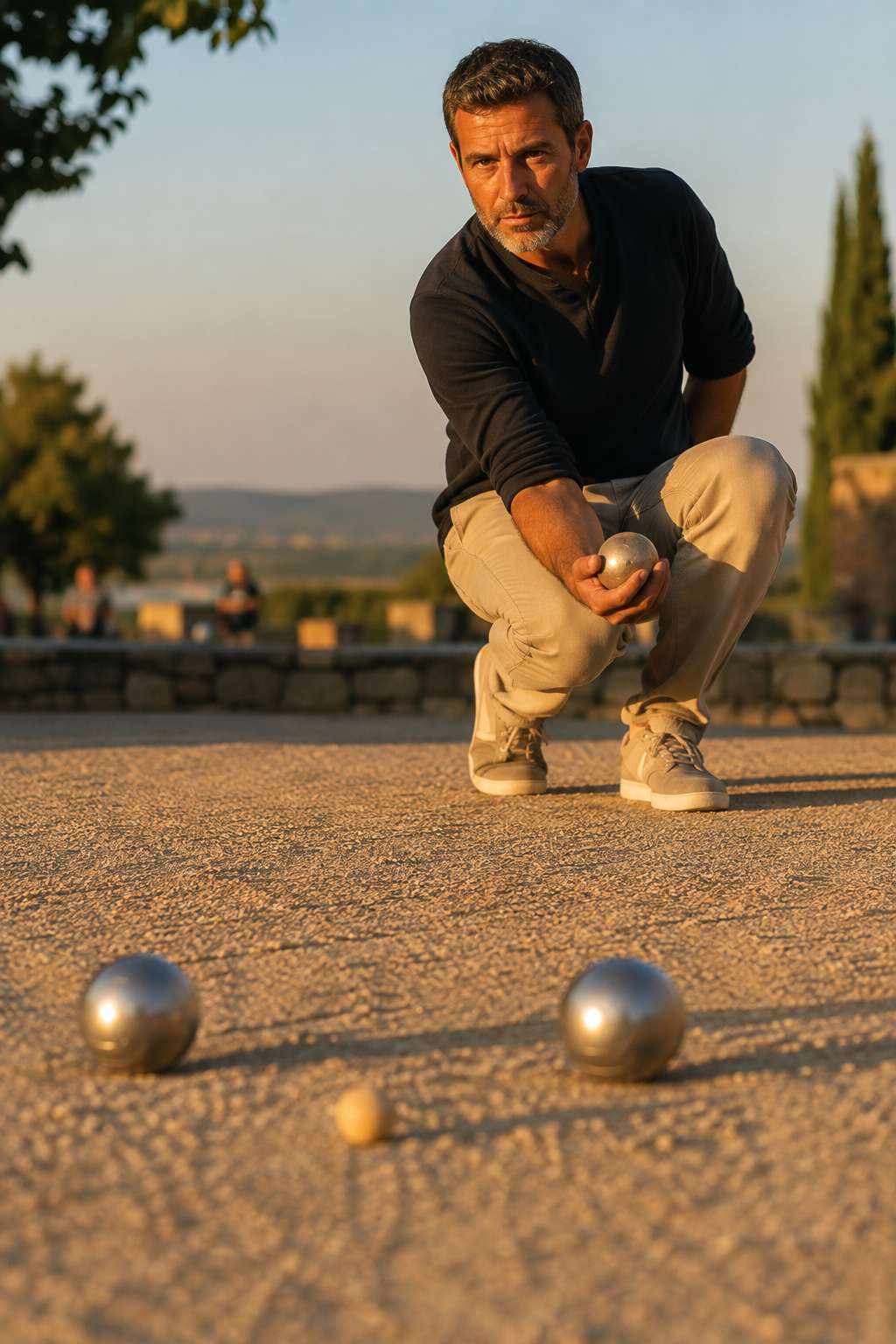
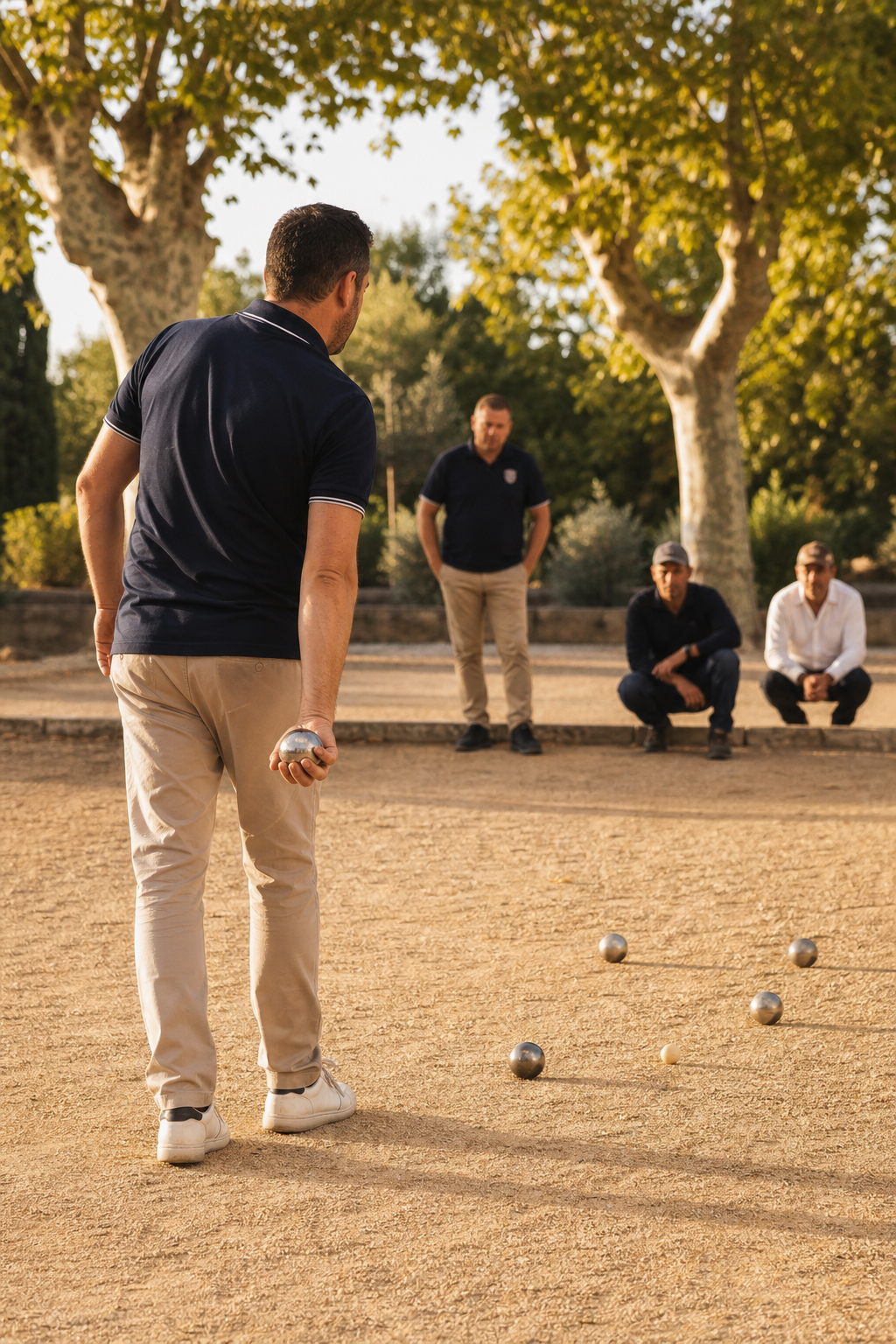
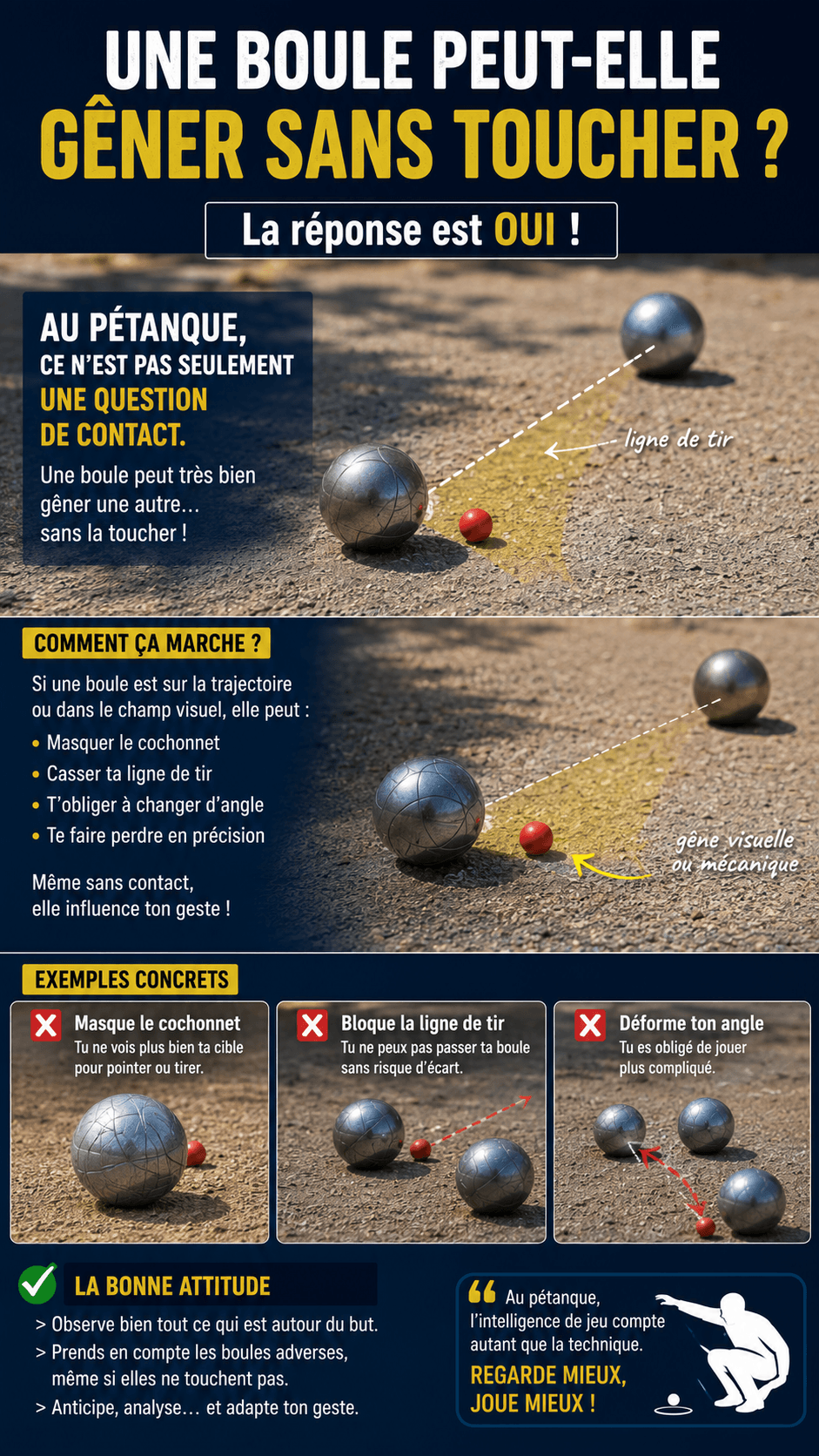
👁️ 1. Visual hindrance — masking the view of the jack VISUAL CONCENTRATION HOW IT WORKS A boule placed in the axis between the opponent's circle and the jack partially masks the view of the jack from the throwing position. The opponent no longer sees the jack directly — they must mentally "calculate" its position behind the hindering boule, which increases the cognitive load and reduces the accuracy of distance and direction evaluation. → To exploit: deliberately point in the line of the opponent's gaze, even if it isn't the closest spot to the jack. The visual hindrance can be worth more than a few extra centimetres. THE REAL EFFECT ON THE OPPONENT'S GAME The opponent must move to find a clear viewing angle, change their direction reference, or play without a direct view of their target. These micro-adaptations consume concentration and disrupt the throwing routine — particularly for players who rely on a direct aim. The visual hindrance is amplified at long distances where the jack is naturally harder to make out. → To counter: shift slightly to the side in the circle to regain a direct view. Don't try to play from the usual axis if the view is obstructed — a shift of a few centimetres in the circle solves the problem. → To remember: the visual hindrance is often underestimated because it's invisible — it doesn't show up in the game's statistics. But its effect on the opponent's consistency is real and cumulative over several ends. 🛤️ 2. Trajectory hindrance — blocking the natural approach line TRAJECTORY PLACEMENT HOW IT WORKS Each rolled boule follows a natural lane from the circle to the jack. A boule placed in this lane — even at 30 or 40 cm from the jack — forces the opponent's boule to go over it, around it, or to take a different trajectory. This constraint forces the opponent to play at half-height or change their axis, two adaptations that reduce their usual accuracy. → To exploit: identify the opponent's natural rolling lane and intentionally place a boule in it. Even at a good distance from the jack, this boule creates a trajectory constraint the opponent will have to account for. WHAT CHANGES FOR THE OPPONENT The opponent must either play high to go over the hindrance, find an alternative lane, or attempt an angled point. All three of these adaptations increase the difficulty compared to an unconstrained point. The trajectory hindrance is particularly effective on narrow grounds where alternative lanes are limited, or when the hindering boule is placed on the only practicable lane between the ground's natural obstacles. → To counter: identify the available alternative lanes before playing. A good pointer analyses the ground from the start of the end to spot 2 or 3 possible approach lines — and isn't caught off guard by a trajectory hindrance mid-end. → To remember: the trajectory hindrance is particularly useful in ends where you aren't the first to point — placing your boule on the opponent's lane after they've pointed once lets you complicate their second point. 🔒 3. Shooting-angle hindrance — closing the direct shooting line SHOT ANGLE HOW IT WORKS A boule placed slightly to the side of an opponent's boule you want to protect can make a direct shot on that boule technically very difficult. The opponent must either accept the risk of touching both boules (which can make the situation worse), or attempt an angled shot to get around the protection. An angled shot is noticeably harder than a straight shot, even for a good shooter. → To exploit: after pointing well, the next boule can be placed not to be even closer, but to close the shooting angle on the first boule — creating indirect protection without losing placement. THE MECHANICS OF ANGLE PROTECTION The straight shot is the most effective and most repeatable — it's the one most shooters have developed their technique on. As soon as the target requires a lateral angle, accuracy drops — proportionally to the size of the angle. A boule placed 10 cm to the side of a boule to protect can halve the probability of a successful shot if it forces an unusual angle. It's a protection that costs nothing in terms of placement but seriously complicates the opponent shooter's task. → To counter: if an opponent's boule closes the direct shooting angle, honestly assess whether the angled shot is within your real range of mastery — if not, point instead and don't sacrifice a boule on a low-probability shot. → To remember: angle protection is an advanced but very rewarding technique. It requires thinking not only about your own placement but about the relative position of the boules — and anticipating the type of shot the opponent will have to attempt to counter. 💥 4. Rebound hindrance — the boule that worsens the miss REBOUND OPPONENT'S SHOT HOW IT WORKS A boule placed in the likely impact zone of a missed opponent's shot doesn't prevent the shot — but it worsens the consequences of the miss. If the opponent's shot misses slightly and the shot boule deflects off the hindering boule, the rebound can propel the jack or move boules in a direction unfavourable to the opponent. It's a hindrance on the missed shot, not on the successful shot — which makes it particularly sneaky. → To exploit: after pointing well, identify the zone where a missed opponent's shot boule would likely land. Place a "rebound barrier" boule there — even if it's far from the jack, its mere presence increases the risk of the opponent's shot. WHAT GOES ON IN THE OPPONENT'S HEAD A shooter who sees a well-placed boule in their natural rebound zone in case of a miss is a shooter who must either succeed with their shot, or accept that their miss may worsen the situation. This awareness increases the pressure on the shot — and pressure is precisely what makes shots miss. The rebound boule is therefore as much a psychological pressure as a real physical hindrance. It's one of the most subtle and most rewarding forms of hindrance to master. → To counter: before shooting, identify the opponent's rebound boules and frankly assess whether a slight miss can move the jack in an unfavourable direction. If this risk is high, pointing may be safer — even if the shot seems "obvious". → To remember: the rebound boule is little noticed by beginner players — they see the opponent's boule to shoot, not the rebound boule behind it. An experienced player sees the whole ground and accounts for all obstacles in their shooting decision. 🌐 5. Zone hindrance — occupying the space around the jack ZONE GROUND CONTROL HOW IT WORKS Two or three well-spread boules around the jack create an "occupied zone" that makes it very difficult for an opponent's boule to arrive precisely on the jack. Every opponent's boule that drops into this zone risks colliding with one of the boules that make it up, with an unpredictable result. The opponent must point into a very precise zone to avoid the hindrance — or accept a random result. → To exploit: don't try to place all the boules in the same spot. Boules intelligently spread around the jack create a more effective zone hindrance than a single very close boule — and are harder to eliminate with a single shot. WHY IT'S STRONGER THAN A SINGLE BOULE A single very close boule can be eliminated with a good shot — and the jack becomes accessible again. Three boules spread around the jack can't be eliminated in a single shot. The opponent will have to play several boules to eliminate the zone hindrance, consuming their resources. And if one of their boules fails to knock out the target boule, it stays in the zone and reinforces the hindrance. It's a particularly powerful tactic late in an end with a lead on the scoreboard. → To counter: faced with a zone hindrance, don't try to eliminate all the boules. Look for the "gap" in the zone — the approach angle where the opponent hasn't placed a boule — and aim precisely at that free space. → To remember: the zone hindrance is the tactical tool of the leading team. Once in a favourable position, spread the remaining boules around the jack rather than piling them up in the same spot — each boule added to the zone increases the opponent's problem non-linearly. 🧠 6. Psychological hindrance — the boule that creates doubt MENTAL PRESSURE HOW IT WORKS A visible, well-placed boule that "looks at" the opponent from the ground creates real psychological pressure — regardless of its exact position relative to the jack. The opponent knows they have to do better than that boule. This awareness alters their mental state at the moment of playing: they're in "catch-up" mode rather than "building" mode, which statistically degrades the quality of their play. → To exploit: keep a visible, well-placed boule in the opponent's field of vision. Don't hide it behind other boules — a psychologically hindering boule is more useful if the opponent constantly sees it from their circle. THE MECHANICS OF DOUBT Doubt consumes concentration. A player who starts playing thinking "I absolutely have to place better than that boule" splits their attention between the target and the result — instead of focusing solely on their technique. This division of attention is precisely what produces errors under pressure. The psychologically hindering boule doesn't act on the physics of the opponent's game — it acts on their mental process, and that's often where ends are really won and lost. → To counter: develop a routine to shut out the context — focus solely on your target and your technique, not on what the opponent has done. The mental discipline of "playing your own game" is the best protection against the psychological pressure of an opponent's hindering boule. → To remember: the psychological hindrance doesn't disappear when the opponent's boule is shot or moved — it can return every end if the opposing team understands they can create this type of pressure. Recognising your own relationship to the opponent's pressure is a fundamental mental skill. 🧩 Think "hindrance" as much as "proximity"Before pointing, the question isn't only "where is the jack?" but also "which position on the ground creates the most problems for the opponent?" A boule 20 cm from the jack on the opponent's shooting axis is often worth more tactically than a boule at 8 cm in a neutral position. The best pointers don't just seek to be close — they seek to be where it makes life harder for the other side.
Using or countering an indirect hindrance
🎯 CREATING AN INDIRECT HINDRANCE — THE PRINCIPLESAnalyse the ground before pointing: identify the opponent's shooting axis, the natural rolling lane, the rebound zone of a missed shot. This information guides optimal placement.
Think "relative position": a boule's value depends not only on its distance to the jack but on its position relative to the opponent's boules and the available trajectories.
Stack the hindrances: a boule that creates both a trajectory hindrance and a visual hindrance is doubly effective. The best positions stack several forms of indirect hindrance.
→ Objective: force the opponent to play a shot they hadn't planned. 🛡️ COUNTERING AN INDIRECT HINDRANCE — THE RESPONSESIdentify the form of hindrance: visual, trajectory, shooting-angle, zone hindrance? Each form has a specific response — confusing them produces ill-suited responses.
Find the free lane: faced with a zone hindrance, look for the unoccupied space. Faced with a trajectory hindrance, find the alternative angle. There's almost always a practicable path.
Don't let yourself be forced: a well-constructed hindrance seeks to impose a difficult shot. Recognising the constraint and refusing to play it if the conditions aren't met is a valid tactical response.
→ Objective: don't play the shot the opponent has prepared for you. ❌ MISTAKES IN THE FACE OF AN INDIRECT HINDRANCEShooting the hindering boule reflexively: some indirect-hindrance boules are placed far from the jack — shooting them consumes a boule without solving the problem if it isn't the closest boule.
Not adapting your trajectory: continuing to play on the usual axis despite an obvious trajectory hindrance — and being surprised by a result disrupted by the hindering boule.
Ignoring the psychological hindrance: not recognising the pressure created by a well-placed opponent's boule and playing in a degraded mental state without realising it.
→ These mistakes offer the opponent exactly the effects they were trying to create with their placement. 📖 READING THE GROUND — BEFORE EVERY BOULETake 5 seconds to read the ground: identify the boules present, their relative positions, the open trajectories and the obstructed ones.
Ask yourself what the opponent was trying to do: understanding the intention behind the opponent's placement lets you identify the hindrance and find the most effective response to it.
Decide before entering the circle: the placement decision must be made before stepping into the circle — not during the throw, when concentration must be on the technique.
→ 5 seconds of reading before each boule is worth more than 30 seconds of regret afterwards. 🔑Indirect hindrance is the tool of players who think of the ground as a system and not as a simple question of measuring. A player who understands the 6 forms of indirect hindrance can build favourable positions even when their boules aren't exceptionally close to the jack — and can thwart the opponent's positions even when they seem solid.
Mistakes in reading the hindrance
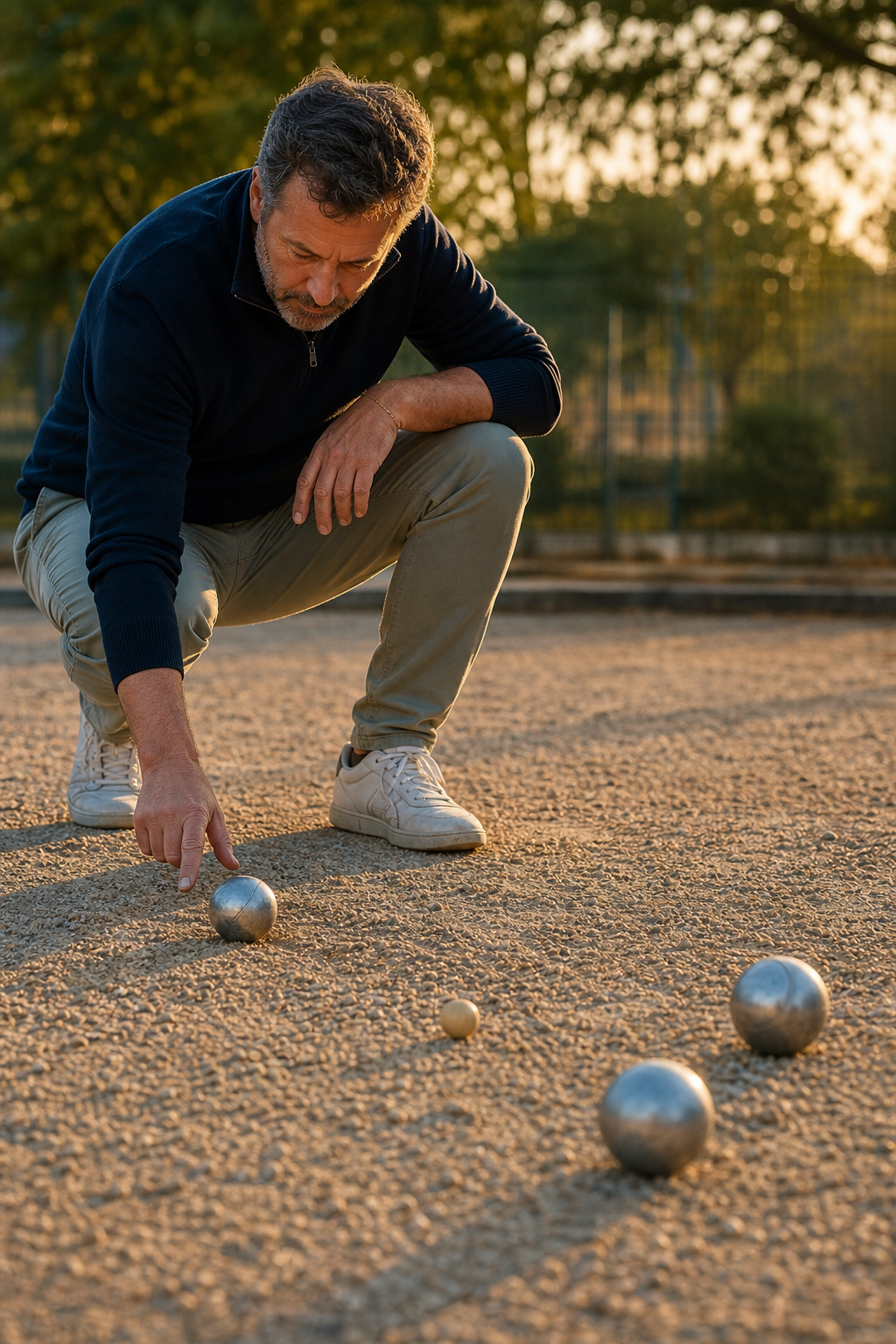
📏Judging only by distance Evaluating an opponent's boule solely by its distance to the jack without accounting for its relative position on the ground. A boule at 15 cm on the shooting axis is worth more than a boule at 8 cm in a neutral position. A correct reading always integrates the position within the context of the whole ground. → Test: look not only at the opponent's boule's distance to the jack, but also its position relative to the available trajectories. 🎯Shooting a non-priority boule Shooting an indirect-hindrance boule (trajectory, rebound) that isn't the closest boule — because it "hinders" — without assessing whether eliminating it actually changes the situation. Shooting a boule 40 cm from the jack to free up a trajectory when the opponent has a boule at 5 cm is a mistake of tactical priority. → Test: before shooting a hindrance boule, ask whether eliminating it solves the real problem or whether the closest boule is the real priority. 🌀Confusing the forms of hindrance Responding to a zone hindrance with a shot attempt when a precise point in the free lane would be more effective. Or responding to a trajectory hindrance with a point on the obstructed axis instead of looking for an alternative angle. Each form of indirect hindrance has a specific response — generic responses (always shoot, always point) are often ill-suited. → Test: precisely identify the form of hindrance before deciding on the response. The response follows from the nature of the hindrance, not from a habit. 😤Suffering the pressure without recognising it Playing in a degraded state of concentration without realising that the psychological hindrance of an opponent's boule is responsible. Explicitly acknowledging "this boule is putting pressure on me, I have to play my own game" is the first step to countering the psychological hindrance — a hindrance you haven't identified can't be neutralised. → Test: if you're playing worse since an opponent's boule has been well placed on the ground, it's psychological hindrance. Naming the phenomenon already reduces its effect.Exercises to develop tactical placement
01 The "constraining boules" exercise — learning to place to hinder 📍 2-player training ⏱️ 45 min 🎯 Develop tactical intent in placementPlay a series of ends with a modified rule: each boule must be placed with a tactical intent declared before the throw — not just "point close to the jack" but "place on the opponent's shooting axis" or "occupy the rolling lane".
Before each throw, declare out loud the boule's tactical intent : "I'm placing on the rolling trajectory", "I'm covering the left shooting angle", "I'm filling the free zone to the right of the jack". This verbalisation forces an explicit tactical reflection before each throw. After the end, analyse together which boules actually created constraints and which were neutral despite the declared intent. Identify the gap between the intent and the actual result — this gap is the precision gap to work on. Gradually, reduce the analysis time between boules. The goal is for the tactical reading to become faster and more intuitive — going from 30 seconds of verbalised analysis to 5 seconds of silent reading without loss of decision quality. Vary the situations: place the jack in different positions (back, middle, side), on different grounds (hard, soft, sloping). The tactical reading must work in all configurations, not only in the usual standard configurations. 02 The "hostile ground" — playing against deliberate maximum hindrance 📍 2-player or team training ⏱️ 1 h 🎯 Develop the reading of hindrances and the ability to get around themOne player (or team) plays normally. The other has the sole objective of creating a maximum of indirect hindrances — without seeking to be close to the jack. After 30 minutes, the roles swap. The aim is to learn to identify and counter all forms of hindrance in a situation where they are deliberately maximised.
The "hindrance" team places its boules exclusively to create constraints: on the shooting axes, in the rolling lanes, as zone cover. It isn't trying to score — it's trying to make the opponent's game as difficult as possible. This counter-intuitive role forces an in-depth understanding of the mechanics of obstruction. The "normal" team must find answers to each obstruction built. It analyses out loud: "here it's a trajectory obstruction, I'll go through on the left", "here it's zone obstruction, I'm looking for the free space at 3 o'clock from the jack". Verbalising the analysis develops tactical awareness. After each end, the two teams discuss: which obstructions worked and why, which answers were effective and which ones made the situation worse. This shared debrief is the most valuable part of the exercise — both players progress simultaneously in their understanding of the terrain. At the end of the session, play 3 "normal" ends — both teams play to win. Observe whether the placement decisions have evolved compared to the start of the session. A visible improvement in tactical awareness on placement after this exercise is common from the very first session. 📋 QUICK READING CHECKLIST BEFORE EACH BOULE 5 questions to place with intention — in under 10 seconds 👁️ What is the opponent's line of sight? From where will the opponent play? What is their natural line of sight towards the jack? A boule placed in this axis creates an immediate visual obstruction. 🛤️ What is the opponent's natural rolling lane? Where would the next opposing boule naturally come if it rolls from the opposing circle? Occupying this lane forces a change of trajectory. 🔒 Is there a boule to protect via the angle? Does one of my boules deserve to be protected by closing the opponent's direct shooting angle? If so, the next boule can go into protection rather than pure placement. 🌐 What is the free zone around the jack? Where can the opponent still point without constraint? Occupying this free zone reduces the opponent's options — even if the boule is not exceptionally close to the jack. 💥 Where would a failed opposing shot land? If the opponent shoots and misses slightly, where does the shot boule go? Placing a boule in this probable rebound zone worsens the consequences of a miss and increases the pressure on the opposing shooter. 📚 PAQUITA'S BOOKS Progressing at pétanque — Paquita's guides 🎯 TACTICS — MENTAL — TECHNIQUE Playing everywhere — from technique to on-ground tactics Tactical reading of the terrain, intentional placement, indirect obstructions, role discipline within a team — the complete guide to progressing in every dimension of the game. 📦 Amazon 💥 SHOOTER — TECHNIQUE — CONSISTENCY Become a formidable shooter Reading angle and rebound obstructions before shooting, building a reproducible shot in every terrain configuration, deciding when not to shoot — the guide for the shooter who thinks before acting. 📦 Amazon 🎳 POINTER — AWARENESS — REFERENCE POINTS The art of pointing — precision and consistency Tactical placement, zone control, trajectory and shooting obstructions, reading the terrain before each boule — the guide for the pointer who places with intention, not just with precision. 📦 Amazon 🧠 MENTAL — ROUTINE — METHOD Pétanque by method Managing the opponent's psychological pressure, terrain-reading routines, developing tactical automatisms — progressing methodically to make the right decisions under pressure. 📦 Amazon