Actualités · 10 June 2026
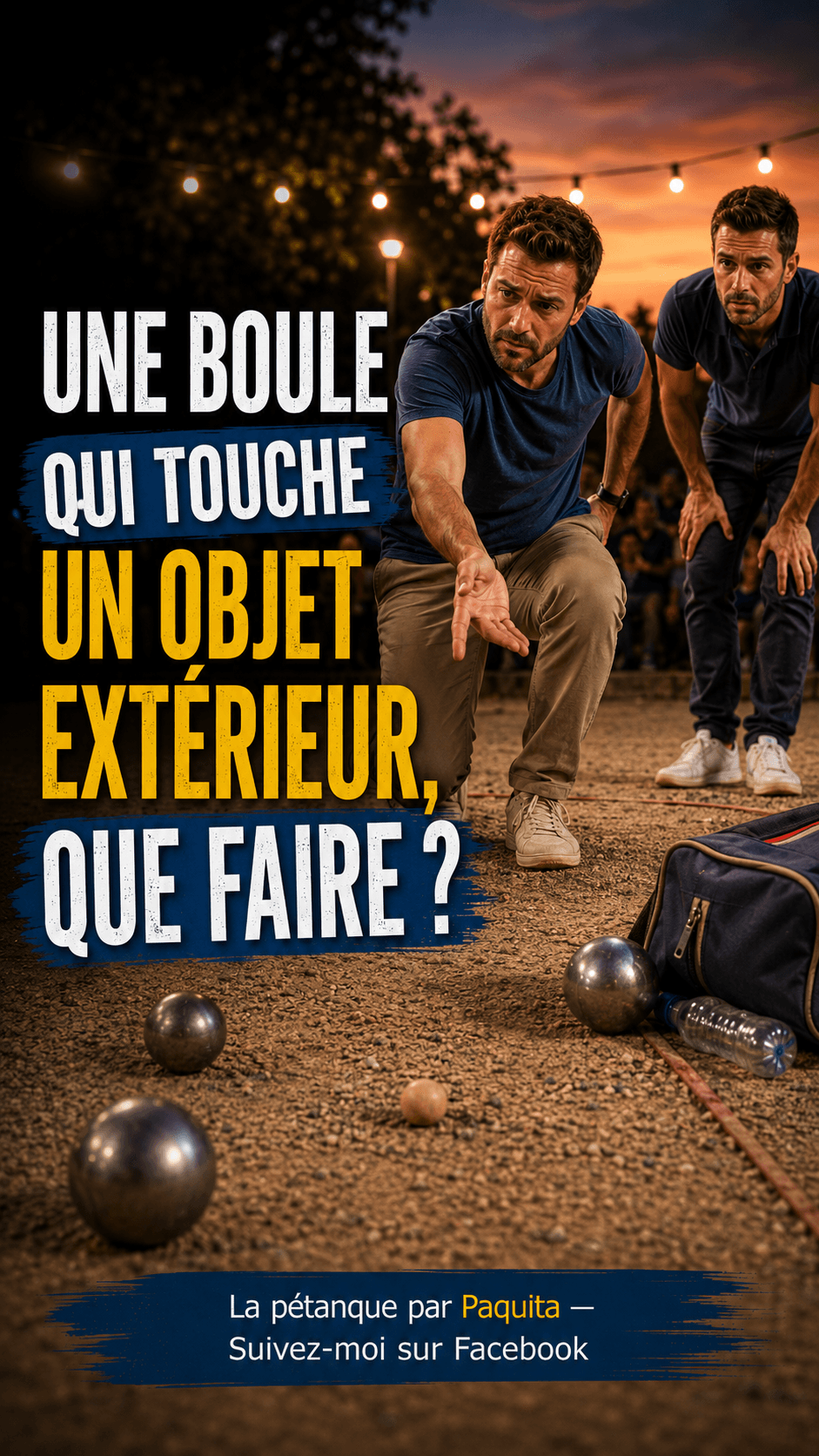
A boule that touches an outside object: what to do?
A dog, a ball, a boule from the neighbouring game, a spectator… When a boule touches an outside object, what do the rules say? Paquita clears it up: everything depends on whether the boule was still rolling or had already stopped. Case by case, official FIPJP verdicts.The only question that matters
Before looking for who touched the boule, ask yourself one thing: was the boule still moving, or already stopped? This point, and it alone, changes everything.
A boule still rolling hasn't finished its story: if a foreign element disturbs it, we correct according to the nature of that element. A boule already stationary, for its part, has found its place: if something moves it afterwards, we put it back where it was. Here is the complete decision tree:
A ball hits an external object ▼ Was the ball still rolling? YES — MOVING ▼ Stopped or diverted by what? ▼ A spectator or the referee → she maintains her position An animal, a ball, a ball from another game → it is replayed NO — ALREADY STILL ▼ Moved by an external element → put back in place (if it was marked)Case 1 — The boule was still rolling
When a foreign object intervenes while the boule is moving, between the circle and the jack, the rules distinguish two situations according to the nature of the intruder. It's the nuance that most players are unaware of.
🧍 A spectator, or the umpire, stops or deflects your boule in full flight. ✓ IT KEEPS ITS POSITIONThe boule stays exactly where it finally comes to rest, as if nothing had happened. It is not replayed, it is not put back: what's done is done. It's sometimes frustrating — a spectator's foot can save or ruin a point — but that's the rule.
🐕 A animal, a ball, or a boule (or jack) coming from another game deflects your boule during its run. ↺ IT IS REPLAYEDHere, the trajectory has been distorted by an element totally foreign to the game. The boule is therefore replayed: you throw it again as if that throw had not taken place. The logic is sound — you can't be held responsible for a dog or a ball that turns up.
PAQUITA'S NUANCEBear in mind the difference: a spectator or the umpire, the boule stays where it stops; a animal, an object or a boule from another game, it is replayed. Same disturbed throw, two opposite outcomes. It's the subtlety that wins (or loses) the debates at the end of an end.
Case 2 — The boule had already stopped
A total change of logic. If a boule has already found its place and a foreign event then moves it, we put it back where it was. No matter the intruder: the principle is the same.
🍃 A boule already stationary moves because of the wind, of the slope of the terrain, or is moved by a spectator, an animal, an object… ⟲ PUT BACKWe reposition it precisely at its original spot — with one major condition: that it was marked. Without a mark on the ground, it is impossible to prove where it was, and the claim is not admissible (we come back to this below).
🎯 A boule from the game in progress comes and touches your already-placed boule. ✓ IT'S THE GAME — EVERYTHING STAYSWatch out for the trap: a boule from your game is not a foreign object! It's the normal course of play. Everything that moves at that moment is valid, nothing is put back. The replacement rule concerns only elements foreign to the end.
Watch out: a player is not a foreign object
Many confuse « foreign element » with « person who isn't me ». Yet a player in the game obeys specific rules, and they are not necessarily in your favour. Here are the four cases to know.
🙋 Your own side involuntarily stops your moving boule. ✕ IT IS DEAD 🤝 An opponent involuntarily stops your boule pointed. ⇄ YOUR CHOICE: REPLAY IT OR LEAVE IT 💥 A opponent involuntarily stops your boule shooting (shot or struck boule). ⇄ THE OPPONENT CHOOSES: LEAVE IT OR REPLACE IT ON THE LINE ✋ Someone stops voluntarily a moving boule. ⛔ DISQUALIFICATION OF THE PLAYER AND THEIR TEAMThis last point admits no discussion: deliberately stopping a rolling boule leads to the immediate exclusion of the offending player and and of their entire team for the game in progress. The rules are deliberately strict.
And the jack (cochonnet)?
The jack follows a logic very close to that of the boules — with one particular feature at the throw.
🟡 The jack you have just thrown is stopped by the umpire, an opponent, a spectator, an animal or a moving object. ↺ IT IS THROWN AGAIN 🎳 The jack, struck by a boule in play, is then stopped or deflected by a spectator or the umpire. ✓ IT KEEPS ITS POSITION 🌬️ The jack already in place is moved by a external element (wind, animal, spectator, boule from another game…). ⟲ PUT BACK IN PLACE (if marked)And as with the boules: if the jack is moved by one boule from the game in progress, the movement is perfectly valid — it is the very heart of the game.
The reflex that saves you: marking
You saw it come up in every case of putting back in place: everything hinges on having marked the boule or the jack. It is the simplest and most neglected gesture in pétanque.
To mark means drawing a small reference mark on the ground around the boule (or the jack) once it is stationary and has value. If an external event moves it, this mark proves its position and allows you to obtain the replacement. Without a mark, no claim is admissible : you simply lose the benefit of the rule.
THE RIGHT REFLEX IN 4 POINTS- Was the boule still rolling? That is the first question, always.
- In motion: spectator or umpire → keep it; animal, object, boule from another game → replay it.
- Already stationary: moved by an external factor → put it back in place, provided it has been marked.
- Systematically mark your boules and the jack that matter. Without a mark, no recourse.
On the ground, the real question is never "who touched my boule". It is "was it still rolling". Answer that, and you already hold almost the whole rule.
— Paquita 📕 Never lose a rules debate againDisputed cases, measurements, placement of the jack, penalties… Paquita's book brings together the rules that really matter, explained simply and illustrated with concrete examples — to play with peace of mind and umpire fairly.
📦 Order on AmazonAvailable on Amazon.fr · Paquita — PétanqueLand
Frequently asked questions
A dog crosses and deflects my boule in mid-roll: do I replay it?Yes. A boule deflected or stopped during its roll by an animal — as by a ball or a boule from another game — must be replayed. Note, however: this is not the case if it is a spectator or the umpire who stops it. In this specific case, the boule keeps its position where it comes to rest.
Why do a spectator and an animal not give the same result?Because the rules treat them differently when the boule is in motion: stopped by a spectator or the umpire, it stays where it stops; deflected by an animal, a moving object or a boule from another game, it is replayed. On the other hand, for a boule already stationary, all these factors give the same result: put back in place. The distinction "spectator vs animal" therefore only applies to a boule still in motion.
A boule from another game pushes my boule that is already at rest. What do we do?We put your boule back to its original place, provided it has been marked. A boule from another game is an external element to your game. It is very different from a boule from your own end: if it had been a boule from your game that had pushed yours, the movement would have counted normally, because that is the game.
And what if someone stops my boule on purpose?It is a serious fault. Deliberately stopping a moving boule results in the immediate disqualification of the offending player and their entire team for the current game. The rule leaves no room for interpretation on this point.
My teammate stopped my boule without meaning to: do I replay it?No. A boule stopped by a player from their own team is dead. It is one of the cases where you have to understand that a player is not a "foreign object": they are subject to separate rules, and this one does not work in your favour. The boule is removed from play.
Do you really have to mark the boules and the jack?Yes, it is THE reflex to adopt. All replacements — whether of a boule or of the jack moved by an external element — are only granted if the position had been marked beforehand. Without a mark on the ground, no claim is admissible and you lose the benefit of the rule. A small line on the ground, and you are covered.
📎 Related articles Rules The rule of the minute — what every player should know Rules 2026 Sweeping penalised: what is changing Rules Boule out of the terrain: good or dead? Tactics The invisible mistakes in doublette Mental Playing under pressure: what really changes Tools Free PétanqueLand Tools© Pétanque by Paquita — petanqueland.fr
📖 Order the book on Amazon