News · 9 February 2026
Alcohol and CBD on the terrain: What the 2026 anti-doping test says
NewsIs CBD allowed or not? Blood alcohol in competition, anti-doping controls, FFPJP penalties 2026: Paquita takes stock of what's tolerated — and what earns a suspension.Substances table: allowed, tolerated, banned
Before going into detail, here is a quick overview of the status of each substance frequently mentioned by players. This table follows the positions of the AFLD (French Anti-Doping Agency) and the FFPJP 2026 framework.
🌿 Pure CBD ✓ AllowedPure cannabidiol is not on the AFLD list of banned substances. But "pure" is the key word.
🟡 "Full spectrum" CBD ⚠ High riskFull-spectrum oils contain traces of THC. A positive test remains an offence.
🚫 THC (cannabis) ✗ BannedAFLD-controlled substance. Detected in urine for several weeks after consumption.
🍺 Alcohol ⚠ RegulatedVariable threshold depending on competitions and categories. Zero tolerance possible for youth and elite.
💊 Common medicines ✓ Generally OKMost OTC medicines have no impact. Check if in doubt about a specific prescription.
⚡ Stimulants / EPO ✗ BannedAll substances on the AFLD/WADA list are banned, including stimulants.
⚠ The principle of individual responsibilityIn matters of anti-doping, each player is responsible for what they consume. Pleading ignorance ("I didn't know this product contained THC") does not constitute a sufficient defence. The test result stands, whatever the reason for the presence of the substance.
CBD in pétanque: the true regulatory situation
CBD (cannabidiol) has become popular among athletes for managing stress, joint pain and recovery. Many pétanque players use it. The regulatory situation is nuanced — not as simple as "allowed" or "banned".
🌿 CBD isolate or pure CBD — AFLD position: not banned Cannabidiol (CBD) was removed from the list of banned substances by the AFLD and the World Anti-Doping Agency (WADA). A product containing exclusively pure CBD, with no THC or other controlled cannabinoid, is not an offence. This is the official position in force. ✓ Allowed if pure CBD without THC 🟡 "Full spectrum" oils — a real danger zone Full-spectrum CBD oils contain other cannabinoids naturally present in the plant — including traces of THC (tetrahydrocannabinol). These traces are enough to trigger a positive test. The legal limit in France (0.3% THC) in a CBD product is not a guarantee of absence during a biological test. ⚠ Risk of a positive THC test 🚫 THC detected — major offence, regardless of the source If a test reveals the presence of THC — even at a low concentration, even due to a poor-quality CBD product — the offence is established. The justification "it was CBD, not cannabis" is not sufficient if the test is positive for THC. The responsibility lies with the player, not the product manufacturer. ✗ Offence — possible suspension 🔍 The CBD reflex before a competitionIf you use CBD, systematically check the product's composition : look for the mention "CBD isolate" or "pure CBD" and a third-party analysis certificate attesting to the absence of THC. Avoid full-spectrum oils in the weeks before an official competition. In case of doubt, consult the AFLD portal or your doctor before playing in an approved competition.
🏅The FFPJP is gradually aligning with the anti-doping standards of the sports federations recognised by the French National Olympic and Sports Committee (CNOSF). This rigour is directly linked to pétanque's ambition for Olympic recognition. The higher the level of requirement, the more systematic testing becomes in major competitions.
Blood alcohol in competition: what the FFPJP says
The "pétanque + pastis" image is ingrained in popular culture. In official competition, the reality is stricter — and varies according to the categories and the level of the competition.
⚖️ BLOOD ALCOHOL THRESHOLDS IN COMPETITION — FFPJP 2026 🧑 Adult player — standard competitions Reduced threshold in competition Competition threshold In official FFPJP competition, the threshold is lowered compared to the highway code. Check the specific regulations of each competition. 🏆 Elite players / national level Stricter tolerance Elite threshold For high-level competitions (Nationals, French Championships), the threshold is markedly lowered. Near-zero tolerance in practice. 👦 Young players (minors) 0.0 g/l Zero tolerance Absolute zero tolerance for minor players, whatever the competition. No exceptions. ⚠ Check the specific regulations of each competitionBlood alcohol thresholds can vary from one competition to another depending on the specific regulations set by the organiser. Before any competition, consult the specific regulations or the FFPJP portal to know the exact conditions that apply. What is tolerated in a local competition may not be in a regional or national championship.
💧 Optimal preparation according to PaquitaTo stay sharp and performant over the duration of a National or a competition of several hours: regular hydration with water, short food breaks, and concentration maintained end after end. Alcohol dehydrates and alters the precision of your delivery — two direct enemies of a good shot. The pastis after the competition has more flavour than the one before.
How does a test work in a competition?
Anti-doping tests and blood-alcohol checks do not happen in the same way. Here is what you can expect in each case.
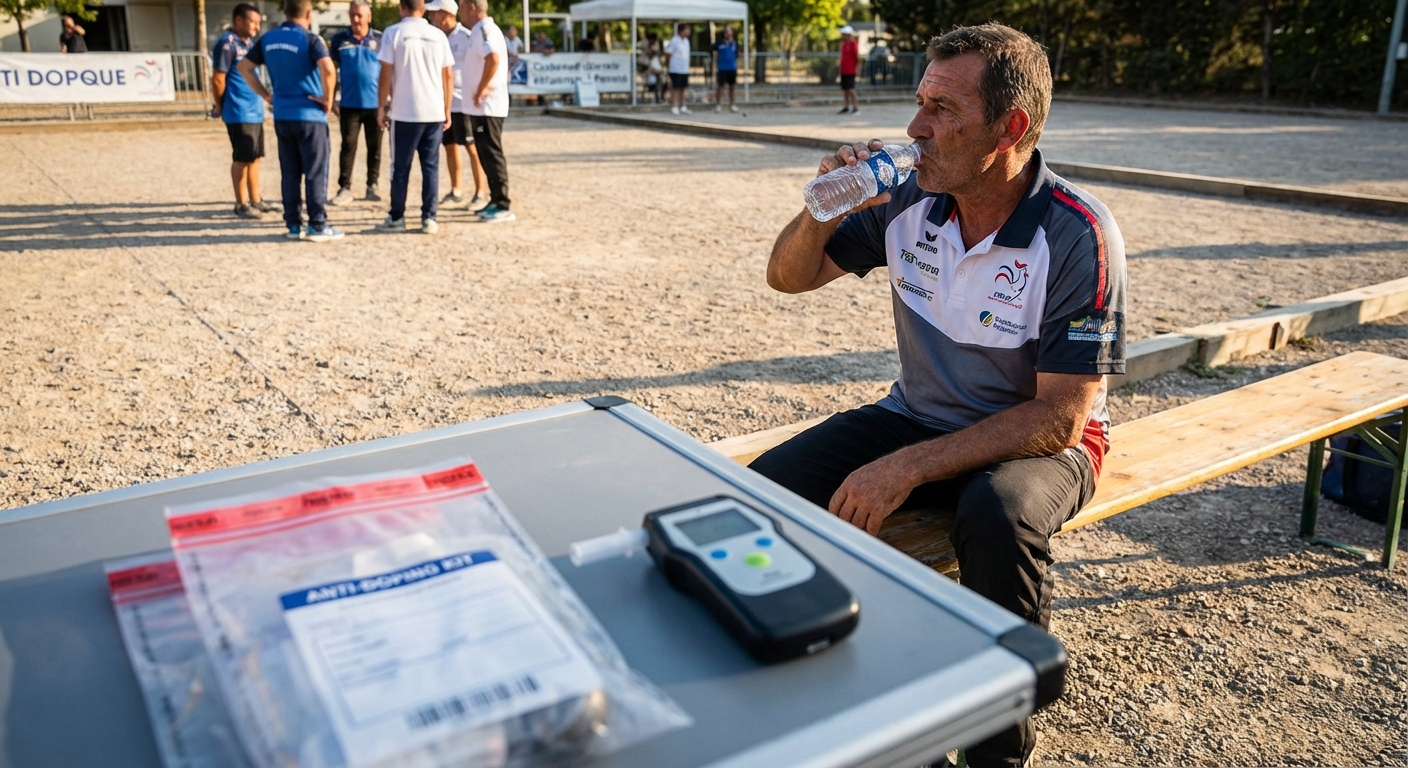
- 🍺Blood-alcohol test — The referees of certain official competitions are equipped with electronic breathalysers. The test can be triggered by questionable behaviour or at random according to the competition's regulations. The result is immediate.
- 🧪Anti-doping test — Carried out by accredited AFLD agents during major competitions (French Championships, international competitions). The designated player is escorted to the testing zone and provides a urine sample. The results are processed in a laboratory.
- 📋Designation of the player — The tested player may be drawn by lot, designated by the organisers, or chosen from among the finalists. They are not necessarily the player with the best result.
- 🚫Refusal of testing — Any refusal to submit to a test (blood-alcohol or anti-doping) is treated as a positive result. The sanction is identical to that of a confirmed positive test. There is no "right to refuse" in official competition.
- 📱Entry on the player's record — Any incident related to a substance (positive test, refusal of testing, sanction) is now recorded digitally in the FFPJP licensee file. The 2026 digital licence centralises this information.
The sanctions incurred in 2026
The FFPJP's disciplinary framework is graduated according to the nature of the offence, the substance involved and any repeat offences. Here is the reference sanctions table.
| Infraction | First occurrence | Repeat offence | Severity |
|---|---|---|---|
| Positive test for THC (cannabis) | 6 months minimum suspension | 2 years or more | Major |
| Blood alcohol exceeding the competition threshold | Immediate exclusion from the competition | Suspension + report | Serious |
| Refusal to submit to testing | Equivalent to a positive test | Aggravated sanctions | Major |
| Positive test for a substance on the AFLD list | Suspension, duration depending on the substance | Long-duration suspension | Very serious |
| Zero-tolerance blood alcohol limit exceeded (youth / elite) | Disqualification + disciplinary proceedings opened | Licence suspension | Major |
| Confirmed repeat offence after suspension | — | Permanent expulsion possible | Maximum |
The maximum penalty — permanent removal from the FFPJP register of licence holders — may be imposed for a confirmed repeat offence following an initial suspension. It bars the player from taking part in any official competition. No tolerance or special arrangement is possible once this penalty has been imposed by the disciplinary committee.
📱Since 2026, the FFPJP digital licence centralises every licence holder's disciplinary history. An anti-doping incident is immediately visible to all organisers and committees. It is no longer possible to "start afresh elsewhere" without the player's disciplinary record being accessible. See our article on the new FFPJP 2026 digital licence.
The right habits before a competition
🔍 Check your CBD productsRead the ingredients and look for "CBD isolate" or "0% THC certified by a third-party laboratory". Avoid full-spectrum oils before an official competition.
📋 Read the competition rulesBlood alcohol limits and testing conditions vary. Check the specific rules for each competition, particularly for National tournaments and championships.
💊 Declare your medical treatmentsIf you are taking prescription medication, consult your doctor about obtaining a Therapeutic Use Exemption (TUE) if the substance appears on the AFLD list.
💧 Make hydration a priorityDuring competitions lasting several hours, drinking water is your best ally. It helps maintain concentration and accuracy of delivery throughout the day.
🚫 Never refuse a testRefusing a test is an offence equivalent to testing positive. Whatever the circumstances, submitting to testing is mandatory in official competition.
🔗 Consult the AFLD whenever in doubtIf you are unsure about a medicine, dietary supplement or CBD product, the AFLD portal lets you check a substance's status before using it.
FAQ — Your frequent questions
Can I have a drink during a friendly competition? + In unofficial friendly game, no federal rules apply. You are free. On the other hand, as soon as the game falls within the framework of an approved FFPJP competition – even a local competition – the competition regulations apply. Check whether the specific rules of the competition provide for a blood alcohol threshold or not. If in doubt, refraining from playing remains the safest rule. Are CBD capsules safer than oil? + The dosage form (oil, capsule, infusion) is not the determining criterion. What matters is the composition of the product. A CBD isolate capsule is safer than a full-spectrum oil — but a full-spectrum capsule carries the same risks as a full-spectrum oil. Always read the composition and look for an independent laboratory certificate of analysis verifying the absence of THC. Can a check take place in a village competition? + Theoretically, any FFPJP approved competition can be subject to inspection. In practice, formal anti-doping controls (carried out by AFLD agents) mainly concern high-level competitions — Nationals, French Championships, international competitions. Breathalyzer tests are more accessible and can be carried out in more local competitions according to the organizer's regulations. Remain vigilant regardless of the size of the competition. Is the detection time for THC in urine long? + Yes. THC binds to fat and can remain detectable in urine for several days to several weeks depending on the frequency of exposure, metabolism and dose. Even occasional consumption of a CBD product containing THC may remain detectable when tested one to two weeks after consumption. This is why exposure to “full spectrum” products in the weeks leading up to a competition is risky. Can a prescription drug trigger a positive test? + Yes, some prescription medications contain substances on the AFLD list — including certain corticosteroids, diuretics or beta-blockers. If your doctor prescribes a treatment that could interfere with a doping test, you can request a Therapeutic Use Exemption (TUE) with the AFLD. This procedure protects the athlete and does not constitute an offense. To anticipate before the start of an important competition. Does a positive test impact the license the following year? + Yes. Since the introduction of the FFPJP 2026 digital license, the disciplinary history of a licensee has been centralized and accessible to federal authorities. A positive test or a disciplinary sanction linked to a substance is recorded and may affect the allocation of the license for subsequent seasons — particularly in the event of a repeat offense. The digital file does not “reset” from one season to the next. See our article on FFPJP 2026 digital licence. 📚 Sources and references- 🔗 AFLD — French Anti-Doping Agency (substance list, CBD status)
- 🔗 AMA / WADA — World Anti-Doping Agency (international list of prohibited substances)
- 🔗 FFPJP 2026 Rules — administrative, sporting and disciplinary regulations
- 🔗 FFPJP 2026 digital licence — petanqueland.fr
© Pétanque by Paquita — petanqueland.fr
This article is intended to provide general information. If you have any questions about a specific substance, consult theAFLD or a sports doctor directly. Limits and rules may vary between competitions — always check the specific regulations.