Règlement FFPJP · 9 February 2026
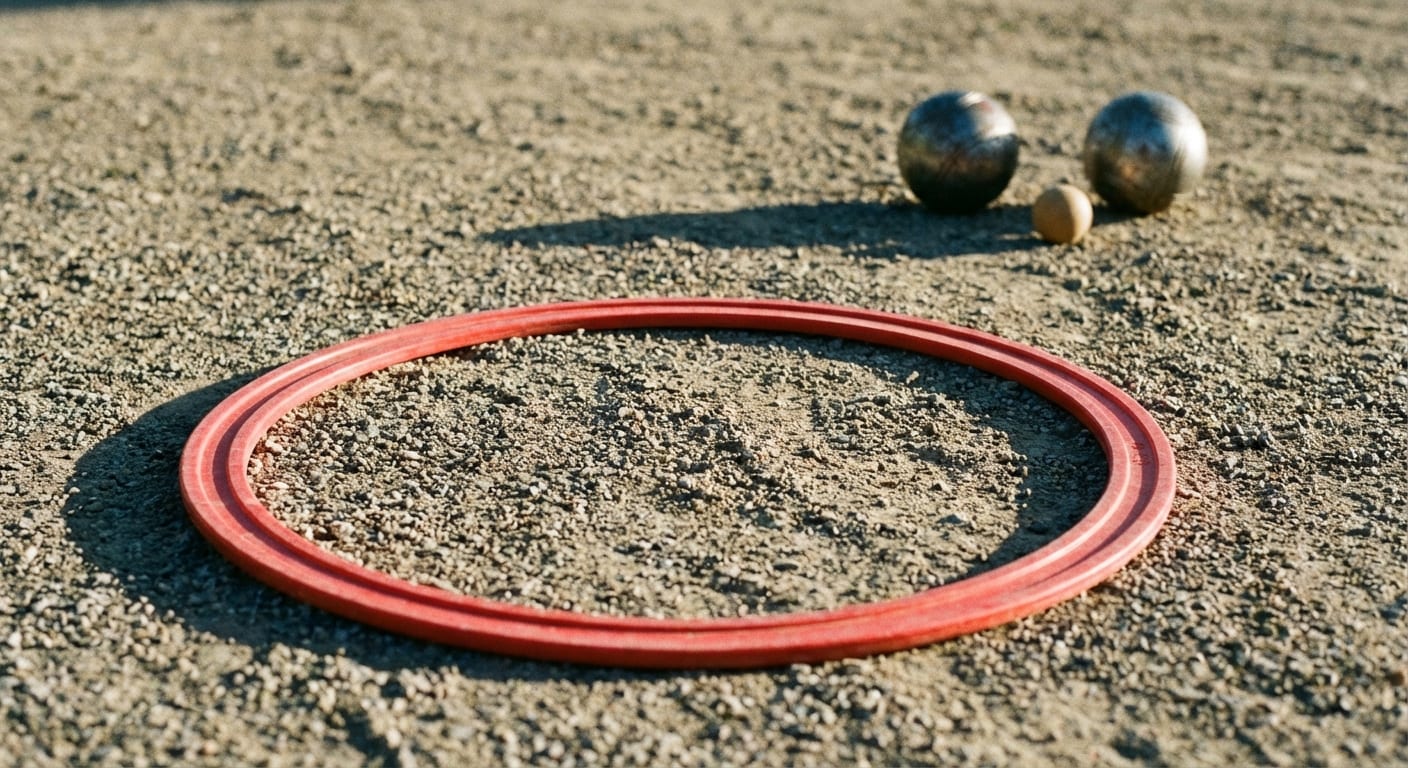
The rigid circle: The definitive end of the hand-drawn "circle"!
A rigid circle compulsory in pétanque: regulation diameter, placement, why it replaces the hand-drawn circle. Everything the FIPJP/FFPJP rules say — explained by Paquita.What is the rigid circle really for?
The throwing circle is often presented as a mere formality. In reality, it is one of the most structuring elements of the FIPJP rules — and the switch to the rigid circle meets concrete needs, not an administrative whim.
📏 Immutable diameterThe rigid circle is between 35 and 50 cm in inside diameter. Always. Unlike the hand-drawn circle, which tends to "strangely grow bigger" when a shooter needs a little more run-up...
🦵 Stance stabilityThe rigid edge is visible and indisputable. It requires each player to keep both feet entirely inside until the boule touches the ground — with no possible debate over "the line was blurry".
⚖️ Sporting fairnessAn identical circle for all the players in the same game ensures that no one benefits from a more advantageous throwing zone through gradual distortion of the marking.
🎯 Reference for umpiringA precise rigid edge is essential for modern umpiring — in particular for the use of high-precision laser marking in measuring disputed points.
📄 FIPJP principle — Throwing circle The official FIPJP rules provide that the circle may be drawn on the ground or materialised by a rigid circle. In competition, when the organiser makes regulation circles available, they must be used. This obligation aims to guarantee uniformity of playing conditions across all courts and all games. Source: Official FIPJP rules — Article on the throwing circleDrawn circle vs rigid circle: the honest comparison
No question of condemning the circle drawn on the ground indiscriminately — it remains permitted by the rules when no rigid circle is provided. But the comparison between the two is brutally in favour of the rigid one.
🦶 Hand-drawn circle- Diameter varies according to the hand, the ground, the fatigue
- Fades with repeated foot traffic
- Can be oval, approximate, or "interpreted"
- Hard to challenge precisely (blurry edge)
- Unintentional temptation to enlarge it as the ends go by
- Unusable as a reference for laser measurement
- Fixed and compliant inside diameter (35–50 cm)
- Withstands foot traffic and foot movement
- Perfectly round — no interpretation possible
- Visible and indisputable edge for the umpire
- Identical for all the players in the game
- Compatible with high-precision laser umpiring
The real question is not "drawn circle or rigid circle?" but "does the circle have a compliant diameter?". A circle drawn on the ground with care, within the standards (35 to 50 cm), remains regulation-valid where no rigid circle is imposed. The rigid circle, for its part, makes compliance automatic and non-debatable.
Regulation diameter: 35 to 50 cm
The FIPJP rules set a range of admissible diameters, not a single diameter. This is a point often poorly known among players, who sometimes imagine that "the circle is 50 cm and that's that".
| Circle type | Inside diameter | Permitted use | Status |
|---|---|---|---|
| FIPJP/FFPJP approved rigid circle | 35 to 50 cm | All official competitions | Compliant |
| Approved folding rigid circle | 35 to 50 cm (deployed) | Competitions if approved | Subject to conditions |
| Circle drawn on the ground (compliant) | 35 to 50 cm | With no rigid circle available | Tolerated |
| Circle under 35 cm | <35cm | None | Not compliant |
| Circle over 50 cm | > 50cm | None | Not compliant |
"The circle is 50 cm, full stop." — That's false. The FIPJP rules set a range of 35 to 50 cm of inside diameter. A 40 cm circle is perfectly compliant. What is not compliant is a circle outside this range — whether too small (impossible to place two feet side by side comfortably) or too large (an unjustified advantage for the throw).
🛒Approved rigid circles can be found in every pétanque equipment shop from a few euros. A minimal investment to avoid 100% of disputes over the circle's diameter. A pétanque bag is not complete without its circle.
Regulation placement in 3 rules
Having a compliant circle is good. Placing it in the right spot is essential. Here are the three placement rules every player should know.
1 More than one metre from any fixed obstacle Walls, benches, trees, posts, court edges, barriers... The circle must be placed at least one metre from any fixed obstacle that could hinder the throw or the player's stance. A circle pressed against a wall is systematically non-compliant. 📐 Minimum distance: 1 metre 2 More than two metres from another active circle In competitions with several adjacent courts or several simultaneous games, each circle must be at least two metres from the neighbouring circle. This distance protects players from interference between games and guarantees the independence of each game. 📐 Minimum distance: 2 metres between circles 3 On a flat and stable surface The circle must be placed on a surface that allows the player to stand upright without risk of losing balance. On a very steep or uneven court, if the circle cannot be placed stably, its position can be challenged. A circle that tips or is not flat is not compliant. ⚖️ Stability required 📍 The placement reflexBefore placing the circle at the start of an end: a quick glance right, left and behind to check the distances to the walls and neighbouring circles. In a tight competition or on a cramped court, it is best to call the umpire before the first boule if a placement looks contentious. A challenge after the fact is always harder to manage.
The feet-in-the-circle rule
That is the other side of the circle rule, often forgotten or poorly applied. Having a compliant rigid circle is not enough — you also have to respect the position of the feet inside.
- ✓Both feet entirely inside the circle — heel, sole and toes. A foot that encroaches on the edge, a heel that overhangs: it is a fault, even if unintentional.
- ✓No contact with the ground outside during the action — no tip of the foot placed outside the circle for balance during the throw, whatever technique is used.
- ✓Stay in the circle until the boule lands — the body's natural forward movement after a shot is the most common fault. The foot must not cross the edge before the boule touches the ground.
- ✗Don't step out "just after" the throw — "just after" does not mean "before impact". The rule is clear: after that the boule has touched the ground.
Leaving the circle early — when the player steps forward before their boule touches the ground — is the most common and least sanctioned fault in a friendly game. In an umpired competition, the umpire can invalidate the throw. In an un-umpired game, the opponent must signal it immediately, not after the boule comes to rest.
Practical scenarios at the boulodrome
🦶 A player draws a circle of "about 50 cm" with their foot With no rigid circle available and no control measurement, this circle remains theoretically accepted — but at the first challenge, it is impossible to prove it is compliant. In an official competition where the organiser provides rigid circles, this improvised marking is not acceptable. → Acceptable with no rigid circle available — challengeable in official competition 🧱 The circle is placed 60 cm from a wall — an opponent challenges it The challenge is well-founded. The minimum distance of one metre is not respected. Before the first boule of the end, the opponent may ask for the circle to be repositioned. After the first boule has been played, the challenge is more complex — call the umpire. → Non-compliant placement — to correct before the first boule ⭕ The organiser does not provide rigid circles The rules allow a circle drawn on the ground in this case — provided the regulation diameter (35 to 50 cm) is respected. The organiser should ideally provide them, but their absence does not invalidate the game if the drawn circles are compliant. → Drawn circle allowed — diameter to be respected 🏃 A player leaves the rigid circle before their boule lands The rigid edge makes the fault indisputable: the exit is visible. In an umpired game, the umpire can invalidate the throw. In an un-umpired game, the opponent must signal it immediately — before the boule comes to rest. → Fault — early exit from the circle ✅ Approved rigid circle, placed 1.2 m from the wall, feet respected Ideal and fully compliant situation. The circle is regulation, well positioned, and the player respects the three obligations: two whole feet in the circle, no outside contact during the action, waiting for impact before stepping out. → Compliant — no challenge possibleWhy the rigid circle is good news
The rigid circle requires a small investment — a few euros in the pétanque bag. In return, it settles the most frequent disputes linked to the throwing circle for good.
- 🎉End of the "your foot was over the line" debate — the rigid edge is visible to everyone. The fault is indisputable, or it is not.
- 🎉End of the circle that grows bigger between ends — the diameter is fixed, impossible to change between two throws.
- 🎉End of the "creative" oval circle — the rigid circle is perfectly round, by definition.
- 🎉Time saving — no need to redraw the circle after each turn. It is placed and picked up in two seconds.
- 🎉Compatible with modern umpiring — laser measurement, video umpiring, precise timing: the rigid circle is the foundation on which precision umpiring rests.
An approved rigid circle costs between 3 and 10 euros depending on the model. The folding versions are handy to slip into a bag. It is one of the best quality/social-peace ratios of all pétanque equipment. Paquita approves.
FAQ — Your frequent questions
Is the rigid circle obligatory in all games? + Not without nuance. In official competition where the organiser provides approved rigid circles, their use is mandatory. In a friendly game or in a competition which does not impose a rigid circle, the circle drawn on the ground remains authorized - provided that it respects the regulatory diameter (35 to 50 cm). Good practice is to always have your rigid circle in the bag to use it as soon as the game requires it. Is my “junk” folding circle compliant? + It depends. A folding circle is authorized by the FIPJP regulations if it is approved. In practice, the folding circles sold in specialized petanque equipment stores are generally compliant. On the other hand, a DIY circle, an unapproved flexible rod or a circle purchased in a garage sale without approval marking can be contested in an official competition. If in doubt, check the approval with the organizing committee. What happens if the rigid circle is accidentally moved during the round? + The circle must be returned to its original location. If witnesses observed the initial location (which is generally the case), the repositioning is done with the agreement of both teams. In case of disagreement, the arbitrator decides. This is an advantage of the rigid circle over the traced circle: a trace erased by the passage of feet is difficult to reconstruct precisely, whereas a displaced rigid circle can be reinstalled in its original location with more reliability. Can we play without a circle at all in a friendly game? + No, the FIPJP regulations require that the circle be materialized – whether by a rigid circle or by a circle drawn on the ground. Playing without a circle at all is not in compliance with the rules. In a "wild" game between friends without competitive stakes, no one is going to stop you - but as soon as there is a competition, even local, the materialization of the circle is obligatory. Is the rigid circle the same thing as the “Provençal game circle”? + No. In the Provençal game, the player takes momentum before throwing - the circle is therefore different in its dimensions and in its use. The FIPJP rules which apply to pétanque are not identical to those of the Provençal game on this point. The rigid circles approved for pétanque are not necessarily compliant for the Provençal game, and vice versa. This article focuses only on the pétanque. Can an opponent contest the circle after the first ball played? + In principle, disputes over the placement of the circle must be raised before before the first boule is played in the end. A late challenge — after several boules have been played — is harder to make stick and may be rejected by the umpire. It is for this reason that it is important to check the placement of the circle systematically at the start of the end, not after the fact. 📚 Official sources- 🔗 Official FIPJP rules — fipjp.com (article on the throwing circle)
- 🔗 Commented FFPJP rules — petanqueland.fr
© Pétanque by Paquita — petanqueland.fr
Content based on the official FIPJP rules. In case of doubt about the approval of your equipment, consult your regional FFPJP committee.