News · 20 July 2026
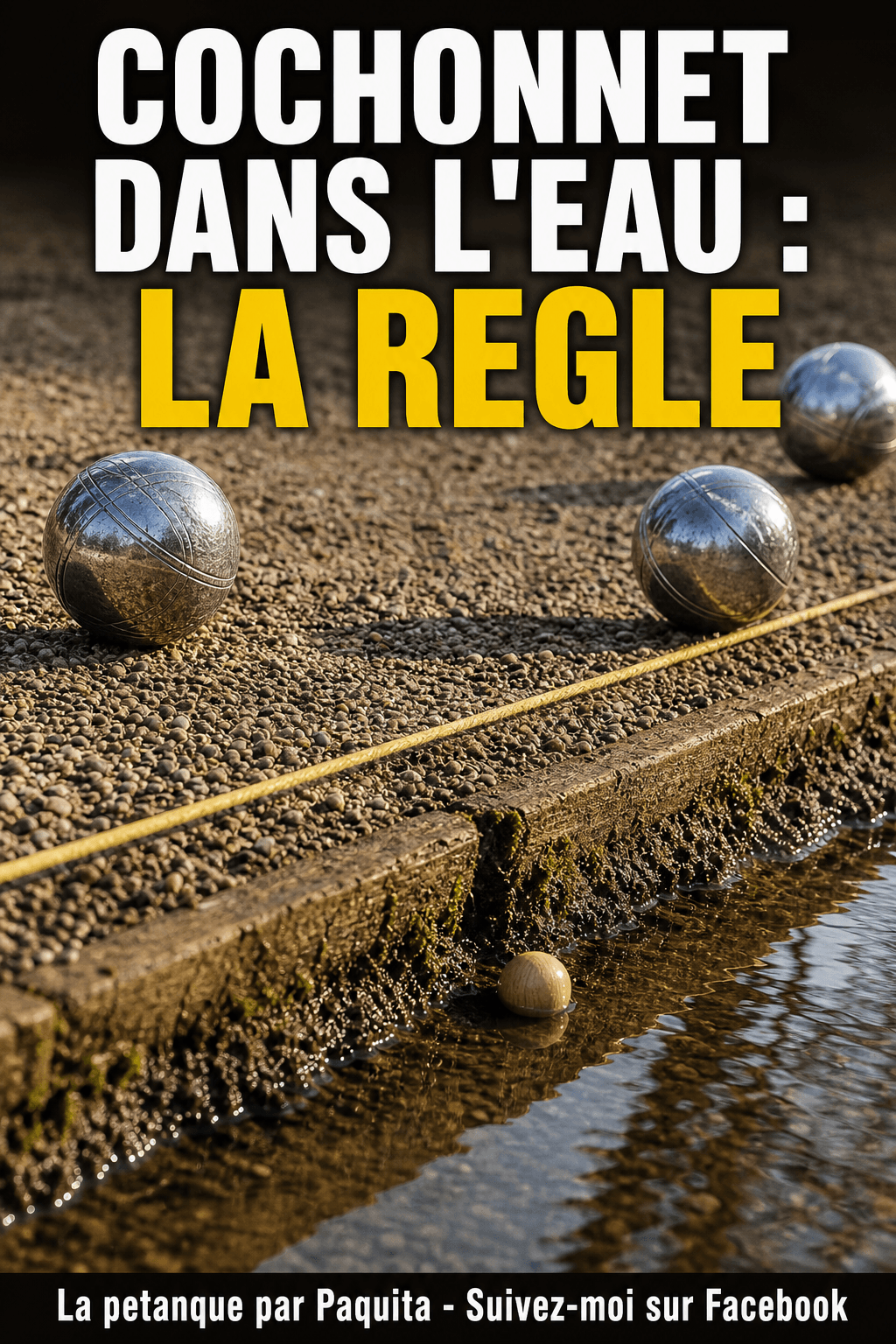
Pig falls into water or a pit: what official petanque rule?
NewsPiglet falls into the1.Why water and pits change everything
The regulations do not reason in terms of difficulty but of validity. A jack can be difficult to play and remain valid; it can also appear close to the game but be invalid because it has crossed a limit, is no longer visible or no longer allows normal practice. Water and pits pose these three questions at once.
On natural terrain, the limit is not always a white line. It can be a string, a border, a gutter, a separation between two games or an area declared prohibited before the game. This is why players must identify the limits before the start, not just at the time of dispute.
Key point: we don't decide according to what suits the lead. We decide according to the validity of the goal and the limits announced for the field.
2.When the jack becomes void
The goal becomes void if it leaves the authorized frame, if it becomes untraceable, if it is no longer visible from the circle under the conditions provided, or if it finds itself in a prohibited zone. A superficial puddle on the pitch is not always enough: if the goal is visible, accessible and within limits, the referee can maintain it.
On the other hand, a goal falling into a deep hole or beyond a loss line should not be treated as a simple obstacle. The lead then switches in the case of a draw during the lead, with different consequences depending on the balls remaining to be played.
3.Who scores the point if the goal is zero
This is the question that annoys. The answer depends on the balls still available. If only one team still has balls to play, it scores as many points as it has balls left. If both teams still have balls, or if no one has any more, the lead is zero and the goal is restarted in the planned order.
This logic surprises beginners, because it does not only look at balls already close to the goal. The rules protect the possibility of continuing the lead: if this possibility disappears for both camps, we do not create a fictitious score.
4.The role of goal marking
Marking the jack before important shots remains a fundamental reflex. If the goal is moved to a wet area and then returns, or if it is moved by an external element, the marking allows you to know whether it must be replaced or noted its new position. Without a mark, the discussion becomes more vague and the referee must decide with the visible elements.
Before playing near a boundary or a bunker, mark the goal and calmly announce the boundary. This small gesture saves ten minutes of palaver.
5.How to manage the dispute without making the game worse
The correct method is simple: we stop the game, no one touches the goal, we check the limit, then we apply the corresponding case. If the game is official and doubt persists, the referee decides. In competitions, continuing to play after an unresolved dispute complicates everything, because the following balls modify the situation.
The precision of the vocabulary also helps: say “is the goal zero? » rather than “shall we play again? ". The first question calls for a rule; the second calls for negotiation.
Decision made
Rushed decision
| Situation | Decision | Error to avoid |
|---|---|---|
| Goal visible in a puddle | May remain valid | Declare it void too quickly |
| Goal out of bounds | Jack dead | Replace it for judge |
| A team has boules | Possible points | Automatic replay |
Water, wind, heavy terrain, tricky edges: this guide helps you adapt your choices when the terrain is not don't forgive.
Discover