News · 10 July 2026
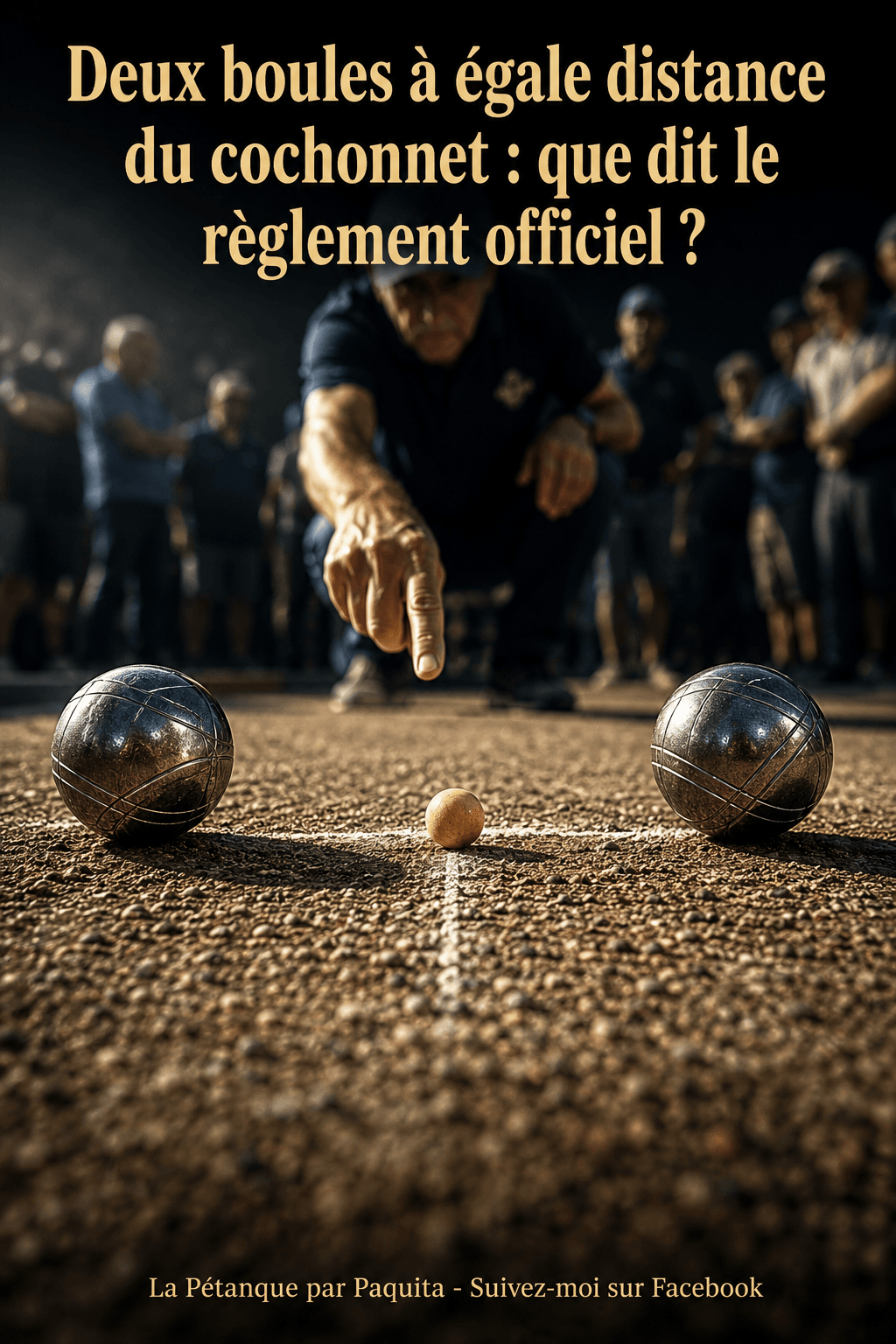
Two boules equidistant from the jack: what do the official rules say?
NewsTwo boules at exactly the same distance from the jack: a rare but real case that sometimes holds up a game. Here is exactly what the FFPJP rulebook provides to decide.1.The principle: the measurement always prevails over perception
Before even talking about a tie, we must recall the basics: in pétanque, only a reliable and contested measurement can objectively determine which boule is closest to the jack. Visual perception, even shared by several spectators, never replaces a measuring instrument when the gap is tiny.
An essential point: a strict tie is only declared after a effective measurement accepted by both teams (or validated by the referee in competitions). We never speak of a tie “by eye”.
2.What the rules provide for in case of a strict tie
When the measurement confirms a strictly identical distance between the two boules and the jack, the FFPJP rulebook provides thatno point is awarded for these two boules at this stage. The logic is crystal clear: if nobody is objectively ahead, nobody can score on this specific comparison.
3.What happens if boules remain to be played?
If one of the two teams still has boules in hand, it is up to them to play again first, exactly as if they did not yet have the point (since, mathematically, they do not). This rule logically drives the game forward: instead of being stuck on a tie, you move it along by playing the next boule.
If both teams still have boules, the one that would normally have had to play if they did not have the point continues — in plain terms, the team that no longer has the advantage plays again.
A strict tie is never inevitable: it is an invitation to play again intelligently. The best reaction is often a careful boule placed near the jack rather than a risky shot — the goal is to break the tie safely, not to bet everything on a spectacular play.
4.And what if the tie persists until the end of the mène?
An extremely rare but anticipated case: if, after all the boules of both teams have been played, the strict tie remains between the two best boules, the mène earns no point for anyone. A new mène is simply started again, the jack thrown from the same circle as the previous mène.
5.The right tools to measure without dispute
To prevent doubt from setting in, it is better to measure with a suitable instrument (rigid tape measure or approved measuring calipers) than with an approximate string or a boule-based estimate. A clean measurement, taken calmly and accepted by both teams, avoids almost all disputed tie situations. Our free tools and our page little-known rules detail the best measuring practices.
6.Actual frequency of this case: the gap in figures
A strict tie remains a rare case, but statistically it occurs more often than you might think in large competitions, where the volume of mènes played is very high:
| Situation | What the rules say | Frequent mistake |
|---|---|---|
| Strict tie confirmed | No point awarded | Point awarded on “perception” |
| Boules remaining in play | The team without the advantage plays again | Confusion over who should play |
| Tie at the end of the mène | Dead end, we re-throw | Arbitrary point awarded to one side |
7.The reflex to adopt when facing this rare case
If a strict tie is observed, no panic: nobody loses a point, and play continues normally according to the logical order (the team without the advantage plays again). In official competitions, if doubt persists despite the measurement, the referee remains the only one authorized to confirm the tie and indicate what to do next.
Placing an accurate boule, handling tight situations and ties: this complete guide works on pointing precision to turn these uncertain moments into a clear advantage.
📗 Discover the book