Actualités · 27 June 2026
Why some boules seem drawn to the jack in pétanque
The expert pointer's "magnetic" boule: real phenomenon or illusion? We break down the mechanics of that magical moment when the boule finds the jack as if naturally.1.The physics behind the magnetic boule
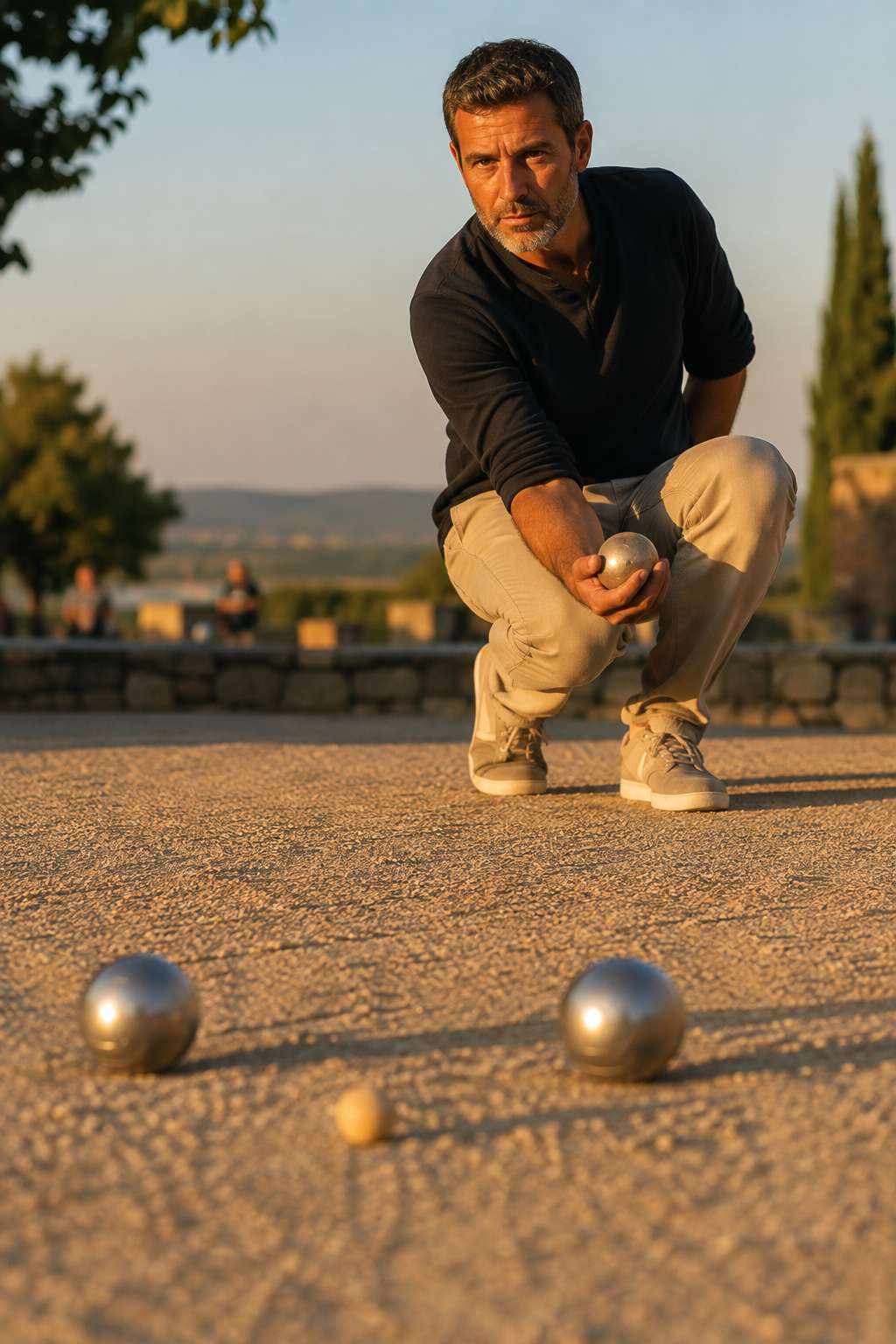
There is no magnetic attraction between a steel boule and a wooden jack. But there is something even more interesting: the physics of guided rolling. On slightly sloping, slightly convex ground, or with micro-irregularities, a boule thrown with the right speed and the right angle will tend to follow a natural path toward the low areas — and the jack, often placed in a slight depression or stabilized against a pebble, is in those areas.
The expert pointer has memorized these dynamics. They don't see flat ground — they see energy lines, zones of natural attraction. Their boule “finds” the jack because they chose the trajectory that uses the terrain's physics to their advantage. It's applied physics, not magic.
⚙️A pointer who plays rolling often uses the ground's micro-depressions as natural guides. Their boule isn't “attracted” to the jack — it follows a path the terrain opens for it, and that the player read before throwing.
2.Muscle memory: the real engine
Muscle memory is the nervous system's ability to reproduce a complex gesture without conscious intervention. For an experienced pointer, evaluating the distance, calibrating the force, choosing the throwing angle and dosing the rotation happens in a fraction of a second — because this system has been trained thousands of times on similar distances and situations.
That's what gives the impression that “it can't miss”. The player doesn't seem to aim: they throw, and it goes in. That's because the aiming and calibration phase is so integrated that it's invisible. It took place before the hand even started to rise.
This memory takes time to build — it's estimated that between 5,000 and 15,000 repetitions on varied situations are needed for a technical gesture to be deeply automated. But once installed, it's remarkably stable, even under pressure.
3.The role of the mental and concentration
The magnetic boule phenomenon is often associated with what sports psychologists call theflow state : an optimal level of concentration where the player is totally absorbed by the gesture, with no distraction, no doubt, no apparent conscious effort.
In this state, the eye and the hand synchronize perfectly. The eye fixes on the jack with precision — not vaguely “toward the jack”, but an exact point on the jack. The hand responds to this signal with all the memorized precision. The result: boules that seem guided.
Outside of flow — when doubt sets in, when score pressure disrupts concentration — the synchronization degrades. The hand receives an imprecise signal, muscle memory can't compensate, and the boules that “all went in” start to miss. It's not a loss of talent: it's a loss of concentration.
🎯 Paquita's tipTo approach the state where your boules “attract” the jack: choose a precise point on the jack as a target — not the jack in general. Your hand calibrates on what your eye gives it. The more precise the target, the more precise the muscular response.
4.Reading the ground so physics works for you
The third component, often underestimated, is reading the terrain. A pointer who chooses a trajectory that follows the ground's natural slope makes physics work for them. Their boule arrives in the jack's zone having naturally compensated for the irregularities, because the trajectory itself integrated them.
It's the opposite of the player who forces a straight trajectory on ground that isn't straight: their boules arrive fast, with too much energy, and bounce. The expert pointer arrives with just the right amount of energy, on the most favorable trajectory, at the moment when the terrain offers the best conditions to finish close to the jack.
5.Comparison: the factors that create the magnetic effect
To understand each factor's contribution to this phenomenon, here is a visualization of their respective weight in a pointer who “regularly finds the jack”.
Contribution of factors to pointing precision (out of 5 boules) Muscle memory + ground reading dominant factors — long-term work Luck / terrain factor residual randomness — reduced by reading Technique quality by criterion — expert level out of 10 Visual target precision · 9/10 Focus on a precise point of the cochonnet, not on the area. Technique automation · 8/10 Thousands of repetitions — the technique requires no more conscious effort. Terrain reading · 7/10 The chosen trajectory uses the natural slopes to its advantage.6.How to reproduce this state more often
This magnetic boule effect isn't reserved for champions. It's accessible to any player who works on the right areas.
Repeating long series to the same point
Automation comes from repetition. Playing 20 consecutive boules toward the same jack, while slightly varying the conditions (distance, angle, type of ground), solidifies muscle memory more effectively than playing 20 boules toward 10 different targets.
Working on visual fixation
Before each throw, practice identifying a very precise point on the jack. Not “the jack”, but “the left edge of the jack”. This visual discipline improves the gesture's automatic calibration.
Playing on varied terrain
Ground reading develops by playing on many different terrains. Each terrain teaches new rolling patterns, enriching the pointer's mental library. To go deeper into pointing technique, discover our free tools and the lesser-known rules.
📗 Paquita's book The Ultimate Guide to Pointing in PétanqueEverything you need to know to develop a precise, consistent point adapted to all terrains. The mechanics of the gesture, ground reading, the exercises that automate precision.
📗 Discover the book