Actualités · 23 June 2026
Why some pétanque teams seem unbeatable
Communication, complementarity, team rituals and handling rough patches: why some pétanque teams seem unbeatable and how to build the same cohesion.1.The myth of the 'gifted' team
We tend to explain a good team's consistency by individual talent: 'they're better'. That's rarely the only reason. If you watch over several tournaments, you often notice that the triplettes that last are not the ones lining up the three best players in the club, but the ones with the best collective momentum. Talent sets the ceiling; cohesion determines the level you actually reach.
🔗A solid team has an observable quality: under setbacks, its level doesn't collapse. A fragile team can be brilliant for thirty minutes and then disappear completely after losing an end. The collective resilience is the hallmark of the triplettes people call 'unbeatable'.
2.Pillar 1 — Brief and precise communication
Good teams talk little, but they talk right. The calls are short ('in front at six', 'shoot the 2'), neutral, without judgment. Conversely, in fragile teams you hear long, ambiguous sentences, or worse, blame after misses ('you should have done the other one'). This precise communication reduces the mental load on the player about to throw: they know exactly what's expected of them, and they have all the room to execute.
3.Pillar 2 — Clear and accepted roles
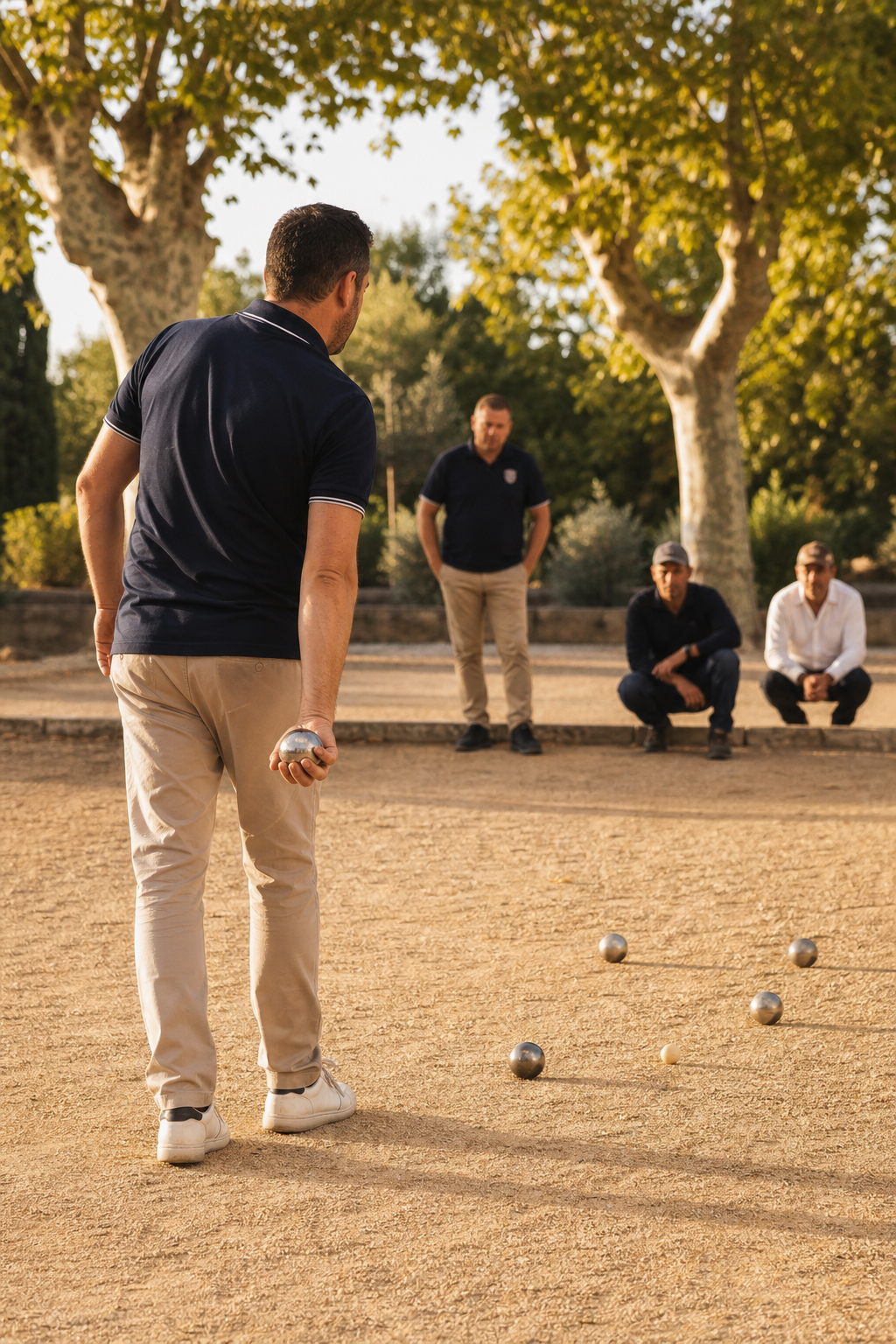
In a triplette that works, everyone knows exactly what they have to do and accepts that role. The pointer points, the shooter shoots, the middle does both depending on the end. No overlap, no silent frustration, no hidden desire to hold another position. This clarity avoids the implicit conflicts that drag down a large share of Sunday teams. It is built before the tournament, not during it.
🤝 Paquita's tipBefore a tournament, take five minutes as a team to settle three things: who points when, who shoots first, who decides in case of disagreement. These three rules, mentally written down, defuse 80% of the internal tensions of a playing day.
4.Pillar 3 — Shared management of setbacks
This is arguably the most differentiating pillar. When an end turns bad — a bowl in front of the opponent, a series of misses, a point narrowly missed — the fragile team cracks: blame, heavy silences, a player who 'switches off'. The solid team, on the other hand, shares it, verbalizes it briefly ('ok, we go again'), and moves on to the next end without rancor. This ability to collectively digest shocks is what makes people say of champions that they're 'always in the game'.
5.Pillar 4 — Team rituals between ends
The most consistent triplettes almost all have collective micro-rituals: a gesture, a phrase, a quick check between two ends. It's not just for show: these rituals create a common anchor point that resynchronizes the three players, especially after a lost end. They symbolically mark the end of one play and the start of the next, which helps not to drag negative emotions from one end to another.
6.Relative impact of each pillar
Let's visualize the estimated weight of each one on a team's consistency over a tournament:
Estimated importance of each pillar on collective performance Tightly-knit team managing setbacks › communication › roles › rituals Fragile team blame › vagueness › frustrations › isolation| Situation | Tightly-knit team | Fragile team |
|---|---|---|
| End lost 6-0 | 'We go again' | Silence, blame |
| Difficult shot choice | Quick, clear decision | Hesitates, contradicts themselves |
| After a miss by the middle | Neutral support | 'You should have…' |
| Between two ends | Mini-ritual | Each in their own corner |
7.How to build the same cohesion
Cohesion doesn't fall from the sky; it's trained like technique. Four concrete actions to put in place over your next training sessions.
1. Define and respect the roles
Everyone knows their base position and accepts it. The discussion happens calmly, not during a tournament.
2. Adopt a common playing language
A few short ('in front', 'shoot', 'play safe') and neutral phrases, shared by the three players. No long sentences, no judgment.
3. Agree on an 'after a miss' rule
Agree explicitly never to blame a miss in the moment, and save the analysis for after the game. This simple rule changes the mood of a whole day.
4. Set up a collective ritual
A gesture, a phrase, to do together after every end. It may seem anecdotal, but it's actually a powerful refocusing tool. To structure your approach, see our free tools and the page little-known rules.
📘 PAQUITA'S BOOK Winning under pressure in pétanqueThis guide devotes a whole chapter to team dynamics: how to build cohesion that holds under pressure, how to react to disastrous ends, how to handle level gaps within the triplette. Methods, key words, concrete examples.
📗 Discover the bookFAQ — Your frequent questions
Can we have a good team with three players of different levels?+ Yes, provided that the roles correspond to the level: the most consistent player at the point, the most precise in shooting, the versatile in the middle. It is the role/level mismatch that destroys, not the difference in level in itself. What to do when a teammate openly criticizes a failure?+ Do not respond at the time, finish the game, then approach the subject cold: “we told ourselves that we weren't blaming ourselves for anything at the time, we'll save the analysis for later”. If the behavior is repeated, it is because there is no explicit team rule to set. Does a triplet always have to play together to perform well?+ Collective regularity requires playing time together. A stable triplet has a clear advantage: she knows herself, she has her own language, her rituals, her management of shocks. A second-hand triple can play well, but it will plateau more quickly under pressure. Is there a need for a “leader” in a pétanque team?+ Ideally, yes — not an authoritarian leader, but someone who decides when disagreements arise and who speaks up after a difficult time. The role can rotate depending on the phase of play, but someone must assume this function otherwise the team floats at key moments. How long does it take for a team to become truly united?+ A few months of regular practice with joint competitions. The first bases (roles, language) are quickly established. Managing hard knocks and real rituals are built over time, through shared experience — especially well-digested defeats. 📎 Related articles GameThe lesser-known rules of pétanque ToolsFree PetanqueLand tools HomePétanque by Paquita© Pétanque by Paquita — petanqueland.fr ·
📘 Discover my books on PetanqueLand
Educational article based on observing team play. Cohesion is built over time and through regular practice.