News · 20 February 2026
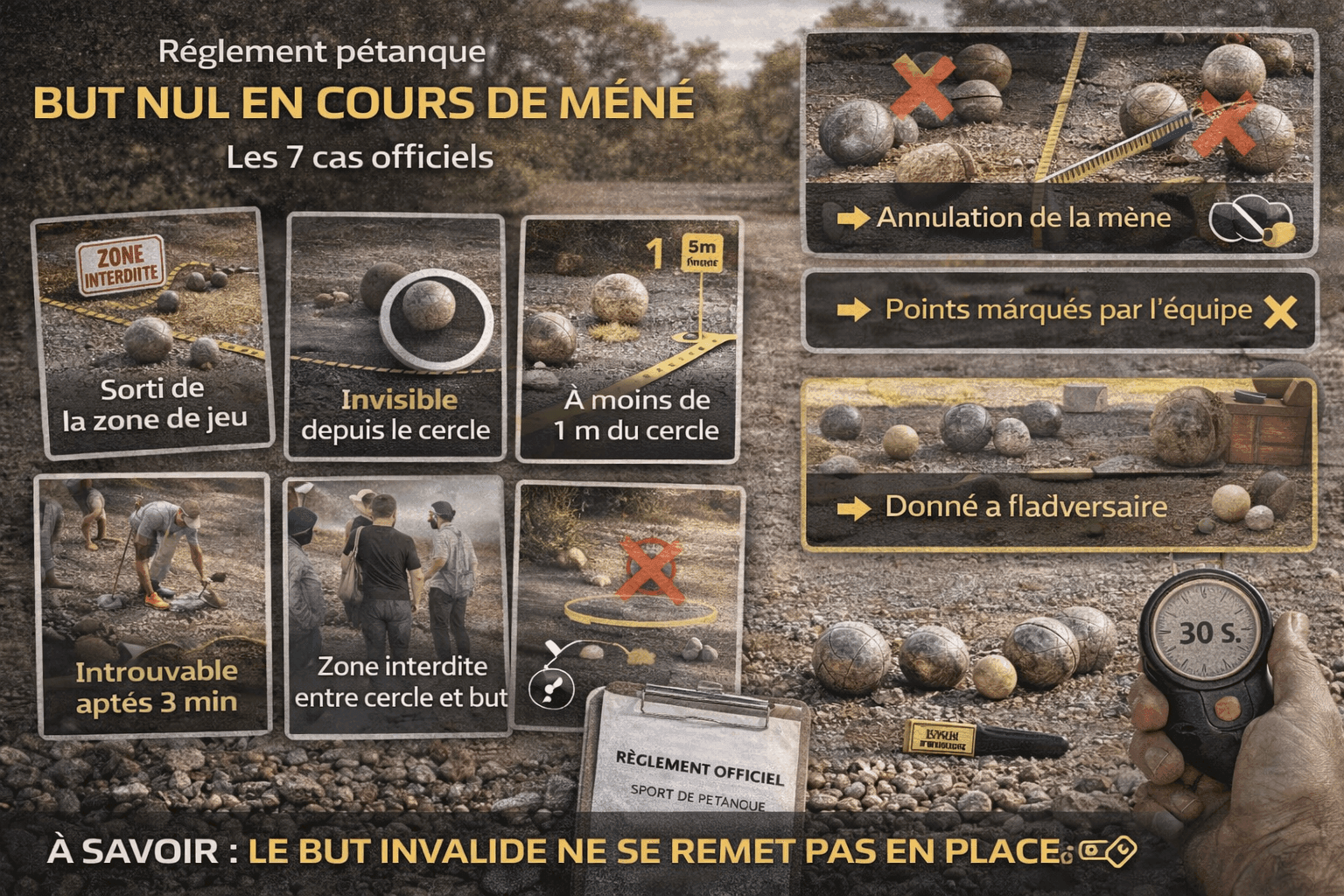
Pétanque rules: a dead jack during an end (the 7 official cases)
NewsWhen does the jack become dead during an end? The 7 official cases of the FIPJP rules explained clearly: jack out, untraceable, not visible, in a forbidden area and more.Why this rule is central
The jack isn't a decorative detail — it's the absolute reference for the whole end. Every measurement, every point, a team's entire strategy is built around its position. When it becomes dead, the whole end turns on its head.
- 🎯The end can be cancelled — in some cases, no one scores and it's replayed.
- 🏆Points can be awarded — in other cases, the team that still had bowls to play scores automatically.
- 🔄Play resumes according to a defined procedure — not according to the random agreement of the players present.
- ⚖️It's not a house rule — improvising a "logical" solution in case of doubt is the number one source of post-end conflicts.
Continuing to play after a potentially dead jack. If the situation isn't settled immediately, it becomes very difficult to contest the score afterwards — even if the rule was in your favour. Stop, check, then replay.
The 7 official cases of a dead jack
The FIPJP rules exhaustively list the situations in which the jack is declared dead during an end. These cases are exhaustive : outside these 7 situations, the jack remains valid even if it has moved.
1 🚧 Jack out of the terrain or in a forbidden terrainThe jack has been moved into an area outside the defined playing limits — terrain boundary, fixed obstacle, off-terrain area. It is immediately declared dead.
🔴 Common case 2 👁️ Jack not visible from the circleThe jack must be visible from the throwing circle by the player about to play. If a bowl or an obstacle completely masks it, the rules regulate this situation precisely. Note: a partially masked jack is not automatically dead — this is the case that causes the most confusion on terrains.
🔴 Very common case — source of conflicts 3 📏 Jack outside the regulated distancesFollowing an impact, the jack ended up at a distance from the circle of less than 6 metres or more than 10 metres (official FIPJP distances). The distance no longer being compliant, the jack is dead. See our article on the regulated playing distances.
🟡 Moderately common case 4 🔍 Jack not found after the search timeOn a difficult terrain, the jack can disappear after a violent impact. The rules provide for a search time. If the jack is not found within this time, it is declared dead. This case is more common than you'd think on grassy or very stony terrains.
🟡 Case specific to difficult terrains 5 🤚 Jack moved by a player, an animal or a third partyIf the jack is accidentally moved by a player, a spectator, an animal or any external element, the rules distinguish several situations depending on whether the movement is attributable to a team or not. In some of these cases, the jack is declared dead.
🟡 Situational case 6 💧 Jack carried away by water or an unforeseen obstacleOn an outdoor terrain, a puddle of water, a strong air current or an unforeseen obstacle can move the jack uncontrollably. If this movement takes it out of the valid area or makes it non-compliant, it is dead.
🔵 Rare but real case 7 ⭕ Jack in the throwing circle areaIf the jack, after being moved, ends up inside or too close to the throwing circle, its position no longer allows regular play. The rules provide that this situation results in the jack being dead.
🔵 Rare case 💡 Paquita's tipThese 7 cases are the only ones that matter. If a player invokes a different reason to declare the jack dead, it's a house rule — not the official rules. In case of serious doubt, the umpire is the only legitimate authority to settle it. Our page umpiring videos illustrates several of these situations with concrete examples.
Live jack or dead jack: the decision flowchart
The most common confusion comes from a wrong reflex: believing that a jack that has moved is automatically dead. That's not the case. The jack can move, be touched, even move considerably far away — and remain perfectly valid if none of the 7 cases applies.
🚫 DEAD jack — official cases- Out of the terrain or in a forbidden zone
- Completely invisible from the circle (under the specified conditions)
- Outside the regulated distances (less than 6 m or more than 10 m)
- Not found after the official search time
- Moved by a third party under certain conditions
- Carried away by an unforeseen obstacle outside the valid area
- In the throwing circle area
- Moved by a bowl within the valid area
- Partially masked by a bowl
- In a difficult but accessible position
- Touched but still visible from the circle
- Far from the starting point but within the distances
- In a hollow or on a natural relief
- Wedged against a bowl or a natural obstacle
What happens when the jack is dead?
The consequence of a dead jack isn't always a cancelled end. It depends on the number of bowls remaining in each team at the moment the jack becomes dead.
| Situation at the moment of the dead jack | Official consequence | Who scores? |
|---|---|---|
| Both teams still have bowls to play | Dead end | Nobody — the end is replayed |
| Only one team still has bowls to play | Points awarded | The team that still had bowls scores as many points as it had bowls remaining |
| Neither team has any bowls remaining | Dead end | Nobody — the end is replayed |
| Dead jack following a player's fault | Umpire's decision | The umpire applies the sanctions provided for depending on the context |
The most common mistake is to systematically cancel the end without checking whether there are still bowls to play. If a team still had 2 bowls in hand at the moment the jack becomes dead, it scores 2 points — a dead end is not the right answer in this case.
The official 3-step procedure
As soon as doubt arises about the validity of the jack, there's only one course of action:
1 Stop play immediately Don't play any additional bowl until the situation is settled. Any bowl played after a potentially dead jack that hasn't been recorded makes the dispute harder. 2 Check the position and visibility of the jack Check whether the jack falls into one of the 7 official cases. In an umpired competition: call the umpire immediately. In an unumpired game: agree between players on the basis of the rules, not a "house rule". 3 Apply the official consequence before replaying Depending on the number of bowls remaining: dead end or awarding of points. Count the bowls remaining in each team before before deciding. Then resume play normally. 📋This procedure also applies to the hidden jack or masked jack — a special case that's worth knowing about separately, as partial visibility isn't enough to declare the jack dead.
Common mistakes on the terrain
- ✗Continuing to play when the jack is clearly out or unfound — the score becomes disputed and hard to correct afterwards.
- ✗Systematically cancelling the end when points should be awarded — it's penalising for the team that still had bowls.
- ✗Forgetting to count the remaining bowls before deciding on the consequence — yet it's the key criterion that determines everything.
- ✗Confusing a masked jack with a dead jack — a jack partially hidden by a bowl remains valid in the vast majority of cases.
- ✗Inventing an 8th case — "it's dead because it moved too much", "it's too far away now"... These justifications don't exist in the official rules.
- ✗Waiting until after the end to dispute — a dead jack not reported during the end will be very hard to uphold once the points have been counted.
The jack throw at the start of an end follows its own validity rules — distinct from the cases of nullity during an end. A jack invalidated from the outset (non-compliant throw, incorrect distance) is a different case from these 7 situations. The two articles complement each other.
FAQ — Your frequent questions
Is a goal partially obscured by a ball automatically void? + No. This is one of the most common confusions. A partially obscured goal is not void within the meaning of the FIPJP regulations. Case 2 specifically concerns the goal completely invisible jack under the conditions provided for by the article in question. A jack that can be glimpsed even partially from the circle generally remains valid. In case of doubt, see the dedicated article on the hidden jack. How long do we have to search for a pig that cannot be found? + The FIPJP regulations provide for a search period, but its exact duration is not universally quantified — it depends on the discretion of the referee or, in the absence of a referee, a reasonable agreement between the players. In refereed competitions, call the referee as soon as the goal cannot be found: it is he who decides the time limit and officially declares the nullity if necessary. Who decides that a goal is void in the absence of a referee? + In a game without a referee, both teams must agree on the basis of the official rules. If the disagreement persists, during a competition, you must request the intervention of an arbiter or a competition manager. In a friendly game, it is better to replay the game rather than let the conflict fester — but agreeing on the right rule remains the objective. If an opposing ball sent the goal out of bounds, is the opponent penalized? + No, not automatically. Knocking the goal out of bounds with a ball is not a foul in itself — it is simply a case of a void goal (case 1). The consequence is the nullity of the goal according to the usual rules (drawn lead or allocation of points according to the remaining balls). Only a deliberate foul or unsportsmanlike behavior could result in an additional disciplinary sanction from the referee. Can the goal become void after the end of the end? + No. The nullity of the goal is appreciated during leads it, at the moment when the situation occurs. Once all balls have been played and points have been counted and accepted, the round is closed. It is no longer possible to retrospectively challenge the validity of the goal to call into question the score. Does this rule apply to doubles as well as triplets? + Yes, the 7 cases of a draw apply identically in head-to-head, doubles and triplets. Only the number of balls remaining to be counted to determine the consequences changes depending on the format (6 balls per team in triplet, 7 in doublet, 3 in heads-up). 📚 Official sources- 🔗 Official FIPJP Rules — fipjp.com
- 🔗 Official FFPJP Rules — full commented version on petanqueland.fr
© Pétanque by Paquita — petanqueland.fr
Content based on the official FIPJP rules. In case of doubt, always consult the official version in force.