Règlement FFPJP · 20 February 2026
Pétanque rules: how long do you have to play? (the one-minute rule)
The one-minute rule in pétanque: when does the timer start, who monitors it, what are the penalties? EverythingThe minute rule: general principle
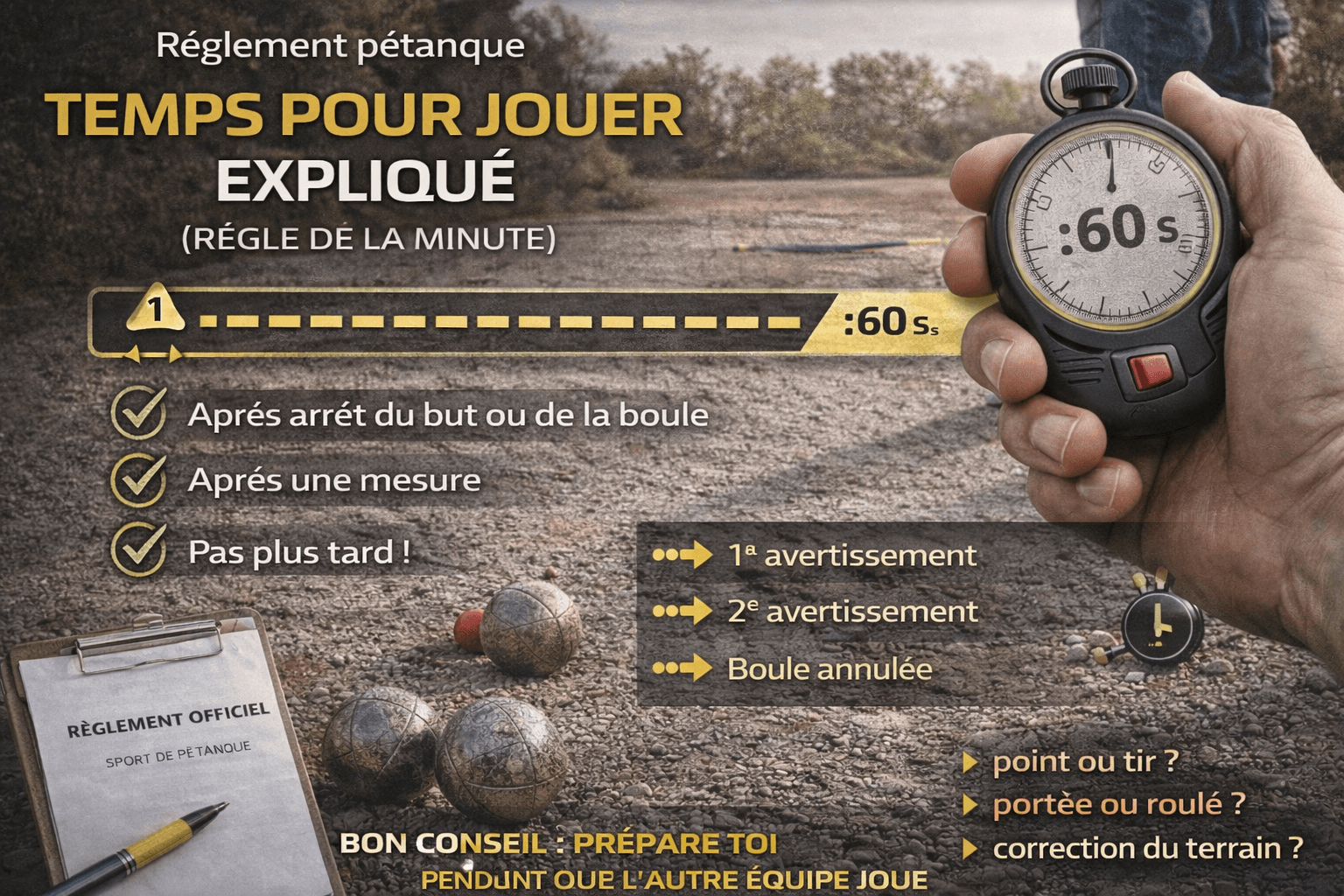
The official FIPJP rules set a maximum time of one minute to play a boule or throw the jack. This rule keeps a proper pace of play and avoids excessive dead time that penalizes the whole organization of a tournament.
60 seconds Regulation time to play FIPJP — Official pétanque rules 📄 FIPJP regulatory principle Every player has one minute to play their boule from the moment the team whose turn it is to play is designated and the terrain is free. The umpire may grant additional time in certain exceptional circumstances, but this case remains rare in tournaments. Source: Official FIPJP Rules — Article on playing timeWhen does the timer start?
That's often where disputes arise: "The timer hasn't started!" — "Yes it has, it's been a while already...". The rules are precise on this point. The one-minute time limit starts in three distinct situations :
🎯 Situation 1 — After the jack comes to rest As soon as the jack comes to rest after being thrown, the timer starts for the first player who has to point. Not when they stand up, not when they pick up their boules — when the jack stops. 🎳 Situation 2 — After the previous boule comes to rest As soon as the boule that was just played comes to rest, the timer restarts for the next player. It doesn't wait for the players to confer, for the opponents to comment on the shot, or for the umpire to confirm who plays. 📏 Situation 3 — After a measure Once the measure is finished and the verdict given, the timer restarts immediately. Many players consider that measuring offers a "natural break" — that's wrong. The minute resumes as soon as the measuring tape is put away. ⛔ The most common mistakeThinking that the timer starts when you decide to play. No: it starts when the terrain is free and it's your turn. Standing up slowly, observing at length, discussing with your teammate — all of that counts within the minute.
Practical scenarios — when the timer really starts
To ground the rule in the reality of the terrain, here are the most common situations encountered in tournaments:
✅ You play within 45 seconds after the opponent's boule comes to rest You take the time to analyze the terrain, you position yourself, you play within the time. No problem. Compliant ⏳ You wait for your partner to come and advise you before playing If this exchange takes more than a minute since the previous boule came to rest, the timer doesn't wait for you. The umpire can warn you even if the discussion seemed "normal". Risky if it drags on 📏 The measure has just finished — you take 90 seconds to play Classic mistake: many players think the measure resets the clock. The time limit restarts as soon as the measure is over — one minute, no more. Out of time 🚨 You dispute the previous point for 2 minutes before playing The dispute doesn't suspend the timer. If the umpire has ruled and it's your turn to play, the minute has already started during the discussion. Probable infraction ☀️ You play a friendly game between friends without an umpire Outside of official tournaments, the time rule is not formally applied. But getting into the habit of playing quickly remains good training for competition. Not applied in friendliesWhy does this rule exist?
The minute rule isn't there to stress players — it serves specific goals that any competitor understands as soon as they've waited 3 hours in a poorly managed tournament:
- ⏱️Keeping a regular pace of play — a pétanque game should flow smoothly, without endless waits between each boule.
- ⚖️Ensuring fairness between teams — without a time limit, a nervous player could deliberately slow down to put the opponent off.
- 📅Keeping tournaments on schedule — in competition, terrains rotate and games follow one another. A round with no time management can derail a whole day.
- 🎯Forcing decision and concentration — knowing you have 60 seconds forces you to analyze the terrain while the opponent plays, not after.
- 🤝Reducing tensions — paradoxically, a clear rule on time prevents more disputes than it creates. Without a rule, every wait becomes subjective and conflictual.
Penalties for exceeding the time
The rules provide for progressive disciplinary penalties. In an umpired tournament, it's always the umpire who applies these penalties according to the context and the repetition of the fouls.
| Infraction | Context | Prescribed sanction | Who decides |
|---|---|---|---|
| 1st time the minute is exceeded | Official umpired tournament | Verbal warning | Referee |
| Repeat offence in the same game | Official umpired tournament | Yellow card / official warning | Referee |
| Deliberate refusal to play | Official umpired tournament | Boule lost or point awarded to the opponent | Referee |
| Repeated behavior, systematic delay | National competition | Possible disqualification | Jury / Central umpire |
| Friendly game without umpire | Leisure | No formal penalty | Agreement between players |
If you feel your opponent is deliberately abusing the time, don't start commenting out loud — it ruins the atmosphere without solving the problem. Calmly address the umpire. That's exactly what they're there for. Our feature on the umpire's role explains how to request an intervention.
Common mistakes and good habits
✗ What many players do- Thinking the minute starts when you stand up to play
- Believing that measuring suspends the timer
- Waiting for the opponent to finish commenting before playing
- Discussing tactics with your partner for the whole minute
- Confusing the rules of a friendly game and an official tournament
- Preparing your boules and markers once in the circle
- Analyzing the terrain while the opponent plays their boule
- Deciding point or shoot before before it's your turn
- Preparing your position and markers while walking toward the circle
- Entering the circle ready to play, not still thinking
- Asking the umpire if in doubt about when the timer starts
- Practicing in friendlies to respect the time limit, even without penalties
Practical tips for respecting the time
Time management in pétanque is first and foremost a matter ofhabit and mental preparation. Here are the principles used by top-level players to play fast and well:
- 🎯Decide while the other player plays. The question "Point or shoot?" must be settled before it's even your turn. When you enter the circle, the decision is already made.
- 🪨Read the terrain as you walk. The 5 seconds of walking toward the circle are used to analyze the irregularities of the ground, the placement of the boules, the shooting angles.
- 🤫Keep the discussion to the essentials. A sign with your partner (coded gesture, look) is worth more than a 30-second out-loud discussion in front of everyone.
- 🔄Practice playing fast in friendlies. If you impose the minute rule on yourself even in a relaxed game, it becomes natural in tournaments — and your concentration improves as a result.
- 🧘Breathing before the boule. A short breath in as you enter the circle refocuses your attention and avoids wasting seconds finding your feel once in position.
This rule is linked to other aspects of the rules that every player must master: the validity of the throwing circle, the conditions for validity of the jack throw, and what happens in case of a dead jack during an end.
FAQ — Your frequent questions
Does the one-minute rule also apply to the goal throw? + Yes. The player who must kick the goal also has one minute from the moment it is his team's turn to place it. The clock starts once the opposing team has played its last ball and the court is free to restart it. The conditions of validity of the jack throw are detailed in our dedicated article. Who watches in practice during a competition? + In non-refereeed competitions (the majority of open Sunday competitions), it is up to the players themselves to self-regulate — and it is up to the opponent to report if a delay seems excessive. In refereed competition, it is theterrain umpire who monitors and decides. Major national competitions have central referees who can be called upon. Can we request additional observation time before playing? + No, the FIPJP regulations do not provide for "time out" on request to observe the field. The minute encompasses everything: observation, consultation, positioning, shooting. In very exceptional circumstances (damaged pitch, external object, incident), the referee can suspend the clock - but this is not an option granted to the player at his request. Does the timer apply if the validity of the previous ball is contested? + If the referee intervened to rule on a dispute, the clock starts again as soon as his decision is rendered. If no referee is present and the discussion drags on, the principle remains the same: the minute starts as soon as the field is considered free and the team concerned is designated to play. The challenge does not legally suspend the deadline – it begins it. Does this rule apply differently in triplets or doublets? + No, the one-minute rule applies identically in doubles, triplets and heads-up. The formation of the team does not modify the time allocated to each player to play his ball. In triples, if a midfielder has to wait for his shooter to come and see the field, this time counts towards the minute of the player who must play. 📚 Official sources- 🔗 Official FIPJP Rules — fipjp.com
- 🔗 Official FFPJP Rules — full commented version on petanqueland.fr
© Pétanque by Paquita — petanqueland.fr
Content based on the official FIPJP rules. In case of doubt, always consult the official version in force.